This compound belongs to the class of organic compounds known as steroid esters. These are compounds containing a steroid moiety which bears a carboxylic acid ester group.
External Descriptors
Not available
1. Djoumbou Feunang Y, Eisner R, Knox C, Chepelev L, Hastings J, Owen G, Fahy E, Steinbeck C, Subramanian S, Bolton E, Greiner R, and Wishart DS. ClassyFire: Automated Chemical Classification With A Comprehensive, Computable Taxonomy. Journal of Cheminformatics, 2016, 8:61.
Determine the necessary mass, volume, or concentration for preparing a solution.
Dilution Calculator
Determine the dilution needed to prepare a stock solution.
Reconstitution Calculator
Recensioni
Recensioni dei clienti
Application Protocols
No assay-specific protocols are provided for this item.
General laboratory guidance (literature; adapt to your system)
Stock preparation: Dissolve in anhydrous DMSO or ethanol to 10–50 mM. Vortex and sonicate gently if needed. Filter (0.22 μm PTFE) for analytical applications.
Working solutions: Dilute into assay buffer/media ensuring final organic content ≤1% v/v. Include appropriate vehicle controls.
Hydrolysis studies: For base-catalyzed hydrolysis, treat aliquots with 0.1–0.5 M NaOH in MeOH/H2O at room temperature; quench with acid and analyze by LC–MS for released boldenone (literature guidance).
Stability checks: Store interim samples protected from light; analyze time-course by HPLC to monitor degradation or isomerization.
For validated, application-specific procedures, consult peer-reviewed literature or your internal SOPs.
Biological Roles
General biology (literature; no clinical claims)
Boldenone is a synthetic anabolic–androgenic steroid (AAS) structurally related to testosterone, featuring a 1,4-diene and a 3-keto group. The undecylenate ester is a lipophilic pro-ester at C17 that modulates physicochemical properties (solubility, depot behavior) and enzymatic hydrolysis to the parent alcohol.
In biochemical contexts, the parent steroid interacts with the androgen receptor (AR) as a ligand; esterification mainly alters pharmacokinetics and tissue distribution rather than receptor affinity of the hydrolyzed species (literature).
Metabolism (in vitro/in vivo, literature): Esterases cleave the C17 ester to release boldenone; subsequent steroid metabolism includes reduction/oxidation at the A-ring enone and conjugation (glucuronidation/sulfation). Specific rates and pathways depend on species and system.
Laboratory study considerations
For receptor-binding or cell-based assays, pre-hydrolysis to the free alcohol or ensuring adequate intracellular esterase activity may be necessary. Co-solvent levels and vehicle controls are critical due to extreme hydrophobicity.
Analytical detection often targets both the intact ester and the liberated steroid, using LC–MS/MS transitions optimized for each species.
Note: This product is for research use only and not for human or veterinary use.
Buffer Applications
This hydrophobic steroid ester is not a buffering reagent and has no conventional role in preparing pH buffer systems.
Practical note
When using in aqueous buffers for assays, employ co-solvents (e.g., DMSO or ethanol) and surfactants/complexing agents as appropriate. Maintain low final organic content (typically ≤1% v/v) and confirm that the vehicle does not perturb assay readouts (literature guidance).
Green Alternatives
While the compound itself is a hydrophobic steroid ester, greener choices can be made around its handling and transformation, primarily in solvent and reagent selection (literature guidance).
Greener solvent options for handling
Replace dichloromethane/chloroform with ethyl acetate, 2-MeTHF, cyclopentyl methyl ether (CPME), or dimethyl carbonate where solubility and selectivity permit.
For stock solutions, ethanol can substitute for DMSO in some assays; confirm compatibility with the biological system.
Workup and purification
Prefer aqueous ethanol or isopropanol for precipitation/washes when feasible; avoid halogenated solvent waste.
Use supercritical CO2 or greener normal-phase eluents (heptane/EtOAc) instead of hexane/DCM mixtures when chromatographing hydrophobic esters.
Reaction conditions
Enzymatic (lipase) catalysis in solvent-free or green media for transesterification/hydrolysis can replace strong acid/base methods.
Trade-offs
Highly hydrophobic substrates may demand nonpolar media; greener substitutes can affect rates/solubilities. Conduct small-scale solubility/reaction screens before full substitution.
Comparison snapshot (literature, general)
DCM vs 2-MeTHF: 2-MeTHF offers lower toxicity and biorenewable sourcing but may change selectivity/solubility; drying is straightforward and it is water-immiscible.
DMSO vs ethanol: Ethanol is greener but may limit achievable concentrations and can impact bioassays; DMSO remains valuable for high-concentration stocks.
Pharmaceutical Uses
No pharmacopeial grade or excipient role is specified for this catalog item.
Product Data (item-specific)
Grade/Purity: Not specified for this item; refer to CoA/Spec Sheet.
General formulation/CMC considerations (literature; research/manufacturing science context, no therapeutic claims)
Steroid esters like boldenone undecylenate are model compounds for studying oil-based depot formulations, solubility in long-chain esters (e.g., ethyl oleate), and release kinetics governed by ester hydrolysis.
Key analytical controls include monitoring related substances (free steroid, free acid), stability under accelerated conditions (light, heat), and residual solvents.
For process development research, inert atmosphere and light protection can mitigate enone oxidation; glass vials with low extractables are preferred for long-term storage of oily actives.
This product is supplied strictly for research use only and is not intended for human or veterinary administration.
Physical Properties
Product Data (item-specific)
Appearance: Not specified for this item; refer to CoA/Spec Sheet.
Literature/General properties (for reference; not item-specific specs)
Physical state: typically a clear to slightly yellow, viscous, lipophilic oil at ambient temperature (literature)
Solubility: practically insoluble in water; soluble in nonpolar and moderately polar organic solvents (e.g., dichloromethane, chloroform, ethyl acetate, toluene); soluble in polar aprotic solvents (DMSO, DMF) and lower alcohols (EtOH) (literature)
Partitioning: expected high logP due to C30 steroid ester and long aliphatic chain (literature)
Volatility: very low; high-boiling, non-volatile under ambient pressure (literature)
UV-vis: conjugated enone typically shows π→π* absorption in near-UV region; exact λmax depends on solvent and not specified for this item (literature)
Density, refractive index, melting/boiling point: Not specified for this item; refer to CoA/Spec Sheet.
Notes for use
For solution preparation, DMSO or ethanol stocks are commonly employed for hydrophobic compounds; verify clarity and absence of precipitation upon dilution into assay media (literature guidance).
Quality and Grades
Product Data (item-specific)
Grade/Purity: Not specified for this item; refer to CoA/Spec Sheet.
Guidance on interpreting grade (general)
When provided, an assay (e.g., HPLC area %) indicates chemical purity of the bulk material. For steroid esters, residual free acid (undecylenic acid) and free steroid (boldenone) are typical related substances monitored by HPLC.
Identity confirmation commonly involves NMR (characteristic 1,4-dienone and ester resonances), IR (C=O ~1735 cm−1 for ester, ~1660–1680 cm−1 for enone; literature), and MS (M+ at ~m/z 452.7 for the neutral molecule; literature). Specific acceptance criteria are item-specific and provided in the CoA.
Low-moisture content is typically desirable to limit ester hydrolysis; Karl Fischer or loss on drying limits, when applicable, will appear on the Spec Sheet. Not specified for this item.
Stabilizers: None specified for this item; refer to CoA/Spec Sheet. If present, antioxidants or inert atmosphere packaging may be used to limit enone oxidation (general note).
For chromatography-sensitive applications (e.g., analytical standards), select lots with documented low levels of isomerization or hydrolysis products as reported in the CoA.
Reaction and Applications
Manufacturer Applications (from catalog)
Not specified beyond research use.
Research and laboratory applications (literature/general; not item-specific)
Prodrug/ester hydrolysis models: Serves as a substrate in chemical and enzymatic hydrolysis studies examining steroid ester kinetics (chemical saponification, lipase-catalyzed cleavage) and release of boldenone.
Analytical standards: Employed as a reference standard in method development and validation for GC–MS/LC–MS screening of steroid esters (sample prep often includes transesterification or hydrolysis steps).
Steroid chemistry: Starting point for transformations at the 1,4-diene (e.g., selective hydrogenation, epoxidation of the enone), or for ester interchange at C17 to generate an ester series for SAR and physicochemical profiling.
Formulation science: Model hydrophobic active for studying oil-based delivery systems, partitioning, and depot release (research use only).
Practical tips
Maintain anhydrous conditions for reactions where ester retention is required; the ester is susceptible to base- or acid-catalyzed hydrolysis at elevated temperature.
Protect the conjugated enone from light and oxygen to minimize side reactions (e.g., peroxidation or photochemical isomerization). Use inert atmosphere when scaling sensitive reactions.
For analytical workflows, include internal standards and consider derivatization to improve volatility or ionization efficiency when using GC–MS or ESI–MS.
Reaction Conditions
The following are literature-general conditions for transformations involving boldenone undecylenate or closely related steroid esters. They are provided as guidance and are not item-specific specifications.
Ester formation (from boldenone)
Reagent: Undecylenyl chloride, pyridine or Et3N base; or DCC/DMAP with undecylenic acid (Steglich conditions).
Solvents: DCM, toluene, or 2-MeTHF (greener alternative).
Temperature/time: 0–25°C, 2–24 h; monitor by TLC or LC–MS.
Notes: Exclude moisture; protect from light to preserve the 1,4-diene.
Ester hydrolysis (to boldenone)
Basic: K2CO3 or NaOH in MeOH/H2O (careful with enone), or NaOMe in MeOH at 0–25°C; quench to avoid over-reaction.
Acidic: Catalytic H2SO4 or HCl in MeOH; milder enzymatic approaches (lipase in organic solvent or buffer) provide selectivity.
Side-chain manipulation (undec-10-enoate alkene)
Hydroboration–oxidation: 9-BBN, THF, then H2O2/NaOH; affords terminal alcohol derivatives (post-ester cleavage if desired).
Olefin metathesis: Grubbs/Hoveyda catalysts in toluene or DCM at 25–60°C; monitor for isomerization.
A-ring modifications
Selective hydrogenation: H2, Pd/C or Pd(OH)2/C, 1–3 bar, EtOAc/EtOH, 0–25°C; control extent to avoid over-reduction of enone.
Expected yields and exact parameters vary with substrate, scale, and purity; consult primary literature and perform small-scale optimizations.
Safety and Handling
Product Data (item-specific)
GHS Classification: Not specified for this item; refer to SDS.
Signal Word: Not specified for this item; refer to SDS.
Hazard Statements (H-Statements): Not specified for this item; refer to SDS.
Pictograms: Not specified for this item; refer to SDS.
Storage Conditions: Store at 2-8°C
Shipped In: Wet ice
General safety guidance (literature/standard lab practice; not a substitute for SDS)
Handling: Work in a chemical fume hood. Avoid inhalation, ingestion, or skin contact. As a steroidal compound, avoid aerosolization; minimize exposure by using closed transfers and dedicated tools.
PPE: Lab coat, safety glasses, and appropriate chemical-resistant gloves (e.g., nitrile). For bulk handling, consider double-gloving and using a face shield.
Incompatibilities: Strong oxidizers and strong acids/bases may promote degradation or hydrolysis of the ester (literature). Avoid prolonged exposure to light and elevated temperature.
Stability considerations: Ester linkages may hydrolyze under strongly acidic/basic or high-temperature conditions; 1,4-diene enone can undergo photochemical or oxidative reactions (literature).
First aid (overview): If on skin, wash with soap and water. If in eyes, rinse cautiously with water for several minutes and seek medical attention. If inhaled, move to fresh air. If ingested, rinse mouth; do not induce vomiting; seek medical advice. Always follow your institution’s emergency procedures.
Waste: Dispose of according to local regulations for organic chemical waste; segregate halogenated from non-halogenated solvent waste.
Always consult the product-specific SDS for authoritative hazard and response information.
Solvent Selection
Boldenone undecylenate is a highly lipophilic steroid ester; solvent choice is driven by its poor water solubility and good solubility in organic media.
Polarity and miscibility (literature)
Polarity: strongly hydrophobic; high logP expected
Water: practically insoluble
Good solvents: DMSO, DMF, dichloromethane, chloroform, ethyl acetate, toluene, hexanes mixtures; soluble in ethanol and isopropanol
Practical recommendations
Stock solutions: Prepare concentrated stocks (e.g., 10–50 mM) in anhydrous DMSO or ethanol. Verify clarity upon dilution into aqueous buffers by co-solvent strategies (final DMSO ≤0.5–1% v/v in biological assays; literature guidance).
Sample prep for analytical work: Use nonpolar mobile phase components (e.g., MeCN or MeOH with water, plus 0.1% formic acid or ammonium formate for LC–MS) and consider C18 or phenyl columns; guard against on-column hydrolysis by controlling pH.
Formulation studies: For oil-based vehicles, use pharmaceutically acceptable esters (e.g., ethyl oleate) or medium-chain triglycerides in research settings; assess solubility and stability experimentally.
Comparison (literature)
Versus parent boldenone (free alcohol): The undecylenate ester shows markedly reduced polarity and enhanced solubility in nonpolar solvents, but slower hydrolysis to the active alcohol. Choose the ester for prodrug or depot-model studies; choose the free alcohol for direct receptor-binding or rapid in vitro work.
Storage and Reconstitution
Product Data (item-specific)
Storage Conditions: Store at 2-8°C
Shipped In: Wet ice
General guidance for this compound class (literature; not item-specific specs)
Light and atmosphere: Protect from light. Store under inert gas (nitrogen/argon) if possible to minimize enone oxidation, especially for long-term storage.
Container: Use amber glass vials with PTFE-lined caps to minimize sorption and permeation.
Stability: Ester linkages can hydrolyze upon prolonged exposure to moisture or extremes of pH; keep tightly closed and limit headspace humidity.
Reconstitution: For preparing solutions, use anhydrous solvents (DMSO, ethanol, or chlorinated/aromatic solvents as appropriate). Mix thoroughly; warm gently (≤40°C) if needed to reduce viscosity, avoiding prolonged heating.
Aliquoting: Prepare single-use aliquots of stock solutions to avoid repeated freeze–thaw or extended bench exposure. Store solution aliquots at 2–8°C for short term; for longer-term storage, consider −20°C and verify stability by analytical testing.
Always refer to the specific CoA/SDS for definitive handling and storage requirements for your lot.
Structure and Identity
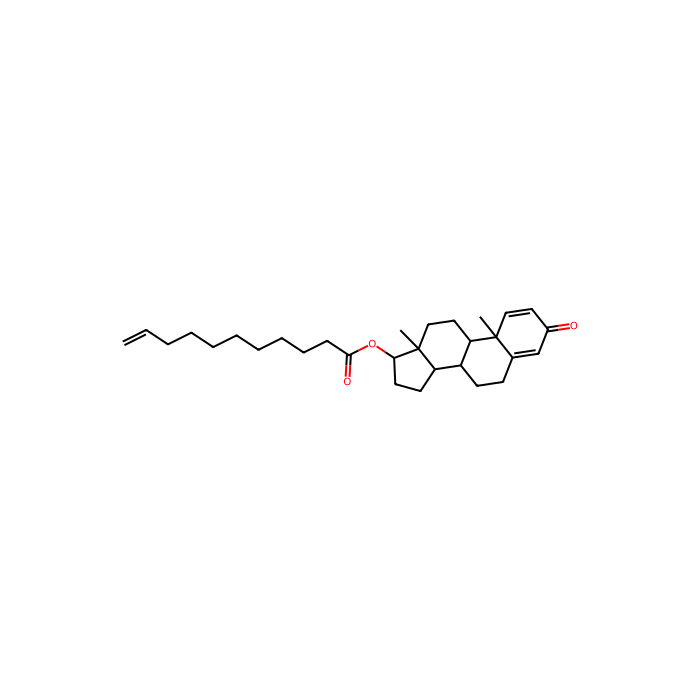
A long-chain fatty acid ester of an anabolic-androgenic steroid, boldenone undecylenate is the 17β-undec-10-enoate ester of boldenone (androsta-1,4-dien-17β-ol-3-one).
Product Data (as provided)
CAS: 13103-34-9
PubChem CID: 11954310
InChIKey: Not specified for this item; refer to CoA/Spec Sheet.
SMILES: Not specified for this item; refer to CoA/Spec Sheet.
Literature/Computed identity (for reference; not item-specific specs)
Common name: Boldenone 17β-undecylenate; 1,4-androstadien-17β-ol-3-one 17-undec-10-enoate
Molecular formula: C30H44O3 (literature)
Molecular weight: ~452.68 g/mol (literature)
Core scaffold: androst-1,4-diene steroid nucleus (four fused rings: three 6-membered, one 5-membered)
Functional groups: 3-keto (enone), 17β-ester (undec-10-enoate), conjugated 1,4-diene in the A-ring
Stereochemistry: tetracyclic steroid framework with multiple defined stereocenters (17β-configuration for the esterified alcohol)
2D structural description (literature)
A tetracyclic perhydrophenanthrene skeleton bearing a 3-one. Double bonds at C1–C2 and C4–C5 form a conjugated enone system. The 17β position is esterified with an 11-carbon mono-unsaturated (ω-1) carboxylate chain containing a terminal C=C (undec-10-enoate).
Synthetic Utility
Functional group handles (literature)
17β-Undecylenate ester: amenable to hydrolysis (acid/base or enzymatic), transesterification (e.g., lipase-catalyzed), and acyl exchange to generate alternative ester series for SAR.
Conjugated enone (3-one with 1,4-diene): participates in selective hydrogenation (1,4- or 1,2-addition control), Michael-type additions under constrained steroid geometry, and enone-specific photochemistry.
Terminal alkene in side chain (undec-10-enoate): optional handle for metathesis, hydroboration–oxidation, or thiol–ene additions on the side chain without perturbing the steroid core.
Retrosynthetic perspective (literature)
Typically accessed by acylation of boldenone (17β-OH) with undecylenic acid derivatives (acid chloride/anhydride or Steglich esterification) under conditions that preserve the 1,4-diene.
Protecting-group-free strategies exploit the inherent selectivity of the secondary 17β-OH vs other positions; mild, non-acidic coupling minimizes A-ring isomerization.
Applications
Intermediate/standard for analytical method development across a family of C17 esters.
Benchmark substrate for comparing hydrolysis/transesterification catalysts and conditions in steroidal systems.
Target Specificity
Not applicable. This product is a small-molecule steroid ester, not a biological targeting reagent or antibody. No antigen/epitope, species reactivity, clone, or isotype information applies.
We use cookies to ensure the website functions properly and, where permitted, to improve your experience. You can manage your preferences at any time in Settings. Learn more in our Cookie Policy.
Shall we send you a message when we have discounts available?
Remind me later
Thank you! Please check your email inbox to confirm.
Products are supplied to verified businesses, institutions, and qualified professionals for research and development use only. Not for use in humans, animals, diagnosis, or therapy.

 K2218151