This compound belongs to the class of organic compounds known as perfluoroalkyl carboxylic acid and derivatives. These are organic compounds containing an alkyl chain attached to the C-alpha of a carboxylic acid group (or a derivative thereof), where all hydrogens of the alkyl chain are replaced by fluorine atoms.
External Descriptors
Not available
1. Djoumbou Feunang Y, Eisner R, Knox C, Chepelev L, Hastings J, Owen G, Fahy E, Steinbeck C, Subramanian S, Bolton E, Greiner R, and Wishart DS. ClassyFire: Automated Chemical Classification With A Comprehensive, Computable Taxonomy. Journal of Cheminformatics, 2016, 8:61.
Determine the necessary mass, volume, or concentration for preparing a solution.
Dilution Calculator
Determine the dilution needed to prepare a stock solution.
Reconstitution Calculator
Recensioni
Recensioni dei clienti
Application Protocols
No assay-specific protocols (e.g., WB, IHC, IF, FC) apply to this small-molecule reagent. For synthetic or materials applications, refer to the Reaction & Applications and Reaction Conditions sections for general procedural guidance.
If developing a custom method (e.g., aminolysis or transesterification):
Start with small-scale trials (0.1–1 mmol), validate solvent and base/acid choice, and monitor by 19F NMR/GC.
Control moisture and temperature; document mass balance (including butanol liberation) and assess phase behavior during workup.
Biological Roles
This product is intended for research and laboratory use only. It is a synthetic perfluoroalkyl ester and does not serve a natural biological role.
General literature context (non-clinical, not item-specific):
PFAS interactions: Long-chain perfluoroalkyl substances can bind to serum proteins (e.g., albumin) and may partition uniquely in biological matrices due to their amphiphobic character; however, specific binding data for the butyl ester is limited compared to the corresponding acid/salt forms.
Biotransformation: Esters can, in principle, undergo esterase-mediated hydrolysis to the perfluoroalkyl acid in biological systems; the rate and extent depend on structure and conditions. No item-specific kinetic data are provided.
Membrane interactions: Strong hydrophobicity and low surface energy can influence micelle/vesicle interactions in model systems; utility is primarily in physicochemical studies rather than as a buffer or nutrient component.
No claims are made regarding therapeutic, diagnostic, or clinical utility. For any work involving biological matrices, use appropriate containment and waste management consistent with PFAS best practices.
Buffer Applications
Not typically applicable. Butyl perfluorooctanoate is a neutral, highly hydrophobic ester with negligible water solubility and no buffering capacity. It is not used to prepare aqueous buffer systems.
For work involving this compound, focus on:
Nonaqueous media selection (see Solvent Selection).
Phase transfer or emulsification strategies if interfacing with aqueous systems (surfactants, cosolvents), while considering PFAS stewardship.
Green Alternatives
Long-chain perfluoroalkyl substances (PFAS) are persistent. Where functionally feasible, consider substituting materials or process conditions that reduce environmental footprint while meeting performance needs.
Shorter-chain fluorinated analogs or branched PFAS that may have reduced bioaccumulation potential (trade‑offs: often lower performance; still PFAS).
Nonfluorinated hydrophobes (e.g., silicone-based surfactants, hydrocarbon wax esters) for surface energy modification where extreme repellency is not essential.
Zwitterionic/siloxane surfactants in emulsion polymerizations to avoid PFAS surfactants.
Process modifications:
Use supercritical CO2 or HFEs as processing media in lieu of halogenated hydrocarbons when compatible.
Employ solid-supported catalysts and fluorous phase alternatives (e.g., PEGylated tags) to facilitate separation without PFAS content.
Function | Fluorous hydrophobe/modifier | Green solvent for transformations | Non-PFAS wetting/leveling agent
Persistence | High (PFAS class) | Low | Low–moderate
Performance | Excellent repellency | Solvent only | Good wetting; lower oil repellency
Note: Alternatives may not match the unique low-surface-energy profile of long-chain PFAS; validate performance and regulatory compliance early in development.
Pharmaceutical Uses
No pharmacopeial status or excipient role is provided in the Product Data. This product is supplied strictly for research use only.
General context (non-clinical):
Long-chain perfluoroalkyl esters are not typical pharmaceutical excipients. In research materials science, fluorinated esters may be explored as surface-energy modifiers or processing aids in device coatings. Any such use would require extensive safety and regulatory evaluation beyond the scope of this listing.
Item-specific details:
Excipient status/compendial listings: Not specified for this item; refer to CoA/Spec Sheet.
Residuals/impurity expectations for GMP: Not applicable here; product is not offered for clinical or GMP use.
Researchers should ensure strict segregation from clinical development streams and manage waste consistent with PFAS handling guidance.
Physical Properties
Item-specific physical constants are not listed in the Product Data; consult the CoA/SDS for authoritative specifications. Below are general/literature expectations for this class of compound to aid method planning (do not treat these as specifications).
Appearance: Not specified for this item; refer to CoA/Spec Sheet.
Molecular weight: ~470.16 g/mol — literature/computed from C12H9F15O2.
Boiling point: High for an ester of this size; perfluoroacyl esters with C7F15 typically boil in the ~200–260 °C range at 1 atm — literature (class trend).
Melting point: Often liquids at room temperature; exact MP not specified for this item; refer to CoA/Spec Sheet.
Density: Fluorinated esters are typically dense (≥1.4 g/mL at 20–25 °C) — literature (class trend). Not specified for this item; refer to CoA/Spec Sheet.
Refractive index: Not specified for this item; refer to CoA/Spec Sheet.
Vapor pressure: Low (literature expectation for high-MW perfluoroalkyl esters); quantitative value not specified for this item.
Solubility (qualitative, literature):
Water: Very low.
Organic: Good in halogenated solvents (e.g., CH2Cl2, chloroform), ketones (acetone), ethers; miscibility may be limited in very nonpolar hydrocarbons due to fluorophilicity.
Fluorous solvents: Enhanced solubility versus hydrocarbon analogs, though the ester and butyl tail reduce perfect fluorous partitioning.
Partitioning: Strongly hydrophobic; high logP/logKow expected for PFAS esters (value not specified for this item).
Quality and Grades
Grade/Purity: Not specified for this item; refer to CoA/Spec Sheet.
Without an explicit grade, users should verify suitability based on the CoA, focusing on:
Assay/purity basis (GC, HPLC, or NMR area %).
Residual solvents/water (KF) and volatile content if applicable.
Acid number or saponification value may be reported for esters and can indicate hydrolysis/state of preservation.
Stabilizers/inhibitors: None stated in Product Data. If present on CoA, note their impact on catalytic reactions or polymerizations.
UV cut-off and low-UV suitability if planning LC/UV detection — Not specified for this item; refer to CoA/Spec Sheet.
Practical notes (general):
For chromatographic or kinetic studies, consider distillation or bulb-to-bulb transfer under reduced pressure to remove trace volatiles if allowed by your quality system.
If trace basic/acidic impurities affect your application (e.g., catalysis), pass through a short basic alumina/silica plug quickly to minimize hydrolysis; verify no interaction with PFAS ester in a small test.
Document lot-specific data from the CoA in regulated workflows; this SKU is designated For research use only (from Product Data).
Reaction and Applications
As a perfluoroacyl ester, butyl perfluorooctanoate serves both as a functional intermediate and as a materials modifier in research settings.
Applications (literature/practice):
Transesterification: Exchange with alcohols under acid (e.g., catalytic H2SO4, p‑TsOH) or base (alkoxide) catalysis to access a library of perfluorooctanoate esters. Remove butanol azeotropically to drive equilibrium.
Aminolysis/Amidation: Reaction with amines (primary/secondary) to furnish perfluorooctanamide derivatives; rate enhanced by heating or by catalytic nucleophiles. For challenging substrates, convert to the acid (hydrolysis) then couple (e.g., EDCI/DMAP) under dehydrative conditions.
Hydrolysis/Saponification: Base-mediated cleavage to the perfluorooctanoate salt; acidification affords perfluorooctanoic acid.
Surface treatment: As a hydrophobe for surface energy reduction in coatings/finishes; the ester can co-migrate into polymer matrices (research-only use; verify compatibility and regulatory constraints).
Emulsion/polymerization aid: PFAS esters can function as co-surfactants or additives in specialty emulsion polymerizations, improving particle stabilization and wetting (lab-scale, research-only).
Fluorous tagging & separations: The C7F15 chain provides a handle for fluorous biphasic or solid-supported fluorous techniques, aiding purification or catalyst recovery.
Practical tips:
Control moisture; even trace base and water accelerate hydrolysis. Use anhydrous glassware and molecular sieves where appropriate.
For nucleophilic substitutions (aminolysis), select polar aprotic solvents (THF, MeCN, DCM) and add base scavengers for liberated butanol.
Monitor by GC or 19F NMR; the perfluoro segment gives distinct 19F patterns facilitating conversion tracking.
Reaction Conditions
The following are general literature-guided conditions for typical transformations of perfluoroacyl esters. These are not item specifications.
Transesterification:
Catalyst: p‑TsOH (1–5 mol%) or sodium alkoxide (5–20 mol%).
Solvent: Toluene, THF, or neat alcohol (as reagent/solvent).
Temperature: 50–110 °C (reflux where applicable).
Strategy: Use Dean–Stark (acid conditions) or continuous removal of butanol to drive equilibrium; molecular sieves aid water removal.
Notes: Electron-withdrawing perfluoroacyl enhances acyl transfer relative to nonfluorinated esters.
Hydrolysis (saponification):
Base: NaOH or K2CO3 (1–3 equiv).
Solvent: MeOH/H2O, THF/H2O biphasic systems.
Temperature: 20–60 °C; monitor to avoid overexposure that may form stable perfluoroalkyl salts.
Monitoring and workup:
Analytical: 19F NMR, GC, or LC as appropriate.
Workup: Separate organic/aqueous layers carefully; PFAS can display atypical emulsification. Employ brine and low-shear mixing; collect halogenated waste.
Expected yields depend on substrate and conditions; consult reaction-specific literature for your target system.
Safety and Handling
No GHS hazard statements or pictograms are provided in the Product Data for this item; always consult the product SDS for definitive hazard classification and response procedures.
General safety considerations for perfluoroalkyl esters (literature/practice):
Persistence and bioaccumulation: Long-chain PFAS derivatives are environmentally persistent. Prevent releases, use secondary containment, and collect waste as halogenated organic waste per institutional and regulatory guidance.
PPE: Lab coat, safety glasses, and suitable chemical-resistant gloves (e.g., nitrile). Use in a fume hood to avoid inhalation of vapors/aerosols.
Incompatibilities:
Strong bases and nucleophiles can induce ester cleavage (hydrolysis/aminolysis), forming perfluorooctanoate salts or amides.
Strong oxidizers: Avoid contact.
Reactive metals/alkoxides: May catalyze transesterification.
Thermal decomposition: Avoid overheating; thermal breakdown of fluorinated organics can produce toxic/irritant fluorinated products and HF. Use appropriate ventilation and heat control.
First aid (overview; defer to SDS):
Inhalation: Move to fresh air; seek medical attention if symptomatic.
Skin/eye contact: Rinse with water for at least 15 minutes; remove contaminated clothing; seek medical attention if irritation persists.
Ingestion: Rinse mouth; do not induce vomiting; seek medical advice.
Spill response: Absorb with inert material (e.g., vermiculite), avoid aqueous washdown, and dispose of as halogenated waste.
Signal word / H-statements / GHS class / Pictograms (item-specific): Not specified for this item; refer to SDS.
Solvent Selection
Butyl perfluorooctanoate is a highly hydrophobic, partially fluorous ester. Selection of solvent influences handling, reactions (hydrolysis/aminolysis/transesterification), and phase behavior.
Polarity class: Very low polarity; strong hydrophobic and fluorophilic character.
Dielectric constant (guidance): Not available for this specific ester; fluorinated esters typically exhibit low to moderate ε — Not specified for this item; refer to literature for analogs.
Preferred solvents (literature/practice):
Halogenated organics: CH2Cl2, chloroform, 1,2-dichloroethane — good solvency and stability.
Ethers/ketones: THF, MTBE, diethyl ether, acetone — useful for aminolysis/transesterification; ensure dryness to limit hydrolysis.
Fluorous solvents: Perfluorohexane, HFE media — enhanced solubility vs hydrocarbon solvents; degree depends on the butyl ester content.
Hydrocarbons: Toluene/heptane — limited to moderate solubility; test first.
For greener processes, prefer HFEs or supercritical CO2 as media when feasible, or nonfluorinated solvents if the fluorous partitioning is not required.
For moisture-sensitive transformations, use anhydrous ether/ketone solvents and add molecular sieves (3Å/4Å) to suppress hydrolysis.
Small comparison (qualitative):
CH2Cl2: excellent solvency; ease of workup; halogenated waste.
Storage conditions (from Product Data): Room temperature. Store tightly closed in the original container.
Shipping (from Product Data): Normal conditions.
Stability considerations:
Protect from moisture and strong bases/nucleophiles to minimize hydrolysis/aminolysis.
Avoid prolonged heating. If distillation is required, use reduced pressure and inert atmosphere.
Inert atmosphere: Optional but recommended for long-term storage to limit adventitious hydrolysis.
Container compatibility: Fluorinated organics are generally compatible with glass and PTFE-lined caps. Avoid reactive metal surfaces or basic packaging materials.
Reconstitution: Not applicable; supplied as a neat substance (appearance not specified for this item; refer to CoA/Spec Sheet). If solidification occurs at low temperature, gently warm to ambient and homogenize before use.
Freeze–thaw: Not relevant for a neat, non-aqueous material; avoid repeated thermal cycling to limit condensation ingress.
Always refer to the lot-specific CoA/SDS for definitive handling and stability information.
Structure and Identity
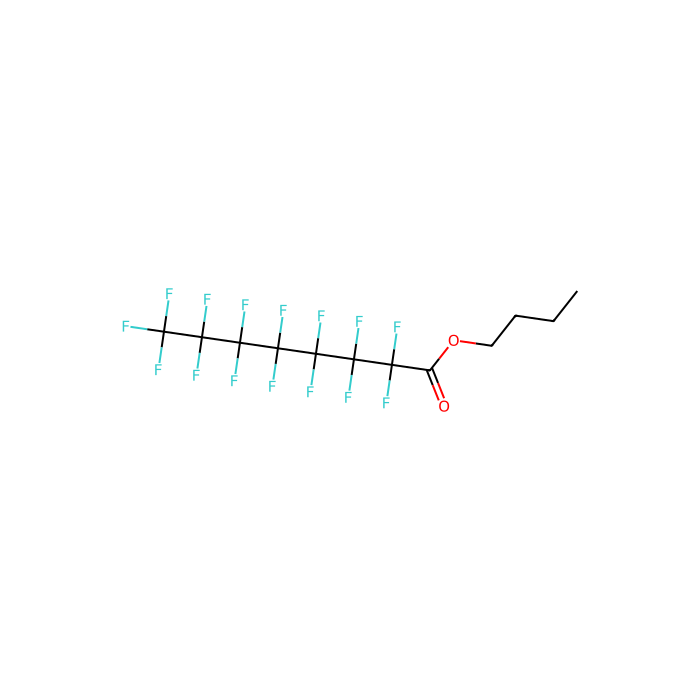
Butyl perfluorooctanoate is the butyl ester of perfluorooctanoic acid (PFOA), comprising a fully fluorinated C7 perfluoroalkyl chain attached to a carbonyl, esterified with an n-butyl group.
InChIKey: Not specified for this item; refer to CoA/Spec Sheet. (Product Data lists a non-standard value)
SMILES: Not specified for this item; refer to CoA/Spec Sheet.
Molecular formula (literature inference): C12H9F15O2 (butyl ester of C7F15CO2–) — literature/computed
Molecular weight (literature/computed): ~470.16 g/mol (computed from formula) — literature/computed
Structural features (descriptive, 2D):
Functional groups: One ester (–C(=O)–O–) linking a perfluoroacyl moiety to an n-butyl chain.
Perfluoro segment: Linear perfluoroheptyl chain terminating as perfluorooctanoyl (–C7F15–C(=O)–), imparting extreme lipophobicity and chemical inertness.
Hydrocarbon segment: Linear n‑butyl group (–O–CH2–CH2–CH2–CH3) confers some organic solvent compatibility.
Stereochemistry: None (achiral, no stereocenters).
Item-specific identifiers not provided in Product Data (e.g., exact SMILES, definitive InChIKey) should be confirmed on the CoA/Spec Sheet for this SKU.
Synthetic Utility
Key functional motif: an activated perfluoroacyl ester flanked by an electron-withdrawing C7F15 chain and an n‑butyl alcohol residue.
Utility in synthesis (literature/practice):
Nucleophilic acyl substitution platform:
Aminolysis → amides: Access perfluorooctanamide scaffolds; rate enhanced vs hydrocarbon analogs due to the strong –I effect of the perfluoroalkyl group.
Transesterification: Modular exchange to introduce alternative alcohols (including labeled or multifunctional alcohols) under acid/base catalysis.
Hydrolysis → acid: Entry to perfluorooctanoic acid; convenient when direct handling of the acid is undesirable.
Fluorous phase strategies: The C7F15 tag can assist in catalyst or reagent immobilization and phase-vanishing workups (fluorous biphase separations, F-SPE) while the ester maintains reactivity.
Surface and polymer modification: As a compatibilizer or hydrophobe in coatings or polymer matrices, imparting oil/water repellency in research formulations.
Practical guidance:
Use anhydrous conditions to avoid unintended hydrolysis; include molecular sieves when running equilibria.
For selective amidations, employ stoichiometric base (e.g., DIPEA) or catalytic DMAP in CH2Cl2/THF, and remove the liberated butanol to shift equilibrium.
Monitor via 19F NMR for rapid diagnostics; downfield CF3/CF2 signatures simplify tracking relative to hydrocarbon esters.
Target Specificity
Not applicable. This product is a small-molecule fluorinated ester and is not an antibody, enzyme, or affinity reagent. No target specificity, clone, isotype, or species reactivity applies.
Utilizziamo i cookie per garantire il corretto funzionamento del sito web e, ove consentito, per migliorare la tua esperienza. Puoi gestire le tue preferenze in qualsiasi momento nelle Impostazioni. Per saperne di più, consulta la nostra Cookie Policy.
Desidera che le inviamo un messaggio quando avremo sconti disponibili?
Ricordamelo più tardi
Grazie! Controlli la sua casella di posta per confermare.
Products are supplied to verified businesses, institutions, and qualified professionals for research and development use only. Not for use in humans, animals, diagnosis, or therapy.

 G2326289