per flussi di lavoro cromatografici e analitici sensibili che richiedono un'interferenza minima della linea di base.
🌡
Stoccaggio e spedizione
Store at -20°C Spedizione Ice chest + Ice pads. Consultare il COA specifico del lotto per le specifiche esatte.
📋
Documenti di qualità
SDS, COA, scheda tecnica e scheda delle specifiche disponibili per il download. COA specifico del lotto accessibile tramite ricerca per numero di lotto.
📚
Prova documentale
Citato in 0 pubblicazioni peer-reviewed su cromatografia, sintesi organica e reazioni di accoppiamento incrociato.
Panoramica
Information
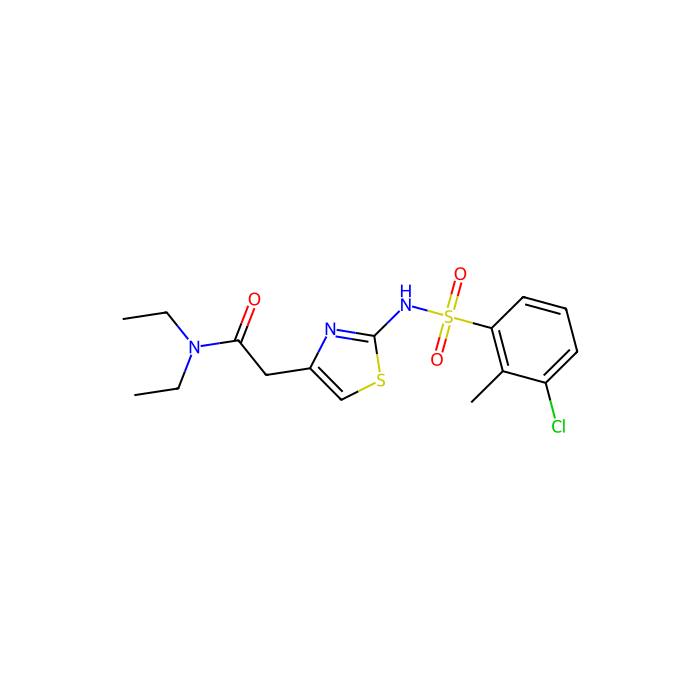
BVT-14225 is a selective inhibitor of 11β-Hydroxysteroid dehydrogenase type 1 (11β-HSD1) with IC50 of 52 nM.
Specifiche
Meccanismi biochimici e fisiologici
BVT-14225 is a selective inhibitor of 11β-Hydroxysteroid dehydrogenase type 1 (11β-HSD1) with IC50 of 52 nM.
Condizioni di conservazione di stoccaggio
Store at -20°C
Spedito in
Ice chest + Ice pads
Questo prodotto richiede spedizione a catena fredda. I servizi di terra e altri servizi economici non sono disponibili.
This compound belongs to the class of organic compounds known as benzenesulfonamides. These are organic compounds containing a sulfonamide group that is S-linked to a benzene ring.
External Descriptors
Not available
1. Djoumbou Feunang Y, Eisner R, Knox C, Chepelev L, Hastings J, Owen G, Fahy E, Steinbeck C, Subramanian S, Bolton E, Greiner R, and Wishart DS. ClassyFire: Automated Chemical Classification With A Comprehensive, Computable Taxonomy. Journal of Cheminformatics, 2016, 8:61.
Certificati (CoA, COO, BSE/TSE e tabella di analisi)
C of A & Other Certificates(BSE/TSE, COO):
Analytical Chart:
Proprietà chimiche e fisiche
Peso molecolare
401.900 g/mol
XLogP3
3.000
Hydrogen Bond Donor Count
1
Hydrogen Bond Acceptor Count
6
Rotatable Bond Count
7
Exact Mass
401.063 Da
Monoisotopic Mass
401.063 Da
Topological Polar Surface Area
116.000 Ų
Heavy Atom Count
25
Formal Charge
0
Complexity
551.000
Isotope Atom Count
0
Defined Atom Stereocenter Count
0
Undefined Atom Stereocenter Count
0
Defined Bond Stereocenter Count
0
Undefined Bond Stereocenter Count
0
The total count of all stereochemical bonds
0
Covalently-Bonded Unit Count
1
Calcolatori di soluzioni
Molarity Calculator
Determine the necessary mass, volume, or concentration for preparing a solution.
Dilution Calculator
Determine the dilution needed to prepare a stock solution.
Reconstitution Calculator
Recensioni
Recensioni dei clienti
Application Protocols
No manufacturer protocols or validated application data are provided for this item.
General example workflows (non-item-specific; verify experimentally):
Preparation of DMSO stock
Allow vial to equilibrate to room temperature in a desiccator.
Add anhydrous DMSO to achieve 10–50 mM concentration based on actual MW from the CoA.
Vortex, sonicate briefly, and, if necessary, warm gently (≤40 °C). Filter through 0.2 µm PTFE.
Biochemical assay addition
Dilute stock into assay buffer to desired final concentration; keep final DMSO ≤0.1–1% v/v per assay tolerance.
Include vehicle controls and, if relevant, detergent (0.01–0.05% Tween-20) to reduce nonspecific aggregation.
LC–MS stability check
Incubate compound in buffer at assay temperature and sample at 0, 1, 4, 24 h; analyze by LC–MS to confirm stability.
All parameters above are illustrative and must be adapted once the item’s MW, solubility, and stability are confirmed from the CoA.
Biological Roles
Item-specific biological targets or pathways for BVT-14225 are not provided in the Product Data. Do not infer pharmacology without corroborated references and alignment with the supplied CoA.
General context for small-molecule library members:
Such compounds are commonly used as chemical probes or tool molecules in discovery biology to modulate enzyme activity, receptors, transporters, or signaling nodes in vitro.
When a literature target is identified (via CAS 376638-65-2 or PubChem CID 6918663), confirm that the structure, salt form, and purity of the literature compound match this catalog item before extrapolating biological roles.
Biophysical characterization (e.g., thermal shift assays, ligand-observed NMR) can help validate direct target engagement independent of cellular phenotypes.
Best practices:
Verify compound integrity (LC–MS, HPLC) before running long-duration biology assays.
Control for nonspecific effects such as colloidal aggregation or redox cycling using orthogonal counterscreens and detergent-containing buffers when appropriate.
Report vehicle percentages, final compound concentration ranges, and plate layout to ensure reproducibility.
Disclaimer: No clinical or therapeutic claims are made. This product is for research use only and any biological role must be established experimentally in the user’s system.
Buffer Applications
BVT-14225 is not presented as a buffering reagent, pH modifier, or biochemical buffer component.
Buffer capacity, pKa ranges, and standard buffer recipes: Not applicable to this item.
Practical note (general):
If using BVT-14225 in biochemical assays, dissolve first in a compatible solvent (often DMSO) and then dilute into your chosen buffer (e.g., PBS, HEPES, Tris) while monitoring final co-solvent percentage. Optimize buffer composition (salt, pH, detergent) for protein stability and to minimize nonspecific aggregation.
Refer to the Storage & Reconstitution section for guidance on preparing stock solutions.
Green Alternatives
Because BVT-14225 is a discrete small molecule rather than a commodity solvent or reagent, “green alternatives” primarily concern solvent choice and handling practices during dissolution, assay preparation, and purification.
Prefer water, ethanol, or bio-based solvents where compatible with solubility and assay constraints.
Minimize DMSO percentage in final assay media; evaluate ethanol or PEG-400 co-solvent if biologically acceptable.
For purification, consider EtOAc/heptane systems instead of dichloromethane where chromatographic performance permits.
Example comparison (general; not item-specific):
DMSO vs. Ethanol
Solvency: DMSO broader; ethanol greener but may have lower solvency for hydrophobic compounds.
Assay tolerance: Both typically tolerated ≤1% v/v; verify for your system.
DMF/ACN vs. 2-MeTHF/EtOAc (for workups/purification)
2-MeTHF, EtOAc offer lower toxicity and better environmental profiles but may not dissolve very polar analytes.
Operational green practices:
Prepare higher-concentration stocks to reduce solvent volumes and shipping mass.
Use microscale assays and sealed plates to limit evaporation and VOC emissions.
Consolidate waste streams and favor non-halogenated solvents when feasible.
Note: Select solvents strictly based on verified solubility and stability of BVT-14225; confirm with small-scale trials.
Pharmaceutical Uses
No pharmacopeial status, excipient role, or manufacturing use is provided for BVT-14225.
Regulatory listings (USP/EP/JP), GMP status: Not specified for this item; refer to CoA/Spec Sheet.
Typical role: This product is supplied for research use only and is generally used in discovery-stage in vitro studies rather than as a formulated excipient or API.
Guidance for formulation research (general, non-clinical):
For pre-formulation studies (e.g., solubility/permeability screens), characterize pH–solubility profiles and solvent compatibility using the exact lot supplied, as salt form and purity can impact results.
If conducting stability studies, document storage history, container closure, and analytical methods (HPLC/LC–MS) to track degradation products.
Compliance note: Do not use this material for human or veterinary applications. No medical or therapeutic claims are made.
Physical Properties
Item-specific physical data are not provided in the Product Data for BVT-14225. Do not treat external database values as specifications. For regulated or quantitative work, obtain the item’s CoA/Spec Sheet.
Appearance: Not specified for this item; refer to CoA/Spec Sheet.
Molecular weight: Not specified for this item; refer to CoA/Spec Sheet.
Melting point: Not specified for this item; refer to CoA/Spec Sheet.
Boiling point: Not specified for this item; refer to CoA/Spec Sheet.
Density: Not specified for this item; refer to CoA/Spec Sheet.
Refractive index: Not specified for this item; refer to CoA/Spec Sheet.
pKa/logP/LogD: Not specified for this item; refer to CoA/Spec Sheet.
Solubility: Not specified for this item; refer to CoA/Spec Sheet.
General laboratory guidance (not item-specific):
Screening compounds are often supplied as solids suitable for dissolution in DMSO, DMF, ethanol, or aqueous buffers (with co-solvent). Perform a small-scale solubility screen before preparing concentrated stocks.
If hygroscopic or light-sensitive behavior is suspected, handle quickly under dry conditions and protect from light; confirm with the CoA.
Note: Any literature values found via CAS 376638-65-2 or CID 6918663 should be treated as contextual information only and not as specifications for this catalog item.
Quality and Grades
Grade/Purity: Not specified for this item; refer to CoA/Spec Sheet.
Interpretation and guidance:
In the absence of an explicit grade (e.g., screening-grade, >95% by HPLC), rely on the batch CoA for purity method (HPLC/UPLC/GC), assay result, and impurity profile. Many screening compounds are supplied at ≥95% purity (HPLC), but this is not guaranteed for this item without the CoA.
If stabilizers, salt form, or residual solvent limits are critical for your application (e.g., biochemical assays, biophysical binding studies), verify:
Assay/purity methodology and detection wavelength(s)
Water content (Karl Fischer) and residual solvents (GC)
Counterion content for salts; free base/acid vs salt identity
Lot-to-lot consistency specifications
UV cutoff, metal limits, and specific contaminants: Not specified for this item; refer to CoA/Spec Sheet.
Recommendations for use:
For medicinal chemistry or SAR, record lot numbers and analytical data alongside biological results to ensure traceability.
If needed, perform in-house QC (1H/13C NMR, HRMS, HPLC) on receipt. Where absolute stereochemistry matters, confirm by chiroptical methods or enantioselective HPLC.
If ultra-low background absorbance is required (e.g., photophysical assays), request UV–Vis traces from the batch CoA.
Reaction and Applications
Manufacturer-supplied application notes are not provided for this item. Given its categorization as a small-molecule library compound, typical research uses include chemical biology screening and medicinal chemistry exploration rather than bulk synthetic transformations.
Potential research applications (general, not item-specific):
Primary/secondary screening hit: Evaluate activity in biochemical or biophysical assays. Record precise stock concentration and solvent composition for reproducibility.
Reference or control compound: Use as a comparator in SAR panels if the target class is known from literature via CAS/CID; verify identity against the item’s CoA before use.
Probe development starting point: If a target association is identified from literature, analog design and synthesis can proceed from the reported scaffold. Confirm the same salt/form and purity as used in published studies.
Analytical and handling tips:
Prepare concentrated DMSO stocks (e.g., 10 mM) and filter through 0.2 µm PTFE if particulate remains.
For biophysical assays (SPR, ITC, DSF), remove particulates and assess aggregation (e.g., detergent controls, DLS). Consider PAINS/aggregator filters when literature structure is known.
Stability checks: Assess stability in assay buffer over the experimental time frame by LC–MS to rule out hydrolysis/oxidation.
Note: Without a confirmed chemical structure for this specific catalog item, no named-reaction utility can be asserted.
Reaction Conditions
No reaction condition data are provided for BVT-14225, and without a confirmed structure, specific transformation conditions cannot be recommended.
General guidance for handling in solution (non-reactive context):
Stock preparation: Often 10–50 mM in DMSO; warm gently (≤40 °C) and sonicate if needed. Filter if particulates persist.
Aqueous dilution: Add the DMSO stock into vigorously stirred buffer to the desired final concentration and solvent percentage; avoid local supersaturation.
Stability checks: Monitor by HPLC/LC–MS after incubation under planned assay conditions (pH, temperature, time) to detect hydrolysis/oxidation.
If a literature synthesis or named reaction involving BVT-14225 is identified via CAS/CID, confirm congruence with this specific catalog item (salt form, stereochemistry, purity) before reproducing conditions. Otherwise, treat any external conditions as general background rather than specifications.
Safety and Handling
Safety details specific to this item have not been provided. Always consult the product’s SDS for authoritative hazard, PPE, and first-aid information.
GHS classification: Not specified for this item; refer to SDS.
Signal word and H-statements: Not specified for this item; refer to SDS.
Pictograms: Not specified for this item; refer to SDS.
Research use: For research use only (Product Data).
General laboratory precautions (non-item-specific):
PPE: wear lab coat, safety glasses, and appropriate chemically resistant gloves. Work in a fume hood when handling powders, solutions, or volatile solvents.
Incompatibilities: Until specific chemistry is known, avoid strong oxidizers and strong acids/bases. Do not mix with unknown reagents.
First aid (general): In case of skin or eye contact, rinse with water for at least 15 minutes and remove contaminated clothing. If inhaled, move to fresh air. If ingested or exposure is significant, seek medical attention and provide the SDS.
Spill response: Avoid dust formation. Absorb liquid spills with inert material. Collect in sealed, labeled containers for disposal according to institutional and local regulations.
Waste: Dispose as organic laboratory waste per institutional guidelines; segregate halogenated from non-halogenated solvents if applicable.
Transport and storage notes:
Shipped with ice packs in an ice chest (Product Data). Maintain cold chain on receipt and immediately store as directed.
Solvent Selection
Item-specific solubility data are not provided. The following guidance is general for small-molecule screening compounds and should be verified experimentally for BVT-14225.
Primary solvents for stock solutions: DMSO (anhydrous), DMF, acetonitrile, ethanol/methanol. Start with DMSO for 10–50 mM stocks unless contraindicated by the CoA or assay.
Aqueous work: Prepare DMSO concentrate, then dilute into buffer (final DMSO typically ≤0.1–1% v/v for cell-free assays; follow your assay tolerance). Consider co-solvents (0.5–5% v/v) or cyclodextrin inclusion if needed.
Solubility screening workflow:
Test 1 mg in 50–100 µL DMSO at RT with gentle warming/sonication.
If insoluble, try DMF or MeOH, then ACN/EtOH.
Evaluate pH-assisted solubilization only if the compound is known to be ionizable (consult structure/CoA first).
Adsorption minimization: Use low-bind polypropylene vials and avoid freeze–thaw of dilute aqueous solutions.
Comparison (general):
DMSO: broad solvency, high boiling point; may interfere in some assays at >1%.
DMF: strong polar aprotic; consider toxicity and water uptake.
ACN: volatile, LC–MS friendly; lower solvency for highly lipophilic solids.
EtOH/MeOH: biologically tolerated at low %; may affect protein stability.
Note: Confirm actual solubility and compatibility of BVT-14225 with your assay matrix before large-scale preparations.
Storage and Reconstitution
Storage conditions: Store at -20°C (Product Data). Keep tightly closed in the original container. Minimize exposure to moisture and air; consider desiccant storage if compatible with the container system.
Shipping: Shipped in an ice chest with ice pads (Product Data). Maintain cold chain on receipt.
General reconstitution guidance (verify with CoA for this item):
Solid to stock solution
Allow vial to warm to room temperature in a desiccator before opening to avoid condensation.
Determine accurate mass and molecular weight from the CoA to prepare target molar stocks (commonly 10–50 mM) in anhydrous DMSO.
Vortex and sonicate; if needed, warm gently (≤40 °C). Avoid prolonged heating.
Aliquoting and storage of solutions
Prepare single-use aliquots to avoid repeated freeze–thaw.
Store DMSO stocks at -20°C or below in tightly sealed, chemically resistant vials. Protect from light if the compound is chromophoric (confirm via CoA).
Typical shelf-life of solutions should be established by periodic HPLC/LC–MS checks; no item-specific stability claims are made.
Specifications not provided for this item:
Appearance, water content, stabilizers, and salt form: Not specified for this item; refer to CoA/Spec Sheet.
Always consult the product’s CoA and SDS for lot-specific guidance before use.
Structure and Identity
Brief overview: BVT-14225 is listed as a small-molecule library member (SKU B412260) for research screening. Limited item-specific identifiers are provided.
CAS: 376638-65-2 (Product Data)
PubChem CID: 6918663 (Product Data)
InChIKey: 281936 (as provided; note this is not a standard-length InChIKey; consult SDS/CoA for confirmation) (Product Data)
SMILES: Not specified for this item; refer to CoA/Spec Sheet.
Molecular formula: Not specified for this item; refer to CoA/Spec Sheet.
Molecular weight: Not specified for this item; refer to CoA/Spec Sheet.
Synonyms/trade name: BVT-14225 (Product Name)
Category path: 全部 / 可售 / 小分子和化合物库 (Product Data)
Structural features (general guidance):
Functional groups, ring systems, stereochemistry: Not specified for this item; refer to CoA/Spec Sheet.
Without a provided structure or SMILES, stereochemical information and 2D/3D depictions cannot be confirmed for this specific lot.
Practical identity notes:
Use the CAS and CID to retrieve public database records for orthogonal confirmation (spectra, predicted properties). Match any retrieved structure against the item’s CoA to ensure the same salt/form and polymorph before use in quantitative studies.
If available, verify identity by in-house NMR/LC–MS using reference spectra from the CoA.
Synthetic Utility
Specific synthetic functionality for BVT-14225 cannot be described without a confirmed structure. No SMILES or functional group information is provided for this item.
General notes (when structure is known from CoA/literature):
Functional-group leverage: Identify handles (e.g., aryl halides, amines, acids) for diversification. Use cross-coupling, amide coupling, or nucleophilic substitutions as appropriate to explore SAR.
Late-stage functionalization: Consider C–H activation or electrophilic aromatic substitution if the scaffold is amenable.
Salt/form: Verify free base/acid vs. salt; neutralize or reprotonate as needed before derivatization.
Until the item’s structure is confirmed for this catalog lot, refrain from planning synthetic sequences predicated on assumed functional groups. Obtain the CoA and, if needed, verify with NMR/HRMS.
Target Specificity
Target, epitope, or binding specificity data are not provided for this product.
Antigen/target name: Not specified for this item; refer to CoA/Spec Sheet or primary literature via CAS/CID.
Assay-validated selectivity panel: Not specified for this item; refer to CoA/Spec Sheet.
Species cross-reactivity: Not applicable.
Note: If literature associates CAS 376638-65-2 with a particular biological target, independently confirm that the structure and form of that literature compound match this catalog lot before interpreting specificity data.
Utilizziamo i cookie per garantire il corretto funzionamento del sito web e, ove consentito, per migliorare la tua esperienza. Puoi gestire le tue preferenze in qualsiasi momento nelle Impostazioni. Per saperne di più, consulta la nostra Cookie Policy.
Desidera che le inviamo un messaggio quando avremo sconti disponibili?
Ricordamelo più tardi
Grazie! Controlli la sua casella di posta per confermare.
Products are supplied to verified businesses, institutions, and qualified professionals for research and development use only. Not for use in humans, animals, diagnosis, or therapy.