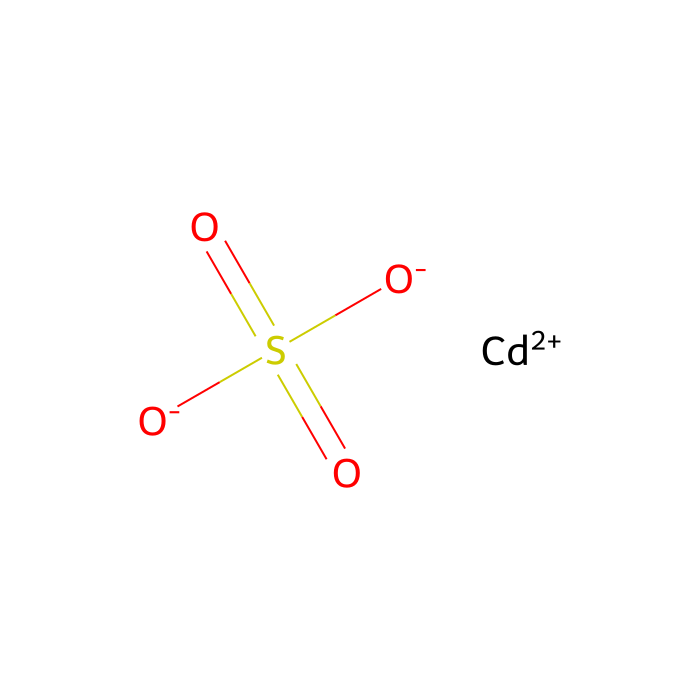
Determine the necessary mass, volume, or concentration for preparing a solution.
Cadmium sulfate is water soluble, toxic cadmium salt which is one of the main source of cadmium in the environment. Cadmium is an environmental pollutant and a suspected carcinogen.The role of cadmium sulfate in inducing aneuploidy and modulation of genomic DNA-methylation status has been studied in a pig Robertsonian translocation model.
Application:
Cadmium sulfate was used in the synthesis of two-dimensional cadmium-thiocyanate coordination solids with checkerboard or herringbone structures.
It may be used as cadmium source in the synthesis of the following:
cadmium sulfide (CdS) thin films
cadmium carbonate (CdCO3) microcrystal
cadmium sulfide-montmorillonite nanocomposites
cadmium sulfate phases
cadmium sulfide (CdS) quantum dots
Taxonomy Tree
| Kingdom | Inorganic compounds |
|---|---|
| Superclass | Mixed metal/non-metal compounds |
| Classe | Transition metal oxoanionic compounds |
| Subclass | Transition metal sulfates |
| Intermediate Tree Nodes | Not available |
| Direct Parent | Transition metal sulfates |
| Alternative Parents | Inorganic oxides Inorganic cadmium salts |
| Molecular Framework | Not available |
| Substituents | Transition metal sulfate - Inorganic cadmium salt - Inorganic oxide - Inorganic salt |
| Descrizione | This compound belongs to the class of inorganic compounds known as transition metal sulfates. These are inorganic compounds in which the largest oxoanion is sulfate, and in which the heaviest atom not in an oxoanion is a transition metal. |
| External Descriptors | cadmium salt |
Find and download the COA for your product by matching the lot number on the packaging.
| Lot Number | Certificate Type | Data | Oggetto |
|---|---|---|---|
| Certificate of Analysis | Aug 04, 2026 | C357813 | |
| Certificate of Analysis | Mar 01, 2025 | C357813 | |
| Certificate of Analysis | Mar 01, 2025 | C357813 | |
| Certificate of Analysis | Mar 01, 2025 | C357813 | |
| Certificate of Analysis | Mar 01, 2025 | C357813 | |
| Certificate of Analysis | Mar 01, 2025 | C357813 | |
| Certificate of Analysis | Mar 01, 2025 | C357813 | |
| Certificate of Analysis | Mar 01, 2025 | C357813 | |
| Certificate of Analysis | Mar 01, 2025 | C357813 | |
| Certificate of Analysis | Mar 01, 2025 | C357813 | |
| Certificate of Analysis | Aug 21, 2024 | C357813 | |
| Certificate of Analysis | Aug 21, 2024 | C357813 | |
| Certificate of Analysis | Aug 21, 2024 | C357813 | |
| Certificate of Analysis | Jan 17, 2024 | C357813 | |
| Certificate of Analysis | Jan 17, 2024 | C357813 | |
| Certificate of Analysis | Jan 17, 2024 | C357813 | |
| Certificate of Analysis | Jan 17, 2024 | C357813 | |
| Certificate of Analysis | Jan 17, 2024 | C357813 | |
| Certificate of Analysis | Jan 17, 2024 | C357813 | |
| Certificate of Analysis | Jan 17, 2024 | C357813 | |
| Certificate of Analysis | Feb 23, 2023 | C357813 | |
| Certificate of Analysis | Feb 23, 2023 | C357813 | |
| Certificate of Analysis | Feb 23, 2023 | C357813 | |
| Certificate of Analysis | Feb 23, 2023 | C357813 | |
| Certificate of Analysis | Feb 23, 2023 | C357813 | |
| Certificate of Analysis | Feb 23, 2023 | C357813 |
| Solubilità | 767 g/l soluble in water at 25 °C |
|---|---|
| Punto di fusione (°C) | 1000° C |
| Peso molecolare | 208.48 |
| XLogP3 | |
| Hydrogen Bond Donor Count | 0 |
| Hydrogen Bond Acceptor Count | 4 |
| Rotatable Bond Count | 0 |
| Exact Mass | 209.855 Da |
| Monoisotopic Mass | 209.855 Da |
| Topological Polar Surface Area | 88.600 Ų |
| Heavy Atom Count | 6 |
| Formal Charge | 0 |
| Complexity | 62.200 |
| Isotope Atom Count | 0 |
| Defined Atom Stereocenter Count | 0 |
| Undefined Atom Stereocenter Count | 0 |
| Defined Bond Stereocenter Count | 0 |
| Undefined Bond Stereocenter Count | 0 |
| The total count of all stereochemical bonds | 0 |
| Covalently-Bonded Unit Count | 2 |
H301:Toxic if swallowed
H330:Fatal if inhaled
H340:May cause genetic defects
H350:May cause cancer
H360FD:May damage fertility; May damage the unborn child
H373:May causes damage to organs through prolonged or repeated exposure
P260:Do not breathe dust/fume/gas/mist/vapors/spray.
P264:Wash hands [and …] thoroughly after handling.
P270:Do not eat, drink or smoke when using this product.
P271:Use only outdoors or in a well-ventilated area.
P273:Avoid release to the environment.
P280:Wear protective gloves/protective clothing/eye protection/face protection.
P281:Use personal protective equipment as required.
P284:[In case of inadequate ventilation] Wear respiratory protection.
P320:Specific treatment is urgent (see ... on this label).
P321:Specific treatment (see ... on this label).
P330:Rinse mouth.
P391:Collect spillage.
P304+P340:IF INHALED: Remove person to fresh air and keep comfortable for breathing.
P405:Store locked up.
P403+P233:Store in a well-ventilated place. Keep container tightly closed.
P501:Dispose of contents/container to an approved waste disposal plant.
P203:Obtain, read and follow all safety instructions before use.
P301+P316:IF SWALLOWED: Get emergency medical help immediately.
P318:if exposed or concerned, get medical advice.
P316:Get emergency medical help immediately.
P319:Get medical help if you feel unwell.
No vendor-validated bioassay protocols are provided for this inorganic salt. Typical laboratory uses include:
For detailed, application-specific protocols, consult the primary literature and your institution’s safety procedures. This product is for research use only.
This product is for research use only. Cadmium has no known beneficial biological role and is widely recognized as a toxic metal.
General/literature context
Laboratory relevance
No clinical or therapeutic uses are implied; this information is provided strictly for biochemical context.
Cadmium sulfate is not a buffering agent and is not typically used to prepare pH buffer systems.
Given cadmium’s high toxicity and persistence, substitution is strongly encouraged where functionally feasible.
Potential substitutes (general/literature)
Comparison highlights
Green chemistry practices when CdSO4 is unavoidable
Cadmium salts are not used as pharmaceutical excipients due to toxicity and regulatory restrictions.
Manufacturing/formulation context
Regulatory status
No therapeutic or clinical claims are made; for research use only.
Item-specific specifications
General/literature values (for reference; may vary by hydration state)
Practical implications
Item-specific
What PrimorTrace™ generally implies (general description)
Practical considerations for CdSO4 in trace analysis
Documentation
Materials synthesis (literature/general)
Analytical chemistry
Catalysis and mechanistic studies
Practical tips (general)
General, literature-based guidance for common laboratory uses of cadmium sulfate (parameters may vary by setup; optimize empirically and consult primary sources):
Precipitation of CdS (pigment/nanomaterial precursor)
Electrodeposition (research scale)
Preparation of analytical standards
Item-specific hazard fields
General cadmium-compound hazards (literature/typical)
PPE and engineering controls (best practice)
Storage incompatibilities and precautions (general)
First-aid overview (consult SDS for full guidance)
Always defer to the product SDS and institutional EHS policies for authoritative safety guidance.
Cadmium sulfate is an inorganic ionic salt; solvent considerations primarily concern dissolution for processing or analysis.
Polarity and miscibility (general/literature)
Practical guidance
Comparison (general)
Item-specific storage and shipping
General handling and solution preparation
Stability
Freeze–thaw and aliquoting
Always consult the product CoA and SDS for definitive guidance specific to the supplied lot.
Brief overview: Cadmium sulfate is an inorganic cadmium(II) salt of sulfuric acid, widely used in materials science, electroplating, and as a cadmium source for sulfide/chalcogenide materials.
Item-specific (from Product Data)
Structure (general/literature)
Notes on forms (general/literature)
Functional role (general/literature)
Representative transformations and uses
Retrosynthetic/value considerations
Limitations
Not applicable. This product is an inorganic salt, not a biological targeting reagent (e.g., antibody, enzyme inhibitor). No antigen/epitope specificity information applies.
La nostra guida alla selezione delle qualità copre purezza, stato dello stabilizzatore e idoneità all'applicazione per tutte le varianti del nostro catalogo.
Visualizza la guida alle qualità PrimorTrace™ →