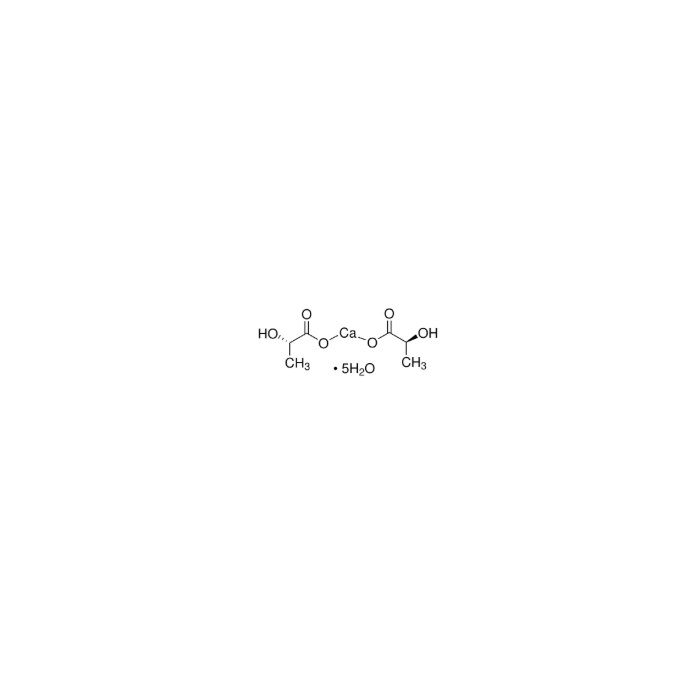
Determine the necessary mass, volume, or concentration for preparing a solution.
Almost odorless. Loses all crystalline water at 120°C to become anhydrous. pH 6-7. Soluble slowly in cold water, faster in hot water, and nearly insoluble in ethanol, ether, or chloroform. L-calcium lactate is produced from starch through natural fermentation. It exhibits mild weathering resistance and antioxidant properties, is easily soluble in water but insoluble in ethanol, and loses all crystalline water at 120°C. It functions to enhance activity and stabilize pH. Primarily used as a food additive, feed additive, and pharmaceutical raw material.
Taxonomy Tree
| Kingdom | Organic compounds |
|---|---|
| Superclass | Organic acids and derivatives |
| Classe | Carboxylic acids and derivatives |
| Subclass | Carboxylic acid derivatives |
| Intermediate Tree Nodes | Not available |
| Direct Parent | Carboxylic acid salts |
| Alternative Parents | Secondary alcohols Organic calcium salts Monocarboxylic acids and derivatives Carboxylic acids Organic zwitterions Organic oxides Hydrocarbon derivatives Carbonyl compounds |
| Molecular Framework | Not available |
| Substituents | Secondary alcohol - Carboxylic acid salt - Organic calcium salt - Monocarboxylic acid or derivatives - Carboxylic acid - Organic oxygen compound - Organic oxide - Hydrocarbon derivative - Organic salt - Organic zwitterion - Organooxygen compound - Carbonyl group - Alcohol - Aliphatic acyclic compound |
| Descrizione | This compound belongs to the class of organic compounds known as carboxylic acid salts. These are ionic derivatives of carboxylic acid. |
| External Descriptors | Not available |
Find and download the COA for your product by matching the lot number on the packaging.
| Lot Number | Certificate Type | Data | Oggetto |
|---|---|---|---|
| Certificate of Analysis | Apr 16, 2026 | C110506 | |
| Certificate of Analysis | Apr 16, 2026 | C110506 | |
| Certificate of Analysis | Jul 10, 2025 | C110506 | |
| Certificate of Analysis | Jul 10, 2025 | C110506 | |
| Certificate of Analysis | Jul 10, 2025 | C110506 | |
| Certificate of Analysis | Jul 10, 2025 | C110506 | |
| Certificate of Analysis | Apr 23, 2024 | C110506 | |
| Certificate of Analysis | Aug 31, 2022 | C110506 | |
| Certificate of Analysis | Aug 31, 2022 | C110506 | |
| Certificate of Analysis | Aug 31, 2022 | C110506 | |
| Certificate of Analysis | Aug 31, 2022 | C110506 | |
| Certificate of Analysis | Aug 31, 2022 | C110506 |
| Peso molecolare | 308.290 g/mol |
|---|---|
| XLogP3 | |
| Hydrogen Bond Donor Count | 7 |
| Hydrogen Bond Acceptor Count | 11 |
| Rotatable Bond Count | 0 |
| Exact Mass | 308.063 Da |
| Monoisotopic Mass | 308.063 Da |
| Topological Polar Surface Area | 126.000 Ų |
| Heavy Atom Count | 18 |
| Formal Charge | 0 |
| Complexity | 53.500 |
| Isotope Atom Count | 0 |
| Defined Atom Stereocenter Count | 0 |
| Undefined Atom Stereocenter Count | 2 |
| Defined Bond Stereocenter Count | 0 |
| Undefined Bond Stereocenter Count | 0 |
| The total count of all stereochemical bonds | 0 |
| Covalently-Bonded Unit Count | 8 |
No manufacturer-tested biological assay protocols (e.g., WB, IHC, IF, FC) are provided for this reagent. Not specified for this item; refer to CoA/Spec Sheet.
General laboratory procedures (literature/typical):
These are example procedures for research use only; adjust to your system and observe appropriate safety and waste protocols.
General biochemical context (literature; not specific to this item):
Relevance for laboratory work:
Notes:
While calcium lactate itself is not a classical buffer pair, it is complementary to lactic acid for preparing lactate-buffered solutions in the acidic range and for modulating free Ca2+.
General guidance (literature; not item-specific):
Example preparation (reference procedure):
Cautions:
Calcium lactate pentahydrate is itself a relatively benign, low-toxicity, water-compatible salt derived from lactic acid (a biogenic, biodegradable α-hydroxyacid). Nevertheless, selection of a calcium source or counterion can influence environmental burden and process safety.
Comparison of common calcium sources (literature/general):
Greener practice tips:
Item-specific designation: USP grade (Product Data). No therapeutic claims are made; this product is for research use only.
General formulation context (literature; not item-specific):
Compliance notes:
Item-specific numerical specifications (e.g., water content, residual solvents, metals, UV cutoff) are not provided. For exact quality attributes, Not specified for this item; refer to CoA/Spec Sheet.
Literature/general properties (for reference; not item specifications):
Notes for use:
Implications for use:
Recommendations:
Calcium lactate pentahydrate serves predominantly as a benign, water-compatible calcium source and as a provider of the α-hydroxycarboxylate (lactate) ligand in aqueous systems.
Representative laboratory applications (literature/general):
Practical tips:
General guidance for representative transformations utilizing calcium lactate pentahydrate (literature; not item-specific):
Notes:
Product Data do not list GHS classifications or hazard statements for this item. Not specified for this item; refer to CoA/Spec Sheet and SDS for authoritative safety information.
General laboratory safety guidance (literature/standard practice):
Always consult the SDS for this exact SKU prior to use. For research use only.
This product is a solid inorganic-organic salt used as a reagent or excipient; it is not used as an organic solvent.
Practical dissolution guidance (literature/general):
Selection vs alternatives (contextual):
Filtration/clarity:
Reconstitution/solution preparation (general):
Freeze–thaw guidance:
Research Use Note: For research use only.
Calcium lactate pentahydrate is the hydrated calcium salt of lactic acid, consisting of one Ca2+ coordinated by two lactate anions and five waters of crystallization.
From a synthetic standpoint, calcium lactate pentahydrate provides both a Lewis-inactive alkaline-earth cation and an α-hydroxycarboxylate ligand under aqueous conditions.
Utility highlights (literature/general):
Practical considerations:
This product is a small-molecule inorganic-organic salt, not a biological targeting reagent (e.g., antibody, ligand probe). No antigen/epitope specificity, clone, isotype, or species reactivity applies.
Item-specific data: Not specified for this item; refer to CoA/Spec Sheet.
For experiments requiring Ca2+ modulation of specific biomolecular targets (e.g., enzymes, channels), consult primary literature for the target’s calcium sensitivity and buffer composition.
La nostra guida alla selezione delle qualità copre purezza, stato dello stabilizzatore e idoneità all'applicazione per tutte le varianti del nostro catalogo.
Visualizza la guida alle qualità PharmPure™ → Visualizza la guida alle qualità USP →