GRADE & PURITYMoligand™?Moligand™ — Aladdin's line of ligands and bioactive small molecules. Use for receptor, pathway, and binding studies needing defined small-molecule tools.10 mM in DMSO
Moligand™, 10 mM in DMSO Moligand™ for sensitive chromatographic and analytical workflows requiring minimal baseline interference.
🌡
Storage & shipping
Store at -80°C Ships Dry ice packs + Cold packs Check lot-specific COA for exact specifications.
📋
Quality documents
SDS, COA, datasheet, and spec sheet available for download. Lot-specific COA accessible via lot number lookup.
📚
Literature proof
Cited in 0 peer-reviewed publications across chromatography, organic synthesis, and cross-coupling reactions.
Panoramica
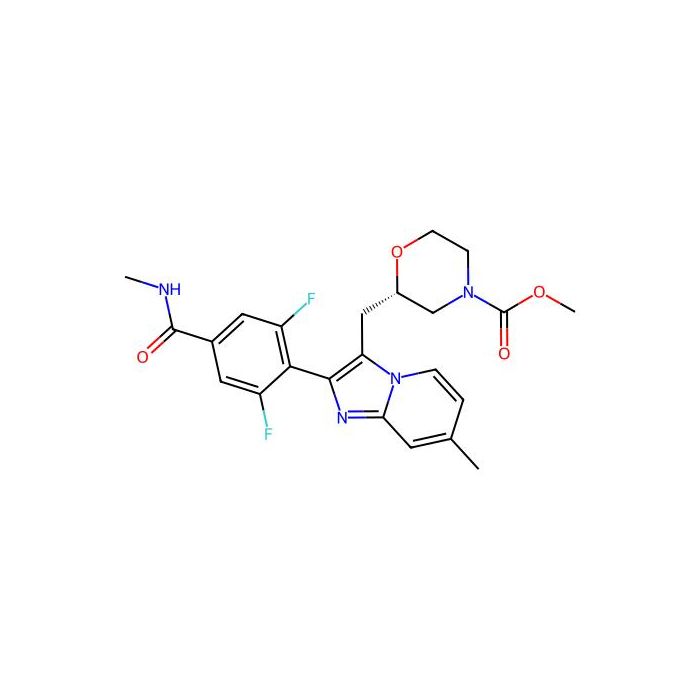
Camlipixant (BLU-5937) a potent, selective, non-competitive and orally active P2X3 homotrimeric receptor antagonist with an IC 50 of 25 nM against hP2X3 homotrimeric. Camlipixant shows potent anti-tussive effect and no taste alteration. Camlipixant can be used for the research of unexplained, refractory chronic cough.
Specifications
Specifiche e purezza
Moligand™, 10 mM in DMSO
Condizioni di conservazione di stoccaggio
Store at -80°C
Spedito in
Dry ice packs + Cold packs
Questo prodotto richiede spedizione a catena fredda. I servizi di terra e altri servizi economici non sono disponibili.
Certificati (CoA, COO, BSE/TSE e tabella di analisi)
C of A & Other Certificates(BSE/TSE, COO):
Analytical Chart:
Calcolatori di soluzioni
Molarity Calculator
Determine the necessary mass, volume, or concentration for preparing a solution.
Dilution Calculator
Determine the dilution needed to prepare a stock solution.
Reconstitution Calculator
Recensioni
Recensioni dei clienti
Application Protocols
Note: The following are general, literature-informed workflow examples for small-molecule ligands and are not validated protocols for this specific item. Optimize for your system.
A. Preparation of DMSO stock and plate dosing
Allow vial to equilibrate briefly to minimize condensation, then open in a dry environment.
Prepare a 10–50 mM stock in anhydrous DMSO. Vortex and, if needed, sonicate briefly. Filter through a 0.22 µm PTFE filter for particle removal (optional).
Create a serial dilution (e.g., 1:3 or 1:10) across a 96- or 384-well source plate in DMSO.
Transfer to assay plate to achieve final concentrations spanning sub-nanomolar to tens of micromolar, keeping final DMSO ≤0.1–0.5% v/v.
B. Ion channel functional assay (P2X3 model; literature)
Cells: HEK293 or CHO stably expressing human P2X3.
Buffer: HEPES-buffered saline, pH 7.3–7.4, with Ca2+/Mg2+ as required by the readout.
Pre-incubate compound for 5–30 min at 25–37 °C; stimulate with ATP; measure response via patch clamp or fluorescence indicator.
Include vehicle and reference antagonist controls; perform ≥3 technical replicates.
C. Basic LC–MS sample prep (analytics)
Quench assay supernatant with acetonitrile (1:3), centrifuge, collect supernatant, analyze by LC–MS/MS with appropriate MRM transitions once established.
Always include appropriate safety, waste handling, and documentation per institutional SOPs.
Biological Roles
General/literature context (non-item-specific)
Camlipixant is described in the literature as a selective small-molecule antagonist of P2X3-containing ATP-gated ion channels. P2X3 receptors are expressed predominantly in sensory neurons, including vagal and dorsal root ganglia, where ATP acts as a neurotransmitter/modulator in nociception and cough reflex pathways.
Mechanistic considerations (research use only)
Antagonism of P2X3 channels reduces ATP-evoked cation influx, typically measurable via patch-clamp electrophysiology, calcium indicators, or dye uptake assays (e.g., YO-PRO). Distinguishing activity at homomeric P2X3 versus heteromeric P2X2/3 assemblies is a key selectivity objective in research (literature).
Off-target profiling across P2X family members (P2X1–P2X7) and selected GPCRs/ion channels is commonly undertaken to evaluate specificity and potential assay interferences (literature).
Research applications
Tool compound for dissecting ATP-mediated sensory signaling, neurotransmission, and neuro-immune crosstalk in vitro.
Useful in validating assay platforms for P2X3 pharmacology, including potency-rank benchmarking versus other reference antagonists (e.g., gefapixant, eliapixant; literature comparison only).
Important limitations
No biological activity, potency, or selectivity data are provided for this particular catalog item. All uses are for research and laboratory purposes only; not for diagnostic, therapeutic, or clinical use.
Buffer Applications
Applicability
As a hydrophobic/heteroatom-containing small-molecule ligand, Camlipixant is not a buffer component. However, it is commonly dosed into biological buffers for in vitro assays.
Practical guidance (general, non-item-specific)
Stock preparation: prepare concentrated DMSO stock (e.g., 10–50 mM) and dilute into assay buffers such as HBSS, PBS, HEPES-buffered saline, or extracellular solution for electrophysiology.
Vehicle control: match final DMSO concentration across all wells (commonly ≤0.1–0.5% v/v) to control for solvent effects on cells and channels.
Solubility management: when precipitation is observed upon dilution, titrate in stepwise manner and consider adding small fractions of co-solvent allowed by the assay.
Not a buffering agent
pKa values, buffering capacity, and buffer recipes do not apply to this material. Choose your buffer based on the biological system (e.g., HEPES 10–20 mM, pH 7.3–7.4 for ion channel assays; literature).
Green Alternatives
Context
For this small-molecule ligand, the primary environmental considerations arise from solvent choices used for stock preparation, dilution, and analytical workflows rather than from process-scale synthesis.
Greener solvent choices for handling and assays (literature, general)
Prefer DMSO over DMF for stock solutions due to lower toxicity and better biodegradability profile.
Where compatible, use ethanol (pharm./analytical grade) for intermediate stocks, recognizing its favorable EHS profile compared to acetonitrile or methanol.
Replace halogenated solvents in analytics with acetonitrile/water gradients or ethanol/water when method performance allows.
Comparison (general guidance)
DMSO vs DMF: DMSO generally safer and less volatile; DMF offers strong solvency but has higher toxicity concerns.
Ethanol vs methanol: ethanol less toxic; methanol offers stronger solvency for some chemotypes but with higher acute toxicity.
Operational practices
Minimize solvent volumes via high-concentration DMSO stocks and microplate-based dilutions.
Use closed, low-evaporation labware to limit VOC emissions.
Segregate solvent waste streams to facilitate recycling/disposal.
Specification note
No item-specific green metrics (E-factor, PMI, solvent intensity) are provided. Choices should be tailored to your assay’s performance and institutional green-chemistry policies.
Pharmaceutical Uses
Scope and limitations
This product is supplied strictly for research use and is not intended for human or veterinary use, diagnostic procedures, or as an active pharmaceutical ingredient.
Formulation and analytical contexts (research only)
Preclinical enabling studies may require developing solvent systems for dosing in vitro (e.g., DMSO stocks diluted into media) and establishing LC–MS analytical methods for stability/solubility assessments (general guidance; not item-specific).
No pharmacopeial monograph, excipient status, or GMP attributes are provided in this listing. Do not use for manufacturing.
Material control
For any regulated workstreams or collaborations, ensure lot traceability and retain the CoA/Spec Sheet. If additional analytical verification (NMR/HRMS) is needed, perform internally under your QA procedures.
Physical Properties
Item-specific data
Appearance: Not specified for this item; refer to CoA/Spec Sheet.
Molecular weight: Not specified for this item; refer to CoA/Spec Sheet.
Melting point (MP): Not specified for this item; refer to CoA/Spec Sheet.
Boiling point (BP): Not specified for this item; refer to CoA/Spec Sheet.
Density: Not specified for this item; refer to CoA/Spec Sheet.
Refractive index: Not specified for this item; refer to CoA/Spec Sheet.
Solubility: Not specified for this item; refer to CoA/Spec Sheet.
General/literature guidance (non-item-specific)
For small, heteroatom-containing bioactive ligands, DMSO is typically the primary solvent for preparing concentrated stock solutions (e.g., 10–50 mM) due to broad solvency and compatibility with in vitro assays (literature).
Co-solvents such as ethanol or DMF can be used when DMSO solubility is limited; aqueous working solutions are commonly prepared by serial dilution into assay buffers with ≤0.1–0.5% organic solvent content to minimize vehicle effects (literature).
Partition behavior, pKa, and logP/logD should be sourced from publicly available cheminformatics databases using the CAS or PubChem CID if needed for modeling or formulation. These values are not specified for this catalog item.
Notes
Do not treat any literature property as a specification for this particular lot. For exact physical parameters relevant to QC, use the item’s CoA/Spec Sheet.
Quality and Grades
Item-specific grade
Grade/Purity: Moligand™
What Moligand™ indicates (catalog context)
Moligand designates small-molecule ligands suitable for discovery, screening, and chemical biology workflows. Emphasis is typically placed on identity confirmation and handling suitable for bioassay preparation rather than chromatographic solvent-grade specifications.
What is and is not specified for this item
Assay/purity, stabilizers/inhibitors, residual solvents, elemental/metals profile, water content, and chromatographic absorbance cutoffs are not specified in this listing; refer to the lot-specific CoA/Spec Sheet.
Appearance is not specified; consult CoA.
Implications for use
Intended for research use only. Appropriate for exploratory screening, target engagement studies, and mechanistic assays where small-molecule ligand quality and identity are crucial.
If using in sensitive biophysical methods (SPR, ITC, NMR), users should confirm solvent background and, if required, further polish by recrystallization or preparative HPLC, guided by the CoA.
Documentation and traceability
For regulated environments or when publishing, retain the SKU, lot/batch number, and CoA. If orthogonal identity confirmation is required (e.g., HRMS/NMR), request supporting analytical data when ordering.
Stability
Follow storage at −80°C as specified. Avoid repeated freeze-thaw; see Storage & Reconstitution for handling best practices.
Reaction and Applications
Scope of use
This product is positioned as a research ligand for biological assays rather than as a general synthetic reagent. Consequently, classic reaction families (e.g., cross-couplings, condensations) are not the primary use case.
Assay-oriented applications (research use only)
Target engagement studies: evaluation of functional antagonism on purinergic P2X3-containing receptors using electrophysiology or calcium/YO-PRO uptake assays (literature context; not item-specific testing).
Phenotypic screening: assessment in cough pathway models, sensory neuron activation assays, and ATP-evoked response suppression in recombinant or primary cells (literature).
Selectivity profiling: comparative activity versus P2X2/3 heteromers and other P2X family members to understand window for on-target effects (literature).
Analytical applications
Reference standard in LC–MS method development for small-molecule quantification in in vitro matrices (e.g., microsomes, plasma for stability studies), provided a suitable reference spectrum is available from the CoA or user-acquired data.
Not typically applicable
This material is not commonly used as a reagent in multistep synthesis or as a building block. For synthetic method development content, see Synthetic Utility and Reaction Conditions, which provide only general, non-specific guidance.
Notes
No item-specific potency, kinetics, or assay data are provided in this listing. Users should establish internal controls and verify compound identity/purity from the supplied batch documentation.
Reaction Conditions
Not typically applicable
This material is provided as a research ligand rather than a reagent for carrying out organic synthesis. Consequently, standard reaction conditions (solvents, temperatures, catalysts) are not defined for this item.
Stock solutions: commonly 10–50 mM in DMSO at room temperature; gentle warming or brief sonication may be used to aid dissolution.
Working solutions: prepare by serial dilution into assay buffer to the desired concentration range, keeping final organic content low (≤0.1–0.5% v/v; literature practice).
Stability: minimize light exposure and multiple freeze–thaw events; keep on ice during extended plate setup if required by your assay.
Analytical conditions (illustrative, literature)
LC–MS: typical reversed-phase gradients (water + 0.1% formic acid / acetonitrile + 0.1% formic acid). Exact retention and ionization behavior depend on the confirmed structure and are not specified here.
Safety and Handling
Authoritative references
Always consult the product SDS for definitive hazard classification, recommended PPE, spill/first-aid procedures, and disposal guidance.
Item-specific hazard data
Signal word: Not specified for this item; refer to SDS.
H-statements: Not specified for this item; refer to SDS.
GHS classification: Not specified for this item; refer to SDS.
Pictograms: Not specified for this item; refer to SDS.
General laboratory precautions (good practice for research small molecules)
Use in a chemical fume hood. Avoid inhalation of dust/aerosols and skin/eye contact.
Recommended PPE: lab coat, safety glasses or splash goggles, and suitable chemical-resistant gloves (e.g., nitrile). Consider double-gloving for extended handling.
Storage incompatibilities: keep away from strong oxidizers and strong acids/bases unless compatibility is known. Avoid prolonged exposure to light, air, and humidity for sensitive small molecules.
Thermal sensitivity: store as directed; this product is specified to be stored at −80°C.
First-aid overview (non-item-specific)
Skin/eye contact: rinse with water for at least 15 minutes; remove contaminated clothing; seek medical attention as needed.
Inhalation: move to fresh air; seek medical attention if symptoms occur.
Ingestion: rinse mouth; do not induce vomiting; seek medical attention.
Spills and disposal
Small spills: absorb with inert material, collect in chemical waste. Prevent dust formation.
Dispose of material and contaminated packaging as hazardous chemical waste per institutional and local regulations.
Shipping and storage
Shipped on dry ice packs + cold packs; store at −80°C upon receipt (per Product Data).
Solvent Selection
Applicability
Camlipixant is supplied as a research small-molecule ligand. Solvent selection is geared toward stock solution preparation and assay compatibility rather than process-scale chemistry.
Primary solvents (general guidance)
DMSO: first-line choice for preparing concentrated stocks (e.g., 10–50 mM), owing to broad solvency and widespread compatibility with biochemical and cellular assays (literature).
Ethanol or methanol: alternative vehicles for intermediate stocks; often diluted further into aqueous buffers. Consider cytotoxicity thresholds in cell-based assays.
DMF or acetonitrile: useful for analytical sample prep or when DMSO solubility is limited; assess assay tolerance before use.
Aqueous compatibility
Working solutions are typically prepared by serial dilution of organic stocks into assay buffers (e.g., HBSS, PBS, or bespoke assay media) ensuring the final organic content is ≤0.1–0.5% v/v to minimize vehicle effects (literature).
Solubility screening tips (non-item-specific)
Begin with DMSO at room temperature; gently warm (≤40 °C) or sonicate briefly if needed.
If precipitation occurs upon aqueous dilution, increase dilution steps, adjust buffer ionic strength, or add a small percentage of co-solvent compatible with your assay.
Specifications note
This listing does not provide a measured solubility profile, pKa, logP/logD, or dielectric properties. For exact values, consult the CoA/Spec Sheet or authoritative databases via CAS 1621164-74-6.
Storage and Reconstitution
Item-specific conditions
Storage: Store at −80 °C (per Product Data).
Shipping: Shipped on dry ice packs + cold packs. Inspect upon arrival; if thawing is observed, store immediately at −80 °C and consult QA if compromised.
General handling best practices
Minimize freeze–thaw: upon first opening, partition into single-use aliquots (e.g., in low-bind microtubes) under dry, inert conditions if feasible.
Moisture/light protection: keep tightly capped; store desiccated and protected from light. Allow vials to equilibrate to room temperature in a desiccator before opening to prevent condensation.
Reconstitution guidance (non-item-specific)
Prepare concentrated stock solutions in anhydrous DMSO (common range 10–50 mM). If alternative solvents are required (e.g., ethanol, DMF), verify compatibility with your assay.
Mix thoroughly by vortexing; brief sonication or gentle warming (≤40 °C) may assist dissolution. Do not overheat.
For aqueous working solutions, dilute the organic stock into buffer with thorough mixing to avoid local supersaturation; maintain final organic solvent ≤0.1–0.5% v/v as permitted by the assay.
Stability notes
Long-term stability data, hydrate/solvate form, and exact shelf life are not specified for this item; refer to the CoA/Spec Sheet. If extended storage is required, consider periodic re-checks by LC–MS or HPLC for integrity.
Research use note
For research use only. Not for human or veterinary use.
Structure and Identity
Product name: Camlipixant (SKU: C1496452)
CAS: 1621164-74-6
PubChem CID: 76955630
Category: Small molecule library member (Moligand series)
Item-specific identifiers
Molecular formula: Not specified for this item; refer to CoA/Spec Sheet.
Molecular weight: Not specified for this item; refer to CoA/Spec Sheet.
SMILES: Not specified for this item; refer to CoA/Spec Sheet.
InChIKey: Not specified for this item; refer to CoA/Spec Sheet.
General/literature context (non-item-specific)
Camlipixant is a research small molecule reported in the literature as a selective antagonist of P2X3-containing purinergic receptors (literature). Structural details can be retrieved from public databases using the CAS or PubChem CID above (literature).
Structural features (general description; literature)
Chemical class: small-molecule ligand; non-peptidic organic compound.
Functional group overview: specific functional group annotation is not provided in this listing; consult public databases for ring systems and heteroatom pattern (literature reference via CAS/CID).
2D structure description
A 2D depiction is not provided in this product entry. For an accurate structural diagram, consult the SDS/Spec Sheet or trusted databases linked to CAS 1621164-74-6 (literature).
Synthetic Utility
Relevance
Camlipixant is a finished small-molecule ligand provided for biological research and screening. It is not typically deployed as a synthetic intermediate or building block.
General observations (non-item-specific)
If structural modification campaigns are pursued by researchers, late-stage functionalization strategies (e.g., C–H activation, cross-coupling on aryl scaffolds, or amide/urea diversification) depend on the actual functional groups present in the molecule, which are not specified here.
Protecting-group strategies, chemoselectivity considerations, and heteroatom compatibility must be tailored to the confirmed structure available from public databases (via CAS/CID) and not inferred from this listing.
Recommendation
For medicinal chemistry derivatization, consult peer-reviewed literature and database-deposited structures associated with CAS 1621164-74-6 to identify modifiable positions, potential bioisosteres, and SAR vectors. Verify identity/purity of any derivatives independently.
Target Specificity
General/literature context (non-item-specific)
Camlipixant is reported as a selective antagonist of P2X3-containing purinergic receptors (literature). Research interest centers on differentiating activity at homomeric P2X3 versus heteromeric P2X2/3 channels to reduce off-target effects in sensory systems.
This product listing
No item-specific target validation, binding constants, or selectivity panel data are provided. Aladdin Scientific does not state activity data for this SKU.
Recommendations for researchers
Confirm target engagement in your system of interest using orthogonal assays (e.g., Ca2+ imaging, patch clamp, dye uptake) and include known reference antagonists for benchmarking.
Evaluate off-target profiles across P2X family members where relevant to your biology. Use identical vehicle controls to ensure solvent consistency.
Need help choosing the grade?
Our grade selection guide covers purity, stabilizer status, and application suitability for all variants in our catalog.
We use cookies to ensure the website functions properly and, where permitted, to improve your experience. You can manage your preferences at any time in Settings. Learn more in our Cookie Policy.
Shall we send you a message when we have discounts available?
Remind me later
Thank you! Please check your email inbox to confirm.
Products are supplied to verified businesses, institutions, and qualified professionals for research and development use only. Not for use in humans, animals, diagnosis, or therapy.