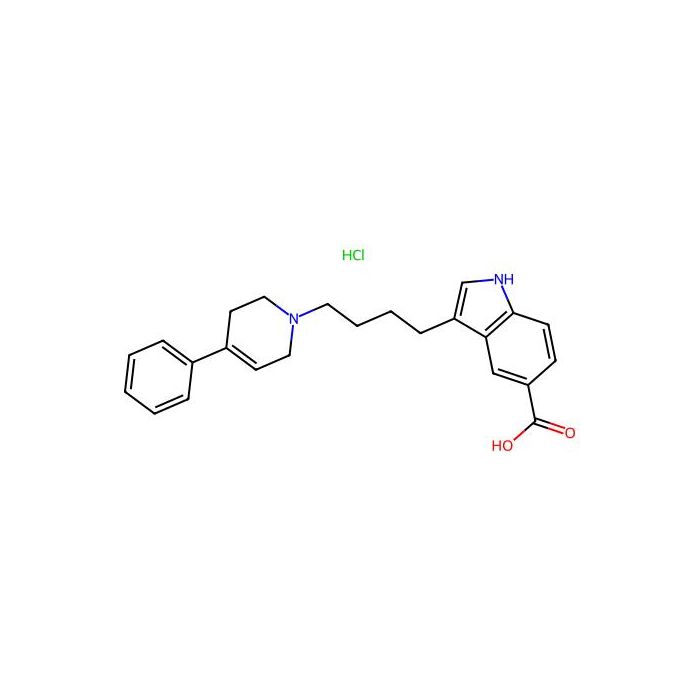
Carmoxirole hydrochloride (EMD 45609 hydrochloride) is a selective, peripherally acting dopamine D2 receptor agonist and exhibits antihypertensive activities in vivo
IC50& Target:Dopamine D2 receptor
Specifiche
Specifiche e purezza
10mM in DMSO
Meccanismi biochimici e fisiologici
Carmoxirole hydrochloride (EMD 45609 hydrochloride) is a selective, peripherally acting dopamine D2 receptor agonist and exhibits antihypertensive activities in vivo.
Condizioni di conservazione di stoccaggio
Desiccated,Store at -80°C
Spedito in
Dry ice packs + Cold packs
Questo prodotto richiede spedizione a catena fredda. I servizi di terra e altri servizi economici non sono disponibili.
Determine the necessary mass, volume, or concentration for preparing a solution.
Dilution Calculator
Determine the dilution needed to prepare a stock solution.
Reconstitution Calculator
Recensioni
Recensioni dei clienti
Application Protocols
Tested/validated applications (item-specific)
Not specified for this item; refer to CoA/Spec Sheet.
General, non-validated guidance for small-molecule handling in assays
Preparation: Equilibrate vial to room temperature in a desiccator before opening. Quickly weigh the required amount to minimize moisture uptake.
Stock: Dissolve in DMSO or acidified water to 10–50 mM. Vortex and, if aqueous, filter-sterilize (0.22 µm) for cell-based assays.
Aliquoting: Dispense single-use aliquots in low-bind tubes; store at −80°C. Avoid repeated freeze–thaw.
Use: Thaw on ice, mix gently, and add to assay buffer to reach target concentration. Keep final DMSO within assay tolerance.
QC: Confirm concentration by UV or LC–MS and check for precipitation after dilution. Include vehicle controls and, where appropriate, reference standards in each run.
These steps are offered as general best practices and are not specific performance claims for this product.
Biological Roles
Scope
The following describes general, literature-based biological roles for dopaminergic receptor agonist tool compounds and is not an item-specific claim. No clinical or therapeutic uses are implied.
Dopaminergic signaling (general)
Dopamine receptors (D1-like and D2-like GPCRs) regulate intracellular pathways including cAMP production, potassium/calcium channel activity, and β-arrestin recruitment.
Small-molecule agonists targeting D2-like receptors are widely used to probe GPCR coupling to Gi/o proteins, examine downstream ERK/Akt pathway modulation, and map receptor desensitization/internalization.
Research applications
Ligand binding affinity determination (radioligand displacement, fluorescence/bioluminescence resonance energy transfer assays).
Functional assays: cAMP inhibition assays in D2-expressing cells, GIRK activation readouts, and reporter gene systems.
Selectivity profiling against GPCR panels to understand off-target interactions and bias (G protein vs β-arrestin signaling).
Experimental considerations
pH and ionic strength can influence membrane permeability and receptor engagement; maintain consistent vehicle composition (e.g., ≤0.1–0.5% DMSO).
Account for salt form when preparing molar solutions (use salt MW from CoA). Validate stability in assay buffer and under incubation conditions by LC–MS where possible.
Buffer Applications
Applicability
This compound is a bioactive small molecule rather than a buffer reagent. However, it is commonly formulated in buffers for biological assays. The following are general recommendations, not item-specific specifications.
Typical buffer systems for GPCR/cell assays
HBSS or PBS supplemented with HEPES (10–20 mM, pH 7.3–7.4) for binding/functional assays at 25–37°C.
Assay buffers may include Mg2+/Ca2+ depending on the receptor system; add BSA (0.1–1%) to reduce nonspecific binding.
Stock preparation
Prepare concentrated stock in DMSO (e.g., 10–50 mM) or water with slight acidification (e.g., 0.01–0.1 N HCl) to maintain solubility. Filter-sterilize aqueous stocks (0.22 µm) if using in cell culture.
Aliquot and store at −80°C per product storage guidance to avoid repeated freeze–thaw.
Dilution into buffer
Add stock to buffer under mixing to avoid local supersaturation. Keep final DMSO below assay tolerance (commonly ≤0.1–0.5% v/v).
Monitor for precipitation or adsorption to plastics; utilize low-binding tubes/plates when working at low concentrations.
Stability checks
Verify concentration and integrity in working buffer by LC–MS or HPLC after representative incubation times.
Green Alternatives
Context
As a solid bioactive hydrochloride salt, the main green-chemistry lever is solvent choice for dissolution, handling, and analytical work rather than replacement of the molecule itself.
Preferable solvent systems (general guidance)
Favor water or buffered aqueous media when compatible with your assay.
Use ethanol or water–ethanol blends over higher-toxicity solvents where feasible.
Minimize DMSO concentration; although widely used, it has environmental and biological considerations at scale.
Comparison (general; not item-specific)
Water (best EHS profile) vs DMSO (high solvency, more demanding EHS) vs acetonitrile (common for LC, volatile and flammable) vs methanol (toxic, flammable). Choose the least hazardous solvent that meets performance requirements.
Operational greening
Work at higher stock concentrations to reduce solvent volumes.
Adopt microplate formats and miniaturized assays to cut waste.
Implement solvent recovery for chromatographic methods when practical.
Tradeoffs
Aqueous media may limit solubility of the free base form at neutral–basic pH; maintaining the salt state (slightly acidic pH) balances performance with greener solvent profiles.
Pharmaceutical Uses
Regulatory and use status
For research use only. Not for human or veterinary use, diagnostic procedures, or clinical applications.
Formulation context (general information on hydrochloride salts; not item-specific claims)
Hydrochloride salts are frequently chosen in pharmaceutical development to enhance aqueous solubility, improve crystallinity, and enable robust solid-form control.
Key developability attributes include salt stoichiometry, hygroscopicity, polymorphism, and dissolution behavior across physiologically relevant pH.
Preformulation considerations for research formulations
Determine accurate salt molecular weight and assay purity from the CoA to dose by molarity correctly.
Screen excipient compatibility for in vivo research models (if applicable to non-clinical studies per institutional approvals), including pH-adjusted aqueous vehicles, co-solvent systems (PEG 400, ethanol, saline), and surfactants (e.g., polysorbate 80) as needed.
Analytical controls
Employ validated HPLC/LC–MS methods to quantify dose formulations and assess stability.
Note
No pharmacopeial monograph, excipient status, or approved drug product information is provided for this item. Consult the CoA and SDS for any additional quality details.
Physical Properties
Item-specific physicochemical data
Appearance: Not specified for this item; refer to CoA/Spec Sheet.
Molecular weight: Not specified for this item; refer to CoA/Spec Sheet.
Molecular formula: Not specified for this item; refer to CoA/Spec Sheet.
Melting point, boiling point, density, refractive index: Not specified for this item; refer to CoA/Spec Sheet.
Purity/grade: Not specified for this item; refer to CoA/Spec Sheet.
Solubility and ionization (general literature guidance for amine HCl salts; not item specification)
Hydrochloride salts of amines are typically freely soluble in water and aqueous buffers and often soluble in polar protic solvents (methanol, ethanol) and DMSO.
The conjugate acid of an amine has a pKa typically in the ~7.5–10.5 range (literature, scaffold-dependent); ionization state will depend on pH, impacting solubility and membrane permeability in assays.
Partitioning (general/literature)
LogP/logD vary with scaffold and pH; hydrochloride salts generally show reduced apparent logD in aqueous systems relative to the free base.
Practical note
For experimental planning, determine exact solubility and pKa from the CoA/Spec Sheet or your own pre-formulation tests. Use freshly prepared aqueous solutions and filter-sterilize if required for cell-based work.
Quality and Grades
Item-specific quality
Grade/Purity: Not specified for this item; refer to CoA/Spec Sheet.
Any stabilizers, residual solvents, water content, or metal limits: Not specified for this item; refer to CoA/Spec Sheet.
How to interpret grade terminology (general guidance)
“Analytical” or “AR” grades typically ensure low inorganic/organic impurities suitable for analytical work.
“HPLC grade” solvents and reagents are screened for low UV absorbance and minimal particulate for chromatography.
“Bioactive small molecule” library items are often provided at defined purity (e.g., ≥95% by HPLC), but exact thresholds must be verified on the lot CoA.
Verification recommendations
Review the CoA for assay method (e.g., HPLC/LC–MS, NMR), purity threshold, and identity confirmation.
If your application is particularly sensitive (kinase/GPCR functional assays, in vivo models), consider confirmatory QC (orthogonal HPLC method, 1H NMR, water content by KF) upon receipt.
Lot-to-lot considerations
Note batch-specific polymorph/solvate state, residual counterion content, and water of crystallization for hydrochloride salts, as these can affect mass-normalized dosing and solubility.
Reaction and Applications
This product is primarily a bioactive small molecule for research and is not commonly used as a synthetic reagent.
Research applications (general, literature-based for dopaminergic tool compounds; not item-specific claims)
Utilized in receptor binding assays, second-messenger/functional readouts (e.g., cAMP modulation via D2-like pathways), and β-arrestin or reporter gene assays in engineered cell lines.
Employed in structure–activity relationship (SAR) work and reference control experiments for dopaminergic signaling studies.
Potential utility in neurochemical pathway interrogation, including pharmacological profiling across GPCR panels.
Practical handling tips
Prepare concentrated stock in DMSO or water (acidified if necessary) and aliquot to avoid freeze–thaw cycles.
For plate-based assays, verify absence of precipitation and adsorptive losses (use low-bind plastics; include a solvent pre-rinse of tips/vials when working at low nM–µM levels).
Confirm stability in chosen assay media (evaluate by HPLC/LC–MS after incubation at assay temperature/time).
Analytical considerations
Quantify dosing solutions by UV or LC–MS where possible; hydrochloride counterion affects mass calculations—use the salt MW from the CoA for molar concentration calculations.
Reaction Conditions
Not typically applicable. This compound is provided as a bioactive reference/assay molecule rather than a reagent for chemical synthesis.
For biological assay conditions (general guidance; not item-specific)
Stock solutions: DMSO or water (acidified), 10–50 mM.
Working concentrations: commonly nM–µM in receptor-binding or functional assays; exact ranges depend on receptor expression and assay design.
Temperatures: ambient (binding) to 37°C (cell-based functional assays).
Readouts: radioligand displacement, cAMP modulation assays, β-arrestin recruitment, or calcium influx (indirect, pathway-dependent).
Please refer to your assay SOPs and validate concentrations empirically.
Safety and Handling
GHS/CLP information (item-specific)
Signal word: Not specified for this item; refer to SDS.
Hazard statements (H-codes): Not specified for this item; refer to SDS.
Pictograms and classification: Not specified for this item; refer to SDS.
General laboratory precautions (best practice; not item-specific)
Handle in a chemical fume hood, avoiding inhalation of dust/aerosols. Prevent contact with skin and eyes.
Recommended PPE: lab coat, safety glasses or face shield, and appropriate chemically resistant gloves (e.g., nitrile). For solid weighing, consider a mask/respirator per institutional policy.
Avoid incompatible materials for amine hydrochloride salts, such as strong bases (may liberate the free base) and strong oxidizers.
First-aid overview (consult SDS for definitive guidance)
Inhalation: move to fresh air; seek medical attention if symptoms persist.
Skin/eye contact: rinse with water for at least 15 minutes; remove contaminated clothing; seek medical attention for persistent irritation.
Ingestion: rinse mouth; do not induce vomiting unless directed by medical personnel; seek medical attention.
Spills and disposal
Collect solids by gentle sweeping; avoid dust formation. For solutions, absorb with inert material. Dispose of according to local regulations and SDS guidance.
Stability note
Follow the specified storage (desiccated, −80°C). Warm only the needed quantity to room temperature in a desiccator before opening to minimize moisture uptake.
Solvent Selection
Polarity and form (general for amine hydrochloride salts)
Hydrochloride salts are typically highly polar and water-soluble; they dissolve readily in water, PBS, dilute acids (e.g., 0.1 N HCl), and polar organic solvents such as methanol, ethanol, and DMSO.
Practical dissolution choices
Aqueous work: Use ultrapure water or buffer at pH 3–6 to maintain the protonated state and maximize solubility. Avoid high-pH buffers that can generate the poorly soluble free base.
Stock solutions for screening: DMSO (e.g., 10–50 mM) is common for plate-based assays, followed by dilution into assay buffer (maintain final DMSO ≤0.1–0.5% v/v to limit biological effects).
For LC–MS reference standards: 50:50 water:acetonitrile with 0.1% formic acid often affords stable ionization and solubility (general guidance).
Compatibility notes
Avoid nonpolar solvents (hexanes, toluene) where hydrochloride salts are typically insoluble.
Check for precipitation upon dilution into high-ionic strength or high-pH media; pre-wet with a small amount of DMSO or acidified water if needed.
Quick comparison (general)
Water (acidified) — maximal solubility, biocompatible.
DMSO — high solubilizing power; watch for hygroscopic uptake and final assay concentration.
Methanol/ethanol — useful intermediates, but consider toxicity for live-cell assays.
Storage and Reconstitution
Item-specific storage and shipping
Storage Conditions: Desiccated, Store at −80°C (per Product Data).
Inspect packaging for temperature excursion indicators. Transfer immediately to −80°C storage in a desiccator or sealed container with desiccant.
Before opening, allow the container to equilibrate to room temperature in a desiccator to prevent moisture condensation on the solid.
Reconstitution guidance (general for hydrochloride salts; verify solubility empirically)
Solvents: DMSO, water, or mildly acidified water (e.g., 0.01–0.1 N HCl) are typical. Start with small volumes and increase as needed to achieve a clear solution.
Concentrated stocks: 10–50 mM are common for screening; filter-sterilize aqueous stocks if used in cell culture.
Label aliquots with compound name, lot, concentration, solvent, and date.
Stability and storage of solutions
Store aliquots at −80°C, protected from moisture and repeated freeze–thaw. For DMSO stocks, consider amber vials to limit light exposure.
Establish in-use stability by periodic LC–MS/HPLC checks after representative storage and assay conditions.
Note
Any item-specific solution stability, hygroscopicity, or solubility limits are Not specified for this item; refer to CoA/Spec Sheet and SDS for authoritative guidance.
Structure and Identity
Item-specific identifiers
SKU: C654632 (Aladdin Scientific)
Product Name: Carmoxirole hydrochloride
CAS: 115092-85-8
Category: Small molecule, research chemical (compound library)
Research Use: For research use only
Structural descriptors (item-specific)
Molecular formula: Not specified for this item; refer to CoA/Spec Sheet.
Molecular weight: Not specified for this item; refer to CoA/Spec Sheet.
SMILES: Not specified for this item; refer to CoA/Spec Sheet.
InChIKey: Not specified for this item; refer to CoA/Spec Sheet.
Structural features (general literature context for carmoxirole class; not item specification)
Carmoxirole is reported in the literature as a small-molecule amine presented as a hydrochloride salt, consistent with protonated amine(s) balanced by Cl−.
Hydrochloride salts typically increase aqueous solubility versus the corresponding free base and may present as crystalline solids.
2D structure description (general/literature)
Typical features for amine HCl salts: a cationic amine center (R–NH2+/R2NH2+) with chloride counterion; additional heteroatoms or ring systems may be present depending on the scaffold. Consult the CoA/Spec Sheet for definitive structure depiction for this catalog lot.
Synthetic Utility
This product is supplied as a bioactive small molecule and is not typically employed as a general synthetic reagent or building block.
Reagent role
Not commonly used as a catalyst, ligand, or stoichiometric reagent in synthetic chemistry.
If derivatization is desired (general considerations)
Hydrochloride salts of amines can be basified to the free base to enable derivatization (e.g., acylation, alkylation) on the amine; however, any such transformations are outside the normal scope of use for this catalog item and require appropriate method development.
Recommendation
For synthetic applications, consult primary literature on the specific scaffold. Otherwise, see Reaction & Applications and Biological Roles sections for the most relevant research uses.
Target Specificity
Item-specific target data
Not specified for this item; refer to CoA/Spec Sheet and primary literature for biochemical target information.
Note
While dopaminergic receptor activity is frequently discussed for compounds in this class, no target affinity/efficacy data are provided with this catalog entry. Users should verify receptor subtype specificity, potency, and selectivity with their own assays or literature sources relevant to their application.
Utilizziamo i cookie per garantire il corretto funzionamento del sito web e, ove consentito, per migliorare la tua esperienza. Puoi gestire le tue preferenze in qualsiasi momento nelle Impostazioni. Per saperne di più, consulta la nostra Cookie Policy.
Desidera che le inviamo un messaggio quando avremo sconti disponibili?
Ricordamelo più tardi
Grazie! Controlli la sua casella di posta per confermare.
Products are supplied to verified businesses, institutions, and qualified professionals for research and development use only. Not for use in humans, animals, diagnosis, or therapy.

 J2622021