Chitoheptaose hydrochloride - ≥96% , CAS No.68232-35-9

CAS: 68232-35-9 Cat. No.: C305405 Formula: C12H9N3 PubChem CID: 102602304
Disponibile su ordine
GRADE & PURITY ≥96%
Synonyms
Chitoheptaose 7-Hydrochloride
Storage
Room temperature
Shipped In
Normal
★
Size
Germania (EU)
USA*
Price
Qty
10mg
C305405-10mg
Su ordinazione · 8–12 settimane

2.017,41€

2.354,09€
Salva 336,68 € (14.30%)
Enter a quantity for the sizes you want to add.
🧪
Why this grade

≥96% for sensitive chromatographic and analytical workflows requiring minimal baseline interference.

🌡

Storage & shipping

Room temperature Ships Normal Check lot-specific COA for exact specifications.

📋

Quality documents

SDS, COA, datasheet, and spec sheet available for download. Lot-specific COA accessible via lot number lookup.

📚

Literature proof

Cited in 0 peer-reviewed publications across chromatography, organic synthesis, and cross-coupling reactions.

Specifications

Sinonimi
Chitoheptaose 7-Hydrochloride
Specifiche e purezza
≥96%
Condizioni di conservazione di stoccaggio
Room temperature
Spedito in
Normal
Purezza
≥96%
Nomi e identificatori
Pubchem Sid
Sorrisi canonici
C(C1C(C(C(C(O1)OC2C(OC(C(C2O)N)OC3C(OC(C(C3O)N)OC4C(OC(C(C4O)N)OC5C(OC(C(C5O)N)OC6C(OC(C(C6O)N)OC7C(OC(C(C7O)N)O)CO)CO)CO)CO)CO)CO)N)O)O)O.Cl.Cl.Cl.Cl.Cl.Cl.Cl
IUPAC Name
(2R,3S,4R,5R,6S)-5-amino-6-[(2R,3S,4R,5R,6S)-5-amino-6-[(2R,3S,4R,5R,6S)-5-amino-6-[(2R,3S,4R,5R,6S)-5-amino-6-[(2R,3S,4R,5R,6S)-5-amino-6-[(2R,3S,4R,5R,6S)-5-amino-6-[(2R,3S,4R,5R)-5-amino-4,6-dihydroxy-2-(hydroxymethyl)oxan-3-yl]oxy-4-hydroxy-2-(hydroxymethyl)oxan-3-yl]oxy-4-hydroxy-2-(hydroxymethyl)oxan-3-yl]oxy-4-hydroxy-2-(hydroxymethyl)oxan-3-yl]oxy-4-hydroxy-2-(hydroxymethyl)oxan-3-yl]oxy-4-hydroxy-2-(hydroxymethyl)oxan-3-yl]oxy-2-(hydroxymethyl)oxane-3,4-diol;heptahydrochloride
InChIKey
XILROFQEQZNQLF-PHLWITABSA-N
INCHI
1S/C42H79N7O29.7ClH/c43-15-24(59)30(9(2-51)66-36(15)65)73-38-17(45)26(61)32(11(4-53)68-38)75-40-19(47)28(63)34(13(6-55)70-40)77-42-21(49)29(64)35(14(7-56)72-42)78-41-20(48)27(62)33(12(5-54)71-41)76-39-18(46)25(60)31(10(3-52)69-39)74-37-16(44)23(58)22(57)8(1-50)67-37;;;;;;;/h8-42,50-65H,1-7,43-49H2;7*1H/t8-,9-,10-,11-,12-,13-,14-,15-,16-,17-,18-,19-,20-,21-,22-,23-,24-,25-,26-,27-,28-,29-,30-,31-,32-,33-,34-,35-,36?,37+,38+,39+,40+,41+,42+;;;;;;;/m1......./s1
Isomeri SMILES
C([C@@H]1[C@H]([C@@H]([C@H]([C@@H](O1)O[C@@H]2[C@H](O[C@H]([C@@H]([C@H]2O)N)O[C@@H]3[C@H](O[C@H]([C@@H]([C@H]3O)N)O[C@@H]4[C@H](O[C@H]([C@@H]([C@H]4O)N)O[C@@H]5[C@H](O[C@H]([C@@H]([C@H]5O)N)O[C@@H]6[C@H](O[C@H]([C@@H]([C@H]6O)N)O[C@@H]7[C@H](OC([C@@H]([C@H]7O)N)O)CO)CO)CO)CO)CO)CO)N)O)O)O.Cl.Cl.Cl.Cl.Cl.Cl.Cl
PubChem CID
102602304

Documentazione

📋 Safety Data Sheet (SDS)

Comprehensive hazard, handling, storage, and regulatory compliance document.

Download SDS →

✅ Certificate of Analysis (COA)

Lot-specific quality data. Enter your lot number to retrieve the exact COA.

Look up COA →

📊 Datasheet

Quick-reference summary of product specifications and applications.

View datasheet →

🔬 Specification Sheet

Full quality attributes and acceptance criteria for this grade.

View spec sheet →

Advanced Data

Struttura 3D
Modello di struttura chimica interattiva


Certificati (CoA, COO, BSE/TSE e tabella di analisi)
C of A & Other Certificates(BSE/TSE, COO):
Analytical Chart:
Calcolatori di soluzioni
Recensioni

Recensioni dei clienti

Application Protocols

No manufacturer-tested bioassay protocols are provided for this catalog item. Below are generic, literature-informed starting points; adjust to your system.

• Preparation of aqueous stock (research grade): Weigh the required amount quickly to minimize moisture uptake. Dissolve to 10 mg/mL in sterile 10 mM acetate buffer, pH 5.5. Mix gently at room temperature until fully dissolved (5–15 min). Sterile-filter (0.22 µm). Store aliquots at 2–8 °C for up to one week; prepare fresh for cell-adjacent assays.

• Polyelectrolyte nanoparticle formation (with sodium alginate): Prepare 1 mg/mL solutions of chitoheptaose HCl (pH 5.5) and alginate (pH 5.5). Add alginate dropwise to chitoheptaose at an amine:carboxyl molar ratio of ~3:1 under stirring. Age 15–30 min. Characterize by DLS and ζ-potential. Optimize ionic strength (0–50 mM NaCl) to tune size and stability.

• Enzyme cleavage assay (chitosanase): Incubate 0.1–1 mg/mL chitoheptaose with enzyme in 50 mM acetate buffer pH 5.5 at 37 °C. Take timepoints (0–120 min). Quench by heating (70 °C, 10 min). Analyze products by HPAEC-PAD or MALDI-TOF to map cleavage.

Note: These are general starting conditions derived from literature; they are not validated for this specific lot. For any regulated application, develop and validate internal SOPs.

Biological Roles

General biology/biochemistry (literature; not product-specific claims): • Structural origin: Chito-oligomers are fragments of chitin/chitosan, major structural polysaccharides in fungi, arthropods, and some algae. DP and acetylation pattern govern recognition. • Enzymatic recognition: Chitoheptaose is a substrate and binding ligand for chitinases and chitosanases. Cleavage patterns across DP ladders are used to map enzyme subsite architecture. • Elicitor activity in plants: Chitin/chitosan oligomers can trigger pattern-recognition receptors (PRRs) in plants, activating defense signaling; chain length (typically DP ≥6) influences potency (literature observation). Use strictly for research in plant biology. • Polycationic interactions: Protonated amines promote binding to negatively charged biomolecules (nucleic acids, glycosaminoglycans), cell surfaces, and membranes—useful for studying adhesion and transfection mechanisms in vitro. • Biodegradation: Degraded by chitinolytic enzymes to N-acetylglucosamine/glucosamine, entering amino sugar metabolism in microbes (literature). • Mucoadhesion: Cationic saccharides interact with mucins via electrostatics and hydrogen bonding, supporting research into mucosal delivery systems (no clinical claims).

Notes for researchers: • Charge and conformation are strongly pH- and ionic-strength-dependent; define buffer conditions rigorously when comparing bioassay outcomes. • Endotoxin/bioburden can confound in vitro responses; consider low-endotoxin grades and sterile filtration for cell-adjacent studies.

Buffer Applications

Relevance: As a solute rather than a buffer component, chitoheptaose HCl does not constitute a classical buffering system. However, its behavior in buffers is critical to reproducible work.

Practical guidance (literature): • Recommended buffers: Acetate (pH 4.0–5.5), MES (pH 5.5–6.5), phosphate (pH 6.0–7.4). Maintain pH below ~7.5 to keep amines largely protonated and the oligomer soluble. • Typical preparation: Dissolve to 1–10 mg/mL in the chosen buffer with gentle stirring; warm to 30–37 °C if needed. Avoid strong base; adjust pH with dilute HCl rather than NaOH. • Ionic strength: 50–200 mM total salt often stabilizes solutions and reduces nonspecific adsorption. For polyelectrolyte complexation, reduce ionic strength to promote binding. • Sterilization: Filter through 0.22 µm; avoid autoclaving (thermal degradation/depolymerization possible). • Storage of solutions: 2–8 °C for short term; add 0.02% sodium azide only for non-biological assays (to suppress microbial growth). For biological assays, prepare fresh.

Not applicable: Recipes for classical Good’s buffers are not provided here because the product is not itself a buffering agent. Use standard buffer references for precise formulations and pair them with the solubility guidance above.

Green Alternatives

Context: As a renewable, biodegradable oligosaccharide derived from chitin/chitosan, chitoheptaose already aligns with several green chemistry principles compared with synthetic petrochemical polycations.

Comparative considerations (literature): • Renewable feedstock: Derived from biomass (crustacean/fungal chitin) vs. poly(ethyleneimine) (PEI) or quaternary ammonium polymers from petrochemical monomers. • Biodegradability: Enzymatically degradable by chitinases/chitosanases; PEI and many quats are persistent. • Toxicity profile: Oligosaccharides generally exhibit lower cytotoxicity than high-charge-density synthetic polycations; however, always assess for your system. • Solvent use: Typically processed in water under mild conditions; alternatives (e.g., cationic surfactants) may require organic solvents.

Small comparison table (literature, qualitative): • Chitoheptaose HCl: renewable, water-processable, degradable; charge density tunable by pH; batch heterogeneity (counterion/water content) requires characterization. • PEI (branched, 25 kDa): strong polycation for complexation but non-renewable, often higher cytotoxicity; excellent buffering but less biodegradable. • Quaternized cellulose derivatives: renewable and water-soluble, but require halogenated reagents for synthesis; permanent cationic charge.

Green tips: • Favor aqueous media and ambient temperature reactions (periodate oxidation, enzymatic coupling). • Recycle precipitation solvents (ethanol/IPA) when used for recovery/purification. • Use catalytic, benign crosslinkers where possible (e.g., enzymatic transglutaminase is not applicable here; consider genipin over glutaraldehyde for milder conditions).

Pharmaceutical Uses

Scope: For research use only. No medical or clinical claims.

Formulation/processing roles in research and pre-formulation (literature context): • Excipient prototype: Cationic oligosaccharides are explored as mucoadhesive, permeation-enhancing excipient candidates for transmucosal delivery in vitro/ex vivo, where defined DP (e.g., 7) allows structure–activity studies. • Complexation agent: Forms polyelectrolyte complexes with anionic APIs or nucleic acids, facilitating nanoparticle assembly studies and screening of delivery vectors. • Stabilizer/coating: Acts as a protective colloid and surface modifier on particles or devices via electrostatic adsorption and hydrogen bonding; supports research into coating homogeneity and charge control. • Conjugation handle: Primary amines enable attachment of PEG, dyes, or targeting ligands to generate model conjugates for release and biodistribution studies in non-clinical settings. • Impurities/quality considerations: Residual endotoxin/bioburden, metal catalysts (if any used during depolymerization), and chloride content can impact biological readouts—verify with CoA/specifications.

Regulatory notes: • Pharmacopeial status: Not specified for this item; refer to CoA/Spec Sheet. Defined chito-oligomers are generally not compendial; any GMP applicability would require custom qualification. • Use limitations: Research and development only; not for human or animal therapeutic use.

Physical Properties

Item-specific specifications (from product data): • Appearance: Not specified for this item; refer to CoA/Spec Sheet. • Molecular weight: Not specified for this item; refer to CoA/Spec Sheet. • Molecular formula: Not specified for this item; refer to CoA/Spec Sheet. • Other specifications (water content, ash, metals, UV cutoff, etc.): Not specified for this item; refer to CoA/Spec Sheet.

General/literature/computed values and notes (not item specifications): • Theoretical backbone mass (neutral chitoheptaose, DP=7): ≈ 7 × 179.17 (GlcN) − 6 × 18.015 ≈ 1146 Da; addition of HCl counterions increases the formula mass depending on the degree of protonation. • Solubility: readily soluble in water under acidic to neutral conditions; solubility increases as pH decreases due to amine protonation; limited to negligible solubility in most aprotic organic solvents (e.g., acetonitrile, THF) (literature). • pKa (GlcN C2 ammonium): ~7.4–7.8 (literature range). Below this pH, chains are polycationic and strongly hydrated. • Hygroscopicity: oligosaccharides and their salts are typically hygroscopic and water-absorbing (literature). • Optical activity: solutions are typically dextrorotatory; specific rotation depends on DP, ionic strength, and pH (literature). • Thermal behavior: carbohydrates decompose/charr rather than exhibit a sharp boiling point (literature); dry oligomers show gradual mass loss upon heating due to bound water followed by decomposition >180–220 °C (TGA/DSC literature for chitosan oligomers). • Refractive index/density: commonly measured in solution; solid-state density seldom reported for discrete oligomers (literature). Always verify with experimental data for your lot.

Quality and Grades

Item-specific quality information (from product data): • Grade/Purity: Not specified for this item; refer to CoA/Spec Sheet.

Guidance on interpreting quality for chito-oligosaccharides (general): • Degree of polymerization (DP) and dispersity: For functional studies, a narrowly defined DP (here, DP=7) is critical. Verify via HPAEC-PAD, MALDI-TOF, or ESI-MS profiles on the CoA. Minor homologs (DP 6/8) may be present depending on production method. • Counterion content: “Hydrochloride” indicates protonated amines with Cl− counterions. The exact chloride content (and thus apparent MW by TGA/ion chromatography) can vary; consult CoA for titratable amine/Cl− analysis. • Degree of acetylation (DA): For “chito-” oligomers, DA should be very low (ideally ≤5% of residues acetylated). DA affects solubility, charge density, and biointeractions. The CoA often lists DA by 1H NMR or IR. • Inorganic/metal impurities and endotoxin/bioburden: Not specified for this item; refer to CoA/Spec Sheet. For biointerfacing work, low endotoxin and bioburden are desirable; request supporting data if needed. • Color/appearance: Oligosaccharide HCl salts are typically white to off-white, free-flowing or slightly tacky powders; actual appearance should match the CoA. • UV profile: carbohydrates have minimal UV absorbance >220 nm; “HPLC grade” concepts are less relevant than for solvents, but low UV background helps when monitoring labels/dyes. • Batch-to-batch: Verify lot-specific DP, water content (Karl Fischer), residual salts, and pH of a defined concentration solution.

Reaction and Applications

This chitoheptaose HCl is a defined-length, cationic carbohydrate oligomer. Its applications span biomaterials, glycobiology, and analytical standards.

Representative uses (literature; expand-on concepts): • Enzyme substrates/standards: Defined DP chito-oligomers are used to profile chitinases/chitosanases and map cleavage specificity by LC-MS or HPAEC-PAD. DP=7 provides mid-length substrate and ladder standards. • Polyelectrolyte complexation: Forms electrostatic complexes with anionic polymers (alginate, DNA/RNA, hyaluronate) below neutral pH; used to study complex coacervation, nanoparticle assembly, and layer-by-layer films. • Conjugation chemistry: –NH2 groups react with activated esters (NHS) to install dyes, linkers, or ligands; vicinal diols can be periodate-oxidized to dialdehydes for Schiff base formation followed by reductive amination. • Crosslinking: Mild crosslinkers (genipin) or dialdehydes (e.g., glutaraldehyde under controlled conditions) generate hydrogels/microgels. DP=7 behaves more like a multifunctional crosslinkable oligomer than a high-MW polymer, enabling soluble conjugates. • Metal ion capture: Multidentate chelation via hydroxyls/amine sites for analytical preconcentration studies. • Mass spectrometry: As calibration/response standards for oligosaccharide analysis and method validation.

Practical tips: • Maintain pH 4–6 during complexation to maximize cationic charge. • For periodate oxidation, work cold and in the dark; quench excess oxidant before bioconjugation. • For NHS-ester labeling, buffer in bicarbonate/borate pH 8–8.5 briefly to activate amines, then immediately quench; monitor for precipitation as amines deprotonate.

Reaction Conditions

General literature guidance for common transformations (not product-specific specifications; optimize for your system):

• NHS-ester labeling (amine acylation): Dissolve chitoheptaose HCl in 50 mM bicarbonate or borate buffer, pH 8.3. Add NHS-activated ester (2–10 molar equivalents per reactive amine, depending on desired substitution). React 0.5–2 h at room temperature, shield from light if dye-labeled. Quench with Tris or ethanolamine. Purify by dialysis/SEC.

• Periodate oxidation of vicinal diols: 1–10 mM NaIO4 in 10–50 mM acetate buffer, pH 4.5–5.5, 0–4 °C, 15–60 min in the dark. Quench with ethylene glycol or sodium sulfite. Proceed to Schiff base formation or oxime ligation.

• Reductive amination at the reducing end: Mix with 10–50 mM amine nucleophile in acetate buffer pH 5.0 with 10–50 mM NaCNBH3 or picoline borane, 25–37 °C, 2–16 h. Remove excess reagents by dialysis/SEC.

• Polyelectrolyte complexation with DNA/alginate: Prepare separate solutions at pH 5.5–6.5, ionic strength ≤20 mM. Mix at defined N:P or amine:carboxyl ratios (e.g., 2:1 to 10:1), gentle stirring, room temperature. Characterize size/charge by DLS/ζ-potential.

• Genipin crosslinking: 0.1–2 mM genipin in acetate buffer pH 5.0–6.0; react 1–24 h at 25–37 °C to achieve blue-tinted crosslinked products; monitor viscosity/absorbance.

Expected outcomes (literature): moderate to high conversions under mild aqueous conditions; degree of substitution and solubility strongly depend on pH and ionic strength. Always run small-scale screens to avoid precipitation or over-modification.

Safety and Handling

Item-specific hazard data (from product data): • GHS classification: Not specified for this item; refer to SDS. • Signal word / H-statements / pictograms: Not specified for this item; refer to SDS.

General safety guidance (literature and best practice; not a substitute for SDS): • Expected hazards: chito-oligosaccharides are generally regarded as low acute toxicity materials. The hydrochloride salt is mildly acidic in solution; dusts/powders can cause mechanical irritation to eyes, skin, and respiratory tract. Avoid creating dust and inhalation of aerosols. • PPE: lab coat, safety glasses, disposable nitrile gloves. Use a dust mask or work in a fume hood if handling fine powders. • First aid (overview): if inhaled, move to fresh air; for eye contact, rinse cautiously with water for several minutes; for skin contact, wash with soap and water; if ingested, rinse mouth and seek medical advice if unwell. Always consult the SDS for authoritative instructions. • Incompatibilities: strong oxidizing agents (carbohydrate oxidation), strong bases at elevated temperature (alkaline degradation/peeling), strong acids with reactive metals (H2 evolution from acid, not from the oligomer). Avoid mixing with anionic polyelectrolytes without control (can form insoluble complexes). • Handling tips: hygroscopic—keep containers tightly closed. Prepare fresh aqueous solutions or filter-sterilize and store cold for extended use to limit microbial growth. • Waste: aqueous, non-halogenated carbohydrate solutions can typically be disposed per institutional guidelines; neutralize acidic solutions before disposal. Follow local regulations.

Solvent Selection

Relevance: This is a polar, polycationic oligosaccharide salt. Solvent choice primarily concerns aqueous media and water-miscible solvents.

General guidance (literature): • Primary solvent: water. Solubility is favored at acidic to near-neutral pH where amines are protonated. Typical working concentrations: 0.1–10 mg/mL, higher with gentle warming and stirring. • pH dependence: solubility increases below pH ~7.5 (GlcN ammonium pKa). At pH >8, deprotonation can reduce solubility and promote aggregation. • Buffers: acetate (pH 4–5.5), MES (pH 5.5–6.5), phosphate (pH 6–7.4) all commonly used. Ionic strength modulates chain conformation and interactions with polyanions. • Cosolvents: ethanol or isopropanol can precipitate the polymer from water; DMSO can dissolve some oligosaccharides but water remains preferred. Avoid strong dehydrating solvents (ACN, acetone) for stock preparation. • Salt effects: presence of NaCl (0.1–0.5 M) screens electrostatics, reducing nonspecific binding; however, high salt can compete with anionic complexation.

Small comparison (literature): • Water (acidified, pH 4–6): maximal solubility, stable, biocompatible. • PBS (pH 7.4): good for biological assays; may reduce binding to polyanions. • DMSO: limited use for conjugation workflows; check compatibility with downstream assays. • Alcohols/ketones: use to precipitate/clean rather than dissolve.

Tip: Filter-sterilize aqueous solutions (0.22 μm) for cell-adjacent research applications; avoid heat sterilization that can induce depolymerization.

Storage and Reconstitution

Item-specific storage/shipping (from product data): • Storage Conditions: Room temperature. • Shipped In: Normal.

General handling guidance (best practice; supplementing product data): • Container: Keep tightly closed in a dry place. Oligosaccharide salts are often hygroscopic; include a desiccant if possible. • Light/microbial control: Protect powders and solutions from moisture and microbial contamination. For solutions intended for prolonged use, sterile-filter and store cold.

Reconstitution (general): • Solvent: Use water or aqueous buffer (pH 4.5–6.5 recommended for rapid dissolution). • Procedure: Add solvent to the powder to reach the desired concentration (e.g., 1–10 mg/mL). Stir gently; brief warming to 30–37 °C can accelerate dissolution. Avoid strong base. • Filtration: If needed for sensitive applications, filter through 0.22 µm PTFE or PES membranes.

Stability notes: • Solid-state stability at ambient conditions is generally good if kept dry; avoid prolonged exposure to high humidity. Specific shelf-life, residual moisture, and assay content: Not specified for this item; refer to CoA/Spec Sheet. • Aqueous solution stability: Over days at 2–8 °C; monitor for microbial growth and pH drift. For long-term storage, prepare fresh as needed.

Research Use Note: For research use only.

Structure and Identity

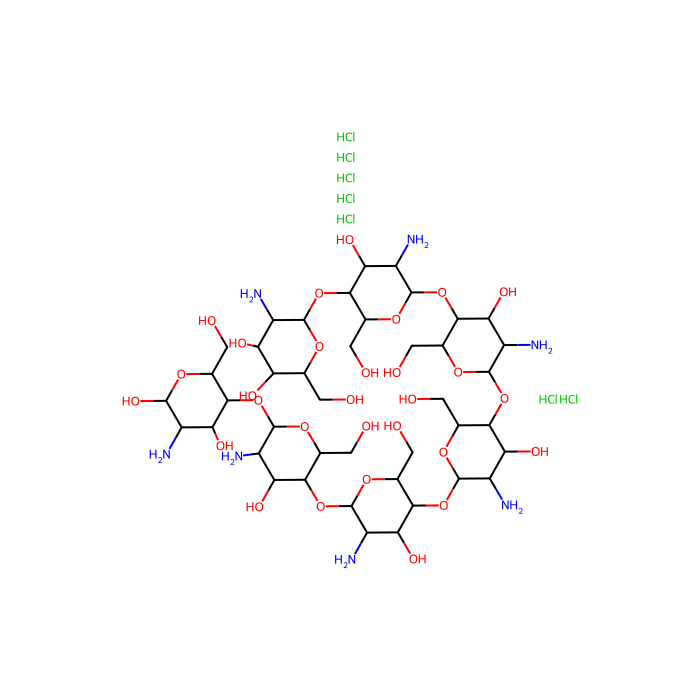
• Item identity: Chitoheptaose hydrochloride (degree of polymerization, DP = 7, D-glucosamine oligomer as hydrochloride salt) • CAS: 68232-35-9 (product data) • CID: 102602304 (product data) • InChIKey: 418770 (as provided; full InChIKey not specified) • SMILES: Not specified for this item; refer to CoA/Spec Sheet. • Molecular formula: Not specified for this item; refer to CoA/Spec Sheet. • Molecular weight: Not specified for this item; refer to CoA/Spec Sheet.

Structural description (general chemistry knowledge): • Chitoheptaose is a linear β-(1→4)-linked oligomer of D-glucosamine (GlcN) comprising 7 residues. Each residue bears a C2 primary amine (–NH2/–NH3+) and multiple secondary alcohols; the termini are a reducing end (hemiacetal) and a non-reducing end. • The hydrochloride denotes protonation of glucosamine amino groups with chloride counterion(s); the exact stoichiometry of HCl per chain can vary by preparation (literature note). • Functional groups: primary amines (protonated under acidic conditions), multiple vicinal diols on the pyranose rings, acetal linkages in the backbone, terminal hemiacetal at the reducing end. • Stereochemistry: all centers correspond to D-glucopyranose configuration; the backbone is β-1,4 configured, producing a ribbon-like conformation typical of chitosan/chitin fragments (literature). • 2D depiction in words: a seven-unit chain of chair-form pyranose rings connected via O-1 to C-4 ether linkages, with axial/equatorial hydroxyls as in D-glucose derivatives, and C2 amine functionalities along the chain.

Synthetic Utility

Chitoheptaose HCl offers a compact, multifunctional scaffold for carbohydrate chemistry and conjugation workflows.

Reactive handles (literature): • Primary amines (at C2): nucleophilic at pH >7; react with activated esters (NHS), isothiocyanates, aldehydes/ketones (Schiff bases), and can be acylated or carbamylated. Salt form requires transient basification for some couplings. • Vicinal diols: susceptible to NaIO4 periodate oxidation to generate dialdehydes for further ligation via oxime/amine formation. • Reducing end: in equilibrium between cyclic and open forms; allows reductive amination with amines, or hydrazide/oxime formation with tags. • Hydroxyls: can be selectively derivatized (e.g., tosylation, carbonate formation) under controlled conditions, though oligomer stability and solubility must be considered.

Applications: • As a defined-length acceptor/donor in enzymatic glycosylation or transglycosylation, probing enzyme specificity. • As a multivalent ligand platform for lectin binding studies after tailored functionalization. • As a building block for dendrimer-like or star conjugates by installing clickable groups (e.g., azide/alkyne) on amine/hydroxyl sites followed by CuAAC or SPAAC.

Practical notes: • Maintain aqueous or mixed aqueous media; use water-miscible cosolvents (DMSO) sparingly to avoid precipitation. • Control pH carefully: for amine-NHS coupling, pH 8–8.5 for short durations; for oxime formation, pH 4.5–6 with aniline catalysis. • Purification typically by dialysis (appropriate MWCO), ultrafiltration, ethanol/IPA precipitation, or SEC.

Target Specificity

Not applicable. This product is a carbohydrate oligomer, not an antibody, enzyme, or small-molecule ligand with a single defined biological target. In research contexts, it can interact broadly with anionic biomolecules and carbohydrate-binding proteins (lectins, chitinases) via electrostatic and stereochemical recognition (general literature), but no item-specific target data are provided.

Shall we send you a message when we have discounts available?

Remind me later

Thank you! Please check your email inbox to confirm.

Oops! Notifications are disabled.