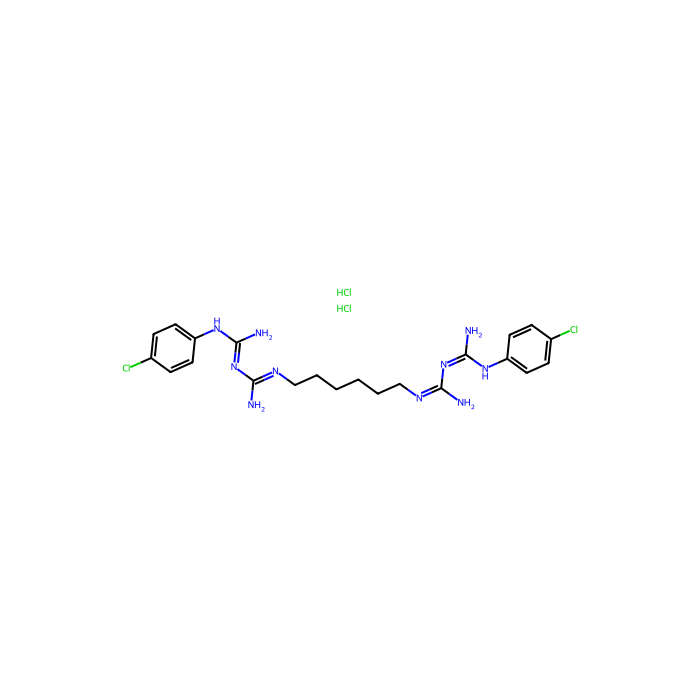
Chlorhexidine, Dihydrochloride is an anti-microbial agent that acts as an inhibitor of MMP-2 and MMP-9 metalloproteinases. However, MMP-2 is more sensitive to chlorhexidine than MMP-9. Chlorhexidine dihydrochloride inhibits the collagenase activity of MMP-8 released by PMA-triggered polymorphonuclear leukocytes (PMNs) in a dose-dependent manner. Chlorhexidine dihydrochloride may possibly act through a cation-chelating mechanism.
Specifiche
Specifiche e purezza
≥98%
Meccanismi biochimici e fisiologici
Antiseptic effective against a wide variety of gram-negative and gram-positive organisms, used in antiseptics and dental products. Bacteriostatic and bactericidal activity due to outer bacterial membrane disruption.
Condizioni di conservazione di stoccaggio
Store at 2-8°C
Spedito in
Wet ice
Questo prodotto richiede spedizione a catena fredda. I servizi di terra e altri servizi economici non sono disponibili.
Tipo di azione
INHIBITOR
Nota
Wherever possible, you should prepare and use solutions on the same day. However, if you need to make up stock solutions in advance, we recommend that you store the solution as aliquots in tightly sealed vials at -20°C. Generally, these will be useable for up to one month. Before use, and prior to opening the vial we recommend that you allow your product to equilibrate to room temperature for at least 1 hour. Need more advice on solubility, usage and handling? Please visit our frequently asked questions (FAQ) page for more details.
This compound belongs to the class of organic compounds known as 1-arylbiguanides. These are organonitrogen compounds containing a biguanide that is N-arylsubstituted at only the 1-position.
External Descriptors
Not available
1. Djoumbou Feunang Y, Eisner R, Knox C, Chepelev L, Hastings J, Owen G, Fahy E, Steinbeck C, Subramanian S, Bolton E, Greiner R, and Wishart DS. ClassyFire: Automated Chemical Classification With A Comprehensive, Computable Taxonomy. Journal of Cheminformatics, 2016, 8:61.
Determine the necessary mass, volume, or concentration for preparing a solution.
Dilution Calculator
Determine the dilution needed to prepare a stock solution.
Reconstitution Calculator
Recensioni
Recensioni dei clienti
Application Protocols
No supplier-tested protocols are provided for this item. The following generic laboratory procedures are offered as literature-based starting points; adjust to your system and verify suitability.
Preparation of aqueous stock solution (example)
Weigh the required mass of chlorhexidine dihydrochloride rapidly to minimize moisture uptake.
Dissolve in sterile water to a target concentration (e.g., 10 mg/mL). Mix until clear.
Optional: Adjust to pH ~6.5–7.0 with dilute HCl/NaOH if needed for compatibility; do not exceed neutral pH to avoid free base precipitation.
Filter-sterilize through a 0.22 μm PES or PTFE membrane. Store at 2–8 °C.
Ion-pair precipitation with polyanions (demonstration)
Prepare 1 mg/mL solutions of chlorhexidine dihydrochloride and sodium alginate separately in water.
Mix equal volumes under stirring; observe turbidity/precipitation. Collect by filtration and characterize if desired.
HPLC reference standard preparation
Dry a small aliquot under vacuum (if required by your method) and accurately weigh.
Dissolve in water or mobile phase to a known concentration (e.g., 100 μg/mL). Store refrigerated; verify stability before use.
These protocols are non-binding examples. Always follow institutional SOPs and consult the SDS for safe handling. Product is for research use only.
Biological Roles
General literature context (not a medical claim): Chlorhexidine is a cationic bisbiguanide whose biological activity arises from strong electrostatic and hydrophobic interactions with biological membranes and polyanionic biomolecules.
Molecular interactions
The dicationic biguanide centers bind to anionic phospholipid headgroups, lipoteichoic acids, LPS, and other polyanions. Hydrophobic aryl groups support partitioning into lipid phases.
At sufficient local surface density, this disrupts membrane integrity and alters permeability—central to its broad biocidal profile in laboratory studies.
Ion pairing and sequestration
Readily complexes with nucleic acids, acidic polysaccharides, and proteins bearing acidic residues; complexation can reduce apparent free concentration.
pH dependence
The compound remains highly protonated and cationic over neutral pH, favoring strong binding to negatively charged surfaces; deprotonation at high pH diminishes binding and solubility.
Resistance and tolerance studies
Model systems explore efflux, membrane remodeling, and biofilm matrix interactions that modulate susceptibility to cationic antiseptics. Chlorhexidine is frequently used as a benchmark in such studies.
Material interactions
Adsorbs to plastics, glass, and mineral surfaces; adsorption is enhanced on negatively charged and high-surface-area materials (e.g., silica, clays). Desorption can be driven by ionic strength increases or competing anions/surfactants.
Note: Any use in biological systems should follow institutional biosafety approvals. For research use only, as stated in the product notes.
Buffer Applications
Chlorhexidine dihydrochloride is not used as a buffering agent. However, because it is a dicationic salt, buffer composition strongly influences its solubility, ionization state, and interactions. Practical considerations (literature/general):
Solvent and buffer selection
Use simple chloride-containing buffers (e.g., NaCl/Na-phosphate, pH 6–7.4) when you want to maintain consistent ionic strength without strong anion competition beyond chloride.
Avoid anionic surfactants (SDS) and high concentrations of multivalent polyanions (e.g., citrate, heparin) unless ion-pairing/precipitation is intended.
Good diluents: water, PBS, or low ionic strength phosphate buffers; HEPES can be used but monitor for ion pairing with its zwitterionic form.
pH considerations
The biguanide nitrogens remain protonated across mildly acidic to neutral pH; solubility is optimal in this window. At high pH, deprotonation and precipitation of the free base can occur.
Stock solution tips
Prepare aqueous stocks at known mass concentration. If molarity is needed, account for the dihydrochloride counterions when calculating.
Filter-sterilize (0.22 μm) if sterile solutions are required. Avoid autoclaving, which can promote degradation.
For systems where buffering capacity is required, select an appropriate external buffer (phosphate, HEPES, acetate) and treat chlorhexidine as an additive influenced by that buffer rather than as a buffering component itself.
Green Alternatives
For many laboratory uses, the environmental footprint of the solvent system dominates. Consider greener media and practices when working with chlorhexidine dihydrochloride.
Solvent choices (literature/general)
Prefer water as the primary solvent where feasible; avoid unnecessary polar aprotics (DMSO/DMF) due to persistence and disposal burdens.
If alcohol is needed for wetting or rapid drying on surfaces, choose ethanol (bio-derived, readily degradable) over isopropanol/acetone mixtures where performance allows.
Comparative considerations (qualitative)
Water vs. DMSO stocks
Water: lowest hazard, easy disposal; limited maximum concentration.
DMSO: enables high-concentration stocks; increased EHS considerations and assay interference.
Digluconate vs. dihydrochloride (counterion perspective)
Digluconate (aqueous solutions): Often supplied in water, reducing solvent handling; gluconate is less corrosive than chloride in some systems.
Dihydrochloride (solid): Ships as a solid, minimizing transport of water but introduces chloride in waste streams.
Process recommendations
Use minimal volumes and prepare only the amount needed for the experimental window.
Implement closed-transfer systems for powders to reduce airborne particulate.
Collect chlorhexidine-containing waste separately; many cationic biocides are hazardous to aquatic life—ensure appropriate treatment before disposal.
These green considerations are general guidance; select media and formats that meet your performance needs while reducing environmental impact.
Pharmaceutical Uses
No medical or clinical claims are made. The following points summarize formulation-related roles reported in the literature/industry context; they are not specifications for this item.
Role in formulations (literature)
Chlorhexidine salts function as cationic antimicrobial preservatives and active biocidal agents in non-clinical product development contexts. The dihydrochloride form is a common solid precursor that can be converted to other salts (e.g., digluconate) used in aqueous systems.
Used in research on preservative systems for topical/oral care prototypes, device coatings, and material treatments to study microbial control mechanisms.
Excipient compatibility
Compatible with nonionic and cationic excipients; forms insoluble complexes with many anionic excipients (e.g., carbomers, sodium lauryl sulfate), which can inactivate the cationic species—critical for formulation screening.
Adsorbs to negatively charged fillers and pigments; pretesting is advisable.
Compendial status
Pharmacopeial monographs commonly exist for chlorhexidine (base) and chlorhexidine digluconate solution; dihydrochloride specifications vary by supplier. Verify monograph alignment if relevant to your workflow.
Analytical control
Assay by HPLC with UV detection (aromatic absorbance) or ion-pair chromatography; chloride content by argentometric titration or ion chromatography; related substances by LC–MS.
This product is for research use only. Suitability for manufacturing or regulated applications must be established independently by the user with appropriate quality documentation.
Physical Properties
Item-specific measured specifications are not provided in the Product Data; consult the CoA/Spec Sheet for authoritative values. The following are literature/general properties for chlorhexidine dihydrochloride and are offered for context only.
Aggregate state: Solid (literature)
Melting point: Typically reported in the ~132–136 °C range (decomp.; literature). Exact behavior may vary with hydration/solid form.
Boiling point: Not applicable (decomposes before boiling; literature).
Solubility (qualitative, literature)
Water: Freely soluble to very soluble; increased solubility relative to the free base due to dicationic form.
Alcohols (ethanol, isopropanol): Moderately soluble to sparingly soluble depending on water content; often used in hydroalcoholic mixtures.
LogP/logD: The salt exhibits very low apparent logD in water at neutral pH due to dicationic nature; intrinsic logP of the neutral base is not directly applicable under aqueous conditions (literature).
pKa (chlorhexidine base, literature): Multiple basic centers; reported apparent pKa values near the biguanide nitrogens are high (strongly basic), leading to predominantly dicationic species around neutral pH; specific micro-pKa assignments vary among sources.
Hygroscopicity: Can absorb moisture depending on solid form (literature observation); handle under tightly closed conditions.
Refractive index/density: Not typically reported for this crystalline solid; Not specified for this item; refer to CoA/Spec Sheet.
Always treat literature values as guidance only; do not use in place of the product’s certified specifications.
Quality and Grades
Item-specific grade/purity: Not specified for this item; refer to CoA/Spec Sheet.
Appearance: Not specified for this item; refer to CoA/Spec Sheet.
Guidance on typical grade considerations for this reagent class (general information):
Research grade chlorhexidine salts are commonly offered with assay purity reported on a dried basis. When relevant, water of hydration and residual solvent are specified by the supplier. For applications sensitive to UV background or trace metals (e.g., analytical methods), review the UV absorbance profile and impurity limits on the CoA.
Counterion form matters: Dihydrochloride vs. digluconate vs. acetate. Solubility, hygroscopicity, and assay are counterion-dependent. This item is the dihydrochloride salt per the product title.
Stabilizers: Typically none are required for solid dihydrochloride; if any stabilizers/anti-caking agents were used, they will be declared on the CoA. Not specified for this item.
Identity verification: Suppliers commonly use NMR (1H/13C for base after basification), IR (biguanide bands), and HPLC/LC–MS for assay and related substances. For salts, argentometric or ion chromatography can determine chloride content.
Suitability notes:
For microbiology or materials studies, low bioburden/sterile filtration readiness may be desired—check bioburden/endotoxin if critical.
For regulatory or formulation development work, confirm compliance with relevant compendial monographs (e.g., Ph. Eur./USP have monographs for certain chlorhexidine salts, typically digluconate and base); dihydrochloride specifications may differ.
Reaction and Applications
This compound is primarily used as a cationic research reagent rather than as a synthetic intermediate. Representative research applications (literature/general) include:
Membrane interaction studies: As a model cationic biguanide, chlorhexidine dihydrochloride is used to study interactions with lipid bilayers, bacterial-mimetic membranes, and polyanionic surfaces. Its amphipathic structure (hydrophobic aryls, cationic biguanides) enables adsorption and permeabilization studies.
Polyion complexation: Forms ion pairs/complexes with anionic polymers (e.g., alginate, hyaluronate, polystyrene sulfonate). Useful in layer-by-layer assemblies, surface coatings, or precipitation/controlled release studies.
Analytical reference: Serves as a reference standard for developing/validating HPLC/LC–MS assays of chlorhexidine in materials or formulations. Mobile phases typically require ion-pairing or high aqueous content to retain the dication; detection often via UV at aryl absorbance bands.
Salt metathesis and counterion exchange: The dihydrochloride can be converted to other pharmaceutically relevant salts (e.g., digluconate) through basification to the free base and re-protonation with the desired acid under controlled stoichiometry.
Surface antimicrobial modeling: Without making product performance claims, solutions are used to model cationic biocide adsorption, desorption kinetics, and resistance of adsorbed layers to washing.
Practical tips
Use chloride-free or defined ionic strength buffers if ion-exchange measurements are planned.
Filter-sterilize aqueous solutions; avoid heat sterilization that can promote degradation.
Account for counterion mass when preparing molar solutions; if assay is reported on a dried basis, adjust calculations accordingly.
Reaction Conditions
Representative laboratory conditions for tasks commonly performed with chlorhexidine dihydrochloride (literature/general guidance, not item-specific specifications):
Preparing aqueous stock solutions
Solvent: Purified water or buffer (e.g., 10 mM phosphate, pH 6.5–7.4).
Concentration: Often 1–50 mg/mL depending on use; ensure complete dissolution with stirring. Filter through 0.22 μm membrane if sterility is required.
Stability: Store refrigerated; avoid prolonged exposure to strong light or elevated temperatures.
Salt interconversion (to digluconate)
Step 1: Basify an aqueous solution to liberate the free base (monitor pH ~10–11), extract into an organic solvent (e.g., ethyl acetate) quickly to minimize aqueous exposure.
Step 2: Combine with aqueous gluconic acid at controlled pH (~5–6) to form the gluconate salt; concentrate as needed under reduced pressure at low temperature. Characterize by assay and chloride/gluconate content.
Layer-by-layer assembly with anionic polymers
Substrate dip cycles in dilute polymer solutions (e.g., 0.1–1 mg/mL polyanion, then 0.1–1 mg/mL chlorhexidine dihydrochloride) in water or low ionic strength buffer, with rinse steps between layers. Optimize ionic strength (0–100 mM NaCl) to tune film growth.
HPLC analysis
Columns: C18 with ion-pair reagent or mixed-mode cation-exchange/C18.
Mobile phase: High aqueous content (e.g., water–acetonitrile) with volatile acid (formic) or ion-pair (heptafluorobutyric acid) for retention; UV detection at ~254–260 nm (aryl absorbance). Adjust for your instrument and validation needs.
Always pilot on small scale and document conditions; stability and interactions are matrix-dependent.
Safety and Handling
Safety classifications (GHS, H-statements, pictograms, signal word) are not specified for this item; refer to the product SDS for authoritative hazard and precautionary information.
General laboratory safety considerations for chlorhexidine salts (literature/common practice):
Likely hazards: Irritation to eyes, skin, and respiratory tract; harmful if swallowed; potential for skin sensitization with repeated exposure has been described for related biguanide antiseptics. Avoid generating dust/aerosols.
PPE: Use lab coat, safety glasses or face shield, and suitable chemical-resistant gloves (e.g., nitrile). Employ local exhaust ventilation when weighing or preparing solutions.
Incompatibilities: Strong oxidizers; strong bases may cause deprotonation/precipitation; anionic surfactants and polyanions can form inactive/insoluble ion pairs with cationic biguanides—avoid mixing unless intended.
Handling tips: Prepare solutions using clean, chloride-compatible glassware or plasticware. Filter-sterilize aqueous solutions through 0.22 μm membranes if sterility is needed (verify membrane compatibility).
First aid (summary; defer to SDS):
Inhalation: Move to fresh air; monitor breathing; seek medical advice if symptoms occur.
Skin contact: Wash with soap and water; remove contaminated clothing.
Eye contact: Rinse cautiously with water for several minutes; remove contact lenses if present and easy; seek medical attention for persistent irritation.
Ingestion: Rinse mouth; do not induce vomiting; seek medical attention.
Environmental note: Toxic to aquatic organisms is reported for quaternary/biguanide antiseptics in general; prevent release to the environment. Dispose in accordance with institutional and regional regulations.
Solvent Selection
Chlorhexidine dihydrochloride is a cationic, highly polar salt. Solvent choice strongly affects performance in applications involving ion pairing, surface interactions, or polymer compatibility.
Polarity and miscibility (literature/general)
Water: Primary solvent; high solubility and full ionization to the dication with chloride counterions.
Aqueous alcohols: Ethanol/water or isopropanol/water mixtures can dissolve moderate to high concentrations; purely anhydrous alcohols may show reduced solubility.
Polar aprotics (DMSO, DMF): Typically soluble; useful for stock solutions when water-incompatible matrices are used. Dilute promptly into aqueous phase to minimize precipitation upon contact with anions.
Nonpolar solvents (alkanes, aromatics): Not suitable.
Selection guide
Use water (or buffered aqueous media) for most biochemical and materials studies; maintain pH where the compound remains protonated to ensure solubility.
Use DMSO for concentrated stocks (e.g., 10–50 mg/mL), then dilute into water-based systems with vigorous mixing to avoid local supersaturation.
Avoid anionic surfactants or polyelectrolytes in solution unless studying ion pairing/precipitation phenomena.
Comparison (literature, qualitative):
Water: maximum ionic activity, minimal organic load.
50–70% ethanol: balances volatility/drying in surface treatments with adequate solubility.
DMSO: highest stock concentration but may affect biological assays; include vehicle controls.
Always confirm solution clarity and stability over time; adjust ionic strength to minimize unexpected precipitation with anionic species.
Storage and Reconstitution
Item-specific storage and shipping
Storage Conditions: Store at 2–8 °C (from Product Data).
Shipped In: Wet ice (from Product Data).
Appearance, stabilizers, and concentration: Not specified for this item; refer to CoA/Spec Sheet.
General guidance (literature/common practice)
Solid handling: Keep container tightly closed to limit moisture uptake. Protect from excessive heat and direct light.
Reconstitution: Dissolve in purified water or appropriate buffer. For high-concentration stocks or water-incompatible matrices, DMSO may be used as a co-solvent with subsequent dilution into aqueous media.
Solution storage: For short-term use, store aqueous solutions at 2–8 °C. Prepare fresh as needed. If longer-term storage is required, aliquot and freeze at ≤−20 °C to minimize microbial contamination and repeated freeze–thaw; verify stability in your matrix.
Compatibility: Avoid contact with strongly basic solutions that can cause deprotonation and precipitation. Avoid mixing with anionic surfactants/polymers unless complexation is intended.
Labeling: Clearly indicate concentration as the dihydrochloride salt (account for counterion mass) and record preparation date.
Always defer to the Certificate of Analysis and SDS for definitive storage, handling, and stability information specific to this lot and item.
Structure and Identity
Chlorhexidine dihydrochloride is the di-protonated hydrochloride salt of the bisbiguanide base chlorhexidine, widely used as a cationic polyguanide research reagent.
Item-specific identifiers (from Product Data)
SKU: C113898
CAS: 3697-42-5
InChIKey: 400036 (as provided)
SMILES: Not specified for this item; refer to CoA/Spec Sheet.
Literature structural information (for context; not item-specific specs)
Common name: Chlorhexidine dihydrochloride
Parent base: Chlorhexidine (bisbiguanide)
Molecular formula (dihydrochloride): C22H32Cl4N10 (equivalently C22H30Cl2N10·2HCl)
Functional groups: Two biguanidinium moieties linked via a hexamethylene chain; two para-chloro-substituted phenyl end groups.
Ionic state: Typically dication (2+) paired with two chloride anions in the dihydrochloride form.
2D structure description (literature)
Symmetric molecule with a central –(CH2)6– spacer connecting two biguanide units. Each biguanide is bonded to a 4-chlorophenyl group via a –NH– linker. In the dihydrochloride, two basic nitrogens are protonated, balancing two Cl− counterions. The structure is largely linear with terminal aromatic rings, providing amphipathic character (hydrophobic aryls, strongly cationic biguanide centers). No stereocenters are present; the compound is achiral.
Note: When precise structural identifiers (SMILES, exact InChI/InChIKey for the salt) are required for regulatory or informatics use, consult the product CoA/SDS or generate from an authenticated structure file.
Synthetic Utility
Although not a classical synthetic building block, chlorhexidine dihydrochloride can be used in preparative and materials workflows (literature/general):
Salt interconversion
Base liberation: Treat with mild base to generate chlorhexidine free base, extract into suitable organic solvent, then re-protonate with a chosen acid (e.g., gluconic, acetate) to afford alternative salts. Control stoichiometry to avoid over/under protonation.
Ion exchange: Employ non-nucleophilic bases and aqueous biphasic systems to minimize degradation.
Immobilization and coatings
Covalent attachment: The anilide-like –NH– linkers and biguanide nitrogens can be derivatized after appropriate protection strategies, enabling tethering onto polymers or surfaces for controlled release studies.
Noncovalent loading: Strong electrostatic binding to anionic polymers (e.g., alginate, PSS) allows layer-by-layer assembly and composite formation.
Analytical standards and calibration
As a reference compound in method development (HPLC/LC–MS), it aids in calibrating detection and recovery in complex matrices. Attention to ion-suppression effects in MS is necessary due to high charge density.
Reactivity notes
Biguanide moieties are strongly basic and nucleophilic when deprotonated; however, under typical aqueous conditions they remain protonated and less reactive.
Aryl chlorides in the para position are not activated toward cross-coupling without prefunctionalization; the molecule is not generally used as an aryl halide coupling partner.
These utilities emphasize salt chemistry, surface science, and analytical method development rather than classical bond-forming synthesis.
Target Specificity
Not applicable. This product is a small-molecule salt, not an antibody, probe, or ligand with defined biological target selectivity in the immunochemical sense. For functional interaction discussions relevant to this compound, see the Biological Roles and Reaction & Applications sections.
Domande frequenti
What is the purity of this product?
This product is supplied at ≥98% purity (chemical assay). Lot-specific values are stated on the Certificate of Analysis.
How should this product be stored?
Store at 2–8 °C. Refrigerated storage is required to maintain the specified shelf life.
How is this product shipped?
This product ships chilled on wet ice. Unpack on arrival and transfer it to the storage condition stated above.
What are the CAS number, molecular formula and molecular weight?
The CAS Number is 3697-42-5, the molecular formula is C22H32Cl4N10, and the molecular weight is 578.37 g/mol. InChIKey WJLVQTJZDCGNJN-UHFFFAOYSA-N.
What documentation is provided?
Available product documentation, including Certificates of Analysis (COA), Safety Data Sheets (SDS), and specification sheets, is shown in the product document area. Document availability and access follow the current site policy.
Utilizziamo i cookie per garantire il corretto funzionamento del sito web e, ove consentito, per migliorare la tua esperienza. Puoi gestire le tue preferenze in qualsiasi momento nelle Impostazioni. Per saperne di più, consulta la nostra Cookie Policy.
Desidera che le inviamo un messaggio quando avremo sconti disponibili?
Ricordamelo più tardi
Grazie! Controlli la sua casella di posta per confermare.
Products are supplied to verified businesses, institutions, and qualified professionals for research and development use only. Not for use in humans, animals, diagnosis, or therapy.

 K2612067