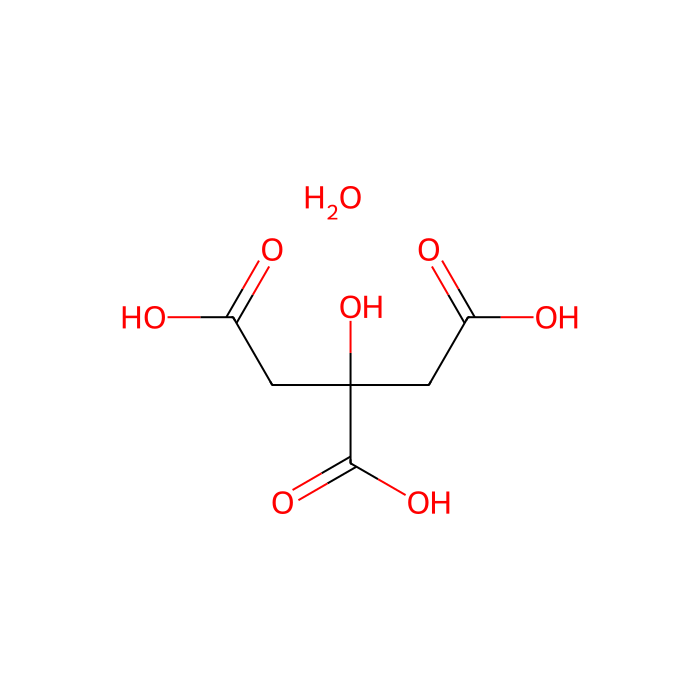
Citric acid monohydrate - GR, ≥99.8% , CAS No.5949-29-1

CAS: 5949-29-1 Cat. No.: C112634 Formula: C6H8O7·H2O Peso molecolare: 210.14 Beilstein Registry Number: 4018641 Numero EC: 611-842-9
Disponibile su ordine
GRADE & PURITY GR ? Guaranteed Reagent grade — the highest analytical purity tier, with tightly controlled impurities. Use for precise quantitative work and reference measurements. ≥99.8%
Synonyms
INS NO.330 | BS-17269 | citrate hydrate | Citric acid monohydrat | B1650 [LANGUAL] | Citric acid monohydrate, JIS special grade, >=99.5% | CITRIC ACID MONOHYDRATE (USP MONOGRAPH) | CITRATE [II] | CITRIC ACID MONOHYDRATE [WHO-IP] | DTXSID7074668 | CITRIC A
Storage
Room temperature
Shipped In
Normal
★
Size
Germania (EU)
USA*
Price
Qty
500g
C112634-500g
3 Disponibile
—
51,98€
12×500g
C112634-12×500g
Su ordinazione · 8–12 settimane
555,27€
Enter a quantity for the sizes you want to add.
🧪
Why this grade

GR, ≥99.8% GR for sensitive chromatographic and analytical workflows requiring minimal baseline interference.

🌡

Storage & shipping

Room temperature Ships Normal Check lot-specific COA for exact specifications.

📋

Quality documents

SDS, COA, datasheet, and spec sheet available for download. Lot-specific COA accessible via lot number lookup.

📚

Literature proof

Cited in 2054 peer-reviewed publications across chromatography, organic synthesis, and cross-coupling reactions.

Specifications

Sinonimi
INS NO.330 | BS-17269 | citrate hydrate | Citric acid monohydrat | B1650 [LANGUAL] | Citric acid monohydrate, JIS special grade, >=99.5% | CITRIC ACID MONOHYDRATE (USP MONOGRAPH) | CITRATE [II] | CITRIC ACID MONOHYDRATE [WHO-IP] | DTXSID7074668 | CITRIC A
Specifiche e purezza
GR, ≥99.8%
Condizioni di conservazione di stoccaggio
Room temperature
Spedito in
Normal
Grado
GR
Purezza
≥99.8%
Nomi e identificatori
Pubchem Sid
Pubchem Sid Url
https://pubchem.ncbi.nlm.nih.gov/substance/508813721
Sorrisi canonici
C(C(=O)O)C(CC(=O)O)(C(=O)O)O.O
IUPAC Name
2-hydroxypropane-1,2,3-tricarboxylic acid;hydrate
InChIKey
YASYEJJMZJALEJ-UHFFFAOYSA-N
INCHI
1S/C6H8O7.H2O/c7-3(8)1-6(13,5(11)12)2-4(9)10;/h13H,1-2H2,(H,7,8)(H,9,10)(H,11,12);1H2
Isomeri SMILES
C(C(=O)O)C(CC(=O)O)(C(=O)O)O.O
WGK Germania
1
RTECS
GE7810000
Peso molecolare
210.14
Beilstein
4018641
Reaxy-Rn
4018641
Reaxys-RN_link_address
https://www.reaxys.com/reaxys/secured/hopinto.do?context=S&query=IDE.XRN=4018641&ln=

Documentazione

📋 Safety Data Sheet (SDS)

Comprehensive hazard, handling, storage, and regulatory compliance document.

Download SDS →

✅ Certificate of Analysis (COA)

Lot-specific quality data. Enter your lot number to retrieve the exact COA.

Look up COA →

📊 Datasheet

Quick-reference summary of product specifications and applications.

View datasheet →

🔬 Specification Sheet

Full quality attributes and acceptance criteria for this grade.

View spec sheet →

Advanced Data

Taxonomic Classification

Taxonomy Tree

KingdomOrganic compounds
SuperclassOrganic acids and derivatives
ClasseCarboxylic acids and derivatives
SubclassTricarboxylic acids and derivatives
Intermediate Tree Nodes Not available
Direct ParentTricarboxylic acids and derivatives
Alternative Parents Alpha hydroxy acids and derivatives  Tertiary alcohols  Carboxylic acids  Organic oxides  Hydrocarbon derivatives  Carbonyl compounds  
Molecular FrameworkAliphatic acyclic compounds
Substituents Tricarboxylic acid or derivatives - Hydroxy acid - Alpha-hydroxy acid - Tertiary alcohol - Carboxylic acid - Organic oxygen compound - Organic oxide - Hydrocarbon derivative - Organooxygen compound - Carbonyl group - Alcohol - Aliphatic acyclic compound
DescrizioneThis compound belongs to the class of organic compounds known as tricarboxylic acids and derivatives. These are carboxylic acids containing exactly three carboxyl groups.
External Descriptors organic molecular entity
Struttura 3D
Modello di struttura chimica interattiva


Certificati (CoA, COO, BSE/TSE e tabella di analisi)
C of A & Other Certificates(BSE/TSE, COO):
Analytical Chart:

Find and download the COA for your product by matching the lot number on the packaging.

23 results found

Lot NumberCertificate TypeDataOggetto
I2624253Certificate of AnalysisOct 12, 2026 C112634
I2603573Certificate of AnalysisSep 08, 2026 C112634
F2625432Certificate of AnalysisJul 17, 2026 C112634
C2619574Certificate of AnalysisMar 25, 2026 C112634
A2629365Certificate of AnalysisFeb 28, 2026 C112634
L2509316Certificate of AnalysisDec 23, 2025 C112634
I2508254Certificate of AnalysisSep 18, 2025 C112634
E2508440Certificate of AnalysisMay 10, 2025 C112634
C2519140Certificate of AnalysisMar 26, 2025 C112634
L2405330Certificate of AnalysisDec 09, 2024 C112634
J2409848Certificate of AnalysisOct 17, 2024 C112634
J2408290Certificate of AnalysisOct 14, 2024 C112634
L2318187Certificate of AnalysisDec 22, 2023 C112634
K2307091Certificate of AnalysisNov 13, 2023 C112634
J2318305Certificate of AnalysisOct 20, 2023 C112634
G2320454Certificate of AnalysisJul 29, 2023 C112634
L2220376Certificate of AnalysisDec 22, 2022 C112634
K2204276Certificate of AnalysisNov 08, 2022 C112634
F2206300Certificate of AnalysisMay 19, 2022 C112634
E2216165Certificate of AnalysisMay 19, 2022 C112634
G2215006Certificate of AnalysisMay 03, 2022 C112634
D2226065Certificate of AnalysisMay 03, 2022 C112634
C2201057Certificate of AnalysisMar 03, 2022 C112634
Proprietà chimiche e fisiche
SensibilitàMoisture sensitive.
Punto di infiammabilità (°F)345.0 °F
Punto di infiammabilità (°C)173.9℃
Punto di fusione (°C)135-152°C
Peso molecolare210.140 g/mol
XLogP3
Hydrogen Bond Donor Count5
Hydrogen Bond Acceptor Count8
Rotatable Bond Count5
Exact Mass210.038 Da
Monoisotopic Mass210.038 Da
Topological Polar Surface Area133.000 Ų
Heavy Atom Count14
Formal Charge0
Complexity227.000
Isotope Atom Count0
Defined Atom Stereocenter Count0
Undefined Atom Stereocenter Count0
Defined Bond Stereocenter Count0
Undefined Bond Stereocenter Count0
The total count of all stereochemical bonds0
Covalently-Bonded Unit Count2
Domande frequenti e articoli
How Organic Acids “Stabilize a System”: Selection Logic via the pH Window, Salt Forms, and Metal-Ion Management (with a navigation guide to Tables A–E)
Phycocyanin: A Review of Sources, Structural Features, Production Processes, Applications, and Claimed Benefits
Technical Comparison and Method Selection for Hydroxyproline Determination
Perovskite Oxides for Energy and Environmental Catalysis: How Oxygen Vacancies, B-Site Metals, and the Metal–Oxygen Bond Network Regulate Reaction Performance
The Role, Selection, and Validation of Chelating Agents in Daily Chemical Formulations
Differences, Functions, and Selection Guidelines for Sodium Hydroxide Flakes, Granules, Liquid Caustic Soda, and Caustic Soda in Household and Personal Care Product Manufacturing: The Functional and Application Logic of Sodium Hydroxide
Practical Guide to TSA Tyramide Signal Amplification: How to Select Reagents, Optimize the Workflow, and Reduce Background When Detection Signals Are Weak for Low-Abundance Targets
How Can Sodium Tripolyphosphate (STPP) Be Replaced? From Detergency Mechanisms to Formulation Choices for Low-Phosphorus/Phosphorus-Free Builder Systems
More Than a pH Adjuster: Mechanisms, Selection Logic, and Alternative Acid Source Analysis of Citric Acid in Home-Care Cleaning
Sodium Metasilicate in Cleaning Applications: Hydration-Form Differences, Mechanisms of Action, and Selection Logic
Establishment and Evaluation Methods of Diabetic Animal Models
Potential Mechanisms of Succinic Acid in Acne Care: From Dicarboxylic Acid–Base Equilibria to Metabolic Antagonism Among Skin Microorganisms
Citations of This Product
Calcolatori di soluzioni
Recensioni

Recensioni dei clienti

Shall we send you a message when we have discounts available?

Remind me later

Thank you! Please check your email inbox to confirm.

Oops! Notifications are disabled.