 B1525009
Determine the necessary mass, volume, or concentration for preparing a solution.
| Activity Type | Relation | Activity value | Units | Action Type | Journal | PubMed Id | doi | Assay Aladdin ID |
|---|

Moligand™, ≥99% Moligand™ per flussi di lavoro cromatografici e analitici sensibili che richiedono un'interferenza minima della linea di base.
Store at 2-8°C Spedizione Wet ice. Consultare il COA specifico del lotto per le specifiche esatte.
SDS, COA, scheda tecnica e scheda delle specifiche disponibili per il download. COA specifico del lotto accessibile tramite ricerca per numero di lotto.
Citato in 0 pubblicazioni peer-reviewed su cromatografia, sintesi organica e reazioni di accoppiamento incrociato.
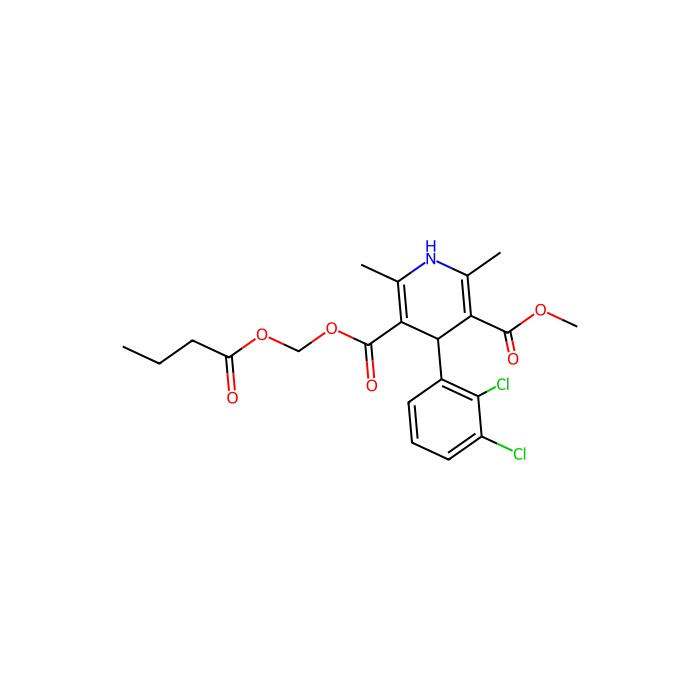
Clevidipine Butyrate is a dihydropyridine calcium channel blocker use as agent for the reduction of blood pressure.
A calcium channel protein inhibitor and blocker
Documento completo su pericoli, manipolazione, stoccaggio e conformità normativa.
<<<<<<< HEAD Scarica SDS → ======= Scarica SDS → >>>>>>> release248-p3Dati di qualità specifici del lotto. Inserisci il numero di lotto per recuperare il COA esatto.
Cerca COA →Riepilogo di riferimento rapido delle specifiche e applicazioni del prodotto.
Visualizza scheda tecnica →Attributi di qualità completi e criteri di accettazione per questa qualità.
Visualizza scheda delle specifiche →Taxonomy Tree
| Kingdom | Organic compounds |
|---|---|
| Superclass | Organoheterocyclic compounds |
| Classe | Pyridines and derivatives |
| Subclass | Hydropyridines |
| Intermediate Tree Nodes | Dihydropyridines |
| Direct Parent | Dihydropyridinecarboxylic acids and derivatives |
| Alternative Parents | Tricarboxylic acids and derivatives Dichlorobenzenes Acylals Fatty acid esters Aryl chlorides Vinylogous amides Methyl esters Enoate esters Amino acids and derivatives Acetals Azacyclic compounds Dialkylamines Enamines Organopnictogen compounds Carbonyl compounds Organochlorides Hydrocarbon derivatives Organic oxides |
| Molecular Framework | Aromatic heteromonocyclic compounds |
| Substituents | Dihydropyridinecarboxylic acid derivative - Tricarboxylic acid or derivatives - 1,2-dichlorobenzene - Chlorobenzene - Acylal - Fatty acid ester - Halobenzene - Aryl chloride - Aryl halide - Monocyclic benzene moiety - Fatty acyl - Benzenoid - Vinylogous amide - Alpha,beta-unsaturated carboxylic ester - Enoate ester - Methyl ester - Amino acid or derivatives - Carboxylic acid ester - Acetal - Carboxylic acid derivative - Secondary amine - Enamine - Azacycle - Secondary aliphatic amine - Organonitrogen compound - Hydrocarbon derivative - Organic oxide - Amine - Organooxygen compound - Carbonyl group - Organopnictogen compound - Organic oxygen compound - Organic nitrogen compound - Organohalogen compound - Organochloride - Aromatic heteromonocyclic compound |
| Descrizione | This compound belongs to the class of organic compounds known as dihydropyridinecarboxylic acids and derivatives. These are compounds containing a dihydropyridine moiety bearing a carboxylic acid group. |
| External Descriptors | Not available |
| Activity Type | Relation | Activity value | Units | Action Type | Journal | PubMed Id | doi | Assay Aladdin ID |
|---|
| Activity Type | Relation | Activity value | Units | Action Type | Journal | PubMed Id | doi | Assay Aladdin ID |
|---|
| Activity Type | Relation | Activity value | Units | Action Type | Journal | PubMed Id | doi | Assay Aladdin ID |
|---|
| Activity Type | Relation | Activity value | Units | Action Type | Journal | PubMed Id | doi | Assay Aladdin ID |
|---|
| Activity Type | Relation | Activity value | Units | Action Type | Journal | PubMed Id | doi | Assay Aladdin ID |
|---|
| Solubilità | DMSO 91 mg/mL Water <1 mg/mL Ethanol 3 mg/mL |
|---|---|
| Sensibilità | Heat Sensitive |
| Punto di fusione (°C) | 143 °C |
| Peso molecolare | 456.300 g/mol |
| XLogP3 | 4.300 |
| Hydrogen Bond Donor Count | 1 |
| Hydrogen Bond Acceptor Count | 7 |
| Rotatable Bond Count | 10 |
| Exact Mass | 455.09 Da |
| Monoisotopic Mass | 455.09 Da |
| Topological Polar Surface Area | 90.900 Ų |
| Heavy Atom Count | 30 |
| Formal Charge | 0 |
| Complexity | 748.000 |
| Isotope Atom Count | 0 |
| Defined Atom Stereocenter Count | 0 |
| Undefined Atom Stereocenter Count | 1 |
| Defined Bond Stereocenter Count | 0 |
| Undefined Bond Stereocenter Count | 0 |
| The total count of all stereochemical bonds | 0 |
| Covalently-Bonded Unit Count | 1 |
No tested application protocols, assay formats, or recommended dilutions are provided for this item. As general guidance for small, lipophilic, light-sensitive ligands:
For detailed, protocol-specific parameters (concentrations, incubation times, controls), design and validate within your laboratory and consult peer-reviewed literature relevant to your biological system.
Mechanistic class (literature/general): Cleviprex (clevidipine butyrate) is a 1,4-dihydropyridine that functions as a calcium channel ligand with high affinity for L-type channels. As with other DHPs, it binds to a transmembrane site within the channel’s alpha subunit.
Biophysical characteristics (literature/general)
Research utility
No biological role or activity specifications are provided for this specific item beyond “For research use only.” Users should design and validate assays appropriate for their biological system and follow institutional policies for handling bioactive small molecules.
This product is not a buffering reagent and is not typically used to prepare biochemical buffers. If used in biological experiments, it is generally dissolved in an organic co-solvent and then diluted into an assay buffer immediately before use. For applicable guidance, see the Solvent Selection and Reaction & Applications sections.
While Cleviprex itself is a target molecule rather than a solvent, greener choices can be made in its handling and synthesis (literature/general guidance).
Greener handling/formulation options
Greener synthetic context (for DHP scaffolds; literature)
Comparative overview
Trade-offs: greener solvents may affect yield, polymorph/form, or impurity profiles; perform risk–benefit assessments and pilot trials before scale-up.
Item-specific process details are not provided; consult your route’s development history and align with green chemistry metrics (E-factor, PMI).
No clinical or therapeutic claims are made for this research-grade material.
Research/formulation context (literature/general)
Regulatory status (item-specific)
Practical notes
Any use in manufacturing or clinical settings requires separately sourced, appropriately qualified material. This catalog item is for research use only.
Only limited item-specific properties are provided for this catalog entry.
No item-specific values for melting point, boiling point, density, refractive index, pKa, logP, or UV cutoff are provided. For method-specific or regulatory testing, refer to the item’s CoA/Spec Sheet.
Supplied grade: Moligand™ (from Product Data)
Purity: Not specified for this item; refer to CoA/Spec Sheet.
What this means for your work
Documentation
This compound is primarily a bioactive research ligand rather than a synthetic reagent. Typical research applications focus on its interaction with voltage-gated calcium channels and on formulation science.
Research use cases (literature/general)
Assay considerations
Analytical support (literature/general)
No manufacturer-provided functional application notes are listed for this item; adapt general DHP-ligand handling to your specific protocol.
No manufacturer-recommended reaction conditions are provided for this product as it is principally a research ligand, not a reagent. The following literature/general guidance addresses stability and common transformations for analytical control:
Hydrolysis (to generate degradation standards)
Oxidation
Photostability testing
Solvents
Always validate and document conditions for your lab’s purpose; yields and rates vary with concentration, solvent, pH, and temperature.
GHS/SDS information (item-specific)
General hazards and precautions (literature/general for DHP esters)
PPE and engineering controls
First aid (overview; defer to SDS)
Incompatibilities (literature/general)
Always consult the product’s SDS for authoritative and current safety information.
Cleviprex/clevidipine butyrate is highly lipophilic and hydrolytically sensitive, which governs solvent choice.
Practical dissolution guidance (literature/general)
Miscibility and polarity considerations
Comparison to alternatives (literature/general)
Handling tips
Item-specific solvent specifications are not provided; confirm compatibility with your assay matrix experimentally.
Storage (from Product Data)
Light and atmosphere
Reconstitution/stock preparation
Stability notes (literature/general)
Follow the SDS and any lot-specific instructions on the CoA for definitive storage and handling directives.
Cleviprex (clevidipine butyrate; literature) is a 1,4-dihydropyridine (DHP) ester used as a small-molecule research ligand. This item is supplied for research use only.
Item identifiers (from Product Data)
Composition fields
Structural features (literature/general)
Note: Exact structural string identifiers (SMILES/InChIKey) and elemental analysis are not specified for this catalog item; consult the CoA/SDS for definitive identity data.
As supplied, this compound is typically a final bioactive target rather than a synthetic building block. However, understanding its functional groups aids in modification and analytical derivatization (literature/general):
Functional groups and reactivity
Transformations useful in method development
Retrosynthetic note
No item-specific synthetic route or impurity profile is provided; consult literature procedures and develop route controls as needed.
No item-specific target, clone, isotype, or epitope data are provided for this product. This is a small-molecule research ligand rather than an antibody or protein. If target engagement studies are planned, determine specificity empirically (e.g., radioligand displacement, electrophysiology, or binding assays) and consult the literature for dihydropyridine-class ligand interactions with L-type calcium channels.
La nostra guida alla selezione delle qualità copre purezza, stato dello stabilizzatore e idoneità all'applicazione per tutte le varianti del nostro catalogo.
Visualizza la guida alle qualità Moligand™ →