Clobenpropit dihydrobromide is a potent histamine H3R antagonist/inverse agonist with a pEC50 of 8.07 for histamine H3LR. Clobenpropit dihydrobromide acts as partial agonist at histamine H4 receptors (Ki 13 nM). Clobenpropit dihydrobromide also binds to serotonin 5-HT3 receptors (Ki 7.4 nM) and α2A/α2C adrenoceptors (Ki 17.4/7.8 nM). Clobenpropit dihydrobromide increases apoptosis.
Selective and competitive H 3 antagonist (pK i = 8.5). Partial agonist at H 4 receptor (EC 50 = 3 nM) Blood-brain barrier permeable.
Fonte
Synthetic
Condizioni di conservazione di stoccaggio
Store at -20°C
Spedito in
Ice chest + Ice pads
Questo prodotto richiede spedizione a catena fredda. I servizi di terra e altri servizi economici non sono disponibili.
Nota
Wherever possible, you should prepare and use solutions on the same day. However, if you need to make up stock solutions in advance, we recommend that you store the solution as aliquots in tightly sealed vials at -20°C. Generally, these will be useable for up to one month. Before use, and prior to opening the vial we recommend that you allow your product to equilibrate to room temperature for at least 1 hour. Need more advice on solubility, usage and handling? Please visit our frequently asked questions (FAQ) page for more details.
This compound belongs to the class of organic compounds known as chlorobenzenes. These are compounds containing one or more chlorine atoms attached to a benzene moiety.
External Descriptors
hydrobromide
1. Djoumbou Feunang Y, Eisner R, Knox C, Chepelev L, Hastings J, Owen G, Fahy E, Steinbeck C, Subramanian S, Bolton E, Greiner R, and Wishart DS. ClassyFire: Automated Chemical Classification With A Comprehensive, Computable Taxonomy. Journal of Cheminformatics, 2016, 8:61.
30 mg/ml in DMSO, 2.5 mg/ml in Ethanol, 20 mg/ml in water
Sensibilità
Heat Sensitive
Punto di fusione (°C)
205 °C
Peso molecolare
470.7
XLogP3
Hydrogen Bond Donor Count
4
Hydrogen Bond Acceptor Count
3
Rotatable Bond Count
7
Exact Mass
469.937 Da
Monoisotopic Mass
467.939 Da
Topological Polar Surface Area
92.400 Ų
Heavy Atom Count
22
Formal Charge
0
Complexity
306.000
Isotope Atom Count
0
Defined Atom Stereocenter Count
0
Undefined Atom Stereocenter Count
0
Defined Bond Stereocenter Count
0
Undefined Bond Stereocenter Count
0
The total count of all stereochemical bonds
0
Covalently-Bonded Unit Count
3
Calcolatori di soluzioni
Molarity Calculator
Determine the necessary mass, volume, or concentration for preparing a solution.
Dilution Calculator
Determine the dilution needed to prepare a stock solution.
Reconstitution Calculator
Recensioni
Recensioni dei clienti
Application Protocols
This section reports only protocols validated or specified in the Product Data. None were provided for this item.
Item-specific status:
Tested applications, recommended concentrations, positive controls, or procedural steps: Not specified for this item; refer to CoA/Spec Sheet.
General guidance (non-specific):
Stock preparation: dissolve in water or DMSO to prepare a sterile-filtered stock; aliquot and store at −20°C to avoid freeze–thaw.
Assay use: define concentration ranges based on your assay sensitivity and literature precedents; include vehicle controls and, when possible, an orthogonal reference.
Documentation: record exact lot number, stock concentration, vehicle percentage, and dilution scheme for reproducibility.
Always adapt conditions to your laboratory’s SOPs and validate in your system.
Biological Roles
General literature context (not product specifications and not therapeutic claims):
Pharmacological class: clobenpropit is widely cited as a potent ligand at histamine receptors, commonly employed as an antagonist/inverse agonist in receptor pharmacology. The dihydrobromide salt enhances aqueous solubility for in vitro work.
Research use: serves as a tool compound to interrogate histaminergic signaling in neuronal and immune cell models, enabling the dissection of receptor coupling to G proteins, second messengers (e.g., cAMP), and downstream transcriptional pathways.
Assay utility: useful in radioligand displacement, functional readouts (e.g., inhibition of adenylate cyclase pathways in certain systems), and to define basal receptor activity versus ligand-induced shifts.
Structure–activity insights: the imidazole and cationic centers mimic histamine’s key pharmacophore while added hydrophobic substituents and thiourea-like features confer potency and selectivity characteristics observed in literature.
Experimental considerations (general):
Concentration ranges for functional assays are typically set based on reported potency values from literature; verify against your system and batch-specific purity.
Receptor expression level, membrane composition, and assay buffer ionic strength can influence apparent potency and efficacy.
Note: This section summarizes typical research roles from literature and is not a statement of product-specific target claims. Refer to your institutional protocols and primary literature for detailed biological procedures.
Buffer Applications
This item is a small-molecule ligand, not a buffering agent. It is not typically used to prepare buffer systems or control pH.
Practical notes (general guidance for working solutions):
Compatible buffers: phosphate-buffered saline (PBS), HEPES, or Tris-based buffers are commonly used as assay media; ensure pH near neutrality to keep the dihydrobromide fully protonated and soluble.
Additive considerations: include 0.1% BSA or 0.01–0.05% Tween-20 if nonspecific binding to plastics is observed in low-concentration assays.
Filtration: if sterility is required, filter through 0.22 μm PVDF or PES; avoid cellulose esters if adsorption is suspected.
Specifications such as buffer recipes, pH ranges, or ionic strengths are not item-specific and should be defined by your assay requirements.
Green Alternatives
Context: As a bioactive reference compound, the main environmental impact arises from solvent choices and solution handling rather than the molecule itself.
Greener handling strategies (general guidance):
Prefer water or aqueous buffers for working solutions when assay-compatible, reducing reliance on high-boiling organic solvents.
If an organic stock is needed, DMSO is generally favored over chlorinated solvents due to lower toxicity and better biodegradation profile.
Use minimal volumes and high-concentration stocks to reduce waste; aliquot to extend shelf-life and minimize repeat preparations.
Comparison of common solvents for stock solutions (general):
Water: greenest option; no VOC emissions; ensure microbial control for multi-use stocks.
DMSO: acceptable green profile; high solvating power; monitor assay tolerance.
Acetonitrile: effective for analytical work; higher environmental burden; limit to method-critical use.
Operational improvements:
Implement microplate-based assays to reduce per-experiment consumption.
Consolidate shipments and use cold-chain reusables where possible. Product ships on ice (per Product Data); re-use gel packs to minimize waste.
Note: No alternative chemical substitute is suggested because clobenpropit’s pharmacology is unique; when target modulation is the goal, greener practice focuses on solvents and workflow, not replacing the ligand.
Pharmaceutical Uses
No clinical or therapeutic use is claimed or supported for this catalog item. For research use only.
General formulation context (non-clinical, literature-informed):
Role in R&D: used as a reference standard or tool compound in preclinical research to study histaminergic pathways; not intended for human or veterinary administration.
Salt form: the dihydrobromide increases aqueous solubility and can simplify preparation of dosing solutions for in vitro or ex vivo assays.
Excipient compatibility: for nonclinical formulations, simple vehicles such as water, saline, or aqueous buffer with minimal co-solvent (e.g., ≤1–2% DMSO) are often sufficient; confirm stability and adsorption in your matrix.
Analytical support: validated LC–MS/MS methods can be developed using this compound as a system suitability standard for method development in discovery environments.
Regulatory note:
No pharmacopeial monograph or GMP status is provided for this item. Any use beyond basic research would require additional qualification and is outside the scope of this product.
Item-specific grade/purity data are not specified; consult the CoA/Spec Sheet if planning regulated or GLP-adjacent studies.
Physical Properties
Item-specific properties:
Appearance: Not specified for this item; refer to CoA/Spec Sheet.
Molecular weight: Not specified for this item; refer to CoA/Spec Sheet.
Molecular formula: Not specified for this item; refer to CoA/Spec Sheet.
Melting point, boiling point, density, refractive index, pKa, logP/logD: Not specified for this item; refer to CoA/Spec Sheet.
General/literature expectations for this compound class (dihalide salts of polar imidazole ligands; guidance only, not product specs):
Physical state: typically a crystalline solid or amorphous powder; dihydrobromide salts are often hygroscopic.
Solubility profile: good solubility in water and polar protic solvents (e.g., water, methanol, ethanol) and in polar aprotic solvents such as DMSO; limited solubility expected in nonpolar media (hexanes, toluene).
Ionization: multiple basic sites; salt form will be fully protonated under neutral conditions, favoring aqueous dissolution.
Stability: salts of this type are usually stable at ambient temperature in the solid state but can be moisture-sensitive; aqueous solutions are generally stable for short-term use at 2–8°C and longer-term at −20°C when aliquoted.
Working guidance (general):
Prepare concentrated stock solutions in water or DMSO, then dilute into assay buffers immediately before use to minimize adsorption and degradation.
Avoid high-pH solutions for prolonged periods to reduce potential base-catalyzed decomposition of thiourea-like linkages.
Quality and Grades
Item-specific grade/purity:
Grade/Purity: Not specified for this item; refer to CoA/Spec Sheet.
Interpretation and guidance:
Without an explicit grade (e.g., ≥98%, HPLC), rely on the batch CoA and analytical traces (HPLC/UPLC, NMR, MS) to confirm identity and purity for sensitive applications (binding assays, receptor pharmacology).
Research Chemicals: compounds in discovery libraries are commonly supplied at high chemical purity with minimal residual solvents/metals; nonetheless, assay-critical work should confirm acceptance criteria.
What different grades typically imply (general):
Reference/Analytical grade: tight purity, identity, and residual solvent limits; suitable for quantitative reference standards.
Screening/Library grade: high purity intended for biological screening; often accompanied by LC–MS purity; may not include exhaustive impurity profiling.
Stabilizers: Not specified for this item; refer to CoA/Spec Sheet. If present in other products, stabilizers can affect UV baselines or biological readouts.
User recommendations:
Verify salt form (dihydrobromide) and counter-ion stoichiometry by CoA before calculating concentrations.
For bioassays, consider an orthogonal purity check (e.g., qNMR) and confirm water content (KF) if dose-response curves appear shifted. If such data are critical, request from the CoA/Spec Sheet.
Reaction and Applications
Scope: Clobenpropit dihydrobromide is primarily a bioactive tool compound for histaminergic research rather than a synthetic reagent.
Research applications (general literature, not product specifications):
Pharmacology: widely used as a potent ligand of histamine receptors in binding, functional assays, and signaling studies to probe receptor biology and ligand bias.
Chemical biology: employed as a reference antagonist/inverse agonist in pathway modulation, often to benchmark novel analogs or validate target engagement.
Method development: useful as a positive/negative control in assay development (radioligand binding, BRET, calcium flux, cAMP modulation), allowing assessment of dynamic range and specificity.
Analytical applications:
Reference standard: can be used to develop and validate LC–MS/MS methods for quantification in in vitro matrices, measuring stability, adsorption, and recovery.
Handling tips (general):
Prepare fresh working solutions shortly before use; aliquot and freeze master stocks to minimize freeze–thaw cycles.
Minimize exposure to high pH and strong oxidants that could degrade thiourea-like motifs.
Salt form considerations: dihydrobromide ensures high aqueous solubility and consistent dosing on a molar basis; confirm counter-ion content for accurate molarity.
Note: There are no manufacturer-provided application expansions beyond “For research use only” in the supplied data.
Reaction Conditions
This catalog item is not typically used as a substrate/reagent in synthetic reactions; therefore, no standard synthetic reaction conditions apply to this product.
General guidance for solution preparation (not reaction conditions, for laboratory handling only):
Solvent: water or DMSO are common for stock solutions; alcohols (MeOH/EtOH) are acceptable alternates depending on downstream use.
Concentration: prepare concentrated stocks (e.g., 10–50 mM) as permitted by solubility, then dilute into assay buffer immediately before use.
Temperature: dissolve at ambient temperature; avoid prolonged exposure to elevated temperatures to minimize potential decomposition.
pH: maintain near-neutral conditions for stability; avoid strong base.
If you intend to perform chemical transformations on this scaffold (research context):
Perform salt-to-free-base conversion prior to coupling or substitution chemistry.
Protect sensitive functionalities as needed and select anhydrous, oxygen-controlled conditions when working with the free base.
Note: No literature yields, catalysts, or time/temperature regimes are applicable here as the product is offered as a final tool compound.
Safety and Handling
Authoritative safety data should be taken from the product SDS for this specific lot.
Item-specific hazard data:
Signal word: Not specified for this item; refer to SDS.
H-statements: Not specified for this item; refer to SDS.
GHS classification/pictograms: Not specified for this item; refer to SDS.
General laboratory precautions for small-molecule dihydrobromide salts (guidance only):
PPE: wear lab coat, safety glasses, and appropriate gloves (e.g., nitrile). Handle powders in a fume hood to avoid inhalation of dust or aerosols.
Avoid contact with skin and eyes. Prevent ingestion and inhalation. Wash thoroughly after handling.
Incompatibilities: strong oxidizers; strong bases may promote degradation of thiourea-like functionalities. Avoid prolonged contact with moisture to prevent clumping and hydrolysis.
First aid (general): if inhaled, move to fresh air; if on skin, wash with soap/water; if in eyes, rinse cautiously with water for several minutes; if ingested, rinse mouth and seek medical attention. Always follow institutional protocols.
Spill response: gently cover solid spills with damp disposable towels or absorbent to minimize dusting; collect for disposal. For solutions, absorb with inert material and clean the area with water/detergent.
Waste disposal: dispose of according to local regulations for organic salts/halides.
Storage and shipping (from Product Data):
Storage: Store at −20°C.
Shipping: Ice chest + ice pads.
Solvent Selection
Purpose: Choose solvents that maximize solubility and stability of a polar, multi-cationic dihydrobromide salt.
General solvent behavior (literature-based guidance; not product specs):
Preferred stock solvents: water, aqueous buffers (near neutral pH), DMSO. Methanol/ethanol can also be used for intermediate stocks.
Miscibility profile: DMSO and water are mutually miscible and allow downstream dilution into most assay buffers; alcohols are miscible with water but may affect biological systems above ~1–2% v/v.
Polarity class: high polarity/ionic compound; poor compatibility with nonpolar solvents (e.g., hexanes, MTBE) without ion pairing.
Selection tips:
For biochemical assays: prepare concentrated DMSO stock (e.g., 10–50 mM) or an aqueous stock; keep final DMSO below assay tolerance.
For receptor binding in membrane preparations: aqueous stock is often preferred to minimize DMSO effects; filter-sterilize through 0.22 µm if sterility is required.
For LC–MS reference solutions: use water:acetonitrile with 0.1% formic acid to ensure sharp peaks; check ion suppression.
Small comparison (general):
Water: maximal ionized solubility; gentle on most assays; may require antimicrobial handling.
DMSO: excellent solubilizer; may perturb biological targets at higher %.
Methanol/Ethanol: good co-solvents; watch for assay interference and volatility.
Note: Specific solubility values are not specified for this item; consult CoA/Spec Sheet or perform a solubility screen.
Storage and Reconstitution
Item-specific conditions (from Product Data):
Storage: Store at −20°C.
Shipping: Ice chest + ice pads.
General reconstitution guidance (not product specifications):
Solvents: reconstitute in sterile water or DMSO to prepare concentrated stocks. Alcohols (MeOH/EtOH) are acceptable alternates if assay-compatible.
Concentration: prepare stocks (e.g., 10–50 mM) according to intended use and solubility testing. If exact solubility is critical, perform a small-scale solubility assessment.
Filtration: if sterility is required, filter through 0.22 µm (PES or PVDF) after dissolution.
Aliquoting: divide into single-use aliquots to minimize freeze–thaw cycles; store tightly sealed under inert atmosphere if feasible to limit moisture uptake.
Stability: short-term working solutions may be kept on ice or at 2–8°C for the day of use; for longer storage, freeze at −20°C or below. Avoid repeated freeze–thaw.
Compatibility and precautions:
Avoid strong bases and oxidants; maintain near-neutral pH for aqueous solutions.
Use low-binding tubes if working at sub-micromolar concentrations to reduce surface adsorption.
Note: Appearance, exact solubility values, and solution stability specifications are not provided for this item; refer to the CoA/Spec Sheet and SDS for authoritative guidance.
Structure and Identity
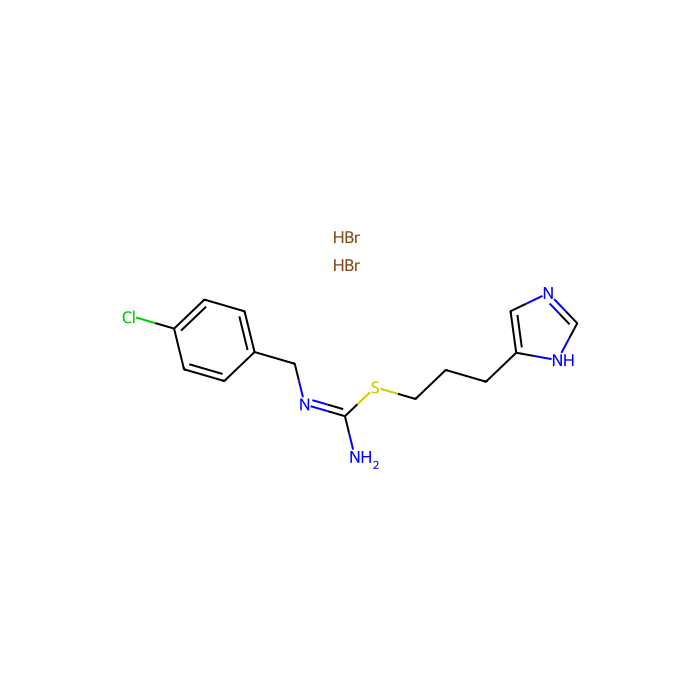
Overview: Clobenpropit dihydrobromide is a small-molecule imidazole-containing thiourea/guanidine-type histaminergic ligand supplied as a dibromide salt for research use.
Item-specific facts (from Product Data):
SKU: C275050
Product name: Clobenpropit dihydrobromide
CAS: 145231-35-2
PubChem CID: 11213569
InChIKey: 161248 (as provided)
SMILES: Not specified for this item; refer to CoA/Spec Sheet.
Molecular formula: Not specified for this item; refer to CoA/Spec Sheet.
Molecular weight: Not specified for this item; refer to CoA/Spec Sheet.
Core features: imidazole ring linked via a propyl spacer to a cationizable basic center and a chloro-benzyl substituent; typically formulated as a dihydrobromide to enhance aqueous solubility.
Functional groups: imidazole (aromatic heterocycle), secondary/tertiary amine(s) in the side chain (protonated in salt), thiourea/guanidine-like functionality enabling strong H-bonding and receptor binding.
2D description: a para-chloro phenyl substituent attached through a methylene to a flexible propyl chain terminating near an imidazole; the cationic center and heteroatoms create a polar, hydrogen-bonding pharmacophore.
Notes:
Exact stereochemistry is not typically a defining feature for clobenpropit (commonly used as racemate or achiral), though salts can crystallize in distinct forms.
For definitive identifiers (full InChIKey/SMILES) and batch-specific characterization (NMR, LC–MS), consult the CoA/Spec Sheet.
Synthetic Utility
Primary role: Clobenpropit dihydrobromide is a finished bioactive ligand; it is not typically employed as a synthetic reagent or building block in routine organic synthesis.
Context for chemists (general):
Derivatization: the scaffold (imidazole + flexible side chain + aryl chloride + thiourea/guanidine-like motif) has inspired SAR programs; medicinal chemists may modify aromatic substituents, spacer length, or heterocycle to tune potency/selectivity.
Counter-ion exchange: conversion between dihydrobromide and other salts (e.g., dihydrochloride) or free base can be achieved for property modulation; ensure rigorous drying and characterization post-exchange.
Analytical handles: imidazole ring provides UV absorbance in the low-UV region; protonated nitrogens facilitate positive-ion ESI-MS; bromide counter-ions may suppress signals if not exchanged in LC–MS mobile phases.
Limitations:
The presence of multiple basic sites and a thiourea-like functionality can complicate protecting-group strategy and downstream transformations; use with care if integrating into multistep syntheses.
Takeaway: Treat this compound as a tool/standard for biological assays. If synthetic modifications are intended, start from the documented free-base core or earlier intermediates rather than the dihydrobromide salt for better control.
Target Specificity
Only product-data-sourced target details may be listed here. The supplied Product Data do not specify targets, epitopes, or selectivity metrics for this item.
Item-specific statement:
Target, receptor subtype, potency, selectivity: Not specified for this item; refer to primary literature and the CoA/Spec Sheet if provided.
For researchers: consult peer-reviewed literature to identify and validate target interactions relevant to your assay system. Do not treat any target attribution as product-specific unless explicitly stated in the product documentation.
Domande frequenti
What is the purity of this product?
This product is supplied at ≥99% purity (chemical assay). Lot-specific values are stated on the Certificate of Analysis.
How should this product be stored?
Store at ?20 °C. Freezer storage is required to maintain the specified shelf life.
How is this product shipped?
This product ships in an insulated container with ice pads. Unpack on arrival and transfer it to the storage condition stated above.
What are the CAS number, molecular formula and molecular weight?
The CAS Number is 145231-35-2, the molecular formula is C14H19Br2ClN4S, and the molecular weight is 470.65 g/mol. InChIKey JIJQPEZAVLJZBO-UHFFFAOYSA-N.
What documentation is provided?
Available product documentation, including Certificates of Analysis (COA), Safety Data Sheets (SDS), and specification sheets, is shown in the product document area. Document availability and access follow the current site policy.
Utilizziamo i cookie per garantire il corretto funzionamento del sito web e, ove consentito, per migliorare la tua esperienza. Puoi gestire le tue preferenze in qualsiasi momento nelle Impostazioni. Per saperne di più, consulta la nostra Cookie Policy.
Desidera che le inviamo un messaggio quando avremo sconti disponibili?
Ricordamelo più tardi
Grazie! Controlli la sua casella di posta per confermare.
Products are supplied to verified businesses, institutions, and qualified professionals for research and development use only. Not for use in humans, animals, diagnosis, or therapy.

 K2230424