QUALITÀ & PUREZZAMoligand™?Moligand™ — Aladdin's line of ligands and bioactive small molecules. Use for receptor, pathway, and binding studies needing defined small-molecule tools.≥98%
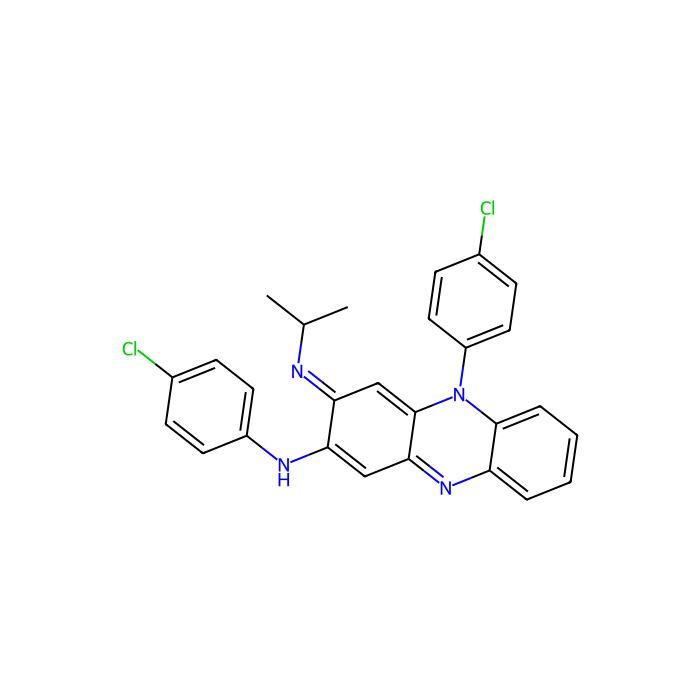
Clofazimine is a rhimophenazine dye, originally developed for the treatment of tuberculosis, it has both antimicrobial and antiinflammatory activity, postulated mechanisms of action include intercalation of clofazimine with bacterial DNA and increasing levels of cellular phospholipase A2.
Specifiche
Sinonimi
CLOFAZIMINE [EP MONOGRAPH] | Clofazimine [USAN:USP:INN:BAN] | Phenazine, 3-(p-chloroanilino)-10-(p-chlorophenyl)-2,10-dihydro-2-(isopropylimino)- | CLOFAZIMINE [USP IMPURITY] | CLOFAZIMINE [VANDF] | Riminophenazine | 2-Phenazinamine, N,5-bis(4-chlorophenyl)-3,5-dihydro-3-[(1-methylethyl)imino]- | B 663 | CLOFAZIMINE [MI] | Colfazimine | P Mostra altro
Specifiche e purezza
Moligand™, ≥98%
Condizioni di conservazione di stoccaggio
Protected from light,Store at -20°C
Spedito in
Ice chest + Ice pads
Questo prodotto richiede spedizione a catena fredda. I servizi di terra e altri servizi economici non sono disponibili.
This compound belongs to the class of organic compounds known as phenazines and derivatives. These are polycyclic aromatic compounds containing a phenazine moiety, which is a linear tricyclic system that consists of a two benzene rings joined by a pyrazine ring.
External Descriptors
phenazines - monochlorobenzenes
1. Djoumbou Feunang Y, Eisner R, Knox C, Chepelev L, Hastings J, Owen G, Fahy E, Steinbeck C, Subramanian S, Bolton E, Greiner R, and Wishart DS. ClassyFire: Automated Chemical Classification With A Comprehensive, Computable Taxonomy. Journal of Cheminformatics, 2016, 8:61.
Insoluble in water; easily soluble in toluene; soluble in chloroform, dimethylformamide; slightly soluble in ether, acetone; very slightly soluble in methanol, ethanol
Determine the necessary mass, volume, or concentration for preparing a solution.
Dilution Calculator
Determine the dilution needed to prepare a stock solution.
Reconstitution Calculator
Recensioni
Recensioni dei clienti
Application Protocols
Item-specific tested applications: Not specified for this item; refer to CoA/Spec Sheet.
General research-use protocols (literature/practice; adapt to your system)
DMSO stock preparation
Warm vial to room temperature protected from light.
Add anhydrous DMSO to achieve 10–50 mM target concentration.
Vortex and sonicate briefly until fully dissolved; avoid foaming. Record exact concentration gravimetrically if needed.
Aqueous working solutions
Add DMSO stock dropwise to vigorously mixed buffer or media to desired final concentration; keep final DMSO typically ≤0.5–1% v/v.
If turbidity appears, add a small amount of nonionic surfactant (e.g., 0.01–0.05% Tween-80 or Pluronic F-68) compatible with your assay, or increase temperature slightly (to 30–37 °C) with mixing.
Filtration and storage of stocks
Filter through 0.2 µm PTFE if particulate persists.
Aliquot into amber vials to minimize headspace and light exposure; store at −20 °C. Avoid repeated freeze–thaw by using single-use aliquots.
Chromatographic analysis (LC–UV/LC–MS)
Use high-organic mobile phases (e.g., 70–90% acetonitrile) with 0.1% formic or acetic acid; monitor at visible wavelengths in addition to 254 nm due to strong chromophore.
Always confirm compatibility of solvents/additives with your biological or analytical system.
Biological Roles
Scope and intent
The following summarizes literature knowledge about clofazimine’s biochemical behavior for research context only. No medical or clinical claims are made.
Literature overview
Mode-of-action hypotheses: clofazimine is a lipophilic phenazine/iminophenazine that intercalates into lipid-rich environments and has been studied for interactions with bacterial membranes and nucleic acids. Redox cycling and generation/modulation of reactive oxygen species have been reported under certain conditions.
Cellular distribution: due to its high lipophilicity and strong color, clofazimine can accumulate in hydrophobic compartments and membranes in cell-based models, forming pigmented inclusions in some systems.
Targets and pathways: reported to affect electron transport processes in bacteria (e.g., interactions with components linked to menaquinone-dependent respiration) and to bind DNA in vitro; exact target specificity is context-dependent and may involve multiple pathways.
Biophysical properties: strong visible absorption and potential fluorescence facilitate optical tracking in research assays; the compound’s aggregation state can influence bioavailability and signal.
Practical considerations for research
Stock preparation in DMSO and careful dilution into assay media are critical to avoid precipitation and nonspecific adsorption.
Nonionic surfactants or protein carriers (e.g., BSA) are sometimes used in vitro to maintain dispersion; validate for your system.
Note
For quantitative biological studies, confirm purity, polymorph, and particle size, as these can markedly influence uptake and apparent activity.
Buffer Applications
Not typically applicable.
Clofazimine is not a buffering agent and does not form conventional laboratory buffer systems.
For biological assays requiring aqueous media, prepare DMSO stocks and dilute into the desired buffer with attention to final DMSO percentage and potential use of solubilizers/surfactants (literature practice). Refer to Solvent Selection and Application Protocols for practical preparation guidance.
Green Alternatives
Context
Clofazimine is a target molecule rather than a process solvent. Greener considerations focus on solvent choices for dissolving, processing, and purifying this highly lipophilic, halogenated, chromophoric compound.
Greener handling strategies
Prefer water-miscible, lower-toxicity solvents for stocks where feasible (e.g., DMSO vs. DMF; ethanol as a cosolvent when solubility allows).
Minimize use of chlorinated solvents (chloroform, dichloromethane) by substituting with ethyl acetate, methyl tert-butyl ether (MTBE), cyclopentyl methyl ether (CPME), or toluene when solubility permits.
Employ microscale processing and high-solids techniques to reduce solvent volumes.
Use closed, amberized systems to limit light exposure and volatilization.
Illustrative comparison (literature/general)
DMSO vs. DMF: DMSO generally offers lower chronic toxicity and better biodegradability profile than DMF; both solubilize clofazimine well for assay stocks.
CPME or MTBE vs. DCM/CHCl3: ethers may provide acceptable solubility with improved environmental profiles; note peroxide formation risk in ethers and manage with testing/stabilizers.
Ethyl acetate vs. DCM for extractions: greener choice but may be less effective for very lipophilic analytes; evaluate partitioning empirically.
Trade-offs
Some greener solvents may reduce solubility or alter crystallization behavior; process optimization (temperature, cosolvents, antisolvent addition) can offset limitations.
Waste and lifecycle
Segregate halogenated wastes; implement solvent recovery/reuse where allowable. Consider solid-phase methods (e.g., dry loading for chromatography) to cut solvent consumption.
Pharmaceutical Uses
Catalog and research context only
This catalog item is designated For research use only.
Clofazimine’s strong lipophilicity and coloration have informed formulation research (e.g., lipid-based delivery, solid dispersions) in preclinical contexts. Such information may be useful for bench-scale experiments studying solubility enhancement, polymorphism, or release kinetics.
As an analytical reference, clofazimine can support development/validation of chromatographic methods (LC–UV/LC–MS) in nonclinical laboratories.
Compliance reminder
No clinical, diagnostic, or therapeutic use is implied for this item. If pharmacopeial conformity (USP/EP/JP) is required, this Moligand™ listing is not intended to fulfill those specifications; consult appropriate reference standards or regulated-grade materials.
Physical Properties
Item-specific facts (from Product Data)
Appearance: Not specified for this item; refer to CoA/Spec Sheet.
Literature and general reference values (for context; not item specifications)
Physical state/color (literature): highly conjugated, intensely colored solid (deep red/orange hues typical of phenazine chromophores); may exhibit strong fluorescence/absorbance due to extended π-system.
Melting behavior (literature): reported to be a high-melting solid; decomposition/softening above ~200 °C has been noted in references for related samples; exact calibrated MP for this item: Not specified for this item; refer to CoA/Spec Sheet.
Boiling point: not applicable (decomposes before boiling under ambient pressure; literature).
Density: Not specified for this item; refer to CoA/Spec Sheet.
Solubility (qualitative, literature): practically insoluble in water; soluble in DMSO and DMF; soluble in chlorinated organics (e.g., chloroform, dichloromethane) and some hot aromatic solvents; sparingly soluble in lower alcohols.
LogP/logD (literature): very high lipophilicity has been reported for clofazimine; specific value varies by source and pH. Not specified for this item; refer to CoA/Spec Sheet for any assigned value.
pKa (literature): weak basicity associated with the imine/aza-aromatic nitrogens; reported pKa values vary depending on measurement conditions. Not specified for this item.
UV-Vis (literature): strong absorption in visible region attributable to phenazine chromophore; exact λmax and ε depend on solvent and protonation state.
Notes
Treat all numerical values above as literature guidance only. For compliance, method validation, or specification-driven workflows, rely on the item’s CoA/Spec Sheet.
Quality and Grades
Item-specific fact
Grade/Purity: Moligand™ (as stated on the catalog listing).
What Moligand™ implies (context and use-case guidance)
Moligand™ denotes a research-grade small-molecule suitable for discovery workflows including target identification, ligand screening, and SAR exploration. While not a pharmacopeial grade, Moligand™ items are intended for use in chemical biology, assay development, and method validation.
How to interpret for your workflow
Analytical characterization: For assay use (biochemical or biophysical), obtain the lot-specific CoA/Spec Sheet for identity/purity confirmation (e.g., HPLC area %, NMR identity, residual solvents, water content). If a particular threshold is required for your application (e.g., ≥98% HPLC area), verify on the CoA—do not assume.
Stabilizer/additives: None specified for this item. If additives are critical to your assay, confirm on the CoA.
UV profile: Not specified for this item; if you rely on UV detection (e.g., HPLC), request the UV cutoff or λmax data or record in-house.
Heavy metals/peroxides/other residues: Not specified for this item; refer to CoA/Spec Sheet.
Best practices
Upon receipt, document lot number and retain a sample of the original container for audit trails. For quantitative studies (e.g., reference standards, calibration curves), perform an independent purity assay or correction via qNMR or HPLC where appropriate.
Reaction and Applications
Relevance
Clofazimine is primarily used as a research small molecule/ligand standard rather than as a general-purpose reagent. Applications cluster around analytical, chemical biology, and materials interfaces.
Applications in research workflows
Reference/standard: analytical reference for method development and validation (e.g., LC–UV/FLD or LC–MS quantification) in discovery and QC laboratories.
Probe development: starting point for structure–activity relationship (SAR) exploration on the phenazine/iminophenazine scaffold; halogen substitution provides handles for derivatization.
Material/photophysical studies: the extended conjugation and strong visible absorption enable studies of aggregation, photostability, and intercalation with polyanionic matrices (DNA, polymers) under research settings.
Chemistry considerations (literature/general)
Derivatization: aryl–Cl positions may undergo metal–halogen exchange or cross-coupling after appropriate activation (e.g., Pd-catalyzed Suzuki/Negishi couplings on suitably functionalized analogs). The imine functionality can be targeted for reduction to amine or imine exchange under acid catalysis.
Redox-active core: phenazine systems can participate in reversible redox chemistry; consider potential sensitivity to strong oxidants/reductants during transformations.
Handling: intense coloration assists visual tracking during chromatography; adsorptive losses to glass/plastics may be mitigated by pre-rinsing with solvent or adding small amounts of carrier (e.g., 0.1% DMSO in mobile phase for analytics).
Note
For exact synthetic steps or reaction conditions with clofazimine itself, consult primary literature; the above are general scaffold-level guidelines.
Reaction Conditions
This product is primarily a research small molecule rather than a reagent; nevertheless, literature offers guidance for handling and derivatization conditions of the clofazimine scaffold.
General handling for analytical/sample prep
Stock solutions: 10–50 mM in DMSO at room temperature; sonication may help dissolution. Protect from light. Filter through PTFE (0.2 µm) if particulate forms.
Dilution: add DMSO stock slowly into vortexed buffer/media to a final DMSO content typically ≤1% v/v for cell-free assays (literature practice); include nonionic surfactant if needed to prevent precipitation.
Derivatization conditions (literature/general)
Imine reduction: NaBH3CN or catalytic hydrogenation (mild conditions, e.g., Pd/C, ambient to modest pressure) can convert the imine to a secondary/tertiary amine in analog syntheses.
Aryl–Cl functionalization: transition-metal-catalyzed couplings may require strong bases and polar aprotic solvents (e.g., Pd catalysts, phosphine ligands, K3PO4/Cs2CO3, in toluene/1,4-dioxane/DMF at 80–120 °C); success depends on substitution pattern and electronic effects.
Oxidation states: phenazine cores can form N-oxides under peracid treatment; control stoichiometry and temperature to avoid decomposition.
Yields and kinetics
Highly substrate- and method-dependent. Expect to optimize ligands, bases, and temperature for each transformation; consult primary literature for specific examples and expected yield ranges.
Caveats
Strong coloration can mask TLC endpoints; use multiwavelength HPLC or MS for monitoring. Protect from light during extended reactions.
Safety and Handling
Item-specific facts (from Product Data)
Storage conditions: Store at −20 °C, protected from light.
Shipping: Ice chest + ice pads.
GHS classification, signal word, pictograms, H-statements: Not specified for this item; refer to SDS.
General safety guidance (literature/practice; not a substitute for SDS)
PPE: lab coat, chemical-resistant gloves (e.g., nitrile), safety glasses or goggles. Handle powders gently to minimize dust/airborne particulates; use a fume hood for weighing and transfers.
Light sensitivity: the highly conjugated chromophore can be light-sensitive; protect from light during storage and handling to avoid potential photo-degradation.
Incompatibilities: avoid strong oxidants; strong acids may protonate and alter solubility/behavior; strong reducing/oxidizing environments may impact the chromophore (phenazine redox activity).
Thermal stability: high-melting, but decomposition may occur on strong heating; avoid unnecessary thermal stress.
Hygiene: wash thoroughly after handling; avoid ingestion and inhalation of dust. Because of intense coloration, staining of skin, labware, and surfaces is likely; clean promptly with appropriate organic solvents in a hood.
First aid (overview): in case of eye/skin contact, rinse with plenty of water for several minutes; remove contaminated clothing. If inhaled, move to fresh air. If swallowed, rinse mouth. Seek medical attention as needed. Always defer to the product SDS for authoritative instructions.
Waste
Collect waste in halogenated organic waste streams if dissolved in chlorinated solvents; otherwise segregate per institutional guidelines. Prevent environmental release.
Solvent Selection
Applicability
Clofazimine is a highly lipophilic, water-insoluble, polycyclic aza-aromatic. Solvent choice is driven by its poor aqueous solubility and strong color.
Practical solvent guidance (literature/practice)
Highly suitable solvents: DMSO, DMF (excellent solubilizers; typical for stock solutions in screening); chlorinated solvents such as chloroform and dichloromethane; hot aromatic solvents (e.g., toluene) for processing steps.
Limited suitability: lower alcohols (EtOH, i-PrOH) and acetone may offer only modest solubility; cosolvent strategies or gentle warming/sonication may be needed.
Aqueous systems: practically insoluble at neutral pH. Use DMSO stock (e.g., 10–50 mM) and dilute into buffer with surfactant (e.g., 0.01–0.1% nonionic detergent) to mitigate precipitation where compatible with the assay. Alternatively, include a small percentage of a water-miscible organic cosolvent.
Polarity and dielectric considerations (general)
DMSO/DMF provide high dielectric environments that stabilize the aza-aromatic and disrupt π–π aggregation, improving apparent solubility. Chlorinated solvents can dissolve the neutral chromophore efficiently for synthetic manipulations and purification.
Comparison (selection hints)
For assay stocks: DMSO is generally preferred for stability and compatibility with screening systems.
For extractions/purifications: dichloromethane or chloroform afford rapid dissolution; consider greener alternatives where feasible (see Green Alternatives).
For crystallization: mixed solvent systems (e.g., chloroform/hexane or toluene/heptane) may be used to modulate solubility; optimize empirically.
Always verify solvent purity, water content, and compatibility with your downstream method.
Storage and Reconstitution
Item-specific facts (from Product Data)
Storage: Store at −20 °C.
Protection: Protect from light.
Shipping: Ice chest + ice pads.
Reconstitution guidance (general best practices for this compound class)
Solvents: For stock solutions, use anhydrous DMSO as the primary solvent. DMF or chlorinated solvents may also dissolve the compound (literature), but DMSO is typically preferred for assay stocks.
Concentration: Prepare 10–50 mM stocks depending on intended use and solubility; verify full dissolution by visual inspection and, if needed, by analytical methods.
Technique: Allow vial to equilibrate to room temperature before opening to avoid moisture condensation. Add solvent, vortex, and sonicate briefly. If necessary, warm gently (≤40 °C) while protected from light.
Aliquoting: Divide into small, amber, airtight aliquots to minimize light exposure and freeze–thaw cycles.
Stability considerations
Light sensitivity: store and handle in amber containers or wrap in foil.
Temperature: long-term storage at −20 °C as specified; for short-term use, keep at 2–8 °C protected from light.
Freeze–thaw: avoid repeated cycles; discard aliquots showing precipitation that cannot be re-dissolved or color changes suggestive of degradation.
Labeling and documentation
Record lot number, concentration, solvent, and preparation date on each aliquot. For regulated workflows, retain CoA and any in-house characterization data with your records.
Note
If any item-specific stability data (e.g., solution shelf-life) are required, consult the lot-specific CoA/Spec Sheet.
Structure and Identity
Item-specific facts (from Product Data)
CAS: 2030-63-9
PubChem CID: 2794
InChIKey: 395641 (as provided)
SMILES: Not specified for this item; refer to CoA/Spec Sheet.
Product Name: Clofazimine
Grade: Moligand™
Literature/structural overview (for context; not item specifications)
Molecular formula (literature): C27H22Cl2N4
Molecular weight (literature): ~473.39 g/mol
Core scaffold: substituted iminophenazine (a phenazine/phenazinimine chromophore) featuring two chloro-substituted aryl rings and a tertiary imine linking motif.
Functional groups/features: di-chloro aryl rings (electron-withdrawing), extended conjugated polycyclic aza-aromatic system (chromophoric), imine (C=N) functionality that can participate in protonation under strongly acidic conditions, and multiple aromatic amines embedded within the phenazine framework.
2D description in words: a tricyclic, planar, nitrogen-containing phenazine core bearing an exocyclic imine that connects to an anilidyl/aryl substituent; two chlorine atoms reside on peripheral phenyl rings, increasing lipophilicity and modulating electronics of the conjugated system.
Notes
The above literature identifiers and descriptions are general chemical knowledge about clofazimine. When precise structure identifiers (e.g., canonical SMILES, exact InChIKey) are required for compliance or registration, consult the item’s CoA/Spec Sheet or SDS to match this specific catalog lot.
Synthetic Utility
Scaffold-level reactivity (literature/general)
Core: phenazine/iminophenazine polycyclic system with extended conjugation; behaves as a redox-active aza-aromatic.
Substituents: aryl chlorides offer potential handles for further derivatization (subject to position and electronic constraints). The exocyclic imine can undergo transformations (e.g., reduction to amine, transimination under acid catalysis).
Representative transformations
Cross-coupling: with appropriate activation, Pd-catalyzed couplings (Suzuki–Miyaura, Buchwald–Hartwig for N-arylation on analogs) can be used to generate clofazimine analog libraries for SAR.
N-oxide chemistry/redox: controlled oxidation/reduction on phenazine nitrogens can tune electronic properties; care is needed to avoid over-oxidation/decomposition.
Salt formation/protonation: while largely neutral and lipophilic, strong acids may form salts at basic sites, which can transiently improve solubility for processing.
Analytical and separation considerations
The intense color aids thin-layer chromatography visualization without staining reagents.
For LC, reversed-phase methods with high-organic eluents and modifiers (e.g., 0.1% formic acid) often provide sharp peaks; adsorption can be mitigated by adding a small percentage of strong solvent (e.g., DMSO) to the sample diluent.
Use as a standard
Suitable as a reference analyte to benchmark extraction recoveries, detector linearity, and carryover in hydrophobic drug-like compound panels (research use).
Target Specificity
Not applicable to this catalog item.
This product is a small-molecule compound, not an antibody, protein, or nucleic acid probe with defined antigen/epitope specificity.
No target specificity data are provided in the Product Data for this item.
Domande frequenti
What is the purity of this product?
This product is supplied at ≥98% purity (chemical assay). Lot-specific values are stated on the Certificate of Analysis.
What is Moligand??
Moligand? is one of Aladdin Scientific's premium product lines, formulated for high-purity applications across multiple workflows. Compared to standard grades in the same workflow, Moligand? products typically offer tighter specifications, more rigorous QC, and stronger lot-to-lot consistency.
How should this product be stored?
Store at ?20 °C, protected from light. The material is light-sensitive — keep it in its original opaque or amber container.
How is this product shipped?
This product ships in an insulated container with ice pads. Unpack on arrival and transfer it to the storage condition stated above.
What are the CAS number, molecular formula and molecular weight?
The CAS Number is 2030-63-9, the molecular formula is C27H22Cl2N4, and the molecular weight is 473.4 g/mol. InChIKey WDQPAMHFFCXSNU-UHFFFAOYSA-N.
What documentation is provided?
Available product documentation, including Certificates of Analysis (COA), Safety Data Sheets (SDS), and specification sheets, is shown in the product document area. Document availability and access follow the current site policy.
La nostra guida alla selezione delle qualità copre purezza, stato dello stabilizzatore e idoneità all'applicazione per tutte le varianti del nostro catalogo.
Utilizziamo i cookie per garantire il corretto funzionamento del sito web e, ove consentito, per migliorare la tua esperienza. Puoi gestire le tue preferenze in qualsiasi momento nelle Impostazioni. Per saperne di più, consulta la nostra Cookie Policy.
Desidera che le inviamo un messaggio quando avremo sconti disponibili?
Ricordamelo più tardi
Grazie! Controlli la sua casella di posta per confermare.
Products are supplied to verified businesses, institutions, and qualified professionals for research and development use only. Not for use in humans, animals, diagnosis, or therapy.

 L2424257