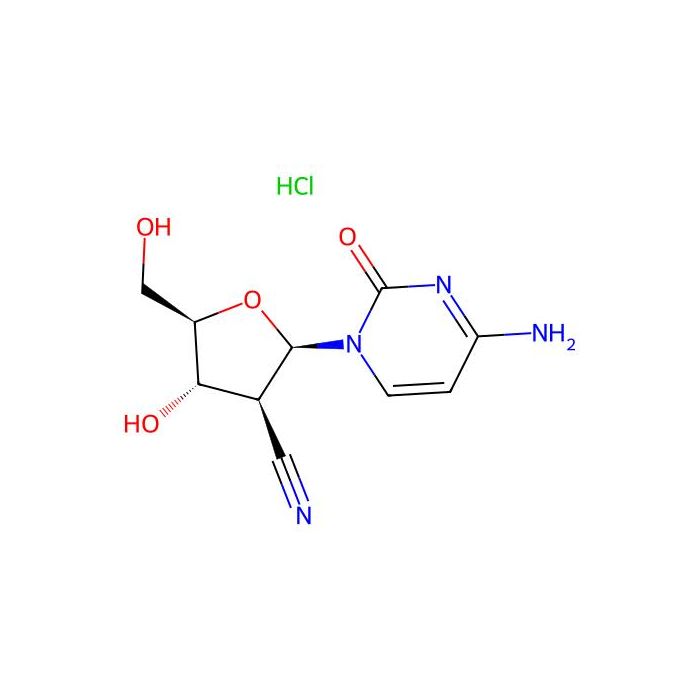
CNDAC hydrochloride is a metabolite of the orally active agent Sapacitabine , and a nucleoside analog. CNDAC hydrochloride induces DNA damage and apoptosis.
In Vitro
CNDAC has a unique mechanism of action: after incorporation into DNA, it induces single-strand breaks (SSBs) that are converted into double-strand breaks (DSBs) when cells go through a second S phase. Lack of Rad51D and XRCC3 sensitizes cells to CNDAC (0-1 μM; 24 h). CNDAC (0-100 μM; 3 days) inhibits proliferation of HL-60 and THP-1 cells. CNDAC (0-10 μM; 3-6 days) induces apoptosis in HL-60 and THP-1 cells. CNDAC (6 μM; 48 h) induces cell cycle arrest in the G2 phase following a delayed S phase in HCT116 cells. MCE has not independently confirmed the accuracy of these methods. They are for reference only. Cell Viability AssayCell Line: Rad51D-deficient 51D1, Rad51D-complemented 51D1.3, wild-type AA8 and XRCC3-deficient irs1SF CHO cells Concentration: 0-1 μM Incubation Time: 24 h Result: Inhibited cell survival with IC 50 s of 0.006, 0.32, 0.48 and 0.0053 μM against Rad51D-deficient 51D1, Rad51D-complemented 51D1.3, wild-type AA8 and XRCC3-deficient irs1SF cell lines, respectively. Cell Proliferation AssayCell Line: HL-60 and THP-1 cells Concentration: 0-100 μM Incubation Time: 3 days Result: Inhibited proliferation with IC 50 s of 1.5832 μM and 0.84 μM against HL-60 and THP-1 cells, respectively. Apoptosis AnalysisCell Line: HL-60 and THP-1 cells Concentration: 0, 0.5, 1, 2, 3, 4, 5 and 10 μM Incubation Time: 3, 4, 5, and 6 days Result: Induced apoptosis in both cells. Cell Cycle AnalysisCell Line: HCT116 Concentration: 6 μM Incubation Time: 48 h Result: 36 and 36% of cells were arrested in late-S and G2/M phases, respectively.
In Vivo
CNDAC (20mg/kg; i.p.; daily for 10 days) shows antitumor activity in mice. MCE has not independently confirmed the accuracy of these methods. They are for reference only. Animal Model: CDF1 mice, P388 tumor modelDosage: 20 mg/kg Administration: Intraperitoneal injection, daily for 10 days Result: Greatly increased the survival time and survival rate.