QUALITÀ & PUREZZAMoligand™?Moligand™ — Aladdin's line of ligands and bioactive small molecules. Use for receptor, pathway, and binding studies needing defined small-molecule tools.≥99%
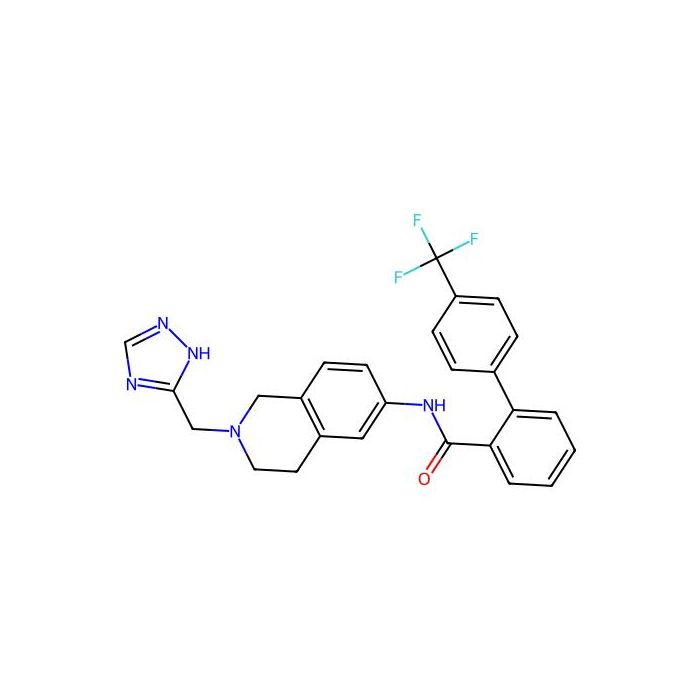
CP-346086 is a microsomal triglyceride transfer protein (MTP) inhibitor, with an IC50 of 2.0 nM for human and rodent MTP. CP-346086 can lower plasma cholesterol and triglycerides in vivo.
Specifiche
Sinonimi
CP346086Dihydrate | 4′-Trifluoromethyl-biphenyl-2-carboxylicacid[2-(2H-[1,2,4]triazol-3-ylmethyl)-1,2,3,4-tetrahydro-isoquinolin-6-yl]amidedihydrate | CP346086 | N-[2-(1H-1,2,4-Triazol-5-ylmethyl)-1,2,3,4-tetrahydro-6-isoquinolinyl]-4'-(trifluoromethyl)-2-biphenylcarboxamide | [1,1'-Biphenyl]-2-carboxamide,N-[1,2,3,4-tetrahydro-2-(1H-1,2, Mostra altro
Specifiche e purezza
Moligand™,≥99%
Condizioni di conservazione di stoccaggio
Store at -20°C
Spedito in
Ice chest + Ice pads
Questo prodotto richiede spedizione a catena fredda. I servizi di terra e altri servizi economici non sono disponibili.
This compound belongs to the class of organic compounds known as biphenyls and derivatives. These are organic compounds containing to benzene rings linked together by a C-C bond.
External Descriptors
Not available
1. Djoumbou Feunang Y, Eisner R, Knox C, Chepelev L, Hastings J, Owen G, Fahy E, Steinbeck C, Subramanian S, Bolton E, Greiner R, and Wishart DS. ClassyFire: Automated Chemical Classification With A Comprehensive, Computable Taxonomy. Journal of Cheminformatics, 2016, 8:61.
Determine the necessary mass, volume, or concentration for preparing a solution.
Dilution Calculator
Determine the dilution needed to prepare a stock solution.
Reconstitution Calculator
Recensioni
Recensioni dei clienti
Application Protocols
No item-specific, validated application protocols are provided. The following are general-purpose procedures for handling small-molecule library compounds; adjust to your system.
DMSO stock preparation (general):
Equilibrate vial to room temperature before opening.
Weigh the desired amount quickly to minimize moisture uptake.
Add anhydrous DMSO to prepare a 10–50 mM stock; vortex until fully dissolved. If needed, sonicate briefly.
Aliquot into low-bind microtubes or plate wells; flush headspace with inert gas if long-term storage is planned.
Biochemical assay dosing:
Prepare serial dilutions in assay buffer containing matched DMSO.
Keep final DMSO at a tolerated level (often 0.5–1% v/v or less).
Mix thoroughly and inspect for precipitation; filter if necessary.
Cell-based assay dosing:
Prepare intermediate dilutions in culture medium to minimize DMSO shock; typical final DMSO ≤0.1–0.5% v/v.
Include vehicle controls and, where available, reference controls.
Analytical verification:
Confirm concentration by UV (if chromophore known) or LC-based quantitation; verify purity/identity by HPLC/LC–MS pre- and post-assay.
These procedures are general guidance and not product specifications.
Biological Roles
Item-specific biological targets, modes of action, or pathways for CP-346086 are not provided in the Product Data. No claims are made regarding biological activity, potency, or selectivity.
General research context (not item-specific claims):
As a member of a small-molecule library, compounds like CP-346086 are often evaluated in discovery workflows to probe protein function, modulate biochemical pathways, or serve as chemical starting points for structure–activity relationship (SAR) exploration once a biological signal is observed.
Typical studies include concentration–response profiling to assess apparent activity, orthogonal assay confirmation to rule out assay interference, and selectivity panels to understand off-target risk.
For mechanistic insights, biophysical binding assays (e.g., DSF, SPR, MST) can be combined with computational docking if a reliable structure is available from literature sources (e.g., PubChem). Ensure the structure used computationally matches the batch-specific form (salt/tautomer) if known.
All uses are for research only. Validate any observed effect with proper controls and follow-up experiments before drawing mechanistic conclusions.
Buffer Applications
This product is not a buffering reagent and is not intended to set or maintain solution pH.
Practical notes for using small-molecule stocks in buffered assays (general guidance):
Prepare a concentrated DMSO stock (e.g., 10–50 mM), then dilute into assay buffer (e.g., PBS, HEPES, Tris, or cell culture media) to the desired final concentration while maintaining DMSO at a tolerated level (commonly 0.1–0.5% v/v for cells; up to 1–2% in many biochemical assays).
Pre-equilibrate buffer and stock to the same temperature to minimize precipitation on mixing.
Add compound last and mix thoroughly (plate shaker or gentle pipetting); inspect wells for turbidity.
Include vehicle controls at matched DMSO levels.
If precipitation persists, consider:
Incremental increases in co-solvent within assay tolerance.
Use of solubilizing excipients (e.g., 0.01–0.1% nonionic surfactant) if compatible with the assay.
Serial dilution in a higher-organic buffer followed by stepwise back-dilution.
These are general buffer-handling practices and not product specifications.
Green Alternatives
Without item-specific solvent/processing requirements, greener choices are best considered around stock preparation, assay dilution, and waste minimization.
General guidance (not item-specific):
Prefer DMSO over DMF/NMP where feasible due to a more favorable EHS profile and established biocompatibility at low percentages.
Use ethanol or water-based cosolvent systems when compatible with the biology and compound solubility, to reduce reliance on high-boiling polar aprotics.
Miniaturize assays (e.g., 384/1536-well) to reduce solvent consumption and waste.
Employ closed, low-dead-volume dispensing systems to limit evaporative losses and emissions.
Example comparison (general; select based on your assay needs):
DMSO: high solvency, widely accepted in HTS; greener than DMF/NMP but still requires controlled disposal.
Ethanol: renewable, readily biodegradable; volatility can cause dosing drift—use sealed plates and controlled environments.
PEG 300/400 as cosolvents: low volatility, reduced emissions; may alter assay readouts or permeability.
Operational tips:
Validate the lowest functional co-solvent level (often 0.1–0.5% v/v) that maintains solubility.
Consolidate compatible waste streams and avoid halogenated solvents when unnecessary.
These are general sustainability practices; align choices with your safety office and assay tolerance.
Pharmaceutical Uses
No pharmacopeial status, excipient role, or clinical/formulation use is specified for this item. This product is supplied strictly for research use only and is not for use in humans or diagnostics.
General preformulation research context (not item-specific claims):
Discovery compounds are commonly profiled for basic developability attributes in vitro (e.g., solubility versus pH, chemical stability, lipophilicity, permeability) to inform medicinal chemistry optimization.
Prototype enabling formulations for animal-model research may be explored in academic/industrial settings (e.g., co-solvent systems, cyclodextrin complexes, lipid-based vehicles); any such work requires independent safety and compatibility assessment and is outside the scope of this product listing.
No claims are made regarding GMP compliance, residual solvent limits, elemental impurities, or sterility/endotoxin control.
For any work beyond in vitro research, source appropriate grade materials and follow institutional and regulatory guidelines.
Physical Properties
Item-specific properties (specification status)
Appearance: Not specified for this item; refer to CoA/Spec Sheet.
Molecular formula: Not specified for this item; refer to CoA/Spec Sheet.
Molecular weight: Not specified for this item; refer to CoA/Spec Sheet.
Melting point, boiling point, density, refractive index, UV cutoff, logP/logD, pKa, solubility: Not specified for this item; refer to CoA/Spec Sheet.
General guidance (literature/practice, not item specifications)
Small-molecule library members like CP-346086 are commonly supplied as solids or concentrated solutions. If solid, they are typically reconstituted in anhydrous DMSO to prepare a 10–50 mM stock, then diluted into assay media.
If literature data are required (for modeling, PBPK inputs, or formulation screens), consult trusted databases (e.g., PubChem for CID 9826309) and clearly annotate values as “literature — not product specification.”
Solubility and polymorph can vary by batch and storage history; confirm experimentally by preparing a small solubility curve (e.g., nephelometry or LC-based quantification) in your intended solvent system.
Hygroscopicity/photolability are unknown for this specific item. As a precaution, minimize exposure to ambient moisture and strong light during weighing and stock preparation.
Always defer to the batch CoA/SDS for authoritative physical property and handling information.
Quality and Grades
Grade/Purity (item-specific): Moligand™
Moligand™ indicates suitability for small-molecule screening and ligand-discovery workflows. It emphasizes consistent identity and high purity appropriate for biochemical/cellular assays.
What this generally implies (context; not item specs)
Typical QC elements for screening-grade small molecules include identity by LC–MS and/or NMR and high analytical purity by HPLC. Exact acceptance criteria (e.g., % area, residual solvents, water content, salt/solvate form) are batch-specific and reported on the CoA.
Trace stabilizers, counterions, or solvates: Not specified for this item; refer to CoA/Spec Sheet.
Intended use: Discovery research, assay development, target validation. Not tested for clinical use, diagnostics, or as a GMP material.
Practical notes for users
Verify the batch CoA prior to critical studies to confirm salt form, polymorph, and purity profile align with your assay requirements (e.g., UV interference, mass spectral background).
If performing quantitative pharmacology or biophysics, document lot number and CoA in your records to ensure reproducibility across campaigns.
For analytical method transfer, request additional QC data if needed (e.g., chromatographic conditions, reference spectra) to match in-house methods.
Reaction and Applications
This product is supplied as a research small molecule for screening/ligand discovery rather than as a synthetic reagent. Consequently, it is not typically used as a substrate, catalyst, or reagent in preparative organic reactions.
Applicable research uses (general, not item-specific claims):
Tool-compound candidate in biochemical binding assays (e.g., target engagement by thermal shift, fluorescence polarization, SPR, MST) after target-specific validation.
Cellular assay probe candidate to explore pathway hypotheses, with proper controls (vehicle, inactive analogs) and concentration–response studies.
ADME profiling: in vitro solubility, stability (microsomal, plasma), permeability (PAMPA/Caco-2), and protein binding, to guide medicinal chemistry.
Physicochemical characterization: determination of pKa, logD, and solid-state properties (XRPD/DSC/TGA) as part of preformulation research.
Not commonly applicable:
Named synthetic reactions (e.g., Grignard, cross-coupling) as a reagent—no data are provided for such use. If chemical modification is intended, obtain or derive the structure from literature sources (e.g., PubChem CID 9826309) and plan transformations accordingly.
Always document lot numbers and experimental conditions when using CP-346086 in discovery experiments to support data reproducibility.
Reaction Conditions
Not typically applicable. CP-346086 is not supplied as a reagent for synthetic transformations, and no item-specific reaction conditions are provided in the Product Data.
General considerations if conducting analytical or biophysical experiments (not synthetic reactions):
Stock preparation: Dissolve in anhydrous DMSO to the desired concentration (e.g., 10–50 mM). Vortex and, if necessary, sonicate briefly to aid dissolution. Filter if particulates persist.
Assay dilution: Add stocks to buffered media with thorough mixing; maintain consistent co-solvent levels across controls and treatments.
Stability checks: Monitor by LC–MS or HPLC over the course of the experiment (e.g., 0, 2, 24 h at room temperature or 37°C) to ensure compound integrity.
For any chemical modification work, consult literature for the compound’s structure and use standard organic synthesis references to plan conditions. Such work falls outside the intended use of this research listing.
Safety and Handling
Hazard information (item-specific)
Signal word: Not specified for this item; refer to SDS.
H-statements: Not specified for this item; refer to SDS.
GHS classification/pictograms: Not specified for this item; refer to SDS.
General laboratory precautions (good practice; not product-specific)
Use in a chemical fume hood; avoid inhalation of dust/aerosols and contact with skin/eyes.
PPE: lab coat, safety glasses or chemical splash goggles, and appropriate chemical-resistant gloves (e.g., nitrile). Change gloves regularly when handling DMSO stocks due to enhanced dermal absorption of many organics.
First aid (overview; refer to SDS for full guidance):
Skin/eye contact: Rinse with water for ≥15 min; remove contaminated clothing; seek medical attention if irritation persists.
Inhalation: Move to fresh air; monitor breathing; seek medical attention if symptoms develop.
Ingestion: Rinse mouth; do not induce vomiting; seek medical attention.
Handling: Open vials at room temperature to prevent condensation ingress; recap promptly. Avoid repeated freeze–thaw of DMSO stocks to limit precipitation and degradation.
Incompatibilities: Unknown for this specific item. As a precaution, keep away from strong oxidizers and acids/bases until compatibility is established.
Waste: Collect in organic waste according to institutional and regulatory requirements.
Consult the product SDS for authoritative safety, toxicological, and ecological information. For research use only.
Solvent Selection
Item-specific solubility data
Not specified for this item; refer to CoA/Spec Sheet.
General guidance for small-molecule screening stocks (literature/practice)
Primary solvent: Anhydrous DMSO is the default for preparing concentrated stocks (e.g., 10–50 mM), owing to its broad solvency and compatibility with HTS workflows.
Secondary solvents (if DMSO is unsuitable for your assay system): ethanol (200 proof), DMF, or aqueous cosolvent systems (DMSO/water; DMSO/PBS) after confirming stability and solubility.
Aqueous buffers: Many discovery compounds have low aqueous solubility; use co-solvent strategies (≤0.1–1% DMSO final in assay) or cyclodextrin inclusion if appropriate for the biology and analytics.
Filtration: If particulates are observed after dilution, pass through a 0.22 µm PTFE or PES filter; confirm no adsorptive losses.
Selection considerations
Avoid solvents incompatible with downstream readouts (e.g., high UV background for absorbance assays, autofluorescence in fluorescence assays).
Test for adsorptive losses to plastics; if significant, switch to low-bind PP or glass vials.
Comparison (general):
DMSO: highest solvency; can affect cells at >0.5–1% v/v.
Ethanol: volatile, evaporative concentration risk; often tolerated up to ~0.5% v/v in cells.
DMF: strong solvency but greater cytotoxicity; use sparingly in biology.
Storage and Reconstitution
Item-specific storage/shipping
Storage conditions: Store at −20°C (from Product Data).
General handling guidance (not item-specific specs)
Upon receipt: Inspect the container; allow to warm to room temperature in a desiccator before opening to avoid condensation.
Reconstitution: If solid and compatible with your application, dissolve in anhydrous DMSO to prepare a concentrated stock (e.g., 10–50 mM). If a solution is supplied, verify concentration on the label/CoA before use.
Aliquoting: Prepare single-use aliquots to minimize freeze–thaw cycles. Store aliquots at −20°C (or as indicated on the label) in tightly sealed, inert containers.
Freeze–thaw: Avoid repeated cycles; thaw quickly at room temperature, mix, and keep on ice during use if stability is uncertain.
Light/moisture: Protect from strong light and humidity until stability is established.
Stability: Not specified for this item; refer to CoA/Spec Sheet and SDS. Verify integrity over time by HPLC/LC–MS if the compound is to be stored for extended periods.
All handling is for research use only. Follow your institution’s chemical hygiene plan and the product SDS.
Structure and Identity
Overview
Product name: CP-346086 (SKU: C649049)
CAS: 186390-48-7; PubChem CID: 9826309
Category: Small molecule library member (Moligand™ grade)
Item-specific identifiers (from Product Data)
InChIKey: 402770 (Note: this string does not match the standard InChIKey length; consult CoA/SDS/public registry for the full key.)
SMILES: Not specified for this item; refer to CoA/Spec Sheet.
Molecular formula: Not specified for this item; refer to CoA/Spec Sheet.
Molecular weight: Not specified for this item; refer to CoA/Spec Sheet.
Structural features
Detailed 2D/3D structure: Not specified for this item; refer to CoA/Spec Sheet or the cited PubChem CID for literature structure if needed for modeling and docking.
Functional groups, ring systems, stereochemistry: Not specified for this item; refer to CoA/Spec Sheet.
Practical identity guidance
For analytical confirmation in-house, typical orthogonal techniques include LC–MS (exact mass), 1H/13C NMR, and HPLC purity by UV/ELSD. Match against the reference spectrum/trace provided in the batch CoA.
If leveraging public databases (e.g., PubChem CID 9826309) for computational work, clearly label such structures as “literature/reference” and verify that they align with the batch-specific CoA supplied with this item. Batch-specific differences (salt form, solvate, polymorph) can affect properties and should be confirmed experimentally.
Synthetic Utility
CP-346086 is offered as a research screening compound rather than as a synthetic building block or reagent.
Item-specific functional groups and reactivity patterns are not provided; do not assume suitability for derivatization or scale-up synthesis without consulting a verified literature structure and conducting feasibility studies.
If medicinal chemistry around this scaffold is desired, retrieve the structure from a trusted public registry (e.g., PubChem CID 9826309) and design transformations accordingly (e.g., late-stage diversification, bioisosteric replacement). Ensure compliance with any intellectual property restrictions where applicable.
For purity and identity retention, avoid harsh conditions during any manipulations (acid/base, oxidative, photolytic) until stability is characterized.
In summary, treat this item as a finished small molecule intended for screening and analytical studies, not as a general-purpose reagent.
Target Specificity
No target, enzyme, receptor, or pathway specificity is provided for CP-346086 in the Product Data. Accordingly, no claims are made regarding potency, selectivity, or mechanism of action.
If used in discovery biology, determine apparent specificity empirically by:
Running orthogonal assays to exclude assay artifacts.
Profiling against related targets or panels to assess selectivity.
Evaluating concentration–response behavior and maximal effect across systems.
All statements of activity must be supported by user-generated data; for research use only.
Hai bisogno di aiuto per scegliere la qualità?
La nostra guida alla selezione delle qualità copre purezza, stato dello stabilizzatore e idoneità all'applicazione per tutte le varianti del nostro catalogo.
Utilizziamo i cookie per garantire il corretto funzionamento del sito web e, ove consentito, per migliorare la tua esperienza. Puoi gestire le tue preferenze in qualsiasi momento nelle Impostazioni. Per saperne di più, consulta la nostra Cookie Policy.
Desidera che le inviamo un messaggio quando avremo sconti disponibili?
Ricordamelo più tardi
Grazie! Controlli la sua casella di posta per confermare.
Products are supplied to verified businesses, institutions, and qualified professionals for research and development use only. Not for use in humans, animals, diagnosis, or therapy.

 H2613252