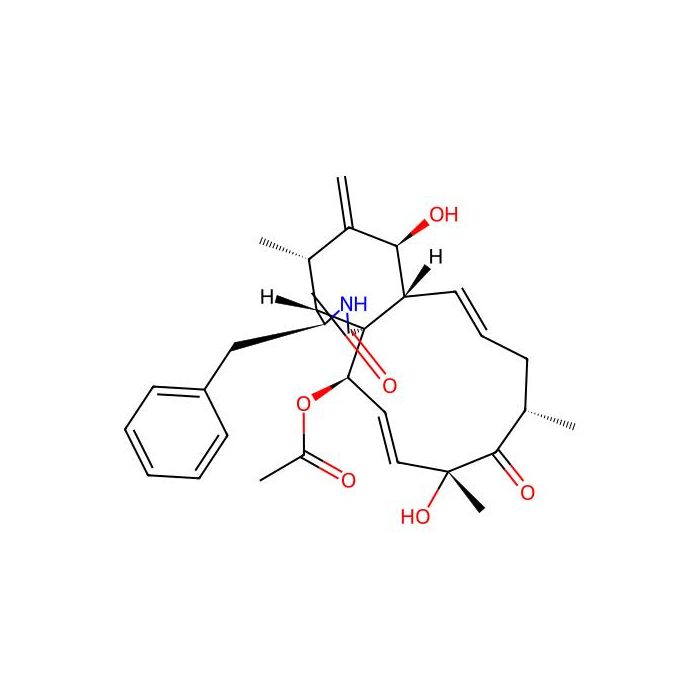
Cytochalasin D - Moligand™, 10 mM in DMSO , CAS No.22144-77-0

CAS: 22144-77-0 Cat. No.: C1499977 Formula: C30H37NO6 Peso molecolare: 507.62 Beilstein Registry Number: 1632828 Numero EC: 244-804-1
Disponibile su ordine
QUALITÀ & PUREZZA Moligand™ ? Moligand™ — Aladdin's line of ligands and bioactive small molecules. Use for receptor, pathway, and binding studies needing defined small-molecule tools. 10 mM in DMSO
Storage
Store at -80°C
Shipped In
Dry ice packs + Cold packs
★
Dimensione
Germania (EU)
USA*
Prezzo
Qtà
1ml
C1499977-1ml
Su ordinazione · 8–12 settimane
891,95€
Enter a quantity for the sizes you want to add.

Panoramica

Cytochalasin D (Zygosporin A) is a potent actin polymerization inhibitor, could be derived from fungus. Cytochalasin D has cell-permeable activity. Cytochalasin D inhibits the G-actin–cofilin interaction by binding to G-actin. Cytochalasin D also inhibits the binding of cofilin to F-actin and decreases the rate of both actin polymerization and depolymerization in living cells. Cytochalasin D can reduce exosome release, in turn reducing the amount of survivin present in the tumour environment. Cytochalasin D induces phosphorylation and cytoplasmic retention of Yap .

Specifiche

Specifiche e purezza
Moligand™, 10 mM in DMSO
Condizioni di conservazione di stoccaggio
Store at -80°C
Spedito in
Dry ice packs + Cold packs
Questo prodotto richiede spedizione a catena fredda. I servizi di terra e altri servizi economici non sono disponibili.
Grado
Moligand™
Nomi e identificatori
Isomeri SMILES
C[C@H]1C/C=C/[C@H]2[C@@H](C(=C)[C@H]([C@@H]3[C@@]2([C@@H](/C=C/[C@@](C1=O)(C)O)OC(=O)C)C(=O)N[C@H]3CC4=CC=CC=C4)C)O
WGK Germania
3
RTECS
GZ4850000
Numero UN
3172
Gruppo di imballaggio
I
Peso molecolare
507.62
Beilstein
1632828
Reaxys
25133796
Reaxys-RN_link_address
https://www.reaxys.com/reaxys/secured/hopinto.do?context=S&query=IDE.XRN=25133796&ln=

Dati avanzati

Certificati (CoA, COO, BSE/TSE e tabella di analisi)
C of A & Other Certificates(BSE/TSE, COO):
Analytical Chart:
Sicurezza e pericoli (GHS)
Pictogrammi
GHS06,   GHS08
Segnale
Danger
Indicazioni di pericolo

H300:Fatal if swallowed

H361:Suspected of damaging fertility or the unborn child

Precauzioni

P280:Wear protective gloves/protective clothing/eye protection/face protection.

P321:Specific treatment (see ... on this label).

P405:Store locked up.

P501:Dispose of contents/container to an approved waste disposal plant.

P264:Wash hands [and …] thoroughly after handling.

P270:Do not eat, drink or smoke when using this product.

P330:Rinse mouth.

P203:Obtain, read and follow all safety instructions before use.

P301+P316:IF SWALLOWED: Get emergency medical help immediately.

P318:if exposed or concerned, get medical advice.

WGK Germania
3
RTECS
GZ4850000
Reaxys
25133796
Reaxys-RN_link_address
https://www.reaxys.com/reaxys/secured/hopinto.do?context=S&query=IDE.XRN=25133796&ln=
Classe
6.1
Domande frequenti e articoli
Mechanisms of Action, Research Applications, and Cold-Induced Effects of Colchicine: An Overview
The uPA/uPAR System in Cell Migration and Microenvironment Remodeling
Cytoskeleton in Cell Structure Maintenance, Migration, and Disease Mechanisms
Exosome-Related Ingredients in Skincare Products: Sources and Preparation, Quality Control, Evidence of Efficacy, and Safety Assessment
Receptor Signaling Regulation of Actin Dynamics and Its Role in Cell Behavior and Disease
Mechanisms by Which PDRN Participates in Skin Repair: A2A Receptor-Related Signaling, Nucleotide Salvage, and Extracellular Matrix Remodeling
Molecular Composition, Signal Transduction Mechanisms, and Targeted Regulatory Strategies of the Hippo Signaling Pathway
Why Have YAP/TAZ–TEAD Become a New Breakthrough Point in the Hippo Pathway?
Citations of This Product
Calcolatori di soluzioni
Recensioni

Recensioni dei clienti

Desidera che le inviamo un messaggio quando avremo sconti disponibili?

Ricordamelo più tardi

Grazie! Controlli la sua casella di posta per confermare.

Ops! Le notifiche sono disabilitate.