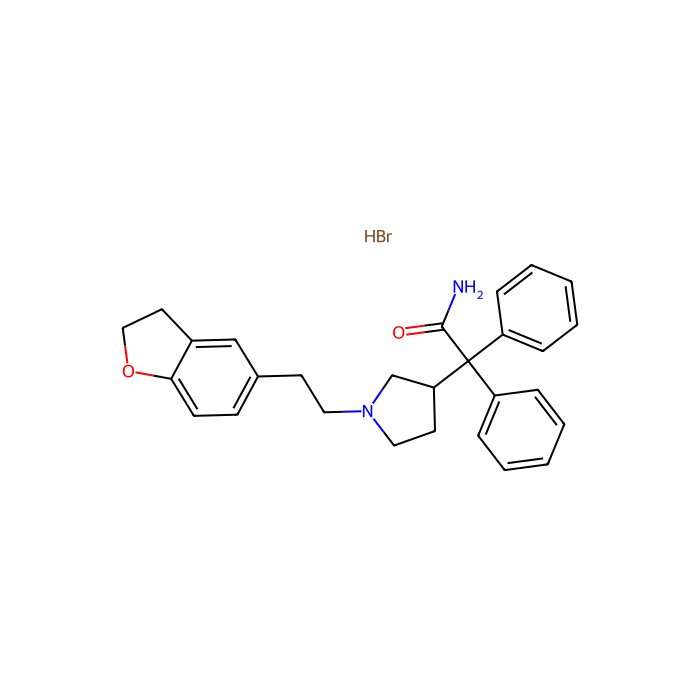
10mM in DMSO for sensitive chromatographic and analytical workflows requiring minimal baseline interference.
🌡
Storage & shipping
Store at -80°C Ships Dry ice packs + Cold packs Check lot-specific COA for exact specifications.
📋
Quality documents
SDS, COA, datasheet, and spec sheet available for download. Lot-specific COA accessible via lot number lookup.
📚
Literature proof
Cited in 1 peer-reviewed publications across chromatography, organic synthesis, and cross-coupling reactions.
Panoramica
Information
Darifenacin HBr (UK-88525) is a selectiveM3 muscarinicreceptor antagonist withpKiof 8.9. In vitro
Darifenacin exerts non-parallel rightward displacement of the agonist curve and also significant depression of the maximum response (+)-cis-Dioxolane produced concentration-dependent contraction of the isolated bladder of rat. Darifenacin produces a concentration dependent increase in R123 (P-gp probe) accumulation in MDCK cells. Darifenacin stimulates ATPase activity in P-gp membrane in a clear concentration dependent response manner with an estimated ED50 value of 1.6\u2009µM. Darifenacin (100 nM) shows a significantly greater permeability for darifenacin in the basolateral to apical direction resulting in an efflux ratio in BBMEC monolayers of approximately 2.6.
In vivo
Darifenacin produces dose-dependent inhibition of amplitude of volume-induced bladder contractions(VIBCAMP), producing 35% inhibition at dose of 283.3 nmol/kg and maximal inhibition of approximately 50–55%. Darifenacin (0.1 mg/kg i.v.) reduces bladder afferent activity in both Aδ and C fibers in female Sprague-Dawley rats, the decrease in afferent spikes in C fibers may be more pronounced than that in Aδ fibers. Darifenacin (7.5 mg and 15 mg, daily) reduces the number of incontinence episodes per week from baseline by 67.7% and 72.8% respectively compared with 55.9% with placebo in patients with overactive bladder (OAB). Darifenacin (7.5 mg and 15 mg, daily) also shows significantly superior to placebo for improvements in micturition frequency, bladder capacity, frequency of urgency, severity of urgency and number of incontinence episodes leading to a change in clothing or pads in patients with overactive bladder (OAB). Cell Data
We use cookies to ensure the website functions properly and, where permitted, to improve your experience. You can manage your preferences at any time in Settings. Learn more in our Cookie Policy.
Shall we send you a message when we have discounts available?
Remind me later
Thank you! Please check your email inbox to confirm.
Products are supplied to verified businesses, institutions, and qualified professionals for research and development use only. Not for use in humans, animals, diagnosis, or therapy.