GRADE & PURITYMoligand™?Moligand™ — Aladdin's line of ligands and bioactive small molecules. Use for receptor, pathway, and binding studies needing defined small-molecule tools.10 mM in DMSO
Certificati (CoA, COO, BSE/TSE e tabella di analisi)
C of A & Other Certificates(BSE/TSE, COO):
Analytical Chart:
Proprietà chimiche e fisiche
Punto di fusione (°C)
129-132°C (lit.)
Calcolatori di soluzioni
Molarity Calculator
Determine the necessary mass, volume, or concentration for preparing a solution.
Dilution Calculator
Determine the dilution needed to prepare a stock solution.
Reconstitution Calculator
Recensioni
Recensioni dei clienti
Application Protocols
No tested application protocols are provided in the Product Data for this item.
Item-specific guidance
Recommended assay types (WB, IHC, IF, FC), dilutions, or control materials: Not specified for this item; refer to CoA/Spec Sheet.
General research-use suggestions (non-validated, literature-based)
Prepare a 10–50 mM stock in anhydrous DMSO; store aliquots at −80 °C.
For biochemical binding assays, titrate final DMSO to 0.1–1% v/v and include vehicle controls.
Verify solubility at working concentrations by visual inspection and back-calculation from LC–MS recovery.
Users should develop and validate protocols within their specific experimental system.
Biological Roles
The following describes literature/general biology of desisobutyryl-ciclesonide and related corticosteroid scaffolds. No medical or clinical claims are made; this product is for research use only.
Class and origin (literature)
Desisobutyryl-ciclesonide is the de-esterified, active metabolite of ciclesonide, belonging to the glucocorticoid class of steroidal ligands.
Molecular pharmacology (literature/general)
Interacts with the glucocorticoid receptor (GR) as a high-affinity ligand, influencing transcriptional programs via GRE-mediated gene regulation in cellular models.
Exhibits high lipophilicity and protein binding in biological matrices, which can modulate free concentrations in assays.
Metabolism/biotransformation studies
Useful as a reference standard for investigating ester hydrolysis pathways of ciclesonide, phase II conjugation (e.g., glucuronidation/sulfation) at phenolic/aliphatic hydroxyls in hepatocyte or microsome systems (literature observations for glucocorticoids).
Experimental considerations
Adsorptive losses to plastics may be significant; prefer glass vials or silanized surfaces for low-nanomolar assays.
Employ carrier proteins (e.g., BSA) or cyclodextrins cautiously, as they can alter apparent potency by changing free fraction.
All biology content above reflects general literature context for corticosteroid research compounds and is not item-specific.
Buffer Applications
This compound is a hydrophobic, neutral small molecule and is not a buffer component. It does not define pH or ionic strength.
Practical guidance
Use standard biological buffers (e.g., PBS, HEPES, Tris) appropriate for your assay and dissolve desisobutyryl-ciclesonide in a compatible co-solvent (commonly DMSO) before spiking into the buffer.
Keep final organic co-solvent content as low as feasible (typically 0.1–1% v/v) and include appropriate vehicle controls.
For buffer formulation specifics (molarities, pH ranges), refer to the buffer system’s documentation; this product does not serve as a buffering agent.
Green Alternatives
While desisobutyryl-ciclesonide is a solid ligand rather than a process solvent, greener choices center on the dissolution and workup solvents employed with this compound.
Greener solvent substitutions (general guidance)
Replace chlorinated solvents (DCM, chloroform) with ethyl acetate, isopropyl acetate, or methyl tert-butyl ether (MTBE) for extractions and rotary evaporation.
For stock solutions, consider Cyrene (dihydrolevoglucosenone) or PolarClean as partial substitutes for DMF/NMP in certain analytics; confirm solubility and assay compatibility.
Use ethanol or isopropanol as co-solvents in place of acetonitrile when LC method sensitivity allows; be mindful of backpressure and elution strength.
Comparison (general)
DMSO vs Cyrene: DMSO offers superior solubility and assay familiarity; Cyrene is bio-based with lower toxicity profile but can be less miscible with water at high fractions and may impact some detection methods.
DCM vs EtOAc: EtOAc is biodegradable with lower environmental impact; volatility is slightly lower but adequate for rapid solvent removal.
Operational practices with environmental benefits
Prepare higher-concentration master stocks to minimize solvent volume in assays (keeping under solubility/viscosity limits).
Employ microscale extractions and 96-well plate evaporators to reduce solvent throughput.
Validate greener solvent choices for recovery and analyte stability before wholesale method changes.
Pharmaceutical Uses
No clinical or therapeutic claims are made. The following reflects formulation and manufacturing context where research-grade desisobutyryl-ciclesonide may be relevant as a reference material.
Reference/analytical uses (general)
Process and impurity profiling: reference standard for monitoring de-esterified species in ciclesonide manufacturing and stability studies.
Method validation: system suitability and calibration in LC–UV/LC–MS for assays targeting ciclesonide and metabolites.
Pre-formulation research (general)
Solubility screens in biorelevant media (FaSSIF/FeSSIF) to evaluate partitioning and potential matrix effects; confirm absence of crystallization upon dilution.
Excipient compatibility checks (with surfactants, cyclodextrins, or lipids) for enabling formulations in early-stage research.
Regulatory context
Pharmacopeial monographs may address ciclesonide but not necessarily its desisobutyryl metabolite; use compendial guidance for analytical technique selection where applicable. Item-specific pharmacopeial status: Not specified for this item; refer to CoA/Spec Sheet.
All uses above pertain to non-clinical research, development, and analytical workflows only.
Physical Properties
Item-specific physicochemical specifications are not provided in the Product Data. The following notes summarize typical characteristics for steroidal corticosteroid analogs like desisobutyryl-ciclesonide; treat all numeric properties as literature/general guidance only and verify against the CoA when critical.
Item-specific values
Melting point, boiling point, density, refractive index, water/peroxide/metal limits, UV cutoff: Not specified for this item; refer to CoA/Spec Sheet.
Literature/general characteristics for steroidal corticosteroids (qualitative)
Physical state: typically a white to off-white crystalline solid.
Volatility: nonvolatile; decomposes before boiling at ambient pressure.
Solubility profile: sparingly soluble in water; soluble in polar aprotic organics (DMSO, DMF, NMP) and moderately in alcohols (EtOH, i-PrOH). Often dissolves in ethyl acetate, acetone, and chlorinated solvents; limited solubility in alkanes.
Partitioning: lipophilic with high affinity for organic phases; typically exhibits positive logP/logD at neutral pH (literature for glucocorticoids).
Acid–base behavior: neutral polyfunctional molecule without ionizable groups in the physiological pH range; lacks simple pKa-relevant amphoteric centers (literature).
Practical notes (general)
Prepare concentrated DMSO stocks (e.g., 10–50 mM) then dilute into assay buffers with vigorous mixing to avoid precipitation.
Use co-solvents/surfactants (0.1–1% DMSO or Tween-20/40) in aqueous assays to maintain solubility. Validate by visual inspection and recovery assays.
Quality and Grades
Item-specific grade
Grade: Moligand™ (Product Data). This designation indicates suitability for screening, chemical biology, and medicinal chemistry workflows where ligand integrity, identity, and purity are critical. It typically emphasizes high chemical identity confirmation (e.g., LC–MS/HRMS, NMR) and controlled impurity profiles appropriate for target-binding studies and SAR campaigns.
What Moligand™ generally implies (general guidance)
Identity control: orthogonal structural verification to ensure the ligand structure used in assays matches the intended entity.
Purity context: optimized for bioassay consistency (commonly by LC/UPLC area percent); specific numeric purity for this item is not provided in the Product Data.
Solubility notes: provided as neat solid unless otherwise noted; users prepare DMSO/organic stock solutions for screening.
Item-specific specifications
Numerical specs (purity %, residual solvents, water by KF, metal limits, stabilizers, UV cutoff): Not specified for this item; refer to CoA/Spec Sheet.
Practical recommendations
Upon receipt, record batch number and link all screening data to the CoA.
For high-sensitivity biophysical assays (SPR, ITC), consider an additional polish (e.g., preparative HPLC) if your application requires >99% area-purity; verify with your QC analytics.
Document exact solvent system and concentration used to ensure inter-assay comparability.
Reaction and Applications
This product is primarily intended as a research-grade reference compound/ligand for screening and analytical workflows rather than as a bulk synthetic intermediate. That said, desisobutyryl-ciclesonide’s functional group set offers useful reactivity in specialized synthetic or derivatization contexts.
Research applications (general)
Reference material for analytical method development (LC–MS, qNMR) in studies involving ciclesonide metabolism and related corticosteroid pathways.
Ligand in target-binding assays (biophysical/biochemical) examining corticosteroid receptor interactions (literature), with careful control of solvent and concentration.
Derivatization/chemistry (general)
Free 21-hydroxyl (relative to the parent isobutyryl ester) enables selective acylation, carbonate/carbamate formation, and silylation for analytical enhancement (e.g., GC–MS derivatization with MSTFA/TMSCl).
Carbonyl functions on the steroid core can participate in oxime/hydrazone formation for tagging or stabilization.
Protective group strategies: transient silyl ethers (TBS, TBDMS) at alcohol sites under mild conditions compatible with steroid skeletons.
Practical tips
Maintain anhydrous, oxygen-protected conditions during moisture-sensitive derivatizations.
Use mild bases (pyridine, DIPEA) to avoid epimerization or retro-aldol-like degradation at sensitive positions.
Monitor reactions by LC–MS with soft ionization to track subtle mass changes due to derivatization.
No manufacturer-specific application notes were provided in the Product Data; the above are general, literature-based suggestions.
Reaction Conditions
No item-specific reaction condition data are provided. The following general conditions reflect literature practices for modifying steroidal alcohols and carbonyls like those present in desisobutyryl-ciclesonide; verify and optimize for your system.
Acylation/silylation of alcohols (general)
Solvent: dry DCM, DMF, or acetonitrile. Base: pyridine, DIPEA, or imidazole. Reagents: acyl chlorides/anhydrides, TBSCl/TBDMSCl with DMAP.
Temperature: 0–25 °C; time: 0.5–16 h. Typical outcomes: high conversion with minimal steroid core rearrangement under mild conditions.
Carbonate/carbamate formation (general)
Reagents: p-nitrophenyl chloroformate or CDI followed by amine/alcohol coupling.
Solvent: DCM/THF; base: DIPEA. 0–25 °C, 1–6 h. Monitor for over-carbonation.
Oxime/hydrazone formation on carbonyls (general)
Solvent: EtOH or MeOH with catalytic AcOH. Temperature: rt–50 °C. Time: 1–6 h.
Reductions (precautionary)
NaBH4 (MeOH/EtOH, 0–25 °C) may reduce selected carbonyls; Luche conditions (CeCl3) can improve chemoselectivity. Avoid conditions that jeopardize stereochemistry.
Purification
Silica gel chromatography with gradients of hexane/EtOAc or DCM/MeOH (0–10% MeOH with 0.1% NEt3 to prevent tailing). Monitor by LC–MS/APCI.
Expected yields (literature, highly dependent on substrate and site)
Protective group operations: often 60–90%.
Carbonate/carbamate tagging: 40–80%.
These are starting points; fine-tune equivalents, temperature, and time based on real-time analytical feedback.
Safety and Handling
Always consult the SDS for definitive safety information. Product Data do not specify GHS details for this item.
Item-specific hazard information
Signal word: Not specified for this item; refer to SDS.
H-statements: Not specified for this item; refer to SDS.
GHS classification and pictograms: Not specified for this item; refer to SDS.
General precautions for steroidal small molecules (literature/general)
Avoid inhalation of dusts and skin/eye contact; handle in a chemical fume hood or ventilated enclosure.
Wear appropriate PPE: lab coat, safety glasses or goggles, and disposable nitrile gloves; upgrade to double-gloving for extended handling.
Prevent environmental release; collect solid and liquid waste as halogen-free organic waste unless otherwise directed by SDS.
Incompatibilities and stability (general)
Typically stable under dry, dark, and cold conditions. Avoid strong oxidizers, strong bases/acids at elevated temperature, and prolonged exposure to light.
For solution stocks, minimize repeated freeze–thaw; aliquot and store protected from moisture.
First aid overview (general)
Skin/eye contact: Rinse with water for at least 15 minutes; remove contaminated clothing.
Inhalation: Move to fresh air; seek medical attention if symptoms persist.
Ingestion: Rinse mouth; do not induce vomiting; seek medical advice.
Note: No medical or clinical use is implied; for research use only.
Solvent Selection
Desisobutyryl-ciclesonide is a lipophilic, neutral steroidal small molecule. Solubility and assay performance depend strongly on solvent choice.
Polarity/miscibility (general, literature)
Sparingly soluble in water; readily soluble in DMSO, DMF, NMP; moderate in EtOH/i-PrOH; soluble in EtOAc, acetone, MeCN to varying extents.
For aqueous assays, use water-miscible organic co-solvents (DMSO 0.1–1% v/v final) to maintain clarity.
Stock preparation strategies
Prepare 10–50 mM stocks in anhydrous DMSO; filter through 0.22 μm PTFE if needed (avoid adsorption with nylon for hydrophobic steroids).
For higher-volatility matrices (GC, prep), EtOAc or acetone may be preferred due to easy removal under reduced pressure.
When to choose each solvent (general guidance)
DMSO: maximal solubilizing power; preferred for biochemical/biophysical assays.
EtOH: acceptable for some cell-free targets; watch precipitation upon dilution.
MeCN: suitable for LC injection preparations; check solubility first.
EtOAc/MTBE: workup/extraction of organic phases from aqueous buffers.
Compatibility notes
Avoid high water fractions without co-solvent; precipitation risk is high.
Surfactants (0.01–0.1% Tween-20/40) or serum proteins can enhance apparent solubility in biological media; validate for assay interference.
All solvent choices should be validated for your specific workflow and detection method.
Storage and Reconstitution
Item-specific conditions (Product Data)
Storage: Store at −80 °C.
Shipping: Dry ice packs + Cold packs.
Appearance: Not specified for this item; refer to CoA/Spec Sheet.
Reconstitution (general guidance for hydrophobic small molecules)
Open vials at ambient temperature in a low-humidity environment to avoid moisture uptake and condensation.
Prepare concentrated stocks in anhydrous DMSO (typical 10–50 mM). If needed, sonicate gently or warm to 25–30 °C briefly to aid dissolution, then allow to cool before use.
For aqueous applications, add the DMSO stock slowly into vigorously stirred buffer to the desired final concentration, keeping DMSO at 0.1–1% v/v.
Aliquoting and stability
Aliquot stock solutions into single-use portions to avoid freeze–thaw cycles; store at −80 °C, protected from light.
Solid-state stability is generally highest under dry, dark, and cold conditions. Solution stability depends on solvent and temperature; confirm by periodic LC–MS.
Incompatibilities and handling
Avoid prolonged exposure to light and elevated temperatures. Keep containers tightly closed; purge headspace with inert gas if long-term storage is anticipated.
Research Use Note
For research use only; not for human or veterinary use.
Structure and Identity
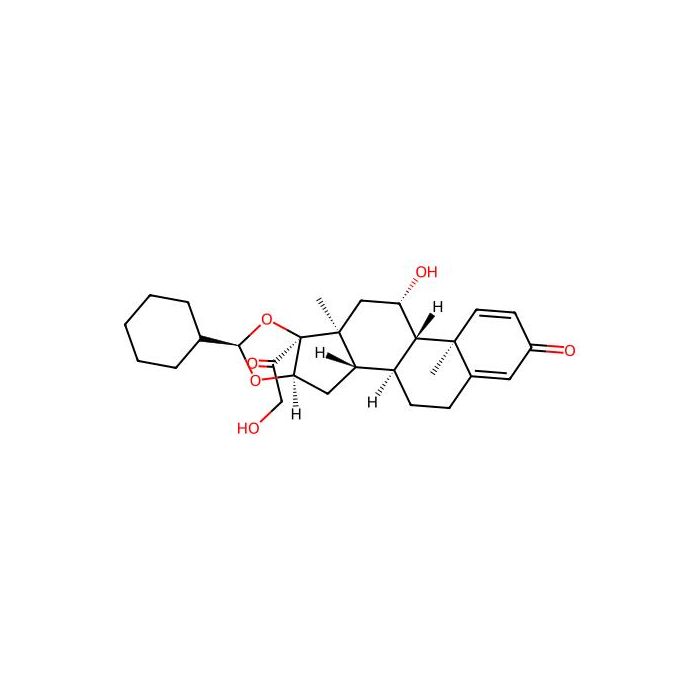
Desisobutyryl-ciclesonide (often abbreviated des-CIC) is a steroidal small molecule related to ciclesonide in which the isobutyryl moiety has been removed to reveal the active corticosteroid alcohol functionality.
Item-specific identifiers (Product Data)
SKU: D1494512
CAS: 161115-59-9
Grade: Moligand™
InChIKey: Not specified for this item; refer to CoA/Spec Sheet.
SMILES: Not specified for this item; refer to CoA/Spec Sheet.
Molecular formula: Not specified for this item; refer to CoA/Spec Sheet.
Molecular weight: Not specified for this item; refer to CoA/Spec Sheet.
Literature/structural description (general)
Core scaffold: tetracyclic cyclopentanoperhydrophenanthrene (steroidal) nucleus with typical A/B/C/D ring fusion.
Functional groups: secondary/tertiary alcohols, a 20-keto/21-hydroxyl region common to glucocorticoids, and an acetal/ketal-type substitution around C16/C17 in ciclesonide-derived structures (literature).
Stereochemistry: multiple defined stereocenters characteristic of corticosteroids (e.g., 8β/9α/10β/13β/14α configurations; literature), preserving the three-dimensional conformation necessary for receptor binding studies.
2D depiction (verbal): a fused four-ring steroid backbone bearing oxygenated substituents on rings A and D; the side-chain at C17 terminates in oxidized/oxygenated functions. The “desisobutyryl” designation indicates absence of the isobutyryl ester present in ciclesonide at the 21-position, yielding a free hydroxy functionality (literature).
Note: Exact line notations (SMILES) and registries for this specific lot are not provided in the Product Data and should be confirmed on the CoA.
Synthetic Utility
Although primarily a screening/analytical ligand, desisobutyryl-ciclesonide contains functional handles useful for selective transformations and probe synthesis.
Functional group reactivity (general)
Secondary/tertiary alcohols: acylation (Ac2O, acyl chlorides), carbonate formation, and silylation (TBS/TBDMS) under mild Lewis acid or base catalysis.
Carbonyls: oxime/hydrazone formation (NH2OH, hydrazines) for tagging; reductive modifications (NaBH4/CeCl3, or catalytic hydrogenation under carefully controlled conditions) may tune physicochemical properties.
Enolizable positions: avoid strong base to prevent isomerization; use non-nucleophilic bases (DIPEA) when needed.
Conjugation strategies
NHS carbonate or carbamate linkers at the 21-hydroxyl can yield biotinylated or fluorescent probes for pulldown or imaging in biochemical systems (research context).
Click-compatible handles can be introduced via propargyl/azido carbonates for subsequent CuAAC/SPAAC labeling.
Selectivity considerations
Protect other alcohols before selective derivatization to minimize mixed products; leverage sterics and reagent choice (e.g., bulky silyl reagents) for site selectivity.
Analytical tracking
Monitor derivatizations by LC–MS; steroid cores ionize well in APCI/ESI with characteristic neutral losses upon fragmentation, aiding site-of-modification confirmation.
These synthetic notes are general to steroidal alcohols and should be validated for this specific compound in your lab.
Target Specificity
Item-specific target/assay validation data are not provided in the Product Data.
For this catalog item
Antigen/target name, receptor selectivity profile, species reactivity, and any lot-specific binding constants: Not specified for this item; refer to CoA/Spec Sheet or associated application notes if available.
General literature context (not item-specific)
Desisobutyryl-ciclesonide is described as a glucocorticoid-class ligand interacting with the glucocorticoid receptor; exact potency/affinity values vary by assay system and are not provided here.
Need help choosing the grade?
Our grade selection guide covers purity, stabilizer status, and application suitability for all variants in our catalog.
We use cookies to ensure the website functions properly and, where permitted, to improve your experience. You can manage your preferences at any time in Settings. Learn more in our Cookie Policy.
Shall we send you a message when we have discounts available?
Remind me later
Thank you! Please check your email inbox to confirm.
Products are supplied to verified businesses, institutions, and qualified professionals for research and development use only. Not for use in humans, animals, diagnosis, or therapy.