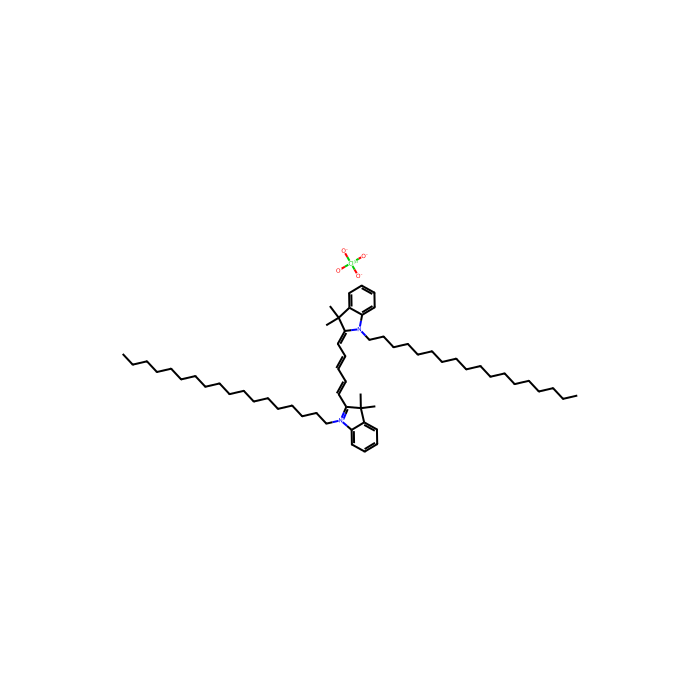
DiD, DiO, DiI, DiR and DiS dyes are a family of lipophilic fluorescent dyes that can be used to stain cell membranes and other fat-soluble biological structures. When combined with the cell membrane, the fluorescence intensity is greatly enhanced, and this type of dye has a high quenching constant and excited state lifetime. Once the cells are stained, this type of dye spreads across the cell membrane, and the optimal concentration can stain the entire cell membrane. Their fluorescence colors are clearly distinguished: DiI (orange fluorescence), DiO (green fluorescence), DiD (red fluorescence) and DiR (dark red fluorescence) which allows them to be used for multicolor imaging and flow analysis of living cells. DiI and DiO can use standard FITC and TRITC filters respectively. DiD can be excited by a 633 nm He-Ne laser, has a longer excitation and emission wavelength than DiI, and is more valuable in cell and tissue staining. DiR's infrared fluorescence can penetrate cells and tissues and be used for tracking in in vivo imaging.
Instructions
1. DiD, DiO, DiI, DiR and DiS cell membrane staining solution preparation
(1) Configure DMSO or EtOH storage solution: Use DMSO or EtOH to configure the storage solution with a concentration of 1 to 5 mM.
Note: Store the unused storage solution at -20°C, avoid repeated freezing and thawing.
(2) Preparation of working solution: Dilute the stock solution with a suitable buffer (such as serum-free medium, HBSS or PBS) to prepare a working solution with a concentration of 1 to 5 µM.
Note: The final concentration of the working solution is prepared according to the experience of different cells and experiments. The best conditions can be found from ten times the recommended concentration. To
2. Suspension cell staining
(1) The suspended cell density is 1 × 10⁶/mL and added to the working solution.
(2) Incubate cells at 37°C for 2-20 minutes. The optimal culture time varies for different cells.
(3) Centrifuge the stained cell tube at 1000-1500 rpm for 5 minutes.
(4) Pour the supernatant, and slowly add the pre-warmed 37°C culture solution again.
(5) Repeat steps (3) and (4) twice or more.
3. Staining of mucosal cells
(1) The cells that adhere to the wall are cultured in a sterile laboratory.
(2) Remove the cover glass from the culture medium, aspirate the excess medium, and place the cover glass in a humid environment.
(3) Add 100μL of dye working solution to one corner of the cover glass, and shake gently to make the dye evenly cover all cells.
(4) Cultivate the cells at 37°C for 2-20 minutes. The optimal culture time is different for different cells.
(5) Blot the dye working solution, wash the cover glass 2 to 3 times with the culture solution, cover all the cells with pre-warmed culture medium each time, incubate for 5-10 minutes, and then blot the culture medium.
4. Microscope inspection
(1) DiI filter selection XF32-Omega, 31002-Chroma
(2) Simultaneous detection of multicolor dyes, the filter is set as follows:
a) DiI and DiO = Omega XF52, Chroma 51004;
b) DiI and DiD = Omega XF92, Chroma 51007;
c) DiI, DiO and DiD = Omega XF93, Chroma 61005
5. Flow cytometry detection
DiD, DiO, DiI, DiR and DiS stained cells can be detected by classic FL1, FL2, FL3 and FL4 flow cytometry, respectively.

 E2609450