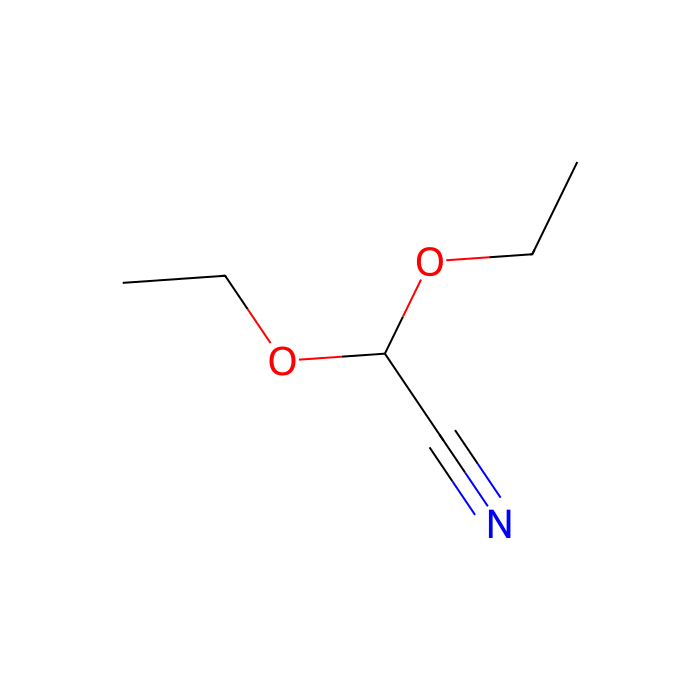
a chemical used for synthesis. With this chemical you can synthesize methyl 5-diethoxymethylimidazole-4-carboxylate by anionic cycloaddition of methyl isocyanoacetate to diethoxyacetonitrile. You can also synthesize ketoacetal, by Houben-Hoesch reaction of diethoxyacetonitrile with 1,2,4-trimethoxybenzene. Diethoxyacetonitrile is a 2,2-dialkoxyalkanenitrile derivative. Reaction of hydrocyanic acid with various ortho esters of aliphatic and aromatic acids in the presence of acidic catalyst has been reported to afford diethoxyacetonitrile. Houben-Hoesch reaction of diethoxyacetonitrile with 1,2,4-trimethoxybenzene affords tris(2,4,5-trimethoxyphenyl)methane
This compound belongs to the class of organic compounds known as acetals. These are compounds having the structure R2C(OR')2 ( R' not Hydrogen) and thus diethers of geminal diols. Originally, the term was confined to derivatives of aldehydes (one R = H), but it now applies equally to derivatives of ketones (neither R = H ). Mixed acetals have different R' groups.
External Descriptors
Not available
1. Djoumbou Feunang Y, Eisner R, Knox C, Chepelev L, Hastings J, Owen G, Fahy E, Steinbeck C, Subramanian S, Bolton E, Greiner R, and Wishart DS. ClassyFire: Automated Chemical Classification With A Comprehensive, Computable Taxonomy. Journal of Cheminformatics, 2016, 8:61.
Utilizziamo i cookie per garantire il corretto funzionamento del sito web e, ove consentito, per migliorare la tua esperienza. Puoi gestire le tue preferenze in qualsiasi momento nelle Impostazioni. Per saperne di più, consulta la nostra Cookie Policy.
Desidera che le inviamo un messaggio quando avremo sconti disponibili?
Ricordamelo più tardi
Grazie! Controlli la sua casella di posta per confermare.
Products are supplied to verified businesses, institutions, and qualified professionals for research and development use only. Not for use in humans, animals, diagnosis, or therapy.

 D23061077