Diethyl trans-1,4-Cyclohexanedicarboxylate - ≥98%(GC) , CAS No.19145-96-1

CAS: 19145-96-1 Cat. No.: D154130 Formula: C12H20O4 Peso molecolare: 228.29
Disponibile su ordine
GRADE & PURITY ≥98%(GC)
Synonyms
1,4-Cyclohexanedicarboxylic acid, diethyl ester | SCHEMBL2375356 | AKOS015833095 | NCIOpen2_004296 | SB47915 | SCHEMBL8891623 | NSC 78975 | trans-Diethyl cyclohexane-1,4-dicarboxylate | 1,4-diethyl cyclohexane-1,4-dicarboxylate | DTXSID0052469 | trans-1,4
Storage
Room temperature
Shipped In
Normal
★
Size
Germania (EU)
USA*
Price
Qty
1g
D154130-1g
—
5 Disponibile
31,15€
5g
D154130-5g
—
3 Disponibile
114,45€
25g
D154130-25g
—
3 Disponibile
343,54€
Enter a quantity for the sizes you want to add.
🧪
Why this grade

≥98%(GC) for sensitive chromatographic and analytical workflows requiring minimal baseline interference.

🌡

Storage & shipping

Room temperature Ships Normal Check lot-specific COA for exact specifications.

📋

Quality documents

SDS, COA, datasheet, and spec sheet available for download. Lot-specific COA accessible via lot number lookup.

📚

Literature proof

Cited in 0 peer-reviewed publications across chromatography, organic synthesis, and cross-coupling reactions.

Specifications

Sinonimi
1,4-Cyclohexanedicarboxylic acid, diethyl ester | SCHEMBL2375356 | AKOS015833095 | NCIOpen2_004296 | SB47915 | SCHEMBL8891623 | NSC 78975 | trans-Diethyl cyclohexane-1,4-dicarboxylate | 1,4-diethyl cyclohexane-1,4-dicarboxylate | DTXSID0052469 | trans-1,4
Specifiche e purezza
≥98%(GC)
Condizioni di conservazione di stoccaggio
Room temperature
Spedito in
Normal
Purezza
≥98%(GC)
Nomi e identificatori
Pubchem Sid
Pubchem Sid Url
https://pubchem.ncbi.nlm.nih.gov/substance/488189057
Sorrisi canonici
CCOC(=O)C1CCC(CC1)C(=O)OCC
IUPAC Name
diethyl cyclohexane-1,4-dicarboxylate
InChIKey
KRJHRNUTLDTSKY-UHFFFAOYSA-N
INCHI
1S/C12H20O4/c1-3-15-11(13)9-5-7-10(8-6-9)12(14)16-4-2/h9-10H,3-8H2,1-2H3
Isomeri SMILES
CCOC(=O)C1CCC(CC1)C(=O)OCC
Peso molecolare
228.29
Reaxy-Rn
2117419
Reaxys-RN_link_address
https://www.reaxys.com/reaxys/secured/hopinto.do?context=S&query=IDE.XRN=2117419&ln=

Documentazione

📋 Safety Data Sheet (SDS)

Comprehensive hazard, handling, storage, and regulatory compliance document.

Download SDS →

✅ Certificate of Analysis (COA)

Lot-specific quality data. Enter your lot number to retrieve the exact COA.

Look up COA →

📊 Datasheet

Quick-reference summary of product specifications and applications.

View datasheet →

🔬 Specification Sheet

Full quality attributes and acceptance criteria for this grade.

View spec sheet →

Advanced Data

Taxonomic Classification

Taxonomy Tree

KingdomOrganic compounds
SuperclassOrganic acids and derivatives
ClasseCarboxylic acids and derivatives
SubclassDicarboxylic acids and derivatives
Intermediate Tree Nodes Not available
Direct ParentDicarboxylic acids and derivatives
Alternative Parents Carboxylic acid esters  Organic oxides  Hydrocarbon derivatives  Carbonyl compounds  
Molecular FrameworkAliphatic homomonocyclic compounds
Substituents Dicarboxylic acid or derivatives - Carboxylic acid ester - Organic oxygen compound - Organic oxide - Hydrocarbon derivative - Organooxygen compound - Carbonyl group - Aliphatic homomonocyclic compound
DescrizioneThis compound belongs to the class of organic compounds known as dicarboxylic acids and derivatives. These are organic compounds containing exactly two carboxylic acid groups.
External Descriptors Not available
Struttura 3D
Modello di struttura chimica interattiva


Certificati (CoA, COO, BSE/TSE e tabella di analisi)
C of A & Other Certificates(BSE/TSE, COO):
Analytical Chart:

Find and download the COA for your product by matching the lot number on the packaging.

3 results found

Lot NumberCertificate TypeDataOggetto
L2209440Certificate of AnalysisSep 01, 2026 D154130
L2209441Certificate of AnalysisSep 01, 2026 D154130
L2209449Certificate of AnalysisSep 01, 2026 D154130
Proprietà chimiche e fisiche
SolubilitàSoluble in Methanol
Punto di fusione (°C)45 °C
Peso molecolare228.280 g/mol
XLogP31.900
Hydrogen Bond Donor Count0
Hydrogen Bond Acceptor Count4
Rotatable Bond Count6
Exact Mass228.136 Da
Monoisotopic Mass228.136 Da
Topological Polar Surface Area52.600 Ų
Heavy Atom Count16
Formal Charge0
Complexity215.000
Isotope Atom Count0
Defined Atom Stereocenter Count0
Undefined Atom Stereocenter Count0
Defined Bond Stereocenter Count0
Undefined Bond Stereocenter Count0
The total count of all stereochemical bonds0
Covalently-Bonded Unit Count1
Calcolatori di soluzioni
Recensioni

Recensioni dei clienti

Application Protocols

Not applicable. No antibody/biological assay protocols (WB, IHC, IF, FC) are associated with this small-molecule reagent. For chemical use, refer to the Reaction Conditions, Reaction & Applications, and Synthetic Utility sections for practical laboratory guidance.

Biological Roles

This compound is a synthetic aliphatic diester and is not a known natural metabolite or cofactor.

  • Biological function: No established endogenous biological roles. It serves primarily as a chemical building block in materials and synthetic organic chemistry.
  • Biocompatibility/toxicity: Specific biological activity and toxicology for this exact compound are not provided for this item; refer to the SDS and primary literature. As a hydrophobic diester, it is expected to partition into lipid phases; however, no conclusions should be drawn without empirical data.
  • Enzymatic susceptibility: Like other simple diesters, it can undergo ester hydrolysis by esterases under biological conditions in principle, generating the corresponding alcohol(s) and acid; actual rates and pathways depend on enzyme complement and environment (literature generality, not product-specific).

Research context:

  • Structural analogs of dialkyl diesters are sometimes used as model substrates in studies of ester hydrolysis and in materials interfacing with biological systems. For this item, no biological application has been validated by the manufacturer; use is limited to research/laboratory purposes.
Buffer Applications

Not typically applicable. Diethyl trans-1,4-cyclohexanedicarboxylate is a neutral, hydrophobic diester with negligible water solubility and does not function as a buffering agent. For aqueous work, focus instead on solvent selection and biphasic reaction strategies described under Solvent Selection and Reaction Conditions.

Green Alternatives

While the product itself is a reagent, greener choices can be made in the solvents and reagents used to transform and process it.

Greener solvent alternatives (literature-based comparison):

  • Consider replacing DCM/chloroform with ethyl acetate or 2-MeTHF for extractions and reactions when feasible.
  • Replace MTBE/diethyl ether with 2-MeTHF or CPME to reduce peroxide risk and improve boiling point/process safety.
  • Favor toluene or xylene over chlorinated solvents for higher-temperature steps, with appropriate engineering controls.

Comparison snapshot (general):

  • DCM vs EtOAc: EtOAc offers lower toxicity and better environmental profile; both dissolve diesters well. EtOAc is more flammable and higher bp; adjust process controls accordingly.
  • THF vs 2-MeTHF: 2-MeTHF is bio-based, less miscible with water (facilitating phase separation), and often allows simplified workups; both can form peroxides—manage with inhibitor checks and periodic testing.
  • IPA/EtOH as reaction media: avoid when preserving ethyl ester integrity; if hydrolysis/transesterification is intended, aqueous EtOH/MeOH can be used deliberately.

Reagent choices:

  • For ester reductions, consider BH3·THF or catalytic hydrogenation methods where applicable as alternatives to stoichiometric LiAlH4, balancing EHS considerations; however, selectivity requirements may still favor classical hydrides.

Waste and energy:

  • Employ solvent recycling (distillation) for high-boiling aromatics/esters.
  • Design for minimal aqueous basic hydrolysis waste by using near-stoichiometric base and phase separation to reduce neutralization loads.

Note: Always validate green substitutions at bench scale to confirm yield, selectivity, and impurity profile.

Pharmaceutical Uses

No pharmacopeial grade or excipient designation is specified for this item; refer to CoA/Spec Sheet if a specific certification is required. This product is supplied strictly for research use only and is not intended for human or veterinary applications.

General context (non-clinical, literature):

  • Saturated diesters can serve as intermediates in the synthesis of prodrugs or polymeric materials (e.g., polyesters) used in formulation science; however, no such use is claimed or validated for this specific material.
  • If considering this scaffold in pre-formulation research, ensure comprehensive toxicological evaluation and compliance with relevant pharmacopeial standards; none are asserted for this catalog item.

Manufacturing considerations:

  • Residual solvent control, isomeric purity (trans-1,4 geometry), and hydrolytic stability are typical CMC considerations for diester intermediates in research settings.
Physical Properties

Item-specific physical specifications (BP, MP, density, refractive index, water content, assay, stabilizers) are not specified for this item; refer to CoA/Spec Sheet.

General/literature-based guidance for dialkyl cyclohexane-1,4-dicarboxylates (informational, not product specifications):

  • Physical state: typically colorless to pale liquid or low-melting solid with an oily character, depending on purity/isomer ratio.
  • Polarity/solubility: hydrophobic; expected to be insoluble in water and miscible with many organic solvents (e.g., ethers, chlorinated solvents, aromatics, esters, ketones). Limited solubility in highly nonpolar alkanes can improve with gentle warming.
  • Volatility: low volatility for a C12 diester; suitable for operations where minimal solvent loss is desired.
  • Partitioning: esters of this size generally exhibit high organic/aqueous partitioning (logP positive), consistent with use in non-aqueous media.
  • Acidity/basicity: neutral ester; no titratable functionality in the physiological pH range. Susceptible to hydrolysis under strong acidic or basic conditions.

Practical notes (general):

  • Drying: can be dried over anhydrous MgSO4/Na2SO4 after organic workups.
  • Viscosity: moderate; may benefit from gentle warming (e.g., 30–40 °C) for accurate volumetric handling.

For exact numerical values (bp, mp, density, RI) for this catalog item, consult the current CoA/Spec Sheet.

Quality and Grades
  • Item-specific grade/purity: Not specified for this item; refer to CoA/Spec Sheet for assay, impurity profile, and any stabilizers.

Guidance on interpreting common grades (general information):

  • Analytical/Reagent grade: typically specifies high chemical purity and low inorganic residues; useful for precise stoichiometry and minimal background in analytical procedures.
  • Synthesis grade/Technical: suitable for most synthetic applications; impurity levels may be higher but acceptable for many transformations, especially when followed by purification.
  • HPLC/UV grade (where applicable): controls UV-absorbing impurities and particulates; a consideration if the compound is to be used as an internal standard or reference in chromatographic method development.

Considerations specific to diesters like diethyl trans-1,4-cyclohexanedicarboxylate:

  • Isomeric purity: the trans-1,4 isomer affects spatial geometry and downstream stereochemical outcomes. If your process is geometry-sensitive (e.g., polymer linkers, macrocycle assembly), request or verify isomeric composition on the CoA.
  • Residual solvents and alcohol content: ester products may retain traces of alcohols/solvents from synthesis; these can influence reactivity (transesterification) and should be within your process limits.
  • Water content: although esters are hydrophobic, trace moisture can accelerate hydrolysis under basic conditions. Karl Fischer moisture specification, if critical, should be confirmed on the CoA.

If a specific certification (e.g., USP/Ph. Eur. compliant) is required, contact us to confirm availability prior to ordering.

Reaction and Applications

Diethyl trans-1,4-cyclohexanedicarboxylate is a versatile difunctional building block offering a rigid, trans-1,4 spacing. Typical uses center on exploiting the two ester handles for divergent transformations and the spatial geometry of the cyclohexane core.

Common reaction families (literature/general):

  • Hydrolysis (saponification/acidic): conversion to trans-1,4-cyclohexanedicarboxylic acid; enables subsequent activation (acid chlorides, anhydrides) for coupling chemistry.
  • Aminolysis/transesterification: direct formation of diamides or alternate diesters under catalysis (e.g., DMAP, alkoxides). Control conditions to avoid scrambling of the ethyl groups when undesired.
  • Reductions:
    • To dialdehyde: partial reduction with DIBAL-H at low temperature (e.g., −78 °C) to furnish trans-1,4-cyclohexanedicarboxaldehyde analogs.
    • To diol: full reduction of the diester to trans-1,4-bis(hydroxymethyl)cyclohexane using LiAlH4 or borane reagents in ether solvents.
  • Crosslinking/polymer chemistry: after hydrolysis to the diacid or conversion to diacid chlorides, used to prepare polyesters, polyamides, and crosslinked materials where trans-1,4 spacing imparts defined rigidity akin to para-substituted benzene but in a saturated scaffold.
  • Orthogonal derivatization: sequential, selective mono-transformation (e.g., controlled mono-saponification followed by coupling) provides asymmetrically substituted 1,4-cyclohexane derivatives.

Practical tips:

  • Monitor for transesterification in alcoholic solvents under acid/base catalysis; choose aprotic media to retain ethyl ester identity.
  • The trans-1,4 topology can influence crystallinity and Tm of resulting polymers; maintain isomeric purity of the starting diester when material properties are critical.
  • For reductions, carefully quench hydride reagents to avoid exotherms and ester overreduction; employ low-temperature control for aldehyde stage isolation.
Reaction Conditions

General literature conditions for typical transformations of diethyl trans-1,4-cyclohexanedicarboxylate (guidance; not product specifications):

  • Base-catalyzed saponification to diacid:

    • Solvent: MeOH/H2O or EtOH/H2O (1:1 to 4:1 v/v)
    • Reagent: NaOH or KOH (2.2–2.5 equiv per ester function)
    • Temperature/time: 25–70 °C, 2–16 h depending on concentration
    • Workup: solvent removal, acidify to pH ~1 with HCl, isolate diacid by filtration/extraction
  • Acidic hydrolysis (less common due to harsher conditions):

    • Reagent: conc. HCl or H2SO4 (aq.)
    • Temperature: reflux; longer times versus base hydrolysis
  • Reduction to diol:

    • Reagent: LiAlH4 (2.5–3.0 equiv per ester) in anhydrous THF or Et2O
    • Addition at 0 °C, then stir to rt for 2–6 h; quench carefully (water then NaOH then water) and filter Al salts
    • Alternative: BH3·THF (1.5–2 equiv per ester) at 0–25 °C
  • Partial reduction to dialdehyde:

    • Reagent: DIBAL-H (1.1–1.5 equiv per ester) in toluene or CH2Cl2 at −78 °C
    • Quench with MeOH at low temp, then aqueous Rochelle’s salt workup to avoid overreduction
  • Aminolysis/transesterification:

    • Reagents: primary amines or alternate alcohols (3–10 equiv), catalytic DMAP or Ti(OBu)4; base such as NaOMe for alcoholysis
    • Solvents: toluene, THF, or neat; 60–110 °C depending on system; remove ethanol to drive equilibrium
  • Activation/coupling after hydrolysis:

    • Convert diacid with SOCl2 (cat. DMF) in toluene or neat at reflux, then react with nucleophile; or use EDC/HOBt/DMAP coupling in DMF/CH2Cl2 for amide formation

Yields and selectivity will depend on precise conditions, isomeric purity, and workup. Always validate on small scale and monitor by GC/LC/NMR.

Safety and Handling

Item-specific GHS classification, signal word, hazard statements, and pictograms: Not specified for this item; refer to the product SDS for authoritative safety information.

General safety profile for aliphatic diesters (informational, not product-specific):

  • Expected hazards: typically low acute toxicity but may cause eye/skin irritation upon contact. Inhalation of mists/vapors at elevated temperatures may cause respiratory irritation.
  • Flammability: combustible organic liquid/low-melting solid; keep away from ignition sources. Although high-boiling, it can burn if heated sufficiently.
  • Reactivity/incompatibilities: esters are hydrolyzed by strong bases or strong acids, especially at elevated temperatures; avoid contact with strong oxidizers. Prolonged contact with strong nucleophiles (alkoxides, amines) can lead to transesterification or aminolysis.

Recommended PPE and handling practices:

  • Wear safety glasses (EN166/ANSI Z87.1), lab coat, and appropriate chemical-resistant gloves (e.g., nitrile). Use in a fume hood to avoid inhalation of vapors/aerosols during heating or transfers.
  • Spill response: contain with inert absorbent (vermiculite, sand), collect for disposal. Wash area with detergent solution. Prevent entry into drains.
  • First aid (general):
    • Skin: wash with soap and water; remove contaminated clothing.
    • Eyes: rinse cautiously with water for several minutes; remove contact lenses if present and easy to do; seek medical attention for persistent irritation.
    • Inhalation: move to fresh air; seek medical advice if symptoms persist.
    • Ingestion: rinse mouth; do not induce vomiting; seek medical attention.

Storage conditions (from Product Data): room temperature. Store tightly closed in a dry, well-ventilated area away from acids/bases and oxidizers. Always consult the SDS for detailed guidance.

Solvent Selection

This product is a hydrophobic diester reagent rather than a laboratory solvent. Solvent selection therefore concerns choosing appropriate media to dissolve and process it in reactions or purifications.

General guidance (literature/experience-based):

  • Polarity class: nonpolar to moderately polar aprotic solute; dissolves well in common organic solvents.
  • Recommended solvent classes for dissolution/reaction:
    • Ethers: THF, 2-MeTHF, MTBE, diethyl ether (good solubility; compatible with reductions and Grignard-type derivatizations of related esters—observe compatibility of reagents).
    • Esters/ketones: ethyl acetate, methyl isobutyl ketone, acetone (good handling; useful for workups and crystallizations of downstream products).
    • Chlorinated: DCM, chloroform (excellent solubility; caution with waste and safety).
    • Aromatics: toluene, xylene (good at elevated temperatures; helpful in DCC/EDC-mediated couplings post-hydrolysis to diacid).
    • Alcohols: methanol, ethanol (limited use as reaction media due to risk of transesterification under acidic/basic conditions).
  • Aqueous media: not expected to be appreciably soluble; employ biphasic systems for hydrolysis/aminolysis with phase-transfer catalysts if needed.

Selection tips:

  • Avoid protic alcohol solvents when suppressing transesterification or when preserving ethyl ester integrity.
  • For base-catalyzed saponification, use MeOH/H2O or EtOH/H2O mixtures deliberately; for aminolysis, use polar aprotics (THF, MeCN) with added base.
  • For scale-up, prefer higher-boiling, recyclable solvents with favorable EHS profiles (e.g., 2-MeTHF, EtOAc, toluene) over DCM/chloroform where possible.
Storage and Reconstitution
  • Storage (from Product Data): Room temperature; ship under normal conditions.
  • Container: Store tightly closed in an inert, chemically compatible container (amber glass recommended) to minimize adventitious hydrolysis and oxidative degradation.
  • Atmosphere: In general, storing under dry air or nitrogen is good practice for esters if long-term storage is anticipated, especially in humid climates.
  • Moisture control: Keep dry. While neutral esters are relatively stable, prolonged exposure to moisture in the presence of acids/bases can promote hydrolysis.
  • Light/heat: Protect from prolonged heat and direct sunlight. Avoid unnecessary thermal cycling.
  • Reconstitution: Not applicable; supplied as a neat chemical. If a stock solution is desired, prepare in a compatible anhydrous organic solvent (e.g., toluene, THF, EtOAc) and store at appropriate temperature in sealed vials; verify stability empirically before extended storage.
  • Freeze-thaw: Not relevant to neat material; for prepared solutions, avoid repeated freeze–thaw by aliquoting.

Always consult the current CoA and SDS for lot-specific storage recommendations and stability information.

Structure and Identity

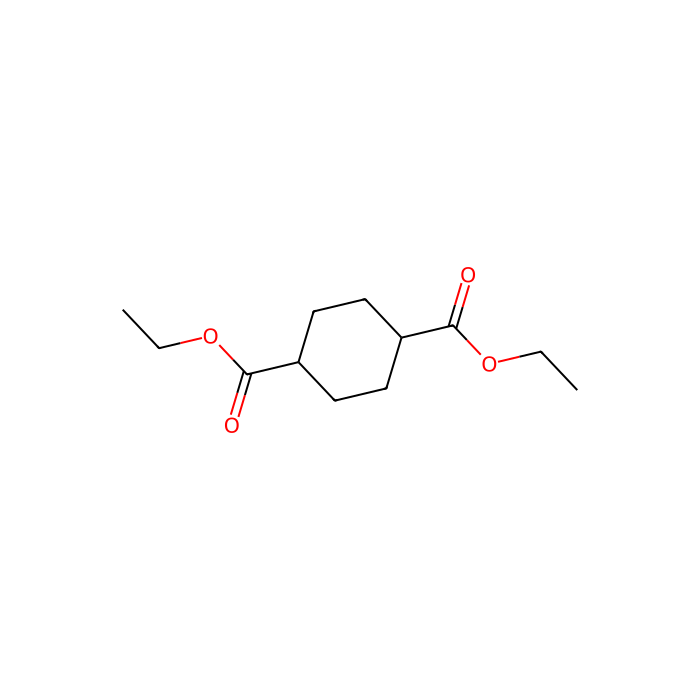
Diethyl trans-1,4-cyclohexanedicarboxylate is the diethyl diester of trans-1,4-cyclohexanedicarboxylic acid, providing a rigid, para-like spacing of two ester groups across a cyclohexane ring.

  • Item-specific identifiers (from Product Data)
    • SKU: D154130
    • CAS: 19145-96-1
    • InChIKey (as provided): 187594
    • Storage: Room temperature; shipped under normal conditions
    • Research Use: For research use only
  • Computed/literature identity (not item-specific specifications)
    • Preferred name: Diethyl trans-1,4-cyclohexanedicarboxylate (trans-1,4-CHD diethyl ester)
    • Molecular formula (computed): C12H20O4
    • Molecular weight (computed/literature): ~228.28 g/mol
    • SMILES (literature, no explicit trans stereochemical encoding): CCOC(=O)C1CCC(CC1)C(=O)OCC
    • Structural features: saturated six-membered cyclohexane ring bearing two ester carbonyls at C-1 and C-4 in a trans-1,4 relationship; two ethyl groups bound to the ester oxygens; no heteroatoms beyond ester oxygens; no rings other than cyclohexane; no chiral centers when defined as meso/trans-1,4 on a symmetric ring.
  • 2D structure description (general): a chair cyclohexane with carbonyls at the 1 and 4 positions; each carbonyl is connected to an –O–CH2–CH3 substituent. In the trans isomer, the 1,4 substituents are on opposite faces of the ring, affording an extended, approximately linear spatial arrangement across the ring.

Note: Exact stereochemical line notation may vary in databases; consult the CoA/SDS for authoritative identifiers for this specific lot.

Synthetic Utility

Functional groups and reactivity leveraged in synthesis:

  • Two ethyl ester groups (–CO2Et) at a fixed trans-1,4 separation on a cyclohexane ring provide a difunctional platform for convergent synthesis.

Key transformations (literature/general):

  • Hydrolysis to diacid: base-catalyzed saponification affords trans-1,4-cyclohexanedicarboxylic acid, which can be converted to acid chlorides (SOCl2, oxalyl chloride) for amide/ester couplings.
  • Reductive routes:
    • DIBAL-H partial reduction to dialdehydes for further elaboration (Wittig/olefination, reductive amination after oxime formation).
    • LiAlH4/BH3 reduction to trans-1,4-bis(hydroxymethyl)cyclohexane, a valuable diol for polycarbonate/polyester synthesis and linker chemistry.
  • Aminolysis to diamides: direct reaction with amines under heating or with activation (e.g., catalytic DMAP) furnishes diamides, enabling SAR libraries with rigid spacing.
  • Orthogonal differentiation: controlled mono-saponification to a half-ester/half-acid allows stepwise functionalization, generating unsymmetrical 1,4-substituted derivatives.
  • Macrocyclizations/linkers: the trans-1,4 spatial arrangement mimics para-phenylene spacing in a saturated scaffold, often improving solubility and oxidative stability versus aromatic analogs.

Retrosynthetic value:

  • Serves as a masked form of trans-1,4-cyclohexanedimethanol (via full reduction) or the diacid (via hydrolysis), enabling late-stage choice of exit vector (alcohol vs acid) without changing the core geometry.

Process notes:

  • Maintain control of isomeric purity (trans vs cis) to ensure reproducibility of physical properties and downstream reactivity.
  • Avoid unnecessary exposure to strong acids/bases unless hydrolysis or transesterification is intended.
Target Specificity

Not applicable. This product is a small-molecule chemical reagent and does not have antigen/epitope targets, species reactivity, clone, or isotype. No bioassay target specificity is provided for this item.

Shall we send you a message when we have discounts available?

Remind me later

Thank you! Please check your email inbox to confirm.

Oops! Notifications are disabled.