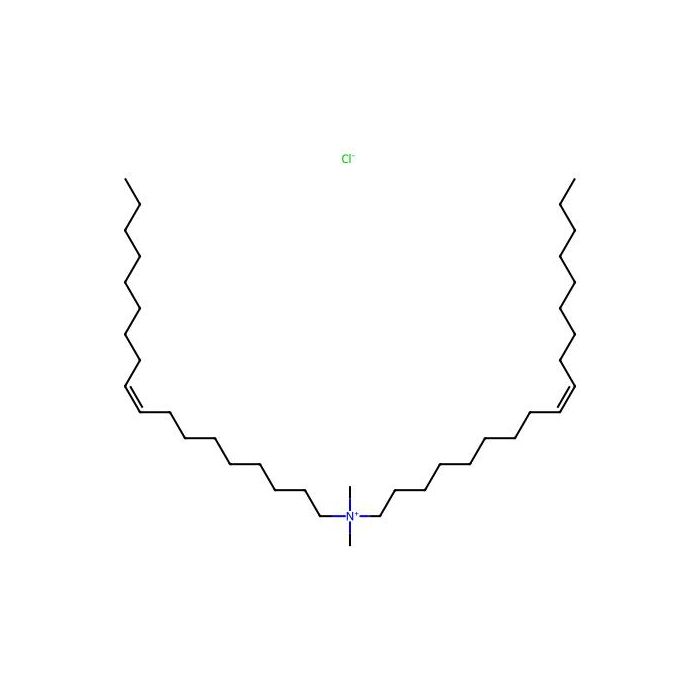
Determine the necessary mass, volume, or concentration for preparing a solution.
Dioleyldimonium chloride , CAS No.7212-69-3
Disponibile su ordine
Storage
Store at 2-8°C,Protected from light,Desiccated
Shipped In
Wet ice

for sensitive chromatographic and analytical workflows requiring minimal baseline interference.
Store at 2-8°C,Protected from light,Desiccated Ships Wet ice Check lot-specific COA for exact specifications.
SDS, COA, datasheet, and spec sheet available for download. Lot-specific COA accessible via lot number lookup.
Cited in 0 peer-reviewed publications across chromatography, organic synthesis, and cross-coupling reactions.
| Sorrisi canonici | CCCCCCCC/C=C\CCCCCCCC[N+](CCCCCCCC/C=C\CCCCCCCC)(C)C.[Cl-] |
|---|---|
| IUPAC Name | dimethyl-bis[(Z)-octadec-9-enyl]azanium;chloride |
| InChIKey | UAKOZKUVZRMOFN-JDVCJPALSA-M |
| INCHI | 1S/C38H76N.ClH/c1-5-7-9-11-13-15-17-19-21-23-25-27-29-31-33-35-37-39(3,4)38-36-34-32-30-28-26-24-22-20-18-16-14-12-10-8-6-2;/h19-22H,5-18,23-38H2,1-4H3;1H/q+1;/p-1/b21-19-,22-20-; |
| Peso molecolare | 582.500 |
Comprehensive hazard, handling, storage, and regulatory compliance document.
Download SDS →Lot-specific quality data. Enter your lot number to retrieve the exact COA.
Look up COA →Full quality attributes and acceptance criteria for this grade.
View spec sheet →Taxonomy Tree
| Kingdom | Organic compounds |
|---|---|
| Superclass | Organic nitrogen compounds |
| Classe | Organonitrogen compounds |
| Subclass | Quaternary ammonium salts |
| Intermediate Tree Nodes | Not available |
| Direct Parent | Tetraalkylammonium salts |
| Alternative Parents | Organic chloride salts Hydrocarbon derivatives Amines Organic cations |
| Molecular Framework | Aliphatic acyclic compounds |
| Substituents | Tetraalkylammonium salt - Hydrocarbon derivative - Organic chloride salt - Organic salt - Amine - Organic cation - Aliphatic acyclic compound |
| Descrizione | This compound belongs to the class of organic compounds known as tetraalkylammonium salts. These are organonitrogen compounds containing a quaternary ammonium substituted with four alkyl chains. |
| External Descriptors | Not available |
| Peso molecolare | 582.500 g/mol |
|---|---|
| XLogP3 | |
| Hydrogen Bond Donor Count | 0 |
| Hydrogen Bond Acceptor Count | 1 |
| Rotatable Bond Count | 32 |
| Exact Mass | 581.567 Da |
| Monoisotopic Mass | 581.567 Da |
| Topological Polar Surface Area | 0.000 Ų |
| Heavy Atom Count | 40 |
| Formal Charge | 0 |
| Complexity | 459.000 |
| Isotope Atom Count | 0 |
| Defined Atom Stereocenter Count | 0 |
| Undefined Atom Stereocenter Count | 0 |
| Defined Bond Stereocenter Count | 2 |
| Undefined Bond Stereocenter Count | 0 |
| The total count of all stereochemical bonds | 2 |
| Covalently-Bonded Unit Count | 2 |
No vendor‑validated application protocols are provided for this SKU.
General guidance (research, non‑validated):
Users should optimize concentrations, temperatures, and mixing methods for their specific system and analytical endpoints.
This compound is not a natural metabolite; it is a synthetic cationic lipid/surfactant. The points below summarize behavior observed for cationic dioleyl ammonium species in research contexts (general literature; not item‑specific):
No medical or clinical claims are made. For cell‑based research, tailor conditions (dose, exposure time, serum content, helper lipids) to minimize nonspecific membrane disruption while achieving the desired complexation or delivery behavior.
Dioleyldimonium chloride is not a buffering agent and does not establish a defined pH range. It is therefore not typically used to prepare classical buffer systems.
For buffer formulation guidance, refer instead to appropriate acid/conjugate base systems and then incorporate this surfactant as a functional additive if needed.
Consideration of greener choices depends on the application (surfactancy vs. templating vs. extraction).
Potential alternatives (application‑dependent):
Comparison highlights (general):
Where possible, design formulations to minimize dose, enable recovery, and prevent release to wastewater. Evaluate alternatives via biodegradation testing, aquatic toxicity screening, and performance metrics relevant to your use.
No pharmacopeial designation or excipient grade is specified for this item; it is supplied for research use only.
General research/formulation context for cationic dioleyl ammonium compounds (non‑clinical, no therapeutic claims):
If regulatory development is anticipated, select materials with defined excipient grades and full impurity/toxicology packages. For this SKU, consult the CoA for residual solvents, chloride content, peroxide/oxidation markers, and perform in‑house biocompatibility screening appropriate to your application.
Item-specific numerical specifications (BP, MP, density, refractive index, water/peroxide/metal limits, UV cutoff) are not provided for this SKU.
General/literature characteristics for dioleyl quaternary ammonium surfactants (informative, not item specifications):
For process or QC needs (e.g., exact softening point, residual solvent, chloride content), consult the CoA/Spec Sheet for this lot.
Guidance for interpreting grade information (general):
Recommendations:
This compound’s main value is as a cationic surfactant/lipid for self‑assembly and interfacial processes rather than as a stoichiometric reagent.
Representative research applications (general/literature):
Practical notes:
For method transfer or scale‑up, characterize aggregate size (DLS), zeta potential, and chloride content lot‑by‑lot.
No item‑specific tested reaction conditions are provided. The following are general, literature‑based practices for using dioleyl quaternary ammonium surfactants in common research workflows:
Analytical controls: measure hydrodynamic size (DLS), zeta potential, and residual solvent. Always confirm that the chosen solvent system is compatible with downstream assays and that no anionic components precipitate the surfactant.
Hazard classification details for this specific item are not provided in the Product Data.
General safety guidance for cationic quaternary ammonium surfactants (informative; defer to SDS):
Always consult the product‑specific SDS for authoritative hazard and response information.
Dioleyldimonium chloride is a strongly amphiphilic, cationic lipid. Solvent choice is dictated by the need to either dissolve it molecularly (organic phase) or to disperse it into aggregates (aqueous phase).
Avoid anionic co‑surfactants/soaps (precipitation). If oxidative stability is critical, choose oxygen‑free solvents and minimize light exposure to protect the olefinic chains.
Practical guidance:
For lot‑specific stability limits and retest dates, consult the CoA/Spec Sheet. Always follow your institution’s SDS and safety protocols during handling and disposal.
Dioleyldimonium chloride is a cationic, long‑chain quaternary ammonium surfactant typically bearing two unsaturated C18 (oleyl, C18:1 Δ9) hydrocarbon chains on a permanently charged nitrogen, paired with chloride as the counter‑anion.
Item-specific identifiers (from Product Data):
Structural features (general/literature description):
Notes: Exact atom connectivity, stereochemistry at the C=C (cis/trans), and substitution pattern should be confirmed from the Certificate of Analysis or detailed specification for this SKU.
Although primarily a surfactant, dioleyl quaternary ammonium chloride can play several roles in synthesis and materials preparation (general/literature):
Tips:
Not applicable. This product is a small‑molecule surfactant, not an antibody or affinity reagent. No target, epitope, or species reactivity information is relevant to this SKU.