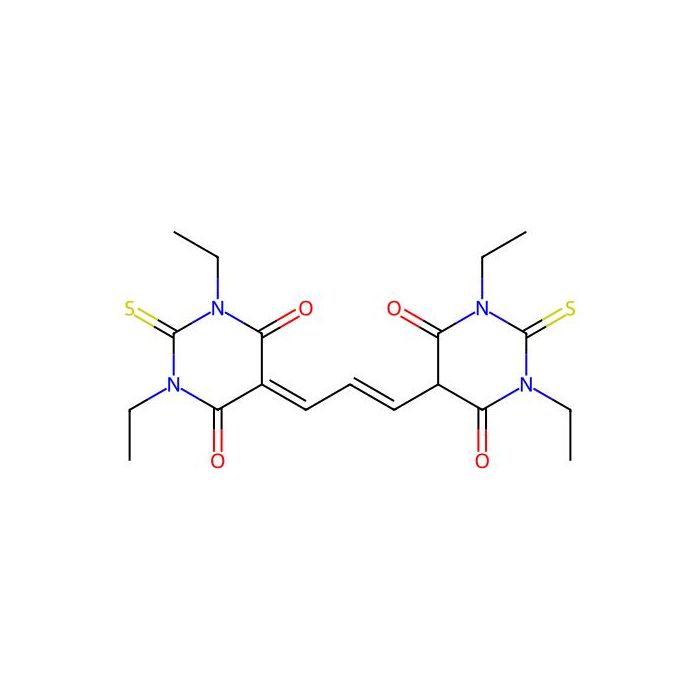
DiSBAC2(3) Membrane Potential Fluorescent Probe - BioReagent, ≥95%(HPLC) , CAS No.47623-98-3

CAS: 47623-98-3 Cat. No.: D1454922 Formula: C19H24N4O4S2 Peso molecolare: 436.548 Beilstein Registry Number: 1232950 Numero EC: 256-325-5 PubChem CID: 23212271
Disponibile su ordine
GRADE & PURITY BioReagent ? BioReagent grade — tested suitable for life-science and molecular-biology use. Use for cell culture, assays, and biochemical work needing biological compatibility. ≥95%(HPLC)
Synonyms
DiSBAC2(3) | Bis(1,3-diethylthiobarbituric acid)trimethine oxonol | Bis(1,3-diethylthiobarbiturate)trimethineoxonol | DiSBAC2 | Bis-(1,3-diethylthiobarbiturate) trimethine oxonol | 4,6(1H,5H)-Pyrimidinedione, 5-(3-(1,3-diethylhexahydro-4,6-dioxo-2-thioxo-
Storage
Protected from light,Store at -20°C,Desiccated
Shipped In
Ice chest + Ice pads
Application
Cell Staining, Fluorescence Analysis
★
Size
Germania (EU)
USA*
Price
Qty
1mg
D1454922-1mg
Su ordinazione · 8–12 settimane
78,01€
5mg
D1454922-5mg
Su ordinazione · 8–12 settimane
164,78€
10mg
D1454922-10mg
Su ordinazione · 8–12 settimane
260,23€
25mg
D1454922-25mg
Su ordinazione · 8–12 settimane
520,56€
Enter a quantity for the sizes you want to add.
🧪

Why this grade

BioReagent, ≥95%(HPLC) BioReagent for sensitive chromatographic and analytical workflows requiring minimal baseline interference.

🌡

Storage & shipping

Protected from light,Store at -20°C,Desiccated Ships Ice chest + Ice pads Check lot-specific COA for exact specifications.

📋

Quality documents

SDS, COA, datasheet, and spec sheet available for download. Lot-specific COA accessible via lot number lookup.

📚

Literature proof

Cited in 0 peer-reviewed publications across chromatography, organic synthesis, and cross-coupling reactions.

Panoramica

DiSBAC2(3) is a permeable anionic phospholipid fluorescent dye sensitive to membrane potential. Its distribution across the cell membrane depends on the membrane potential; thus, changes in its fluorescence intensity can reflect alterations in membrane potential. Upon cell depolarization, the dye permeates into the cell, increasing intracellular fluorescence intensity. During cell hyperpolarization, the dye is extruded from the cell, resulting in reduced fluorescence intensity.

This probe belongs to slow-response membrane potential probes, whose optical response amplitude is far larger than that of fast-response probes (typically a 1% fluorescence change per mV). Therefore, DiSBAC2(3) penetrates cell membranes faster and exhibits higher sensitivity to shifts in membrane potential. It is suitable for detecting rapid membrane potential fluctuations, such as spontaneous electrical activity, ion channel permeability, average membrane potential variations in non-excitable cells induced by drug binding and other factors. Carrying an overall negative charge, DiSBAC2(3) is excluded by mitochondria, making it more ideal for plasma membrane potential measurement than carbocyanine dyes.

Physical Properties & Specifications

Excitation wavelength (Ex, nm) ………………538

Emission wavelength (Em, nm) ………………555

Notes: Solubility data was measured at room temperature; low temperature may impair solubility.

Additional Safety Instructions

For personal safety and health, laboratory coats and disposable gloves must be worn during all handling procedures.

Experimental Protocol (For Reference Only)

1. Cell Preparation

1.1 Adherent cells: Plate cells one day prior to detection. The recommended seeding density for 96-well plates is 4–8×10⁴ cells per well in 100 μL medium.

1.2 Suspension cells: Centrifuge the cell pellet and resuspend cells in HBSS and MP staining working solution (see Step 2.2 below). Adjust cell density to 1.25–2.5×10⁵ cells per well in 100 μL for 96-well plates.

2. Preparation of DiSBAC2(3) Staining Working Solution

2.1 Dissolve the dye powder in anhydrous DMSO to prepare a stock solution at a concentration of 10–30 mM DiSBAC2(3).

Caution: Use the prepared stock solution promptly. Aliquot any remaining stock, store at −20 °C protected from light, and avoid repeated freeze-thaw cycles.

2.2 Prepare 2× DiSBAC2(3) dye solution: Equilibrate the dye stock solution to room temperature. Dilute the stock with HHBS or other appropriate buffer to a final concentration of 20–40 μM to obtain 2× DiSBAC2(3) dye solution. Prepare a mixture containing 0.04–0.08% Pluronic F-127 (pH 7) and 2 mM trypan red; thoroughly combine with the 2× dye solution to yield the complete staining working solution. This working solution remains stable for a minimum of 2 hours at room temperature.

3. Membrane Potential Measurement

3.1 Add 100 μL of DiSBAC2(3) staining working solution per well (96-well plate) to the cells.

Note 1: If your screening compounds interfere with culture medium or serum, and cells can grow normally in serum-free medium, replace the growth medium with an equal volume of HHBS buffer before adding DiSBAC2(3) dye.

Note 2: Do not wash cells after staining.

3.2 Incubate cells in a cell incubator for 30–60 minutes.

Caution: Room-temperature incubation for 30–60 minutes may yield superior results under certain experimental conditions.

3.3 Prepare compound plates using HHBS or your required buffer system.

3.4 Quantify membrane potential by measuring fluorescence intensity at Ex/Em = 540/590 nm.

Stock Solution Preparation

Important Warnings

• This product is supplied non-sterile. If used for cell culture, perform pre-treatment to remove pyrogens and bacteria in advance to prevent microbial contamination.

• Only partial technical information can be provided for some products. The company does not warrant the authority or accuracy of the provided data; all values are for research reference and academic communication only.

Specifications

Sinonimi
DiSBAC2(3) | Bis(1,3-diethylthiobarbituric acid)trimethine oxonol | Bis(1,3-diethylthiobarbiturate)trimethineoxonol | DiSBAC2 | Bis-(1,3-diethylthiobarbiturate) trimethine oxonol | 4,6(1H,5H)-Pyrimidinedione, 5-(3-(1,3-diethylhexahydro-4,6-dioxo-2-thioxo-
Specifiche e purezza
BioReagent, ≥95%(HPLC)
Stabilità e conservazione
Store at -20℃ long term (36 months). Store in the dark. Desiccated.
Condizioni di conservazione di stoccaggio
Protected from light,Store at -20°C,Desiccated
Spedito in
Ice chest + Ice pads
Questo prodotto richiede spedizione a catena fredda. I servizi di terra e altri servizi economici non sono disponibili.
Grado
BioReagent
Purezza
≥95%(HPLC)
Nomi e identificatori
Sorrisi canoniciCCN1C(=O)C(C(=O)N(C1=S)CC)C=CC=C2C(=O)N(C(=S)N(C2=O)CC)CC
IUPAC Name5-[(E)-3-(1,3-diethyl-4,6-dioxo-2-sulfanylidene-1,3-diazinan-5-yl)prop-2-enylidene]-1,3-diethyl-2-sulfanylidene-1,3-diazinane-4,6-dione
InChIKeyVJYNRXFXHKIGLT-MDZDMXLPSA-N
INCHI1S/C19H24N4O4S2/c1-5-20-14(24)12(15(25)21(6-2)18(20)28)10-9-11-13-16(26)22(7-3)19(29)23(8-4)17(13)27/h9-12H,5-8H2,1-4H3/b10-9+
Isomeri SMILES CCN1C(=O)C(C(=O)N(C1=S)CC)/C=C/C=C2C(=O)N(C(=S)N(C2=O)CC)CC
PubChem CID 23212271
Peso molecolare 436.548
Beilstein 1232950

Documentazione

📋 Safety Data Sheet (SDS)

Comprehensive hazard, handling, storage, and regulatory compliance document.

Download SDS →

✅ Certificate of Analysis (COA)

Lot-specific quality data. Enter your lot number to retrieve the exact COA.

Look up COA →

📊 Datasheet

Quick-reference summary of product specifications and applications.

View datasheet →

🔬 Specification Sheet

Full quality attributes and acceptance criteria for this grade.

View spec sheet →

Advanced Data

Taxonomic Classification

Taxonomy Tree

KingdomOrganic compounds
SuperclassOrganoheterocyclic compounds
ClasseDiazines
SubclassPyrimidines and pyrimidine derivatives
Intermediate Tree Nodes Pyrimidones
Direct ParentThiobarbituric acid derivatives
Alternative Parents Diazinanes  1,3-dicarbonyl compounds  Thioureas  Carboxylic acids and derivatives  Azacyclic compounds  Organopnictogen compounds  Organonitrogen compounds  Organic oxides  Hydrocarbon derivatives  
Molecular FrameworkAliphatic heteromonocyclic compounds
Substituents Thiobarbiturate - 1,3-dicarbonyl compound - 1,3-diazinane - Thiourea - Azacycle - Carboxylic acid derivative - Organic nitrogen compound - Organic oxygen compound - Organopnictogen compound - Organic oxide - Hydrocarbon derivative - Organosulfur compound - Organooxygen compound - Organonitrogen compound - Carbonyl group - Aliphatic heteromonocyclic compound
DescrizioneThis compound belongs to the class of organic compounds known as thiobarbituric acid derivatives. These are organic compounds containing a 2-thioxodihydropyrimidine-4,6(1H,5H)-dione skeleton.
External Descriptors Not available
Struttura 3D
Modello di struttura chimica interattiva


Certificati (CoA, COO, BSE/TSE e tabella di analisi)
C of A & Other Certificates(BSE/TSE, COO):
Analytical Chart:

Find and download the COA for your product by matching the lot number on the packaging.

3 results found

Lot NumberCertificate TypeDataOggetto
ZJ26F0838394Certificate of AnalysisAug 25, 2026 D1454922
ZJ26F0838393Certificate of AnalysisAug 25, 2026 D1454922
ZJ26F0838392Certificate of AnalysisAug 25, 2026 D1454922
Proprietà chimiche e fisiche
SolubilitàSoluble in DMSO
Domande frequenti e articoli
Calcolatori di soluzioni
Recensioni

Recensioni dei clienti

Shall we send you a message when we have discounts available?

Remind me later

Thank you! Please check your email inbox to confirm.

Oops! Notifications are disabled.