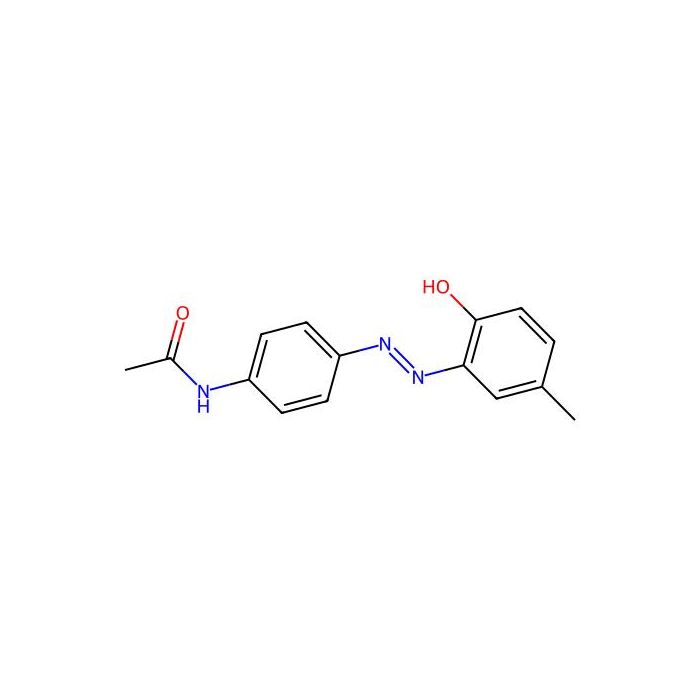
This compound belongs to the class of organic compounds known as azobenzenes. These are organonitrogen aromatic compounds that contain a central azo group, where each nitrogen atom is conjugated to a benzene ring.
External Descriptors
Not available
1. Djoumbou Feunang Y, Eisner R, Knox C, Chepelev L, Hastings J, Owen G, Fahy E, Steinbeck C, Subramanian S, Bolton E, Greiner R, and Wishart DS. ClassyFire: Automated Chemical Classification With A Comprehensive, Computable Taxonomy. Journal of Cheminformatics, 2016, 8:61.
Certificati (CoA, COO, BSE/TSE e tabella di analisi)
C of A & Other Certificates(BSE/TSE, COO):
Analytical Chart:
Proprietà chimiche e fisiche
Punto di fusione (°C)
268-270°C
Calcolatori di soluzioni
Molarity Calculator
Determine the necessary mass, volume, or concentration for preparing a solution.
Dilution Calculator
Determine the dilution needed to prepare a stock solution.
Reconstitution Calculator
Recensioni
Recensioni dei clienti
Application Protocols
No manufacturer-tested biological assay protocols are provided in the Product Data.
General research-use examples (informational; not item specifications)
UV–Vis calibration stock: Dissolve in dry DMSO to 1–10 mM, protect from light, filter (0.2 µm PTFE), and dilute into your measurement solvent. Record baseline of solvent/dispersant.
Aqueous dispersion for adsorption tests: Jet-mill or ultrasonicate dye with 0.1–0.5% nonionic dispersant in buffer; target 10–50 mg/L working concentration; equilibrate with sorbent under controlled ionic strength and temperature; quantify residual dye by UV–Vis/HPLC.
Reductive cleavage assay: Prepare buffered solution with co-solvent; add Na2S2O4 under N2; monitor decrease at the visible λmax and appearance of aniline products by HPLC.
For any application, validate concentration, aggregation state, and light exposure conditions locally. Follow institutional SOPs and the SDS.
Biological Roles
Scope note: Disperse Yellow 3 is a synthetic azo dye for laboratory and materials research. The following points summarize general literature observations; they are not medical or clinical claims.
Xenobiotic behavior (literature)
Biotransformation: Azo dyes are substrates for microbial azoreductases, particularly under anaerobic conditions, yielding aromatic amines. For para-amino/para-nitro substituted azobenzenes, reductive cleavage can generate corresponding anilines.
Environmental microbiology: DY3 is used as a model compound to study reductive decolorization in sludge, sediments, and gut-like reductive environments, and subsequent aerobic mineralization steps of cleavage products.
Interactions with biomacromolecules (general)
Noncovalent binding: Aromatic, hydrophobic chromophores can associate with proteins (e.g., serum albumin) and membranes via π–π and hydrophobic interactions, affecting spectral properties (hypsochromic/bathochromic shifts) and aggregation states.
Photochemical response: Light-driven trans–cis isomerization influences conformation-dependent binding and may be exploited in photoresponsive biomaterials research (e.g., azobenzene-modified biopolymers) with DY3-like motifs as references.
Analytical/biochemical uses
Tracer and colorimetric marker in filtration/adsorption studies with biosorbents (e.g., algal biomass, chitosan) to quantify uptake isotherms and kinetics.
Model substrate in enzymology assays for azoreductase activity where decrease in Amax or formation of aniline products is monitored by UV–Vis/HPLC.
Research use only: Not for diagnostic or therapeutic use.
Buffer Applications
This compound is a hydrophobic disperse dye and is not used as a buffering agent. It does not form a defined acid/base conjugate pair suitable for maintaining pH. For experiments involving DY3 in aqueous media:
Use conventional buffers appropriate to your biological/analytical system (e.g., phosphate, HEPES) and prepare DY3 as a fine dispersion (with nonionic surfactants) or as a co-solvent solution (e.g., ≤1–5% DMSO) added to the buffered phase.
Verify that buffer components and ionic strength do not induce unwanted aggregation/precipitation; pre-filter working solutions and record absorbance baselines to correct for scattering.
Green Alternatives
Greener handling strategies (general)
Solvent choices: Prefer lower-toxicity, high-permittivity solvents (e.g., propylene carbonate, ethyl lactate) over DMF/NMP when feasible; explore 2-MeTHF or Cyrene for synthesis/processing that tolerates their properties.
Aqueous processing: Employ waterborne dispersions with biodegradable nonionic dispersants and minimal organic co-solvent; optimize milling to submicron particles to reduce chemical auxiliaries.
Energy efficiency: Use microwave or ultrasonic dispersion to shorten processing times; consider supercritical CO2 dyeing of polyesters to reduce water use and effluent load (equipment dependent).
Non-azo yellows: Anthraquinone or benzodifuranone yellows may offer improved photostability and reduced amine release risk, though often at higher cost or different hue.
Comparison snapshot (literature/general)
Disperse Yellow 3
Pros: Benchmark chromophore; well-studied photophysics and reduction; strong coloration on PET
Trade-offs: Azo reduction to aromatic amines under anaerobic conditions; limited water solubility; potential sensitization concerns
Trade-offs: Hue/strength differences; altered diffusion in fibers; availability and cost considerations
Note: Selection of an alternative should consider color coordinates (CIELAB), fastness requirements, processing equipment, and regulatory constraints; validate via pilot trials.
Pharmaceutical Uses
Disperse Yellow 3 is not a typical pharmaceutical excipient or processing aid. As a hydrophobic azo dye, it is primarily used in materials, textile, and analytical research contexts.
General formulation note (research context only)
If used as a colorant in materials science or device research (e.g., polymer films, sensors), solubilize in appropriate organic media (DMSO, DMF, NMP) or prepare nanoparticle dispersions with biocompatible stabilizers for exploratory studies.
Ensure extractables/leachables assessments if the dyed material will contact biological systems in research settings.
No pharmacopeial monograph or excipient status is indicated for this item. Avoid any use in human or veterinary applications.
Physical Properties
Item-specific values from Product Data
Appearance: Not specified for this item; refer to CoA/Spec Sheet.
Storage/transport (from Product Data)
Storage: Store at −20 °C
Shipping: Ice chest + ice pads
Literature/typical properties for Disperse Yellow 3 (informational; not item specifications)
Phase: Organic solid dye; markedly hydrophobic with crystalline micro- to nano-particles in dispersions
Solubility: Practically insoluble in water; soluble in polar aprotic organic solvents (e.g., DMF, DMSO, NMP) and moderately soluble in alcohols/acetone depending on temperature and dispersants
Spectral characteristics: Strong π–π* band in the visible region; λmax typically in the blue–green region for azo yellows (commonly ~400–450 nm depending on solvent and aggregation)
Photophysics: Exhibits trans–cis photoisomerization of the azo bond; thermal back-isomerization is solvent and temperature dependent
Partitioning: LogP expected high due to two aromatic rings and limited ionizable functionality (qualitative literature expectation)
Particle behavior: In aqueous systems, exists as fine dispersions stabilized by surfactants; aggregation state shifts absorption maxima (H/J-aggregate phenomena)
Notes
Exact numeric values (mp/bp/density, λmax, logP) vary with source, polymorph, and formulation; consult primary literature or the specific CoA/Spec Sheet for definitive specifications.
Quality and Grades
Item-specific grade/purity from Product Data
Grade/Purity: Not specified for this item; refer to CoA/Spec Sheet.
How to interpret common grades for dyes and analytical use (general guidance)
Technical grade: Suitable for coloration studies and general textile research; may contain inorganic salts, dispersants, and isomeric/byproduct dyes.
Dye content (%): When provided, reflects the fraction of chromophore relative to total mass; critical for quantitative colorimetry and kinetic studies.
Analytical grade / HPLC grade dye standards: Tighter control of inorganic/organic impurities and lower baseline UV absorbance from impurities; suitable for spectroscopic calibration and method validation.
Stabilizers/additives: Disperse dyes are often supplied with dispersants or wetting agents to improve handling; presence should be stated on CoA if applicable and may influence solubility/dispersion.
What to request/verify for your application (best practices)
CoA parameters: Identity confirmation (e.g., UV–Vis λmax and ε, FTIR), assay/dye content, inorganic residue/ash, moisture (Karl Fischer), and particle size distribution for dispersion work.
Chromatographic profile: HPLC or UHPLC trace to assess isomer/byproduct content—important for toxicology and environmental fate studies.
Trace metals and halides: If using for materials/photophysics, request ICP-MS/IC data to rule out catalyst residues that may affect photochemical behavior.
This listing
In absence of a stated grade, plan to qualify the material in-house for your specific analytical threshold and document lot-specific parameters from the CoA.
Reaction and Applications
Research application domains (general/literature)
Textile and polymer research: Model disperse dye for studying dye–fiber interactions (PET, cellulose acetate) including diffusion kinetics, carrier effects, and high-temperature/pressure dyeing.
Photophysics: Serves as a benchmark azo chromophore for cis–trans photoisomerization, solvatochromism, and aggregation-dependent spectral shifts.
Environmental fate: Used in studies of dye reduction/cleavage under anaerobic conditions (azoreductases, reductive decolorization) and advanced oxidation processes (AOPs) such as UV/H2O2, Fenton, and photocatalysis.
Analytical probes: Colorimetric tracer in flow studies and in validating solid–liquid extraction, adsorption on activated carbon, and membrane separations.
Chemical reactivity highlights (literature)
Azo bond reactivity: Susceptible to reductive cleavage (e.g., Na2S2O4, catalytic H2/Pd-C) yielding corresponding para-substituted anilines.
Substituent effects: Para –NH2 (donor) and –NO2 (acceptor) across the azo bond promote intramolecular charge-transfer character, tuning absorption and isomerization barriers.
Protonation/deprotonation: –NH2 can be protonated in strong acid, affecting spectral properties and solubility; azo nitrogen basicity is weak but can be engaged in hydrogen bonding interactions.
Practical tips
For kinetic studies, prepare freshly filtered solutions in dry DMF/DMSO, protect from light, and record temperature precisely—both aggregation and isomer distribution shift λmax and ε.
For reduction experiments, degas solutions to control dissolved oxygen (which competes with reductants) and monitor formation of aniline derivatives by HPLC/UV–Vis.
For dyeing simulations, control particle size (jet-milled dispersions) and use temperature ramps to emulate industrial HT dyeing (e.g., 120–130 °C in pressurized vessels).
Reaction Conditions
The following conditions are general literature guidance for azo dyes like Disperse Yellow 3 and should be optimized per substrate and scale. They are not item-specific specifications.
Reductive cleavage of azo bond
Catalytic hydrogenation: H2 (1–5 bar), Pd/C (5–10 wt%), ethanol or ethyl acetate with a polar co-solvent; 20–50 °C; monitor by TLC/HPLC; typical conversions in 1–4 h.
Sodium dithionite reduction: Na2S2O4 (2–5 equiv) in aqueous buffer (pH 6–8) with co-solvent (e.g., 10–30% ethanol) under N2; 25–60 °C; rapid decolorization in minutes to hours.
Metal–acid systems: Fe/HCl or Zn/AcOH, 0–25 °C initially (exotherm control), then warm to 50–70 °C; quench, basify, and extract aniline products.
Diazotization/coupling (for synthesis of DY3-type structures)
Diazotization: Anilinium substrate dissolved in HCl (2–4 M), cooled to 0–5 °C; NaNO2 added dropwise to maintain slight excess nitrite (starch–iodide test).
Azo coupling: Couple the diazonium salt to the partner aniline in mildly alkaline medium (Na2CO3/NaOAc buffer, pH 8–10) at 0–10 °C initially, then allow to warm; maintain pH to sustain nucleophilicity.
Photophysical studies
Photoisomerization: Irradiate solutions (e.g., in acetonitrile or ethanol) at suitable wavelengths (near π–π* band); monitor trans→cis conversion and thermal back-relaxation by UV–Vis. Oxygen removal can stabilize certain photostationary states.
Analytical control
UV–Vis λmax and ε shift with solvent and aggregation; filter solutions (0.2 µm) and report concentration by mass and extinction coefficients determined in your matrix.
Safety and Handling
Authoritative reference: Always consult the product’s SDS for definitive hazard classification, response, and disposal procedures.
Signal word / H-statements / GHS classification / pictograms: Not specified for this item; refer to SDS.
General/literature safety profile for azo disperse dyes (informational)
Potential hazards: Nitro- and amino-substituted azo aromatics may cause skin/eye irritation and, in some cases, sensitization. Dust may cause respiratory irritation. Avoid inhalation of particulates and contact with skin or eyes.
Combustibility: Organic dye powders are combustible; minimize dust generation and ignition sources.
Photostability: Photoresponsive; avoid unnecessary light exposure to limit photoisomerization and degradation during handling.
Incompatibilities: Strong reducing agents can cleave azo bonds to aromatic amines; strong oxidizers may lead to exothermic reactions; strong acids/bases can alter dispersion state and stability.
Recommended PPE and practices (good laboratory practice)
Wear lab coat, appropriate gloves (e.g., nitrile), safety goggles; handle solids in a fume hood or ventilated enclosure to control dust.
Use dust control (closed transfers, antistatic measures) and secondary containment for weighing.
First aid (overview): After skin/eye contact, rinse with water for at least 15 minutes; after inhalation, move to fresh air; after ingestion, rinse mouth—seek medical attention in all cases. Defer to SDS for detailed instructions.
Waste
Collect dye-containing liquids/solids as hazardous organic waste; do not discharge to drains. Follow institutional and local regulations.
Solvent Selection
Applicability: As a hydrophobic azo dye, Disperse Yellow 3 is generally handled as a solid or as concentrated solutions/dispersions in organic media; it is not water-soluble without surfactants.
Polarity and miscibility (literature/general)
Polarity class: Nonpolar–moderately polar aromatic dye with strong π-conjugation
Water: Practically insoluble; requires surfactants/dispersants for stable aqueous dispersions
Good solvents: DMSO, DMF, NMP, chlorinated aromatics (with caution), pyridine-type solvents, acetone/ethanol (moderate, temperature dependent)
Poor solvents: Aliphatic hydrocarbons; limited solubility may persist even on heating
Practical selection by use case
Spectroscopy/stock solutions: DMSO or DMF provide high solubility and optical clarity; filter through 0.2 µm to remove aggregates before measurements.
Polymer coloration/spin-coating: Use high-boiling polar aprotics (NMP, DMAc) to maintain dye in solution during film formation; consider antisolvent precipitation control for morphology.
Aqueous processing/textile simulation: Prepare fine dispersions with nonionic dispersants (e.g., lignosulfonates or EO–PO block copolymers) and small amounts of co-solvent (e.g., glycol ethers) to assist wetting.
Comparisons (general)
DY3 vs more polar azo dyes (sulfonated “acid dyes”): DY3 offers higher affinity to hydrophobic fibers (PET, acetate) but requires dispersants and often higher temperatures.
DY3 vs solvent dyes: Similar solubility in organic media; disperse dyes are optimized for fiber diffusion under high-temperature dyeing rather than full solubility in common solvents.
Storage and Reconstitution
Item-specific storage (from Product Data)
Store at −20 °C
Shipped in an ice chest with ice pads
General handling
Protect from light to minimize photoisomerization and photodegradation of the azo chromophore.
Allow container to equilibrate to room temperature before opening to reduce moisture condensation.
Minimize dye dust generation; handle solids in a ventilated enclosure.
Reconstitution (general guidance; not item specifications)
Prepare concentrated stocks in dry DMSO or DMF (e.g., 10–50 mM) for spectroscopic and analytical work; mix until fully dissolved and, if needed, gently warm (<50 °C) with stirring.
For aqueous studies, disperse using nonionic surfactants and ultrasonic energy; pre-filter through 0.45/0.2 µm PTFE or PVDF to remove aggregates before quantitation.
Store aliquots of stock solutions at −20 °C, protected from light; avoid repeated freeze–thaw cycles by aliquoting into amber vials.
Stability notes (literature/general)
Stable as a dry solid under inert, dark, and cool conditions. In solution, slow changes in absorption can occur due to aggregation, photoisomerization, or reduction by adventitious agents; verify spectra prior to critical measurements.
Research use only
Not for human or veterinary use. Consult the SDS and CoA for lot-specific stability and handling details.
Structure and Identity
Brief overview: Disperse Yellow 3 (DY3) is a classical aromatic azo dye featuring one aniline ring and one nitro-substituted ring linked through an azo (–N=N–) bond. It exists predominantly in the trans-azo form under ambient conditions and displays strong π–π conjugation.
Item-specific identifiers from Product Data
CAS: 2832-40-8
InChIKey: Not specified for this item; refer to CoA/Spec Sheet. (Product Data entry is non-standard)
SMILES: Not specified for this item; refer to CoA/Spec Sheet.
Literature identity (for reference; not item specifications)
Common structural assignment: 4-amino-4′-nitroazobenzene (literature)
Ring systems: two para-substituted phenyl rings forming an azobenzene core
Conjugation: extended aromatic–azo conjugation enabling strong visible absorption and solvatochromism
Stereochemistry: E (trans) across the azo bond is thermodynamically favored; photoisomerization to Z (cis) possible under UV/visible light
2D structure in words (general)
One phenyl bears an –NH2 group para to the azo bond; the other phenyl bears an –NO2 group para to the azo bond. The rings are connected by –N=N–, forming a planar, conjugated chromophore typical of disperse dyes.
Synthetic Utility
Although typically an end-use chromophore, Disperse Yellow 3 and closely related azo dyes are useful synthetic handles and study substrates.
Transformations (literature)
Reductive cleavage of the azo bond with sodium dithionite, Zn/AcOH, Fe/HCl, SnCl2/HCl, or catalytic H2/Pd-C affords corresponding para-substituted anilines (e.g., p-phenylenediamine and p-nitroaniline analogs for the 4-amino/4′-nitro case). These products are valuable arylamine building blocks.
Electrophilic/nucleophilic tuning: The para–NO2 group deactivates and the para–NH2 group activates the respective rings, enabling selective further functionalization (e.g., diazotization of the –NH2 to build higher-order azo architectures; SNAr on the nitro-activated ring if additional leaving groups are present).
Protection/auxochrome strategy: The azo linkage can serve as a temporary chromophoric protecting group enabling spectroscopic monitoring of transformations; subsequent reductive removal regenerates amines.
Synthesis of DY3 (reference chemistry)
Classical route involves diazotization of p-nitroaniline (or p-phenylenediamine, depending on target orientation) and coupling to aniline under mildly basic conditions with temperature control, followed by isolation and milling to a disperse-grade particle size.
Applications as a probe
Use as a mechanistic reporter in hydrogen transfer and single-electron transfer reductions, with convenient UV–Vis monitoring of azo band decay and amine formation.
Target Specificity
Not applicable. This product is a small-molecule dye, not a biological targeting reagent (e.g., antibody, ligand, or inhibitor) with defined antigen/epitope specificity. No target-specific attributes are provided in the Product Data.
Utilizziamo i cookie per garantire il corretto funzionamento del sito web e, ove consentito, per migliorare la tua esperienza. Puoi gestire le tue preferenze in qualsiasi momento nelle Impostazioni. Per saperne di più, consulta la nostra Cookie Policy.
Desidera che le inviamo un messaggio quando avremo sconti disponibili?
Ricordamelo più tardi
Grazie! Controlli la sua casella di posta per confermare.
Products are supplied to verified businesses, institutions, and qualified professionals for research and development use only. Not for use in humans, animals, diagnosis, or therapy.