This compound belongs to the class of organic compounds known as alpha amino acids. These are amino acids in which the amino group is attached to the carbon atom immediately adjacent to the carboxylate group (alpha carbon).
External Descriptors
Not available
1. Djoumbou Feunang Y, Eisner R, Knox C, Chepelev L, Hastings J, Owen G, Fahy E, Steinbeck C, Subramanian S, Bolton E, Greiner R, and Wishart DS. ClassyFire: Automated Chemical Classification With A Comprehensive, Computable Taxonomy. Journal of Cheminformatics, 2016, 8:61.
Determine the necessary mass, volume, or concentration for preparing a solution.
Dilution Calculator
Determine the dilution needed to prepare a stock solution.
Reconstitution Calculator
Recensioni
Recensioni dei clienti
Application Protocols
No tested bioassay protocols (e.g., WB, IHC, IF, FC) are provided in the Product Data. Typical laboratory uses involve solution preparation and synthetic transformations:
Stock solution preparation (general)
Dissolve in water or buffer (pH 2–5) to 10–100 mg/mL; filter (0.22 µm) if sterility is required.
For organic media, use DMSO or DMF to make concentrated stocks if aqueous solubility is insufficient for the assay; ensure final DMSO content is compatible with the system.
Free base preparation (for synthesis)
Neutralize an aqueous solution with NaHCO3 to pH ~9–10, then extract with EtOAc; dry and use immediately for moisture-sensitive steps.
For application-specific protocols, consult the primary literature or method development resources relevant to your reaction or assay.
Biological Roles
This compound is the hydrochloride salt of pipecolic acid (piperidine-2-carboxylic acid), a non-proteinogenic amino acid related to lysine metabolism.
Biochemistry (literature)
Pipecolic acid arises in the lysine catabolic pathway in organisms ranging from bacteria to plants and mammals, typically via saccharopine or pipecolate pathways.
In plants, N-hydroxypipecolic acid (derived from pipecolic acid) is a well-studied endogenous mediator of systemic acquired resistance signaling; DL material is used for mechanistic studies (non-clinical).
Due to its secondary amine and carboxylate functionality, pipecolic acid can form zwitterions at near-neutral pH, impacting transport and partitioning in biological systems.
Physicochemical aspects relevant to biology
Ionization: at physiological pH, the amine is largely protonated and the carboxylate deprotonated (zwitterionic), affecting membrane permeability (typically low passive diffusion).
Salt form: the HCl salt improves aqueous solubility for in vitro assays and biochemical reactions.
All information above reflects general literature knowledge for the chemical class; this product is supplied strictly for research use only (as per Product Data).
Buffer Applications
DL-Pipecolic acid hydrochloride is not a standard buffering agent in biochemistry. While it possesses acid–base functionality (carboxyl pKa ~2.2; ammonium pKa ~10.8, literature), it is typically used as a substrate or building block rather than a buffer.
Practical note
If needed, solutions can exhibit limited buffering capacity near the stated pKa values, but dedicated buffers (e.g., citrate around pH 3–6 or carbonate around pH 9–11) are preferred for robust pH control.
For assay stock solutions, prepare in water or appropriate buffer and adjust pH as required; confirm compatibility with the biological system.
Green Alternatives
For this ionic amino-acid-derived building block, greener choices focus on solvents, coupling strategies, and resolution methods rather than replacing the scaffold itself.
Greener processing options (literature guidance)
Solvents: prefer water, ethanol, or 2-MeTHF over DMF/NMP when feasible (e.g., enzymatic resolutions or aqueous-phase couplings).
Coupling chemistry: use less hazardous coupling systems (e.g., DMTMM in water or ethyl acetate; CDI in greener media) instead of HATU/HBTU in DMF.
Workups: employ aqueous bicarbonate free-base generation and partitioning into safer organics (EtOAc) rather than chlorinated solvents, where compatible.
Energy: run protections/couplings at ambient temperature; consider micellar catalysis (TPGS-750-M) for amidations in water.
Comparison snapshot (general)
Conventional: DMF/NMP with uronium reagents (HATU/HBTU) — high efficacy but problematic EHS profile.
Greener alternative: DMTMM or EDC/Oxyma in EtOAc, MeOH, or water — reduced toxicity and simpler waste handling; may require optimization for reaction rates.
Note: Selection should balance EHS improvements with performance and impurity control. Item-specific specifications (water content, residuals) are Not specified for this item; refer to CoA/Spec Sheet.
Pharmaceutical Uses
No pharmacopeial or excipient grade is specified for this item; it is provided for research use only.
Roles in pharmaceutical research (literature/general)
Synthetic intermediate: used to prepare pipecolate-containing motifs in API candidates and peptidomimetics.
Salt form advantages: the hydrochloride enhances aqueous solubility for screening, preformulation studies, and salt selection experiments.
Chiral considerations: the DL racemate supports racemic library generation; downstream enantioseparation or asymmetric synthesis may be applied when single-enantiomer candidates are desired.
No therapeutic or clinical claims are made for this product. For GMP or regulatory applications, obtain grade-specific material and documentation; specifications for this catalog item are Not specified for this item; refer to CoA/Spec Sheet.
Physical Properties
Appearance (Product Data): Not specified for this item; refer to CoA/Spec Sheet.
pH effects: enhanced solubility under acidic conditions; conversion to the free base at basic pH reduces aqueous solubility and increases solubility in some organics.
pKa values (literature, free base): pKa1 (carboxyl) ~2.2; pKa2 (conjugate acid of ring nitrogen) ~10.8–11.0. As the HCl salt, the amine is protonated in the solid and in acidic aqueous solution.
LogP/LogD (literature trends): low logD at neutral pH due to zwitterionic/ionic character; octanol/water partitioning is minimal.
Refractive index: not applicable to solids.
All numerical specifications for this catalog item that are not listed as Product Data should be verified against the CoA/Spec Sheet.
Quality and Grades
Grade/Purity: Not specified for this item; refer to CoA/Spec Sheet.
Interpreting grade (general guidance)
Research or laboratory grade materials are suitable for synthetic, analytical, and screening workflows but are not certified for clinical or GMP use.
Where stated, higher purity grades may control residual inorganic salts (e.g., free chloride), moisture content, and related pipecolic acid impurities (e.g., positional isomers or lactam formation) and may include tighter limits on heavy metals and bioburden.
Hydrochloride salt implications
Provides improved aqueous solubility and handling compared with the free base.
Acidic counterion may influence downstream reactions (e.g., amide couplings) by requiring additional base equivalents.
Batch-specific verification
Confirm appearance, assay, optical rotation (for chiral lots; not applicable here as DL racemate unless otherwise stated), water content (Karl Fischer), and residual solvents via the CoA.
If your application is chromatography-sensitive, request UV cutoff and chromatographic purity profiles; when not specified here, these are batch-dependent and documented on the CoA/Spec Sheet.
Reaction and Applications
As the racemic hydrochloride of piperidine-2-carboxylic acid, this compound is a versatile building block for heterocycles, peptidomimetics, and functionalized piperidines.
Typical research uses (literature)
Precursor to N-protected pipecolic acids (Boc, Cbz, Fmoc) for peptide and peptidomimetic synthesis.
Intermediate in synthesis of substituted piperidines and lactams; used in medicinal chemistry SAR libraries.
Starting material for oxidations (to 2-piperidone) or reductions (ester/amide derivatives) and for elaboration at C2.
Platform for synthesis of N-hydroxypipecolic acid analogs used in plant signaling studies (non-therapeutic research).
Practical tips
For amide couplings from the HCl salt, include additional base (≥2 equiv relative to acid) to neutralize both the carboxyl and ammonium; HATU/DIPEA or EDCI/HOBt (or Oxyma) in DMF are common.
Convert to the free base prior to protection with Boc2O for improved yields in non-aqueous media.
Control ring conformation and stereochemistry by using chiral auxiliaries or resolution when enantioenriched products are required; the supplied DL racemate is suitable for racemic library synthesis or later resolution.
Representative transformations (literature)
N-protection (Boc, Cbz, Fmoc), then esterification to give orthogonally protected derivatives.
Lactam formation (oxidation to 2-piperidone), followed by further N- or C-functionalization.
Reductive amination at C2 after activation/derivatization of the carboxyl group.
Reaction Conditions
Typical conditions depend on the transformation; values below are general literature guidance for pipecolic acid derivatives. Optimize per substrate and scale.
Amide coupling (from HCl salt)
Solvent: DMF or NMP (dry); alternatives include MeCN or EtOAc/DMSO mixtures.
Base: DIPEA or NMM (2.0–3.0 equiv to neutralize HCl and drive coupling).
Temperature/time: 20–25 °C, 1–16 h; monitor by LC-MS.
N-Boc protection
Solvent: dioxane/H2O or MeOH, or aqueous NaHCO3 with Boc2O (1.2–1.5 equiv).
Temperature: 0–25 °C, 1–4 h; keep pH 8–9 to favor N-acylation.
Esterification of CO2H
Fischer conditions: ROH with catalytic H2SO4 or HCl(g); for HCl salts, pre-neutralize to free base to avoid over-acidification, or use DCC/DMAP esterification in DCM.
Temperature: reflux in alcohol (2–6 h) or 20–25 °C for DCC routes.
Free base generation and extraction
Dissolve in water; add NaHCO3/Na2CO3 to pH ~9–10; extract with EtOAc or CH2Cl2. Keep temperature ≤25 °C to limit lactamization.
Yields vary with substrates; as general expectations, amidations often reach 70–95% under optimized conditions (literature).
Safety and Handling
GHS/CLP classification, pictograms, and H-statements: Not specified for this item; consult the SDS for authoritative safety information.
General hazards (literature/good practice for amino acid hydrochloride salts)
May cause irritation to eyes, skin, and respiratory tract upon contact or inhalation of dust.
Hygroscopicity can be moderate for hydrochloride salts; minimize moisture exposure.
Recommended PPE and engineering controls
Lab coat, safety glasses or goggles, and appropriate chemical-resistant gloves (e.g., nitrile).
Handle powders in a fume hood or ventilated enclosure to avoid dust inhalation.
Handling guidance
Avoid creating dust; use antistatic measures for micro-gram to gram handling.
If preparing basic solutions, neutralization will release heat and CO2 after base addition (via bicarbonate); add base slowly with stirring and cooling if needed.
Incompatibilities and storage cautions
Avoid strong oxidizers.
Strong bases will deprotonate the ammonium, generating the free base in situ; manage pH carefully.
First-aid overview (general)
Eyes: Rinse cautiously with water for several minutes; remove contact lenses if present; seek medical attention if irritation persists.
Skin: Wash with soap and water; remove contaminated clothing.
Inhalation: Move to fresh air; seek medical attention if symptoms occur.
Ingestion: Rinse mouth; do not induce vomiting; seek medical advice.
Always refer to the product-specific SDS prior to use.
Solvent Selection
DL-Pipecolic acid hydrochloride is an ionic organic salt; solvent choice is driven by its acid–base equilibria and desired reaction or formulation context.
Polarity and miscibility (literature trends)
Highly soluble in water and acidic aqueous buffers.
Moderately soluble in polar protic solvents (MeOH, EtOH), especially with a small amount of acid present.
Sparingly to poorly soluble in aprotic organics (DMF, DMSO can dissolve it; acetone, acetonitrile variable; minimal in ethers and hydrocarbons).
Practical selection guidance
For stock solutions: water or buffer (pH 2–5) at 10–100 mg/mL is typically straightforward; filter sterilize if needed for biological assays.
For amide coupling: DMF or NMP with 2–3 equiv of organic base (e.g., DIPEA) to neutralize the HCl and promote coupling; or pre-neutralize to the free base and switch to less polar media if required.
For salt metathesis or free base generation: partition between aqueous base (NaHCO3/Na2CO3) and an immiscible organic solvent (EtOAc/CH2Cl2) to extract the free base.
Comparison notes
Hydrochloride salt vs free base: choose HCl salt for aqueous workflows and analytical stability; choose free base for nonaqueous transformations and when moisture sensitivity of coupling reagents is a concern.
Storage and Reconstitution
Storage (Product Data)
Store at room temperature.
Shipped: Normal.
General stability guidance (literature/practice)
Keep tightly closed in a dry, well-ventilated place. Minimize exposure to moisture to prevent caking and to maintain accurate massing.
Protect from prolonged exposure to strong bases or strong oxidants.
Reconstitution and solution handling
Aqueous solutions: prepare in deionized water or appropriate buffer. The HCl salt dissolves readily; typical working concentrations are 10–100 mg/mL.
pH adjustment: if free base is required, adjust to pH 9–10 with NaHCO3/Na2CO3, then extract into an organic solvent; use promptly.
Sterile solutions: filter through 0.22 µm if needed for cell-free biochemical assays. Avoid repeated freeze–thaw cycles; aliquot solutions and store at 2–8 °C for short term (days) or at −20 °C for longer term (weeks), assessing stability by LC-MS or HPLC before critical use.
Item-specific specifications (water content, residual solvents, assay): Not specified for this item; refer to CoA/Spec Sheet.
For research use only.
Structure and Identity
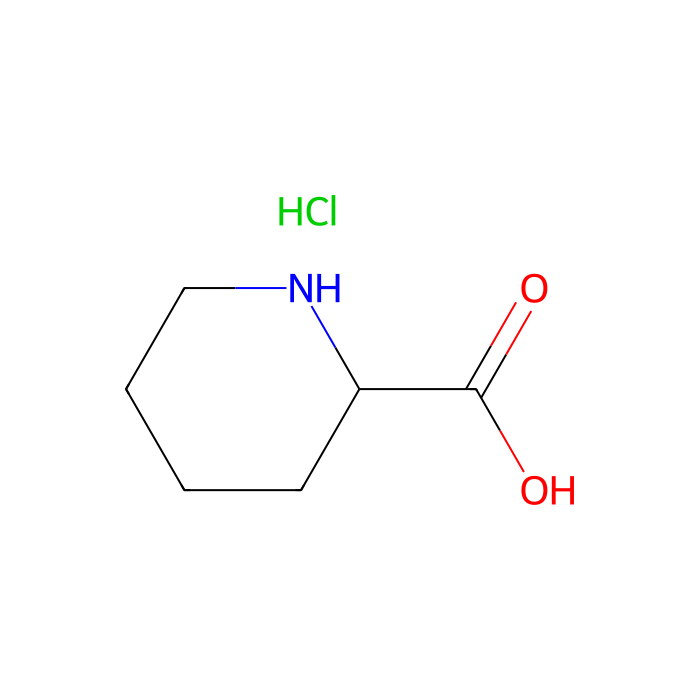
DL-Pipecolic acid hydrochloride is the racemic hydrochloride salt of piperidine-2-carboxylic acid (pipecolic acid). It contains a saturated six-membered piperidine ring bearing a carboxylic acid at C2 and a protonated secondary amine (as the HCl salt). The DL designation indicates a 1:1 mixture of enantiomers at C2.
Product Data identifiers
CAS: 5107-10-8
PubChem CID: 85923 (literature)
InChIKey (Product Data): 15088 (note: non-standard format as provided)
Composition and formulae
Empirical formula (hydrochloride salt, literature): C6H12ClNO2
Counterion: chloride; amine present as ammonium (–NH2+)
Structure description (2D)
Six-membered saturated ring (piperidine) with the nitrogen incorporated in the ring; a carboxyl group at the 2-position relative to N. In the HCl form, the ring nitrogen is protonated and paired with Cl−; the carboxyl remains as –CO2H.
Isomerism: single stereocenter at C2; supplied as racemate (DL).
Notes: Where explicitly not provided in Product Data, identity details above are literature characterizations of the named substance; consult the CoA/Spec Sheet for item-specific confirmation.
Synthetic Utility
Functional groups: secondary amine (as ammonium in the HCl salt) and carboxylic acid. The C2 stereocenter enables access to both enantiomers from the DL mixture via resolution if needed.
Key transformations (literature)
N-protection: Boc2O (Boc), benzyl chloroformate (Cbz), or Fmoc-Cl to differentiate N and CO2H for orthogonal manipulations.
Carboxyl activation: conversion to acid chlorides (e.g., via oxalyl chloride) or in situ activation for amidation/esterification using EDCI/Oxyma, HATU, or DMTMM.
Oxidation to lactam: mild oxidants can convert to 2-piperidone, opening further derivatization routes.
Resolution/deracemization: diastereomeric salt formation with chiral acids/bases, enzymatic esterification/hydrolysis, or chiral HPLC.
Retrosynthetic value
Serves as a hub into piperidine chemistry; substitution at nitrogen or carboxyl elaboration accesses diverse fragments common in medicinal chemistry.
Practical points
From the HCl salt, include base equivalents to liberate the free amine for N-acylation or protection.
Moisture and acidity can influence coupling reagent performance; pre-dry solvents and use non-nucleophilic bases (DIPEA, NMM) to minimize side reactions.
Monitor for potential lactamization under strongly activating conditions; adjust temperature and reagent stoichiometry accordingly.
Target Specificity
Not applicable. This product is a small-molecule building block, not an antibody, enzyme, or affinity reagent. No target, epitope, clone, or species specificity is defined in the Product Data.
Utilizziamo i cookie per garantire il corretto funzionamento del sito web e, ove consentito, per migliorare la tua esperienza. Puoi gestire le tue preferenze in qualsiasi momento nelle Impostazioni. Per saperne di più, consulta la nostra Cookie Policy.
Desidera che le inviamo un messaggio quando avremo sconti disponibili?
Ricordamelo più tardi
Grazie! Controlli la sua casella di posta per confermare.
Products are supplied to verified businesses, institutions, and qualified professionals for research and development use only. Not for use in humans, animals, diagnosis, or therapy.

 J2213634