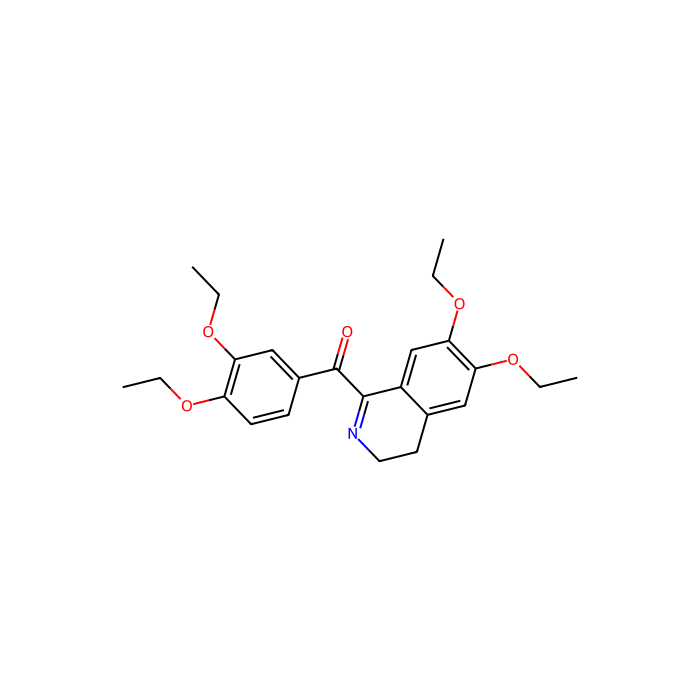
This compound belongs to the class of organic compounds known as benzylisoquinolines. These are organic compounds containing an isoquinoline to which a benzyl group is attached.
External Descriptors
Not available
1. Djoumbou Feunang Y, Eisner R, Knox C, Chepelev L, Hastings J, Owen G, Fahy E, Steinbeck C, Subramanian S, Bolton E, Greiner R, and Wishart DS. ClassyFire: Automated Chemical Classification With A Comprehensive, Computable Taxonomy. Journal of Cheminformatics, 2016, 8:61.
Determine the necessary mass, volume, or concentration for preparing a solution.
Dilution Calculator
Determine the dilution needed to prepare a stock solution.
Reconstitution Calculator
Recensioni
Recensioni dei clienti
Application Protocols
No validated application protocols (e.g., assay conditions, concentrations, or analytical methods specific to this item) are provided in the Product Data. For general small-molecule handling:
Prepare DMSO stock (e.g., 10–50 mM) if soluble; vortex/sonicate to aid dissolution.
Filter working solutions (0.22 µm) before sensitive assays or HPLC injection.
Include vehicle controls matching the final DMSO/co-solvent percentage in biological assays.
Confirm concentration by UV–Vis or quantitative NMR against an internal standard when appropriate.
For project-specific SOPs, develop and validate protocols under your laboratory’s QA framework.
Biological Roles
No item-specific biological function or pathway annotation is provided for Drotaveraldine in this listing. Without a confirmed structure and characterization set, no definitive biological role can be assigned.
General context for small-molecule libraries (research only)
Such compounds are typically evaluated as chemical probes or screening hits in enzymatic, receptor, or cell-based assays. Any observed activity should be treated as preliminary until confirmed with orthogonal assays, counter-screens, and appropriate controls.
If biological testing is pursued, ensure analytical verification of identity/purity immediately prior to assays and establish solubility and stability in the chosen assay matrix (protein binding, adsorption to plastics, and oxidative degradation can confound results).
Consider running PAINS and reactive substructure filters once the structure is confirmed to assess potential assay interference.
Important limitations
No clinical, diagnostic, or therapeutic uses are implied or permitted. This product is provided strictly for research use only.
Buffer Applications
This product is not a buffering reagent and no acid–base parameters (pKa, buffer capacity) are provided. Therefore, buffer preparation guidance does not apply directly.
Practical note
If the compound is to be tested in biological buffers, establish compatibility and solubility by preparing DMSO stocks and diluting into buffers such as PBS, HEPES, or Tris while maintaining ≤0.5–1% DMSO. Confirm absence of precipitation and assess stability over the assay timeframe.
Green Alternatives
Green chemistry considerations here focus on the handling and processing solvents and auxiliaries used with this small-molecule library member, since the molecule-specific hazards are not disclosed in the listing.
Guidance for greener workflows
Prefer bio-based or lower-toxicity solvents where technically feasible:
Replace DCM/chloroform with EtOAc, 2-MeTHF, or cyclopentyl methyl ether (CPME) for extractions and crystallizations when solubility permits.
Replace DMF/DMAc/NMP with acetonitrile, MeOH/EtOH, or water/co-solvent systems for analytics and processing if the compound remains soluble and stable.
For LC, use water–ACN gradients; avoid ion-pairing reagents unless necessary.
Minimize DMSO usage in biological assays by preparing higher-concentration stocks and diluting to ≤0.5–1% v/v in assay media.
Implement microscale reactions and high-throughput experimentation (HTE) to reduce solvent and reagent consumption during method development.
Utilize closed-vial dissolution with vortex/sonication to limit VOC emissions.
Trade-offs and verification
Greener substitutes may change solubility, polymorph outcomes, or chromatographic behavior; verify recovery, purity, and stability under the substituted conditions.
Document solvent selection using metrics (e.g., PMI, CHEM21/GlaxoSmithKline solvent guides) to balance performance with environmental impact.
Pharmaceutical Uses
No pharmacopeial status, excipient role, or formulation guidance is provided for this item. It is supplied strictly for research use only and is not intended for diagnostic or therapeutic applications.
Research formulation context (general)
For in vitro testing, prepare concentrated DMSO stocks (e.g., 10–50 mM) and dilute into assay media within DMSO tolerances.
For pre-formulation research in non-clinical settings, solubility enhancement strategies (cyclodextrins, co-solvents, pH adjustment where chemically appropriate) may be explored only after the compound’s structure and ionization state are confirmed. No claims are made for this specific item’s suitability for such work.
Regulatory note
Absence of a defined grade or pharmacopeial monograph precludes use in GMP manufacturing or clinical contexts. Consult your quality unit before any use beyond basic research.
Physical Properties
Item-specific physical constants are not provided in the Product Data. Where applicable, consult the product CoA/SDS.
Appearance: Not specified for this item; refer to CoA/Spec Sheet.
Melting point (literature/computed): Not available in this listing; consult primary literature or databases for CAS 54088-62-9.
Boiling point (literature): Not available in this listing.
Density (literature): Not available in this listing.
Solubility:
Item-specific aqueous/organic solubility: Not specified for this item; refer to CoA/Spec Sheet.
Practical guidance (general): For small-molecule library members, initial solubility screening is typically performed in DMSO (analytical grade), followed by miscible cosolvents (MeOH, ACN) and buffered aqueous media with ≤1–5% DMSO.
LogP/logD, pKa (literature/computed): Not available in this listing; consult cheminformatics resources tied to the confirmed structure for CAS 54088-62-9.
Refractive index, UV–Vis characteristics: Not specified for this item; refer to CoA/Spec Sheet.
Notes for method development (general)
If chromatographic methods are needed prior to available specs, start with reversed-phase LC (C18), gradient 5–95% ACN/H2O (0.1% formic acid) and monitor at 210–280 nm. Adjust based on any observed chromophores once structural data are confirmed.
Quality and Grades
Grade/Purity: Not specified for this item; refer to CoA/Spec Sheet.
Context and guidance
In small-molecule libraries, materials are commonly provided at research grade with an assay/purity determined by HPLC/LC–MS and identity by LC–MS/NMR. In the absence of an explicit grade on this listing, consult the CoA for:
Purity basis (e.g., HPLC area %, qNMR) and detection wavelength(s).
Residual solvent content (GC), water content (Karl Fischer), and salt/form counterions where applicable.
Identity confirmation (1H NMR, MS, sometimes 13C NMR/HRMS).
If low-UV applications (e.g., HPLC analytics) are intended, request UV-cutoff or baseline trace information; if not specified, assume typical small-molecule UV absorbance dependent on structure and verify empirically.
Trace metals, specific anion/cation limits, and stabilizers: Not specified for this item; refer to CoA/Spec Sheet.
Recommendations
For bioassay screening, target stock solutions ≥10 mM in DMSO when solubility allows; verify purity just prior to screening if the project requires.
For analytical reference purposes, consider re-purifying by preparative HPLC if the intended use demands ≥99.5% purity or single polymorph/salt form control.
Reaction and Applications
This product is listed under a small-molecule/compound library category and is primarily suited for research screening, analytical reference, and method-development contexts. Item-specific reactivity and transformation behavior cannot be detailed without the disclosed structure; the following are general-use scenarios suitable for small molecules in discovery workflows.
Discovery and screening
Use as a discrete chemical entity in target-based or phenotypic screening, with validated identity and purity controls (LC–MS, HPLC, 1H NMR) prior to hit declaration.
Support structure–activity relationship (SAR) exploration when clustered with related analogs; maintain consistent salt/form across series.
Analytical applications
Serve as a reference standard for retention time, ionization behavior (ESI±), and fragmentation profiling once spectral data are acquired.
Stability-indicating methods: stress under heat, light, and pH extremes to define handling windows.
Preparative/processing
If re-formulation or salt screening is needed, evaluate counterions (HCl, mesylate, maleate, citrate) based on functional groups identified from spectral data.
General practical tips
Dry powders or amorphous solids may be hygroscopic; minimize atmospheric exposure.
When planning derivatization or metabolite synthesis, assign functional groups via NMR/IR/MS first; select chemoselective conditions accordingly.
Note: No specific synthetic or biological activity claims are made for this item in the absence of structural disclosure. All uses are for research only.
Reaction Conditions
No reaction conditions specific to Drotaveraldine can be provided without structural information. This section is therefore limited to general best practices if chemical modification or analytical method development is pursued in a research setting.
General best practices (method development)
Analytics: Start with LC–MS (ESI±), C18 column, 5–95% ACN/H2O with 0.1% formic acid, 0.3–0.5 mL/min at ambient temperature; adjust gradient and pH upon learning ionization behavior.
Stability studies: Stress at 40–60°C, light exposure (UV/visible), and pH 2/7/10 to identify degradation pathways prior to scaling any transformations.
If functional groups are later identified:
Amines: consider amide coupling (HATU/EDC), reductive amination (NaBH3CN or BH(OAc)3), acylation/carbamoylation under mild conditions.
Aryl halides/boronates: consider cross-coupling (Pd-catalyzed Suzuki–Miyaura) in green(er) solvents where feasible.
Alcohols/carboxylic acids: esterification (Steglich), carbonate/urethane formation under mild base.
Caution
Do not assume air, moisture, or light stability. Validate experimentally before long reactions or storage in solution.
Safety and Handling
Safety data for this specific item are not included in the Product Data. Always review the current SDS before handling.
GHS classification: Not specified for this item; refer to CoA/Spec Sheet/SDS.
Signal word, H-statements, pictograms: Not specified for this item; refer to SDS.
Storage conditions (Product Data): Store at 2–8°C. Shipped on wet ice.
General laboratory precautions (good practice)
Handle in a chemical fume hood; avoid inhalation of dusts/aerosols and skin/eye contact.
PPE: lab coat, safety glasses or splash goggles, suitable chemically resistant gloves (e.g., nitrile), and closed-toe footwear.
Incompatibilities: Unknown for this specific compound; as a precaution, segregate from strong oxidizers, strong acids/bases, and reactive reducing agents until specific data are available.
Spill/accidental release: Contain solids with inert absorbent, avoid dust generation, and collect in compatible waste. Decontaminate area with appropriate solvent/detergent per SDS guidance.
First aid (overview; defer to SDS):
Inhalation: Move to fresh air; seek medical attention if symptoms persist.
Skin/eye contact: Rinse with water for at least 15 minutes; remove contaminated clothing; obtain medical advice as needed.
Ingestion: Rinse mouth; do not induce vomiting; seek medical attention.
Waste disposal: Dispose of according to institutional and local regulations; consider halogenated vs non-halogenated solvent streams where applicable.
Note: Do not use for diagnostic or therapeutic applications. For research use only.
Solvent Selection
Because structural and polarity parameters are not disclosed for this item, solvent selection should proceed empirically, using a tiered screen appropriate for small-molecule libraries.
Recommended solubility screen (general guidance)
Primary solvent: DMSO (anhydrous, ≥99.9%) at 10–50 mM target concentration.
Polar protic options: MeOH, EtOH, i-PrOH for preparing intermediate concentrates or for LC sample prep.
Polar aprotic options: Acetonitrile, DMF, DMAc for method development; verify compatibility with downstream biology.
Less polar options: EtOAc, THF, DCM if organic workup or recrystallization is required.
Aqueous vehicles: Buffers at pH 6–8 containing 1–5% DMSO or 10–20% co-solvent to enhance apparent solubility, pending stability testing.
Practical tips
Start with 1–2 mg in 1 mL DMSO; vortex/sonicate; if insoluble, add equal volume of DMF or ACN.
For biological assays, filter sterilize working solutions (0.22 µm PTFE for organic-rich, PES/nylon for aqueous) and confirm absence of precipitation over assay time.
Use cosolvent mapping: prepare 10 mM stocks in DMSO and dilute to 0.1–1% DMSO final in assay buffer; monitor turbidity.
Comparison notes
DMSO offers the broadest solubility and freeze–thaw resilience; ACN/MeOH provide LC compatibility; DMF/DMAc may improve solubility but can be less desirable biologically. Choose based on the intended downstream application and tolerability constraints.
Storage and Reconstitution
Storage (Product Data): Store at 2–8°C.
Shipping: Shipped on wet ice to maintain temperature control during transit.
Container: Keep tightly closed in the original container with desiccant if provided. Protect from excessive moisture and light until specific stability data are available.
Reconstitution and solution handling (general guidance)
Stock solutions: Start with DMSO to 10–50 mM where soluble. If insoluble, trial DMF or ACN, then back-dilute with buffer or aqueous media as needed.
Filtration: For assay or analytical use, 0.22 µm filtration is recommended to remove particulates.
Aliquoting: Divide stocks into single-use aliquots to avoid repeated freeze–thaw. Label with concentration, solvent, and preparation date.
Solution stability: In the absence of item-specific data, use solutions promptly (within days at 2–8°C; within weeks at −20°C) and monitor for precipitation, color change, or degradation by LC–MS/HPLC.
Solid stability: Item-specific shelf-life and hygroscopicity are not provided; if long-term storage is required, consider desiccation and inert atmosphere until data are available.
Specifications not provided
Appearance, assay/purity basis, water content, and stabilizers: Not specified for this item; refer to CoA/Spec Sheet.
Use limitation: For research use only.
Structure and Identity
Product name: Drotaveraldine (SKU: D350026)
CAS: 54088-62-9 (Product Data)
PubChem CID: 71777248 (Product Data)
InChIKey: 113167 (as provided; note: full InChIKey format typically has 27 characters; consult CoA/SDS for confirmation)
SMILES: Not specified for this item; refer to CoA/Spec Sheet.
Molecular formula: Not specified for this item; refer to CoA/Spec Sheet.
Molecular weight: Not specified for this item; refer to CoA/Spec Sheet.
Structural features
Item-specific structural details (ring systems, functional groups, stereochemistry) are not available in this listing. Please consult the CoA/SDS or authoritative databases for the definitive structure associated with CAS 54088-62-9.
2D structure (descriptive)
Without a disclosed SMILES/InChI, a text description of the 2D scaffold cannot be provided. If you require a confirmed depiction for method development, request the current CoA/SDS or spectral package from Aladdin Scientific.
Identity assurance
For libraries and screening collections, we recommend verifying identity via orthogonal methods (e.g., LC–MS with exact mass, 1H NMR) prior to critical studies.
Cross-reference: Category Path indicates inclusion in a small-molecule/compound library (产品类别: 小分子和化合物库).
Synthetic Utility
Item-specific functional groups and reactivity patterns are not disclosed in this listing; therefore, no definitive synthetic transformations can be recommended for this compound.
General guidance for small-molecule processing
If derivatization is desired (e.g., for SAR expansion), first confirm identity and obtain spectral data (1H/13C NMR, HRMS, IR). Map potential handles (amines, alcohols, halides, carbonyls) and select chemoselective methodologies accordingly (amide coupling, SNAr/SN2, reductive amination, Suzuki–Miyaura, etc.).
For purification, reversed-phase preparative HPLC or normal-phase silica may be used based on polarity and stability; scout quickly with TLC/analytical LC.
For salt form modification, screen common mineral and organic acids/bases after establishing the compound’s acid/base character.
Note: No named-reaction or reagent-specific recommendations are made here due to the absence of structural information. Refer to the CoA/SDS or request additional documentation to enable targeted synthetic planning.
Target Specificity
No target binding data, enzyme/receptor specificity, or mechanistic annotations are provided for this product. In the absence of such data, it should be treated as a generic small molecule for discovery research. Any target specificity must be established experimentally after confirming identity and purity.
We use cookies to ensure the website functions properly and, where permitted, to improve your experience. You can manage your preferences at any time in Settings. Learn more in our Cookie Policy.
Shall we send you a message when we have discounts available?
Remind me later
Thank you! Please check your email inbox to confirm.
Products are supplied to verified businesses, institutions, and qualified professionals for research and development use only. Not for use in humans, animals, diagnosis, or therapy.

 I2220345