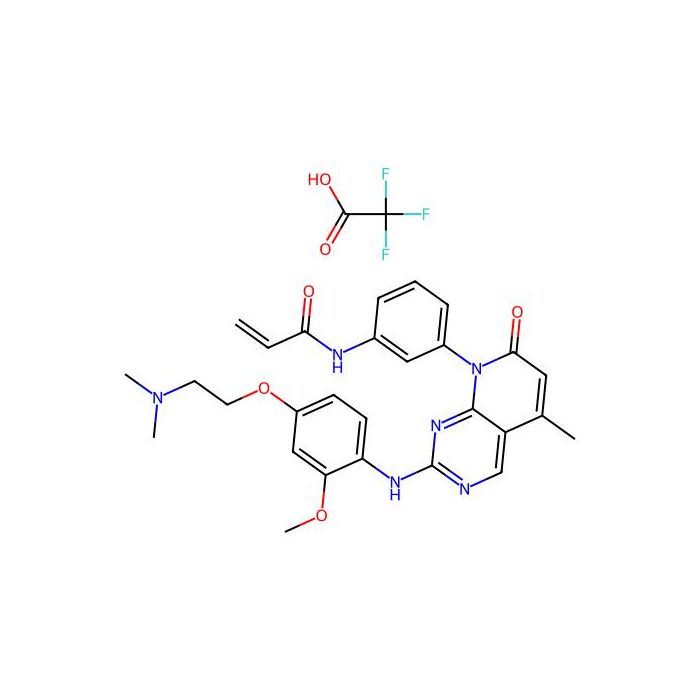
EGFR-IN-1 TFA is an orally active and irreversible L858R/T790M mutant selective EGFR inhibitor. EGFR-IN-1 TFA potently inhibits Gefitinib-resistant EGFR L858R, T790M with 100-fold selectivity over wild-type EGFR . EGFR-IN-1 TFA displays strong antiprolife
IC50& Target:EGFR L858R/T790M
In Vitro:EGFR-IN-1 TFA (compound 24) is an orally active and irreversible L858R/T790M mutant selective EGFR inhibitor. EGFR-IN-1 TFA potently inhibits Gefitinib-resistant EGFR L858R, T790M with 100-fold selectivity over wild-type EGFR. EGFR-IN-1 TFA displays stron
In Vivo:EGFR-IN-1 TFA (30mg/kg; p.o.; daily for 2 weeks) displays significant tumor growth inhibition with no observed loss in body weight. EGFR-IN-1 TFA evaluates in a time course PD experiment upon oral dosing at 30mg/kg. EGFR-IN-1 TFA shows a >50% inhib
Biological Activity:EGFR-IN-1 TFA is an orally active and irreversible L858R/T790M mutant selective EGFR inhibitor. EGFR-IN-1 TFA potently inhibits Gefitinib-resistant EGFR L858R, T790M with 100-fold selectivity over wild-type EGFR . EGFR-IN-1 TFA displays strong antiprolife
Specifiche
Specifiche e purezza
10mM in DMSO
Condizioni di conservazione di stoccaggio
Desiccated,Store at -80°C
Spedito in
Dry ice packs + Cold packs
Questo prodotto richiede spedizione a catena fredda. I servizi di terra e altri servizi economici non sono disponibili.
Tipo di azione
INHIBITOR
Nomi e identificatori
Peso molecolare
628.6
Dati avanzati
Certificati (CoA, COO, BSE/TSE e tabella di analisi)
C of A & Other Certificates(BSE/TSE, COO):
Analytical Chart:
Calcolatori di soluzioni
Molarity Calculator
Determine the necessary mass, volume, or concentration for preparing a solution.
Dilution Calculator
Determine the dilution needed to prepare a stock solution.
Reconstitution Calculator
Recensioni
Recensioni dei clienti
Application Protocols
Validated application types, recommended concentrations, and assay-specific protocols are not specified for this item.
General practice (for small-molecule inhibitors; not item-specific):
Prepare a concentrated DMSO stock (e.g., 10–50 mM) and perform serial dilutions to generate dose–response curves in biochemical or cellular assays.
Include vehicle controls matched for final DMSO percentage.
For time-course experiments, pre-incubate with the compound (e.g., 15–60 minutes) before pathway stimulation; optimize per assay endpoint.
For item-specific, tested applications and positive controls, refer to the CoA/Spec Sheet.
Biological Roles
General background (literature; not item-specific claims):
Epidermal growth factor receptor (EGFR) is a receptor tyrosine kinase that, upon ligand binding (e.g., EGF, TGF-α), undergoes dimerization and autophosphorylation, initiating downstream signaling pathways such as RAS–RAF–MEK–ERK and PI3K–AKT.
Modulators of EGFR kinase activity are widely used as research tools to probe signal transduction, receptor trafficking, feedback regulation, and cross-talk with other receptor families.
Small-molecule inhibitors targeting the ATP-binding site are commonly employed in biochemical kinase assays, cellular phospho-protein measurements (e.g., p-EGFR, p-ERK), and pathway mapping.
How this item is typically used (general practice):
Prepared as DMSO stocks and titrated across a concentration range to determine effects on phosphorylation status or downstream transcriptional readouts.
Combined with genetic perturbations (e.g., siRNA/CRISPR) or ligand stimulation (EGF) to dissect pathway dependencies.
Item-specific target selectivity, potency (IC50/Ki), and off-target profile are not provided here; consult the CoA/Spec Sheet or supporting documentation if available. This product is for research use only.
Buffer Applications
This small-molecule inhibitor is typically introduced into biological buffers as a diluted DMSO stock.
Common assay buffers (general practice):
Biochemical kinase assays: HEPES or Tris (pH 7.0–7.5), Mg2+, ATP, BSA (0.01–0.1%) to minimize nonspecific binding; detergent (0.005–0.02% Tween-20) can improve reproducibility.
Cell-based assays: Culture media supplemented as required; maintain final DMSO typically ≤0.1–0.2% v/v to limit solvent effects.
Preparation tips:
Prepare a high-concentration DMSO stock (e.g., 10–50 mM), then dilute into buffer with vigorous mixing to avoid local supersaturation.
If precipitation occurs, increase mixing time, gently warm to ambient temperature, or add a small amount of co-solvent (DMSO or ethanol) while keeping total organic content low.
Filter through 0.22 µm if clarity is needed for optical readouts; verify compound is not retained by the membrane.
Compatibility:
Avoid strong acids/bases in working buffers that could alter the ionization state or stability of the inhibitor salt.
Adsorption to plastics may occur for hydrophobic compounds; low-binding tubes/plates can mitigate losses.
No item-specific buffer recipes or stability-in-buffer data are provided; consult internal validation as required.
Green Alternatives
As a bioactive tool compound, the main environmental considerations relate to solvent choice and waste minimization rather than replacement of the molecule itself.
Prefer greener solvents for dissolution/dilution when feasible:
DMSO is widely accepted for bioassays and is relatively benign compared to chlorinated solvents; ensure proper disposal.
Where compatible, ethanol or water-based formulations (after a DMSO pre-stock) can reduce solvent hazards.
Comparison (general, not item-specific):
DMSO vs DMF
Greenness: DMSO generally favored; DMF is a reproductive toxin and more regulated.
Performance: Both dissolve many salts; DMSO better tolerated in cells at low %.
Ethanol vs Acetonitrile
Greenness: Ethanol has a better safety/green profile; acetonitrile offers low UV absorbance but higher toxicity and flammability.
Practical steps:
Use the highest feasible stock concentration to minimize total solvent volume introduced to assays.
Employ microvolume dispensing to reduce waste.
Segregate halogenated and non-halogenated waste; avoid unnecessary chlorinated solvents in any cleanup or analytics when alternatives (MeOH, EtOH, water) suffice.
Pharmaceutical Uses
This product is supplied strictly for research use only. It is not intended for human or veterinary use, diagnostic procedures, or as an active pharmaceutical ingredient.
Excipient/formulation status: No pharmacopeial status or excipient role is provided for this item.
GMP/clinical grade: Not specified for this item; refer to CoA/Spec Sheet. Material is offered for laboratory research applications.
Formulation development (research context only): If pre-formulation studies are performed in vitro, typical vehicles may include DMSO stocks diluted into aqueous systems. For any translational work, independently establish full quality, safety, and regulatory assessments—outside the scope of this catalog listing.
Do not use this material in any clinical, diagnostic, or therapeutic context.
Physical Properties
Appearance: Not specified for this item; refer to CoA/Spec Sheet.
Molecular weight: Not specified for this item; refer to CoA/Spec Sheet.
Melting point / Boiling point: Not specified for this item; refer to CoA/Spec Sheet.
Density / Refractive index: Not applicable/Not specified for this item; refer to CoA/Spec Sheet.
Solubility:
Item-specific numeric solubilities: Not specified for this item; refer to CoA/Spec Sheet.
General guidance (literature/typical for TFA salts, not item-specific): TFA salts of basic small molecules are typically soluble in polar organics (e.g., DMSO, DMF) and often show improved dispersion in aqueous buffers after preparing a concentrated DMSO stock.
pKa / logP: Not specified for this item; refer to CoA/Spec Sheet.
Practical notes (general chemistry knowledge):
TFA salts are hygroscopic more often than the corresponding free bases; maintain in a desiccated environment to preserve material integrity and accurate weighing.
For working solutions, dissolve the solid in high-purity, anhydrous DMSO to make a concentrated stock (e.g., 10–50 mM), then dilute into assay buffer as needed, keeping final DMSO typically ≤0.1–0.5% v/v in biochemical assays and ≤0.1–0.2% v/v in sensitive cell-based assays.
Quality and Grades
Grade/Purity: Not specified for this item; refer to CoA/Spec Sheet.
Interpretation and guidance (general):
For small-molecule research inhibitors, suppliers typically provide purity by HPLC (area %), accompanied by identity confirmation (e.g., MS/HRMS and/or NMR). When purity is critical for SAR or cellular assays, review the accompanying CoA/SDS for the exact value and analytical methods.
TFA counterion considerations: The presence and stoichiometry of TFA can influence mass balance and apparent purity by weight. If you require the free base for stoichiometric dosing, consider converting from the TFA salt via ion exchange or basification under controlled conditions, then verify by NMR and acid/base titration.
Residual solvents/water: Not specified for this item; refer to CoA/Spec Sheet. For accurate dosing, equilibrate materials in a desiccator prior to weighing and consider Karl Fischer titration if water content is critical.
If low UV background is needed (e.g., kinase assays with UV detection), request UV cutoff data or chromatographic background profiles from the CoA.
Reaction and Applications
This product is supplied as a bioactive small-molecule research tool and is not typically employed as a synthetic reagent or catalyst.
Synthetic reaction applications (Grignard, cross-coupling, etc.) are not generally applicable to this item.
Primary laboratory use is anticipated to be as a test article in biochemical or cellular assays investigating EGFR-related signaling pathways and kinase biology (research use only). No medical or clinical uses are implied.
If you require a synthetic intermediate or building block version, please inquire for availability of precursor structures or free-base forms better suited to chemical transformations.
Reaction Conditions
Not typically applicable. This product is not supplied for use as a reagent/catalyst in synthetic reactions.
General note (if derivatization is attempted in research):
Convert to the free base under controlled conditions (ion exchange or basification), then purify and verify identity/purity by NMR and MS before any transformations.
Remove residual TFA thoroughly, as it can suppress nucleophilicity and poison bases/catalysts.
No item-specific reaction conditions, catalysts, temperatures, or yields are provided.
Safety and Handling
Item-specific hazard classification and statements are not provided for this listing. Always consult the product SDS for authoritative safety information.
GHS classification, pictograms, H-statements: Not specified for this item; refer to SDS.
General laboratory PPE: Lab coat, safety glasses, and appropriate chemically resistant gloves (e.g., nitrile). Handle powders and DMSO solutions in a fume hood to minimize inhalation and exposure.
Hygroscopicity: TFA salts may be moisture sensitive. Minimize atmospheric exposure; recap promptly and store with desiccant.
Incompatibilities (general): Avoid strong oxidizers and strong bases/acids until compatibility is confirmed. Prevent contact with reactive acylating/alkylating agents unless intended.
First aid (general overview; defer to SDS):
Skin/eye: Rinse with water for ≥15 minutes; remove contaminated clothing; seek medical advice.
Inhalation: Move to fresh air; seek medical attention if symptoms occur.
Ingestion: Rinse mouth; do not induce vomiting; seek medical attention.
Spill response: Avoid dust generation. Cover with inert absorbent (for solutions) or gently sweep (for solids) while wearing appropriate PPE; dispose according to institutional and local regulations.
Waste: Collect as organic hazardous waste. DMSO solutions may increase dermal penetration risk—avoid skin contact.
Solvent Selection
This item is a small-molecule inhibitor typically handled as concentrated DMSO stock for biological assays.
Primary solvent for stocks (practice-based): Anhydrous, high-purity DMSO is commonly used due to broad solvating power and biological compatibility at low percentages.
Alternative polar aprotic solvents: DMF or ethanol (absolute) may dissolve some salt forms but can be less desirable for cellular systems; verify compatibility with your assay and cells.
Aqueous buffers: Direct aqueous dissolution of a TFA salt may be feasible for some structures but can be formulation-dependent; a DMSO pre-stock followed by buffer dilution typically yields clearer solutions.
Miscibility profile (general):
DMSO: miscible with water and many organics; facilitates preparation of serial dilutions.
Ethanol: miscible with water; higher volatility; may affect membranes at >0.5–1%.
Practical tips:
Warm gently (room temperature to 37°C) and vortex/sonicate to aid dissolution; avoid prolonged heating.
Filter working solutions (0.22 µm PTFE/PES) if particulates persist; confirm no adsorption losses.
Maintain final DMSO typically ≤0.1–0.5% v/v for biochemical assays and minimal for cell assays to reduce solvent effects.
No item-specific solubility numbers are provided; consult the CoA/Spec Sheet for any validated solvent recommendations.
Storage and Reconstitution
Storage conditions (item-specific): Desiccated, Store at -80°C.
Shipping (item-specific): Shipped on dry ice packs + cold packs to maintain low temperature and dryness.
Research Use Note: For research use only.
Working guidance (general best practices for small-molecule TFA salts):
Upon receipt, allow the sealed container to equilibrate to room temperature in a desiccator before opening to prevent moisture condensation.
If supplied as a solid, promptly prepare single-use aliquots. Dissolve in anhydrous DMSO to form a concentrated stock (e.g., 10–50 mM), then aliquot into low-bind tubes.
Storage of solutions: Keep DMSO stocks tightly capped under inert gas (optional) at -20°C to -80°C, protected from light. Avoid repeated freeze–thaw; thaw an aliquot once, keep on ice during use, and discard leftovers.
Stability: Item-specific stability data and retest dates are not provided; for critical work, verify integrity by LC–MS or HPLC prior to use after prolonged storage.
Moisture control: Maintain desiccation at all times to prevent uptake of water that can alter mass and concentration.
If precipitation occurs upon buffer dilution, re-clarify by gentle warming and vortexing or adjust the DMSO percentage slightly while maintaining assay-acceptable levels.
Structure and Identity
EGFR-IN-1 TFA is supplied as the trifluoroacetate salt of a small-molecule research inhibitor, intended for biochemical and cellular studies.
Molecular formula: Not specified for this item; refer to CoA/Spec Sheet.
Molecular weight: Not specified for this item; refer to CoA/Spec Sheet.
SMILES: Not specified for this item; refer to CoA/Spec Sheet.
InChIKey: Not specified for this item; refer to CoA/Spec Sheet.
CAS: Not specified for this item; refer to CoA/Spec Sheet.
Salt form: Trifluoroacetate (TFA) salt; the counterion is trifluoroacetate.
Structural overview (general information):
Compound type: Small-molecule kinase-pathway probe (research use only); provided as a TFA salt to aid handling and solubility in polar organic solvents.
General features (literature, not item-specific): EGFR-directed tool compounds commonly incorporate heteroaromatic cores and anilide/heteroaryl substituents compatible with ATP-site binding; the TFA salt indicates the free base bears a basic nitrogen that is protonated in the salt. Exact functional groups and stereochemistry for this item are not specified.
2D description (general):
Expected to contain one or more basic nitrogens (forming the TFA salt). Ring systems and specific substituents are not specified for this item.
Synthetic Utility
This item is a finished bioactive small molecule (TFA salt) rather than a building block and is not typically used as a reagent or intermediate in synthetic chemistry.
If chemical derivatization or SAR expansion is desired, request information on the corresponding free-base form, synthetic precursors, or analog libraries, which are more suitable substrates for coupling, substitution, or heterocycle modifications.
Routine transformations (e.g., acylations, cross-couplings) are not recommended on the formulated TFA salt without first liberating and characterizing the free base; TFA can interfere with many organic reactions and complicate workups.
No item-specific functional group map or reactivity profile is provided.
Target Specificity
Item-specific target(s), selectivity profile, and potency data are not provided in this listing.
Target name, species reactivity, and any quantitative metrics (IC50, Ki, KD): Not specified for this item; refer to CoA/Spec Sheet or supporting documentation if available.
Utilizziamo i cookie per garantire il corretto funzionamento del sito web e, ove consentito, per migliorare la tua esperienza. Puoi gestire le tue preferenze in qualsiasi momento nelle Impostazioni. Per saperne di più, consulta la nostra Cookie Policy.
Desidera che le inviamo un messaggio quando avremo sconti disponibili?
Ricordamelo più tardi
Grazie! Controlli la sua casella di posta per confermare.
Products are supplied to verified businesses, institutions, and qualified professionals for research and development use only. Not for use in humans, animals, diagnosis, or therapy.