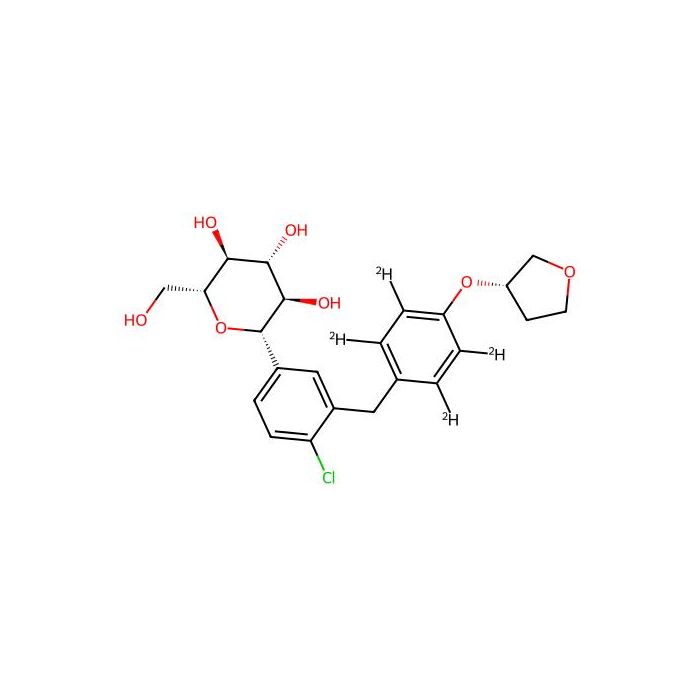
Empagliflozin-d 4 is deuterium labeled Empagliflozin. Empagliflozin (BI 107730 is a selective sodium glucose cotransporter-2 (SGLT-2) inhibitor with an IC50 of 3.1 nM for human SGLT-2.
In Vitro
Stable heavy isotopes of hydrogen, carbon, and other elements have been incorporated into drug molecules, largely as tracers for quantitation during the drug development process. Deuteration has gained attention because of its potential to affect the pharmacokinetic and metabolic profiles of drugs. MCE has not independently confirmed the accuracy of these methods. They are for reference only.
Form:Solid
Specifiche
Specifiche e purezza
≥97%
Meccanismi biochimici e fisiologici
Empagliflozin-d 4 is deuterium labeled Empagliflozin. Empagliflozin (BI 107730 is a selective sodium glucose cotransporter-2 (SGLT-2) inhibitor with an IC50 of 3.1 nM for human SGLT-2.
Condizioni di conservazione di stoccaggio
Store at -20°C
Spedito in
Ice chest + Ice pads
Questo prodotto richiede spedizione a catena fredda. I servizi di terra e altri servizi economici non sono disponibili.
Tipo di azione
INHIBITOR
Purezza
≥97%
Nomi e identificatori
Peso molecolare
454.93
Dati avanzati
Certificati (CoA, COO, BSE/TSE e tabella di analisi)
C of A & Other Certificates(BSE/TSE, COO):
Analytical Chart:
Calcolatori di soluzioni
Molarity Calculator
Determine the necessary mass, volume, or concentration for preparing a solution.
Dilution Calculator
Determine the dilution needed to prepare a stock solution.
Reconstitution Calculator
Recensioni
Recensioni dei clienti
Application Protocols
No item-specific, tested application protocols are provided in the product data. For general guidance on preparing internal standard solutions and setting up LC–MS/MS assays, refer to the Reaction Conditions and Solvent Selection sections. Users should validate all procedures within their own laboratories.
Biological Roles
This product is intended for research use only as an isotopically labeled analog of empagliflozin. It does not have an intrinsic biological role assigned for laboratory use.
Context (general, literature-based on the parent compound)
Empagliflozin is a member of the C-aryl β-D-glucopyranoside class that engages sodium-dependent glucose transporter proteins (SGLTs) in biochemical studies. As a deuterated analog, Empagliflozin-d4 is used to trace and quantify the parent compound in complex biological matrices, without perturbing biological systems at tracer levels.
In bioanalytical workflows, Empagliflozin-d4 acts as a stable-isotope internal standard, co-experiencing matrix effects, extraction efficiencies, and ionization competition similarly to the native compound, thereby improving precision and accuracy of measured concentrations.
Deuteration does not meaningfully alter binding properties or biochemical behavior at the qualitative level; its primary role is to produce a defined mass shift for MS discrimination (literature). Any functional/biological assays should be interpreted with the understanding that this material is supplied for analytical support, not as a tool compound to modulate biology.
Buffer Applications
Not typically applicable. Empagliflozin-d4 is not a buffering reagent. For this product, focus on sections covering Solvent Selection, Reaction & Applications, and Reaction Conditions for guidance on preparing analytical solutions compatible with LC–MS workflows.
Green Alternatives
As a deuterated reference standard, the concept of a “green alternative compound” is not typically applicable; the molecule is selected for isotopic labeling and structural match to the analyte. Greener choices can, however, be made in solvents, sample preparation, and chromatography.
Greener practice recommendations (general)
Prefer acetonitrile over halogenated solvents for extractions when method performance allows; optimize to lower solvent volumes through microextraction or 96-well precipitation formats.
Use aqueous mobile phases with low concentrations of volatile modifiers (formic acid, ammonium formate) to minimize environmental impact and facilitate waste handling.
Consider solid-phase extraction (SPE) methods that reduce solvent consumption relative to liquid–liquid extraction.
Consolidate runs with multiplexed assays where validated to reduce total solvent waste per data point.
Tradeoffs
Highly aqueous mobile phases may reduce retention/peak shape for hydrophobic-leaning glucoside analytes; small percentages of organic modifier (acetonitrile) are usually necessary for performance, representing a balance between green metrics and analytical robustness.
Pharmaceutical Uses
No therapeutic or clinical uses are claimed. For research use only.
Formulation/analytical context (general)
Empagliflozin-d4 is suitable as a reference/internal standard for pharmaceutical analysis of empagliflozin in drug product and drug substance testing, including stability-indicating methods, content uniformity, dissolution profiling, and bioanalytical pharmacokinetic studies (analytical context; no medical claims).
In quality control laboratories, isotope-dilution LC–MS/MS employing deuterated internal standards supports traceability, improved accuracy, and robustness across instruments and lots.
Method validation parameters (ICH/USP/EMA frameworks) typically assessed with this internal standard include selectivity, calibration model, accuracy, precision, recovery, matrix effects, carryover, and stability (bench-top, autosampler, freeze–thaw).
Documentation: Retain CoA detailing isotopic enrichment and identity; include reference standard qualifications in regulated filings where applicable.
Physical Properties
Item-specific properties
Appearance: Not specified for this item; refer to CoA/Spec Sheet.
Grade/Purity: Not specified for this item; refer to CoA/Spec Sheet.
Molecular weight: Not specified for this item; refer to CoA/Spec Sheet.
Molecular formula: Not specified for this item; refer to CoA/Spec Sheet.
Melting point, boiling point, density, refractive index, water content, residual solvents, metals: Not specified for this item; refer to CoA/Spec Sheet.
General expectations (literature/context; not specifications)
Deuterated small-molecule standards of this class are typically solid at ambient temperature and sparingly soluble in water, but readily soluble in polar aprotic organic solvents such as DMSO, DMF, and acetonitrile (literature, parent compound behavior).
Isotopic substitution with deuterium minimally perturbs polarity and pKa; chromatographic retention and UV characteristics are typically very similar to the non-deuterated parent, while mass is shifted by +4 Da for MS detection (literature).
Solubility guidance (general, non-specification)
For analytical stock solutions, 10–20 mM in anhydrous DMSO is commonly used for similar analytes; further dilution into 50–80% acetonitrile/water with 0.1% formic acid is typical for LC–MS injections (literature practice). Adjust based on your method validation.
Quality and Grades
Grade/Purity for this specific item: Not specified for this item; refer to CoA/Spec Sheet.
Context for isotopically labeled reference materials (general)
Deuterated small-molecule standards are typically supplied at high chemical purity and high isotopic enrichment to support quantitative LC–MS/MS bioanalysis. Certificates of Analysis commonly include:
Chemical purity by HPLC/UPLC (area %)
Isotopic enrichment and distribution (e.g., % d4 versus d0/d1/d2 impurities)
Residual solvents and water (Karl Fischer) where applicable
Identity confirmation by HRMS and 1H/13C NMR (with suppressed or shifted signals for D-labeled positions)
Implications for method development:
Higher isotopic purity reduces risk of cross-talk with the native (d0) analyte channels in MRM methods.
Closely matched retention and ionization to the parent compound improve accuracy as an internal standard.
What to verify on receipt
Match the lot’s exact labeling pattern (d4 positions) and enrichment to your validated MRM transitions.
Confirm any stabilizers, salt form, and counterions (if present). For this item: stabilizer and salt form are not specified; refer to CoA/Spec Sheet.
Ensure the item meets your internal acceptance criteria before use in regulated workflows.
Reaction and Applications
This product is principally an isotopically labeled analytical standard rather than a synthetic reagent. Applications focus on quantitative analysis and tracing rather than on facilitating chemical transformations.
Analytical and research applications (general, literature-based)
Internal standard for LC–MS/MS quantification of empagliflozin in biological matrices (plasma, serum, urine), formulation extracts, and stability-indicating studies.
Assessment of extraction recovery, matrix effects, and ion suppression in method validation; deuterated analogs co-elute closely with the analyte and compensate for variability.
Metabolic fate and stability studies: supports identification of parent compound levels alongside metabolite profiling; use in isotope-dilution workflows.
Calibration: construct calibration curves using native analyte spiked at known concentrations with a constant amount of Empagliflozin-d4 to correct for run-to-run variance.
Practical tips
Align MRM/PRM transitions to the +4 Da precursor and appropriate fragment ions that retain deuterium labels. Verify that major product ions are sufficiently mass-shifted to prevent channel overlap.
Spike the internal standard prior to sample workup (e.g., before protein precipitation or SPE) to normalize recovery.
Evaluate potential isotopic exchange under strongly protic or high-temperature conditions; maintain neutral to slightly acidic environments during preparation and analysis.
Reaction Conditions
Because this product functions as an analytical internal standard rather than a reagent, the most relevant “conditions” are those for solution preparation and LC–MS method support (general, literature-based guidance).
Preparation of stock and working solutions
Weigh quickly in a low-humidity environment. Dissolve in anhydrous DMSO to 10–20 mM. Vortex and, if needed, sonicate briefly at room temperature. Filter through a 0.2 μm PTFE filter if particulate is observed.
Prepare working solutions by diluting into acetonitrile/water (50:50 to 80:20) with 0.05–0.2% formic acid. Typical internal standard concentrations in samples are 1–100 ng/mL, adjusted to the calibration range of the native analyte.
LC–MS/MS considerations
MRM setup: choose precursor m/z that is +4 Da versus the native compound. Select fragments that retain deuterium where possible to avoid overlap with d0 product ions. Optimize collision energy and declustering potentials empirically.
Chromatography: reversed-phase C18 or phenyl-hexyl columns with gradients starting at 20–40% organic and ramping to 80–95% over 3–8 minutes often provide adequate retention for C-aryl glucosides (literature). Maintain column temperature at 30–45°C for reproducibility.
Stability (general)
Minimize light, heat, and moisture. Assess bench-top, freeze–thaw, and autosampler stability during method validation. Confirm that no H/D back-exchange occurs under your chosen diluent and pH.
Safety and Handling
Item-specific hazard information
Signal word: Not specified for this item; refer to SDS.
H-statements: Not specified for this item; refer to SDS.
GHS classification and pictograms: Not specified for this item; refer to SDS.
General laboratory safety guidance (good practice; defer to SDS)
Handle in a chemical fume hood; avoid inhalation of dusts/aerosols and contact with skin/eyes.
Personal protective equipment: lab coat, nitrile gloves, and safety glasses as minimum PPE. Change gloves regularly during weighing and solution preparation.
Avoid generating dust. Use antistatic and low-shed weigh boats when handling microgram–milligram quantities for analytical standards.
Incompatibilities (general): strong oxidizers; strong acids/bases may lead to degradation of carbohydrate moieties. Avoid prolonged exposure to elevated temperature and moisture.
First-aid overview: in case of skin contact, wash with soap and water; eye contact, rinse cautiously with water for several minutes and seek medical attention; inhalation, move to fresh air; ingestion, rinse mouth and seek medical attention. Always follow your institution’s emergency procedures.
Environmental precautions: prevent release into drains; collect spills with inert absorbent. Dispose of contents/container according to local regulations.
Special notes for deuterated standards
Deuterated analogs are not intrinsically more hazardous due to deuteration, but their high value and small pack sizes require careful handling to avoid loss/contamination. Work quickly with chilled, dry tools to minimize hygroscopic uptake if applicable.
Solvent Selection
Polarity/solubility profile (general for empagliflozin-like scaffolds): amphiphilic, with multiple hydroxyls (glucoside) and a lipophilic aryl moiety; typically sparingly soluble in water and freely soluble in polar aprotic solvents (DMSO, DMF) and in acetonitrile/methanol mixtures (literature).
Practical choices for analytical use (general, not item-specific specs)
Primary stock solutions: anhydrous DMSO (10–20 mM) is commonly used due to solubility and stability; store aliquots at −20°C.
Working solutions: dilute stocks into acetonitrile/water (50:50 to 80:20) with 0.05–0.2% formic acid for LC–MS/MS compatibility. Methanol/water can also be used; acetonitrile often affords sharper peaks for C-aryl glucosides.
Sample preparation solvents: protein precipitation with acetonitrile or methanol is routine for bioanalytical matrices; include the deuterated internal standard in the precipitant for consistent recovery (literature practice).
When to choose alternatives
If solubility is limited in your chosen mobile phase, modest percentages of DMSO (≤2%) in the autosampler diluent can be tolerated by many LC–MS systems; confirm with your platform.
For NMR characterization, DMSO-d6 or CD3OD are typical choices; water suppression may be needed due to multiple –OH signals in the parent scaffold.
Compatibility notes
Avoid high-pH aqueous buffers that may promote base-catalyzed degradation of carbohydrate motifs. Use freshly prepared, filtered solvents to minimize background noise in trace-level quantitation.
Storage and Reconstitution
Item-specific handling
Storage conditions: Store at −20°C (per product data). Keep container tightly closed in a dry, well-ventilated place. Protect from light and moisture.
Shipping conditions: Shipped in ice chest with ice pads (per product data) to maintain a cold chain during transit.
General reconstitution and use (guidance; not specifications)
Allow vial to equilibrate to room temperature in a desiccator before opening to prevent condensation. Quickly tap material to the bottom of the vial before uncapping.
Prepare a concentrated stock in anhydrous DMSO (e.g., 10–20 mM). Mix thoroughly to ensure complete dissolution. If required, pass through a 0.2 μm PTFE filter.
Aliquot stocks into single-use volumes to minimize freeze–thaw cycles. Store aliquots at −20°C or below. Avoid repeated freeze–thaw; thaw only once immediately before use.
Working solutions in aqueous/organic mixtures are typically stored at 4–8°C for short periods (hours to 1–2 days); confirm stability in your matrix and diluent during method validation.
Notes
Grade/purity, water content, stabilizers, and exact salt form: Not specified for this item; refer to CoA/Spec Sheet.
Always consult the SDS for definitive safety and handling information before use. For regulated studies, retain shipping and storage records to document chain of custody.
Structure and Identity
Item name: Empagliflozin-d4 (deuterium-labeled analog of empagliflozin)
SKU: E648114
CAS: 2749293-95-4
Category: Small molecules and compound libraries (research use)
Item-specific identifiers
Molecular formula: Not specified for this item; refer to CoA/Spec Sheet.
Molecular weight: Not specified for this item; refer to CoA/Spec Sheet.
SMILES: Not specified for this item; refer to CoA/Spec Sheet.
InChIKey: Not specified for this item; refer to CoA/Spec Sheet.
Structural features (general, literature-based for empagliflozin scaffolds)
Empagliflozin is a C-aryl glucoside SGLT chemotype comprising a β-D-glucopyranoside linked via a C–C bond to a substituted aryl/heteroaryl moiety; multiple phenyl- and secondary alcohol-bearing centers are present on the sugar core (literature).
The “-d4” designation indicates four hydrogens are replaced with deuterium at defined positions to provide an isotopic mass shift suitable for LC–MS/MS internal standardization; specific labeling positions for this item are not specified.
Functional group overview (literature, parent scaffold): secondary and multiple hydroxyl groups on the glucopyranose ring; aryl/heteroaryl system; C–C glycosidic linkage resistant to hydrolysis compared to O-glycosides.
2D structure description (general)
A six-membered glucose ring in chair conformation bearing several axial/equatorial hydroxyls; the anomeric carbon forms a direct carbon–carbon bond to an aromatic substituent. Deuterium atoms replace selected hydrogens on the aromatic side chain or defined sites to yield a +4 Da mass shift for mass spectrometric discrimination. Precise substitution pattern for this catalog item is not specified.
Synthetic Utility
This product is not commonly used as a synthetic building block due to its complexity and deuterium labeling value.
Where it can be useful (general)
As a tracer in biotransformation experiments, Empagliflozin-d4 can help distinguish parent drug from metabolites by MS, aiding structural elucidation pipelines when combined with HRMS and MS/MS. The deuterium label can assist in confirming fragmentation pathways and mapping neutral losses.
In stability and stress testing (acid/base, oxidative, photolysis), the deuterated standard enables precise tracking of parent compound decay when co-stressed with the native analyte, facilitating kinetic comparisons and mechanism assignment for degradation routes.
Limits
Deuterium labels are susceptible to H/D exchange at acidic/basic, protic, or metal-catalyzed conditions if labeling resides on exchangeable positions (not specified for this item). For reaction or stress studies that may exchange labels, verify label integrity by HRMS before drawing mechanistic conclusions.
Target Specificity
Not applicable for this catalog item. No antibody/biological targeting information is associated with Empagliflozin-d4, and no target specificity data are provided in the product data.
Utilizziamo i cookie per garantire il corretto funzionamento del sito web e, ove consentito, per migliorare la tua esperienza. Puoi gestire le tue preferenze in qualsiasi momento nelle Impostazioni. Per saperne di più, consulta la nostra Cookie Policy.
Desidera che le inviamo un messaggio quando avremo sconti disponibili?
Ricordamelo più tardi
Grazie! Controlli la sua casella di posta per confermare.
Products are supplied to verified businesses, institutions, and qualified professionals for research and development use only. Not for use in humans, animals, diagnosis, or therapy.