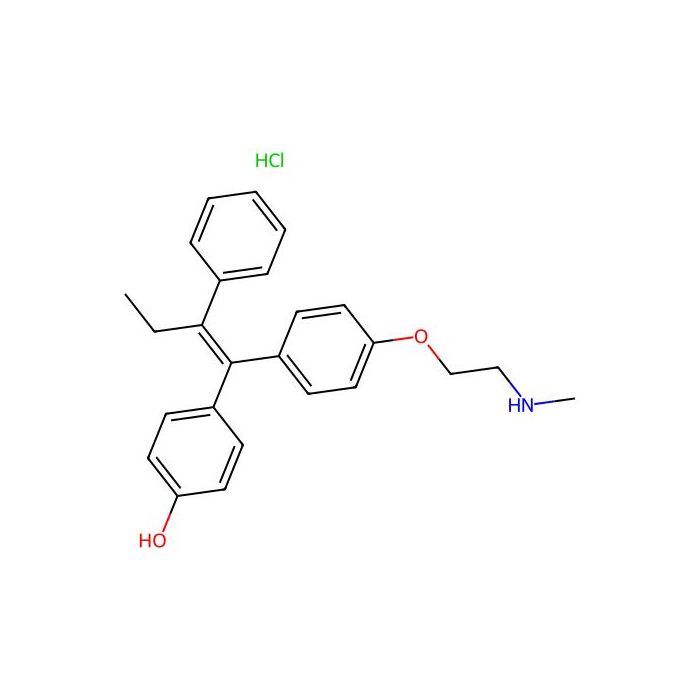
Endoxifen hydrochloride - 10mM in DMSO , CAS No.1197194-41-4

CAS: 1197194-41-4 Cat. No.: E654856 Formula: C25H28ClNO2 Peso molecolare: 409.95
Disponibile su ordine
GRADE & PURITY 10mM in DMSO
Storage
Desiccated,Store at -80°C
Shipped In
Dry ice packs + Cold packs
★
Size
Germania (EU)
USA*
Price
Qty
1ml
E654856-1ml
Su ordinazione · 8–12 settimane
96,23€
Enter a quantity for the sizes you want to add.
🧪

Why this grade

10mM in DMSO for sensitive chromatographic and analytical workflows requiring minimal baseline interference.

🌡

Storage & shipping

Desiccated,Store at -80°C Ships Dry ice packs + Cold packs Check lot-specific COA for exact specifications.

📋

Quality documents

SDS, COA, datasheet, and spec sheet available for download. Lot-specific COA accessible via lot number lookup.

📚

Literature proof

Cited in 0 peer-reviewed publications across chromatography, organic synthesis, and cross-coupling reactions.

Panoramica

Endoxifen hydrochloride is a key active metabolite of Tamoxifen (TAM) with higher affinity and specificity to estrogen receptor that also inhibits aromatase activity. Endoxifen hydrochloride has the potential for breast cancer study

In Vitro

Endoxifen, a hydroxylated Tamoxifen metabolite, is approximately 100-fold more potent as an antagonist of the ER than tamoxifen. It also suggests that endoxifen but not 4-hydroxytamoxifen results in ER-alpha degradation in addition to its effects on the ER at the level of transcription. Endoxifen, is a potent antiestrogen that targets estrogen receptor α for degradation in breast cancer cells. Additionally, it is showed that Endoxifen blocks ERA transcriptional activity and inhibits estrogen-induced breast cancer cell proliferation even in the presence of tamoxifen, N-desmethyl-tamoxifen, and 4-hydroxytamoxifen. Endoxifen is strongly growth inhibitory at 10 μM for all the breast cancer cell lines except for moderate inhibition for MDAMB-468.Cytotoxic effects are quite significant at 10 μM concentration for MCF7, HS 578T, and BT-549 cells. At lower Endoxifen concentrations (0.01-1 μM), the inhibitory effects are not as significant as 10 μM, whereas 100 μM Endoxifen concentration found to be lethal for all tested cells. MCE has not independently confirmed the accuracy of these methods. They are for reference only.

In Vivo

Orally administered Endoxifen is rapidly absorbed and systemically available when tested in female rats. The Endoxifen-treated rats show 787% higher exposure (AUC 0–∞ ) and 1,500% higher concentration (C max ) levels of Endoxifen when compared with Tamoxifen. Oral Endoxifen administration once a day for 28 consecutive days at dosages 2, 4, and 8 mg/kg proves safe and results in progressive inhibition of the growth of the human mammary tumor xenografts in female mice. MCE has not independently confirmed the accuracy of these methods. They are for reference only.

Animal administration

Mice Six-weeks-old, female, athymic NCr–nu/nu mice are implanted subcutaneously (s.c.) near the right flank with 30-40-mg fragment of MCF-7 human mammary tumor from an in vivo passage. The day of tumor fragments implantation is designated as Day 0. To support the estrogen-dependent MCF-7 tumor growth, each animal is implanted s.c. in the back of the neck with a 0.72-mg 17 β-estradiol 60-day release pellet 1 day prior to tumor fragment implantation. Individual tumors grew to 75-196 mm 3 in size on Day 13 after tumor fragment implantation, the day of treatment initiation. A total of 36 tumor bearing mice are randomized and divided into 4 treatments (6 mice/group) and one control (12 mice/group) groups. At day 13 post tumor implantation, treatment with control (water), Endoxifen at three dose levels (2, 4, and 8 mg/kg) or Tamoxifen twice a day, 3 h apart at a dosage of 10 mg/kg are administered by oral gavage once daily for 28 consecutive days. The dose volume 0.2 mL/10 g body weight is kept constant for all treatment groups. The s.c. tumors are measured and the animals are weighed twice weekly starting on the first day of treatment. The study is terminated on Day 58. The median time to reach two tumor mass doublings is used in the calculation of the overall delay in the growth of the median tumor. Additionally, comparison of the median tumor weight in the treatment groups to the median tumor weight in the control group (T/C 9 100%) on Day 41 (1 day after the last treatment) and on Day 58 (the day of study termination) are used for an additional evaluation of the antitumor efficacy . aladdin has not independently confirmed the accuracy of these methods. They are for reference only.

IC50& Target:Aromatase

Specifications

Specifiche e purezza
10mM in DMSO
Meccanismi biochimici e fisiologici
Endoxifen hydrochloride is a key active metabolite of Tamoxifen (TAM) with higher affinity and specificity to estrogen receptor that also inhibits aromatase activity. Endoxifen hydrochloride has the potential for breast cancer study.
Condizioni di conservazione di stoccaggio
Desiccated,Store at -80°C
Spedito in
Dry ice packs + Cold packs
Questo prodotto richiede spedizione a catena fredda. I servizi di terra e altri servizi economici non sono disponibili.
Tipo di azione
INHIBITOR
Nomi e identificatori
Peso molecolare 409.95

Documentazione

📋 Safety Data Sheet (SDS)

Comprehensive hazard, handling, storage, and regulatory compliance document.

Download SDS →

✅ Certificate of Analysis (COA)

Lot-specific quality data. Enter your lot number to retrieve the exact COA.

Look up COA →

📊 Datasheet

Quick-reference summary of product specifications and applications.

View datasheet →

🔬 Specification Sheet

Full quality attributes and acceptance criteria for this grade.

View spec sheet →

Advanced Data

Certificati (CoA, COO, BSE/TSE e tabella di analisi)
C of A & Other Certificates(BSE/TSE, COO):
Analytical Chart:
Calcolatori di soluzioni
Recensioni

Recensioni dei clienti

Application Protocols
  • Item-specific tested applications, recommended concentrations/dilutions, and positive controls: Not specified for this item; refer to CoA/Spec Sheet.
  • General guidance for laboratory use (non-binding)
    • Stock preparation: dissolve in DMSO at 10–50 mM; vortex and sonicate briefly if needed. Filter sterilize through 0.22 µm if using in cell culture.
    • Working solutions: dilute stock into pre-warmed medium or buffer with vigorous mixing to minimize precipitation; keep final DMSO ≤0.1–0.5% v/v for most cellular assays unless otherwise validated.
    • Light protection: wrap tubes/plates in foil to limit photodegradation during long incubations.
    • Controls: include vehicle-only wells and, where appropriate, a comparator SERM to benchmark assay performance.
    • Stability: prepare small aliquots to avoid repeated freeze–thaw; discard aliquots showing precipitation or discoloration after storage. These are general best practices and not validated protocols for SKU E654856.
Biological Roles
  • General biochemical context (literature; not product specifications)
    • Endoxifen is a principal active metabolite in the tamoxifen biotransformation pathway, formed primarily via CYP2D6-mediated N-demethylation and CYP3A/CYP2D6-mediated hydroxylation steps, yielding 4-hydroxy-N-desmethyltamoxifen.
    • It functions as a selective estrogen receptor modulator (SERM) in vitro, binding to ERα/ERβ and modulating receptor conformation, co-regulator recruitment, and transcriptional outcomes in reporter systems.
    • The phenolic OH enhances receptor affinity relative to non-hydroxylated analogs (literature), while the basic amine contributes to cellular uptake and salt-form handling.
  • Experimental utility (research use only)
    • Employed as a tool to interrogate ER-dependent gene expression, chromatin recruitment (e.g., ChIP-based workflows), and coactivator/corepressor dynamics.
    • Used in metabolism and pharmacology research to map biotransformation routes and to benchmark enzyme phenotypes, without implying clinical use.
  • Assay notes
    • In cells, equilibria between intracellular protonation states can influence uptake and nuclear localization (general for basic phenolic ligands). Careful control of medium pH, serum content, and plastic adsorption is advised.
    • Light and oxidative sensitivity may impact long incubations; include appropriate vehicle controls and protect from light when feasible. This section summarizes literature context only; no medical or therapeutic claims are made.
Buffer Applications
  • Not a buffering reagent. Endoxifen hydrochloride is a bioactive small molecule and is not used to set or maintain pH.
  • Practical handling in buffered systems (general guidance)
    • Prepare a concentrated stock in DMSO (e.g., 10–50 mM) or ethanol, then dilute into assay buffers such as PBS, HEPES, or Tris with thorough mixing to avoid precipitation. Keep the final organic solvent fraction low (≤0.1–1% v/v).
    • For higher aqueous concentrations, modest amounts of co-solvent (≤5% v/v methanol/ethanol) or complexing agents (e.g., HP-β-cyclodextrin) can improve apparent solubility; verify that additives do not confound the assay.
    • Filter stocks (0.22 µm PTFE/NYLON) if particulate forms upon dilution; confirm recovery to prevent adsorption losses on filters or plasticware.
  • Stability notes
    • Maintain consistent pH (typically near neutral) to keep the amine protonated and the compound in solution; avoid strong bases that deprotonate the salt and reduce aqueous solubility. No item-specific buffer recipes are provided for SKU E654856.
Green Alternatives
  • Context
    • Endoxifen hydrochloride is a solid API-like research chemical; “green alternatives” primarily concern solvent choices and workup strategies rather than replacement of the compound itself.
  • Greener solvent choices (general guidance)
    • Prefer water or aqueous buffers for assay dilutions when feasible.
    • Use ethanol or isopropanol instead of chlorinated solvents for routine handling where solubility permits.
    • For high-solubility stock solutions, DMSO is widely used; consider propylene carbonate or ethylene carbonate as higher-boiling, less volatile polar aprotics when compatible with the assay.
  • Comparison (general, literature-based)
    • DCM/CHCl3 vs EtOAc/IPA: ethyl acetate and isopropanol reduce halogenated waste, at the cost of different solubility and evaporation rates.
    • ACN vs MeOH (analytical): methanol is generally considered greener than acetonitrile, though ACN may deliver sharper LC peaks; consider mixed aqueous mobile phases to reduce organic solvent use.
  • Operational strategies
    • Use microscale experiments and high-throughput miniaturization to minimize solvent consumption in screening.
    • Implement closed-vial handling to reduce VOC emissions.
    • Optimize crystallization or precipitation from alcohol/water systems instead of halogenated solvents when converting between salt and free base. Note: The core compound has no direct “green substitute” for its biological role; improvements focus on solvent and process selection.
Pharmaceutical Uses
  • Scope of this section
    • Provided strictly in the context of formulation science and analytical development; no therapeutic or clinical claims are made.
  • Formulation/analytical roles (literature/general)
    • Used as a reference standard in impurity profiling and bioanalytical method development for tamoxifen metabolite panels.
    • The hydrochloride salt form offers improved aqueous processability and solid-state stability relative to the free base, aiding preformulation studies.
    • Suitable for solubility and stability screening across pH, co-solvent, and cyclodextrin systems in discovery pharmaceutics.
  • Excipient/interactions considerations
    • Being a basic, aromatic compound, endoxifen can interact with acidic excipients and ion-exchange media; counterion choice (HCl vs alternative acids) affects hygroscopicity and dissolution rate (general to amine salts).
    • Photostability assessments are recommended for conjugated stilbene-like structures; incorporate light-protective packaging in studies when relevant.
  • Standards and monographs
    • No pharmacopeial monograph is cited here for endoxifen hydrochloride. Confirm regulatory status and compendial references as required for your program.
  • Item-specific grade/purity information for SKU E654856 is not provided here; consult the CoA/Spec Sheet for details.
Physical Properties
  • Item-specific specifications
    • Appearance, melting point, solubility, UV cutoff, residual solvents/metals, water/peroxide content: Not specified for this item; refer to CoA/Spec Sheet.
  • Literature/general reference values (non-specification)
    • Physical state (salt): typically a solid for many amine hydrochlorides (literature, general observation for analogous salts).
    • Approximate formula/mass (literature, for reference only): endoxifen free base ~C25H27NO2 (Mr ~373.5 g/mol); hydrochloride salt commonly represented as ~C25H28ClNO2 (Mr ~410.0 g/mol). Exact values for this specific lot are not specified here.
    • Solubility tendencies (literature): HCl salts of basic amines generally show increased solubility in water and polar protic solvents; high solubility in DMSO and methanol is common for screening stocks. The free base is more soluble in nonpolar organics (e.g., dichloromethane, ethyl acetate) but sparingly soluble in water.
    • pKa (qualitative, literature): protonated dialkyl/arylalkyl amines typically have conjugate acid pKa values in the ~8–10 range; the phenolic OH typically has pKa ~9–11 in aryl systems. Specific pKa values for endoxifen may vary among literature sources and are not specified for this item.
    • Partitioning (qualitative, literature): triarylethylene systems are lipophilic; the hydrochloride form exhibits higher aqueous compatibility due to protonation, whereas the free base shows higher logP. Note: All numerical values above are general literature context and are not specifications for SKU E654856.
Quality and Grades
  • Item-specific grade/purity: Not specified for this item; refer to CoA/Spec Sheet.
  • Interpreting common grades (general guidance)
    • Research grade: suitable for discovery chemistry, screening, and reference standard work. Purity is typically established by HPLC/UPLC and identity by NMR/HRMS.
    • Screening/compound library items: often provided with batch CoA including identity (NMR/MS), purity (HPLC), and water content (KF) when applicable.
    • Salt form confirmation: for amine hydrochlorides, CoA often includes chloride content or titration, and can show a characteristic mass shift versus free base.
  • Stabilizers/additives
    • Stabilizers or counterions (e.g., HCl) influence solubility and handling. Any stabilizers present for this SKU are not specified and should be checked on the CoA/SDS.
  • What to look for in the CoA for this item
    • Identity confirmation (1H/13C NMR, HRMS), purity by HPLC (UV/ELSD), residual solvents, inorganic counterion content (chloride assay), and water (KF) if relevant. UV profile may be provided for aromatic systems used in LC detection.
  • Practical implication
    • If working under stringent analytical requirements (e.g., bioanalytical reference), confirm that the batch purity, salt form, and counterion stoichiometry meet your method validation criteria.
Reaction and Applications
  • Research/assay applications (non-clinical)
    • Widely used as a tool compound in receptor-binding, reporter-gene, and transcriptional assays focused on estrogen receptor biology (ERα/ERβ) and co-regulator recruitment, without implying therapeutic use.
    • Serves as a reference standard for bioanalytical LC–MS/MS when quantifying tamoxifen metabolites in matrices during method development and validation.
    • Useful in structure–activity relationship (SAR) studies of triarylethylenes, providing a benchmark for ligand efficacy and potency in in vitro systems.
  • Chemical/manipulative applications
    • Salt/base interconversion: endoxifen HCl can be basified to the free base for extractions, crystallizations, or derivatization, then re-protonated to isolate as a stable salt.
    • Derivatization handles: phenolic OH (O-acylation, O-alkylation) and amine (N-acylation, N-alkylation, quaternization) allow preparation of analogs, prodrugs (research context), or analytical derivatives.
  • Practical tips
    • For biochemical assays, prepare concentrated DMSO stocks under low light and nitrogen if possible; aliquot to avoid freeze-thaw.
    • During LC–MS method development, monitor in-source fragmentation of protonated species and adjust source conditions accordingly; consider chloride counterion effects on ionization.
    • When switching between salt and base forms, verify identity by NMR and confirm counterion by ion chromatography or argentometric titration to ensure reproducibility across experiments.
Reaction Conditions
  • General conditions for common manipulations (literature-based; guidance only)
    • Salt → free base: Suspend endoxifen HCl in water, adjust to pH ~9–10 with NaHCO3/Na2CO3, extract with DCM or EtOAc, dry (Na2SO4), evaporate. Keep exposure to strong base minimal to protect the phenolic moiety.
    • Free base → HCl salt: Dissolve free base in anhydrous ether/EtOAc and bubble dry HCl or add HCl in dioxane/ether at 0–25°C until precipitation ceases; filter, wash with cold ether, and dry under vacuum.
    • O-Acylation: Ac2O (1.1–1.5 eq) with DMAP (cat.) in DCM or pyridine at 0–25°C, 0.5–2 h; typical conversions high under dry conditions.
    • O-Alkylation: Alkyl bromide/iodide (1.2–2.0 eq) with K2CO3 or Cs2CO3 in acetone/DMF at 25–60°C, 2–16 h; monitor by TLC/UPLC.
    • N-Acylation: Acid chloride (1.1 eq) with Et3N in DCM at 0–25°C; quench and purify by silica gel (protect phenol if needed).
  • Analytical considerations
    • Monitor reactions by UPLC–UV (aromatic bands) or LC–MS (protonated species); chloride counterion may suppress ESI(+) unless exchanged.
    • Check E/Z ratio by 1H NMR (olefinic signals) and by HPLC if isomer separation is feasible.
  • Expected outcomes
    • With mild, anhydrous conditions, derivatizations of phenolic OH or amine typically proceed in moderate to high yields in literature analogs. Actual yields depend on isomer, protecting groups, and workup efficiency. Note: The above are general literature-style conditions for triarylethylene phenols and amine salts and are not item-specific recommendations.
Safety and Handling
  • Item-specific hazard data
    • GHS classification, signal word, hazard and precautionary statements, and pictograms: Not specified for this item; refer to the product SDS.
  • General laboratory precautions (good practice)
    • Handle in a chemical fume hood; avoid inhalation of dust or aerosols and contact with skin/eyes.
    • Recommended PPE: lab coat, nitrile gloves, and safety glasses; use a dust mask or respirator if dust generation cannot be controlled (follow institutional policy/SDS).
    • Avoid sources of ignition when handling organic solids in powder form to minimize dust explosion risk (general best practice).
    • Incompatibilities (general): strong oxidizers; strong bases/acids may effect salt/base interconversion and degradation. Avoid prolonged exposure to moisture; many amine hydrochlorides can be hygroscopic.
  • First-aid overview (consult SDS for authoritative guidance)
    • Inhalation: move to fresh air; seek medical attention if symptoms persist.
    • Skin/eye contact: rinse with copious water for at least 15 minutes; remove contaminated clothing; obtain medical attention if irritation continues.
    • Ingestion: rinse mouth; do not induce vomiting; seek medical attention.
  • Additional notes
    • This product is for research use only (non-clinical, non-diagnostic).
    • Given the conjugated polyaromatic scaffold, protect from excessive light during handling to minimize potential photo-degradation (general precaution for stilbene-like systems). Always defer to the official SDS for E654856.
Solvent Selection
  • Polarity/miscibility considerations (literature-based, general)
    • As a protonated amine salt, endoxifen HCl typically dissolves well in water, methanol, ethanol, and highly polar aprotics such as DMSO.
    • For high-concentration screening stocks, DMSO (anhydrous) is commonly used (e.g., 10–50 mM), then diluted into aqueous assay buffers.
    • If conversion to the free base is performed (see Synthetic Utility), solubility shifts towards chloroform, dichloromethane, ethyl acetate, toluene, and reduced water solubility.
  • Practical selection guide
    • Screening/biochemical assays: DMSO stock → dilute into PBS/HEPES- or Tris-buffered saline with gentle mixing; maintain final DMSO ≤0.1–1% v/v to limit assay interference.
    • Analytical standards: methanol or acetonitrile/water with 0.1% acid (formic or acetic) facilitates LC–MS handling; verify salt stability in acidic mobile phases.
    • Preparative manipulations: water/methanol mixtures for salt handling; switch to organic solvents once converted to the free base.
  • Small comparison (general)
    • DMSO vs MeOH: DMSO affords higher solubility and long-term stock stability; MeOH enables direct LC injection but can limit solubility at high concentrations.
    • Water vs buffer: Unbuffered water minimizes salt effects; buffered systems control pH to maintain protonation state and solubility. Note: No item-specific solubility data are provided for SKU E654856; verify with a small-scale test.
Storage and Reconstitution
  • Item-specific storage and shipping (from Product Data)
    • Storage conditions: Desiccated, Store at -80°C.
    • Shipped in: Dry ice packs + Cold packs.
    • Research use note: For research use only.
  • Handling and reconstitution (general best practice)
    • Allow container to equilibrate to room temperature in a desiccator before opening to prevent moisture condensation on a cold solid.
    • Minimize exposure to moisture and light; promptly re-cap under dry air or nitrogen.
    • Prepare concentrated stock solutions in anhydrous DMSO or ethanol (e.g., 10–50 mM), aliquot into amber vials, and store at -20 to -80°C. Avoid repeated freeze–thaw cycles.
    • For aqueous use, dilute the organic stock into buffer with rapid mixing; if precipitation occurs, increase dilution, adjust pH toward neutrality (to maintain protonation), or add a small percentage of co-solvent.
  • Stability monitoring
    • Periodically check aliquots by HPLC/LC–MS for purity and by UV–Vis for gross changes in absorbance profile if long-term storage is planned.
    • Record lot number and preparation date on aliquots for traceability. Note: No item-specific stability window or retest date is provided here; consult the CoA/Spec Sheet for any lot-specific guidance.
Structure and Identity
  • Item-specific identifiers (from Product Data)
    • Product name: Endoxifen hydrochloride (SKU: E654856)
    • CAS: 1197194-41-4
    • Molecular formula: Not specified for this item; refer to CoA/Spec Sheet.
    • Molecular weight: Not specified for this item; refer to CoA/Spec Sheet.
    • SMILES / InChI / InChIKey: Not specified for this item; refer to CoA/Spec Sheet.
  • Literature/structural context (for reference only)
    • Endoxifen is the hydrochloride salt of 4-hydroxy-N-desmethyltamoxifen, a selective estrogen receptor modulator (SERM) metabolite in the tamoxifen pathway.
    • Typical free-base formula reported in literature: ~C25H27NO2; hydrochloride salt commonly represented as ~C25H28ClNO2 (literature, for reference only).
    • Core scaffold: triphenylethylene framework (a substituted stilbene) bearing a para-phenolic OH on one ring and a basic aminoethyl side chain (protonated in the HCl salt) on another aromatic ring.
    • Key functional groups (literature): phenolic alcohol (Ar–OH), tertiary/secondary amine (protonated as ammonium chloride in the salt), conjugated diarylethene (C=C) linking triaryl system.
  • 2D structural description (general)
    • A central ethylene (C=C) connects two aryl units; a third aryl group is pendant via the triaryl-ethylene motif. One ring carries a para-hydroxyl substituent; another ring bears the aminoalkyl substituent. In the hydrochloride form, the amine is protonated with chloride counterion.
  • Stereochemistry
    • The triarylethylene double bond can exist as E/Z geometric isomers; endoxifen materials are commonly the biologically relevant isomer as supplied by vendors (isomeric composition not specified for this item; refer to CoA/Spec Sheet).
Synthetic Utility
  • Role in synthesis
    • Endoxifen HCl is primarily a target molecule/tool compound rather than a synthetic building block. Nonetheless, its functional groups enable derivatization for SAR or analytical purposes.
  • Transformations (general, literature-informed)
    • Salt/base interconversion: treat the HCl salt with aqueous NaHCO3/Na2CO3 and extract with an organic solvent to obtain the free base; re-protonate with dry HCl in ether or gaseous HCl to reform the salt (verify stoichiometry by NMR/IC).
    • Phenolic OH chemistry: O-acylation (Ac2O, DMAP) or O-alkylation (alkyl halides, base) to modulate polarity; carbonate/carbamate formation for protecting-group strategies.
    • Amine chemistry: N-acylation (acid chlorides/anhydrides), N-alkylation (alkyl halides, reductive amination), or quaternization (MeI/MeOTf) to probe receptor SAR or generate analytical derivatives.
    • Conjugation: attachment to reporter tags or linkers via carbamate/urea/amide linkages for pull-downs or imaging (research context).
  • Practical notes
    • Maintain low light and inert atmosphere during prolonged steps to limit potential E/Z isomerization or oxidation of phenolic functionalities (general for triarylethylenes).
    • Verify isomeric purity by NMR/UPLC; phenolic derivatization can shift UV spectra, useful for analytical discrimination.
    • Where stereodefined E/Z material is required, isomerization control and mild conditions are recommended; document conditions for reproducibility.
Target Specificity
  • Item-specific target/assay validation data: Not specified for this item; refer to CoA/Spec Sheet or application notes if available.
  • Literature context (for reference only; non-validated for this SKU)
    • Endoxifen is commonly studied as a ligand for estrogen receptors (ERα/ERβ) in vitro. Binding affinity and functional selectivity depend on isomer, assay conditions, and cell context. These properties are not established here for SKU E654856.

Shall we send you a message when we have discounts available?

Remind me later

Thank you! Please check your email inbox to confirm.

Oops! Notifications are disabled.