Determine the necessary mass, volume, or concentration for preparing a solution.
| Activity Type | Activity Value -log(M) | Mechanism of Action | Activity Reference | Publications (PubMed IDs) |
|---|

Information
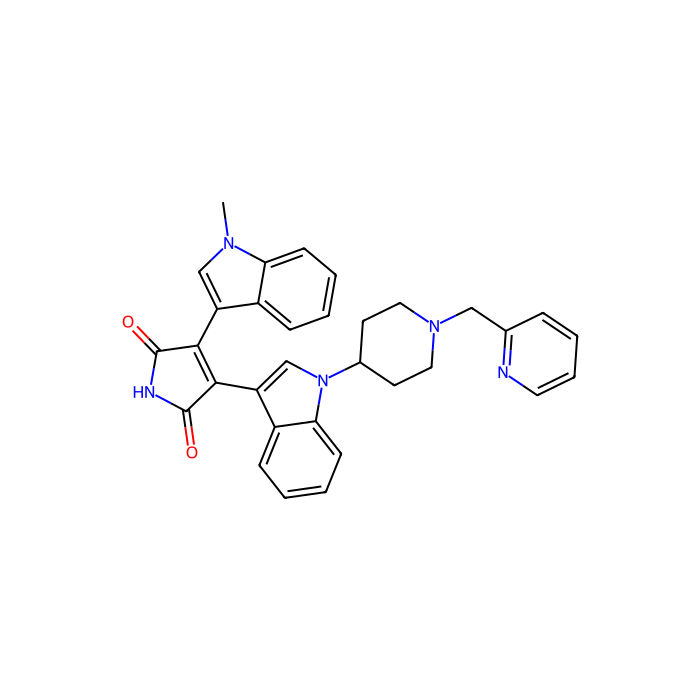
Enzastaurin (LY317615) Enzastaurin (LY317615) is a potent PKCβ selective inhibitor with IC50 of 6 nM in cell-free assays, 6- to 20-fold selectivity against PKCα, PKCγ and PKCε. Phase 3.
In vitro
Enzastaurin application results in a marked dose-dependent inhibition of growth in all MM cell lines investigated, including MM.1S, MM.1R, RPMI 8226 (RPMI), RPMI-Dox40 (Dox40), NCI-H929, KMS-11, OPM-2, and U266, with IC50 from 0.6-1.6 μM. Enzastaurin direct impacts human tumor cells, inducing apoptosis and suppressing proliferation in cultured tumor cells. Enzastaurin also suppresses the phosphorylation of GSK3βser9, ribosomal protein S6S240/244, and AKTThr308 while having no direct effect on VEGFR phosphorylation. Enzastaurin increases apoptosis in malignant lymphocytes of CTCL. When combined with GSK3 inhibitors, enzastaurin demonstrated an enhancement of cytotoxicity levels. Treatment with a combination of enzastaurin and the GSK3 inhibitor AR-A014418 led to increased levels of β-catenin total protein and β-catenin-mediated transcription. Blocking of β-catenin-mediated transcription or small hairpin RNA (shRNA) knockdown of β-catenin induced the same cytotoxic effects as that of enzastaurin plus AR-A014418. Additionally, treatment with enzastaurin and AR-A014418 decreased the mRNA levels and surface expression of CD44.
In vivo
Treatment of xenografts with Enzastaurin and radiation produced greater reductions in density of microvessels than either treatment alone. The decrease in microvessel density corresponded to delayed tumor growth.
Cell Data
cell lines:Human mammary epithelial cells (HMEC), human foreskin fibroblasts (MRHF) cells
Concentrations:0.3-4 μM
Incubation Time:72 hours
Powder Purity:≥98%
| Activity Type | Activity Value -log(M) | Mechanism of Action | Activity Reference | Publications (PubMed IDs) |
|---|
| Activity Type | Activity Value -log(M) | Mechanism of Action | Activity Reference | Publications (PubMed IDs) |
|---|
| Activity Type | Activity Value -log(M) | Mechanism of Action | Activity Reference | Publications (PubMed IDs) |
|---|
| Activity Type | Activity Value -log(M) | Mechanism of Action | Activity Reference | Publications (PubMed IDs) |
|---|
| Activity Type | Activity Value -log(M) | Mechanism of Action | Activity Reference | Publications (PubMed IDs) |
|---|
| Activity Type | Activity Value -log(M) | Mechanism of Action | Activity Reference | Publications (PubMed IDs) |
|---|
| Activity Type | Activity Value -log(M) | Mechanism of Action | Activity Reference | Publications (PubMed IDs) |
|---|
H413:May cause long lasting harmful effects to aquatic life
H302:Harmful if swallowed
P273:Avoid release to the environment.
P501:Dispose of contents/container to an approved waste disposal plant.
P264:Wash hands [and …] thoroughly after handling.
P270:Do not eat, drink or smoke when using this product.
P330:Rinse mouth.
P301+P317:IF SWALLOWED: Get medical help.
La nostra guida alla selezione delle qualità copre purezza, stato dello stabilizzatore e idoneità all'applicazione per tutte le varianti del nostro catalogo.
Visualizza la guida alle qualità Moligand™ →