This compound belongs to the class of organic compounds known as monothioacetals. These are compounds containing a monothioacetal functional group with the general structure R2C(OR')(SR').
External Descriptors
Not available
1. Djoumbou Feunang Y, Eisner R, Knox C, Chepelev L, Hastings J, Owen G, Fahy E, Steinbeck C, Subramanian S, Bolton E, Greiner R, and Wishart DS. ClassyFire: Automated Chemical Classification With A Comprehensive, Computable Taxonomy. Journal of Cheminformatics, 2016, 8:61.
Determine the necessary mass, volume, or concentration for preparing a solution.
Dilution Calculator
Determine the dilution needed to prepare a stock solution.
Reconstitution Calculator
Recensioni
Recensioni dei clienti
Application Protocols
No item-specific, tested bioassay protocols are provided for this product.
General laboratory protocol outline for RAFT/MADIX polymerization (literature example):
Charge a dry Schlenk flask with monomer (e.g., vinyl acetate), this CTA (per desired [M]0:[CTA]0), solvent (e.g., ethanol or toluene), and AIBN (~0.2 eq vs CTA).
Deoxygenate by three freeze–pump–thaw cycles or 30 min inert gas sparging; backfill with argon.
Heat to 65–70 °C with stirring; monitor conversion by 1H NMR (aliquots quenched to ambient and exposed to air).
Quench at target conversion by cooling and air exposure; precipitate polymer into a suitable non‑solvent; collect and dry under vacuum.
Adjust conditions to monomer/solvent/scale. For photopolymerization, replace thermal step with LED irradiation (e.g., 365–405 nm) under inert atmosphere at ambient temperature.
Note: This is general guidance only and not validated for this specific item lot; verify and optimize for your system.
Biological Roles
This product is a synthetic organosulfur reagent intended for polymer chemistry and general laboratory synthesis. It is not a biological metabolite, cofactor, or ligand with a defined physiological role.
Biological function: None established; xanthate thionoesters are not known endogenous biomolecules.
Biochemical interactions (literature, general): Organosulfur thionoesters can undergo nucleophile‑induced reactions in vitro, but such reactivity is primarily exploited in synthetic chemistry rather than biology.
Use in bio‑related research: Polymers prepared via RAFT/MADIX with this CTA may be evaluated for biomaterials or delivery research; however, any biological testing pertains to the polymer products and formulations, not to the CTA itself.
Research use only: As noted in the Product Data, this material is for research use only and not for human or veterinary use.
Buffer Applications
Not typically applicable. This compound is a hydrophobic organosulfur reagent and is not used as a buffering component. For experiments involving this reagent, select organic media suitable for RAFT/MADIX polymerization (see Solvent Selection and Reaction Conditions).
Green Alternatives
Sustainability considerations relate to both the CTA and the media used with it.
Greener media for RAFT/MADIX (literature guidance):
Alcohols (ethanol, isopropanol): Renewable feedstock potential, low toxicity, good for VAc/NVP systems; ensure CTA stability at reaction temperature.
2‑MeTHF and CPME: Bio‑derived/ether alternatives with favorable safety profiles relative to THF/Et2O; dry and peroxide‑test regularly.
Water/aqueous dispersion: Possible with specialized protocols and stabilizers; risk of xanthate hydrolysis must be managed (buffering, lower pH neutrality, lower temperatures, inerting).
Comparison (literature, qualitative):
Toluene vs ethanol: Toluene offers higher bp and hydrolytic stability but has higher VOC and toxicity; ethanol is greener but may participate in chain transfer at elevated temperatures and can affect kinetics.
Dioxane/THF vs 2‑MeTHF/CPME: The latter pair can deliver similar solvation with lower peroxide hazard growth and improved sustainability metrics.
CTA alternatives:
For more activated monomers (MAMs) like acrylates/methacrylates, trithiocarbonates or dithiobenzoates often provide better control, potentially enabling lower loadings and milder conditions. For LAMs, xanthates like this reagent remain among the most effective.
Overall strategy: choose low-toxicity, recyclable solvents (alcohols, esters, green ethers) when compatible with monomer/CTA stability; minimize excess initiator; conduct reactions at the lowest temperature affording desired conversion to reduce energy input.
Pharmaceutical Uses
Direct pharmaceutical or excipient uses are not typical for this compound.
Context (general): Polymers synthesized via RAFT/MADIX using this CTA can be explored for formulation or drug‑delivery research, but the CTA itself is a synthetic intermediate/reagent and is not used as an API or approved excipient.
Compendial status: No pharmacopeial monograph known for this CTA (literature/general). For any pharmaceutically oriented research, ensure complete removal or transformation of the xanthate end group in the final polymer and confirm residuals per ICH guidelines.
Research use only: As specified, this product is for research use only.
Physical Properties
Item-specific physicochemical specifications are not provided in the Product Data. Consult the CoA/Spec Sheet for authoritative values.
Literature/general reference values (for informational use only; not item-specific specs):
Appearance: Typically a pale yellow to orange liquid for many xanthate CTAs (literature). Actual appearance: Not specified for this item; refer to CoA/Spec Sheet.
Density, refractive index, UV cutoff: Not specified for this item; refer to CoA/Spec Sheet.
Boiling point / melting point: Not well-established publicly for this exact compound; many xanthate CTAs decompose before distillation (literature). Not specified for this item; refer to CoA/Spec Sheet.
Solubility (qualitative, literature):
Good solubility in common organic solvents (e.g., toluene, THF, dioxane, acetonitrile, ethyl acetate, dichloromethane, alcohols).
Poor solubility in water; hydrolysis may occur with aqueous base or prolonged moisture exposure.
Partitioning: Expected to be moderately hydrophobic due to dual ethyl esters and thionoester functionality (literature qualitative assessment). Exact logP: Not specified for this item; refer to CoA/Spec Sheet.
Practical notes (general): Protect from moisture, oxygen, and heat to minimize xanthate decomposition (e.g., thioester scission, formation of CS2/EtOH in harsh conditions).
Quality and Grades
Item-specific grade/purity: Not specified for this item; refer to CoA/Spec Sheet.
Context and implications (general guidance for this compound class):
RAFT/MADIX CTAs are typically supplied at high assay to ensure predictable chain transfer constants and narrow dispersity in polymerizations. Trace impurities (e.g., acids, alcohols, peroxides, oxidized sulfur species) can strongly influence polymerization control.
Stabilizers/inhibitors: Not specified for this item; refer to CoA/Spec Sheet. In general, CTAs are not usually supplied with added radical inhibitors, but low-ppm antioxidants may occasionally be present; confirm on CoA if critical for your application.
UV absorbance: Not specified for this item; refer to CoA/Spec Sheet. Many xanthates have moderate n→π*/π→π* absorbance in the near‑UV; if using for photopolymerization, measure background absorbance of your lot.
What the specified storage suggests about quality:
The Product Data indicates storage at 2–8°C under argon and shipment on wet ice, consistent with a moisture/oxygen‑sensitive thionoester. This practice helps minimize hydrolysis/oxidation and preserves CTA performance.
Recommendations for method validation:
Verify assay by quantitative 1H NMR vs internal standard; check absence of residual ethanol or CS2 signals.
Assess purity by HPLC or GC (if volatile enough) and confirm identity by HRMS and IR (C=S ~1050–1200 cm⁻¹; C=O ~1730–1750 cm⁻¹) (literature).
Reaction and Applications
Primary application (literature): This compound is a well-established xanthate RAFT/MADIX chain transfer agent (CTA), commonly termed ECT, used to control radical polymerizations of less-activated monomers (LAMs).
Controlled radical polymerization (CRP):
RAFT/MADIX of vinyl acetate (VAc), N‑vinylpyrrolidone (NVP), N‑vinylcaprolactam (NVCL), N‑vinylcarbazole, vinyl ethers, and certain acrylamides. Xanthates display suitable transfer constants with these monomers, enabling predictable number‑average molecular weight (Mn) and narrow dispersity (Đ ~1.2–1.5 under optimized conditions) (literature ranges).
Compatible thermal initiators: AIBN, ACVA, AIBME; photoinitiated RAFT is also feasible with appropriate light sources and photoinitiators.
Mechanistic notes (general):
The CTA participates via a reversible addition–fragmentation equilibrium of the propagating radical onto the C=S bond, forming an intermediate adduct radical which fragments to re‑form an active radical and a dormant thiocarbonylthio species.
Xanthates favor LAMs because their Z‑group (–OR) tunes the C=S reactivity to balance addition and fragmentation rates.
Practical tips:
Use rigorously deoxygenated media (freeze–pump–thaw or inert gas sparge) and maintain inert atmosphere throughout.
Target DP using [M]0:[CTA]0 ratio; initiator typically set at 0.1–0.3 equivalents vs CTA (literature starting points). Monitor conversion by 1H NMR.
End‑group transformations: Post‑polymerization removal or substitution of the xanthate end group via radical, nucleophilic, or aminolysis pathways can tailor polymer properties (literature).
Other synthetic uses (less common): Xanthates can participate in Barton–McCombie‑type deoxygenations and radical chain transfer processes, though this specific reagent is primarily used as a CTA (literature).
Reaction Conditions
General literature guidance for RAFT/MADIX polymerization using ethyl 2‑[(ethoxycarbonothioyl)thio]propionate (CTA). These are not item-specific specifications; optimize per system.
Solvents: Toluene, dioxane, ethanol/isopropanol, acetonitrile, or bulk monomer. Choose to match monomer solubility and desired temperature.
Initiators: AIBN (60–80 °C), ACHN (higher T), ACVA (in polar media). Photoinitiated RAFT: 365–450 nm LEDs with type I photoinitiators.
Concentrations and ratios (starting points, literature):
[M]0:[CTA]0 typically 50:1 to 500:1 for Mn control across 5–100 kDa.
[Initiator]0:[CTA]0 ~0.1–0.3 to balance radical flux and end‑group fidelity.
Solids content 10–50 wt% depending on viscosity and heat removal.
Temperature/time: 50–90 °C thermally (AIBN half‑life considerations); hours to overnight for 30–80% conversion. Photochemical routes often run at ambient to 40 °C for several hours.
Atmosphere: Rigorous deoxygenation (three freeze–pump–thaw cycles or 20–60 min inert gas sparge). Maintain inert blanket throughout.
Expected outcomes (literature): Linear Mn vs conversion and Đ ~1.2–1.5 when optimized for LAMs.
Workup: Precipitation into non‑solvent (e.g., hexane/diethyl ether for polar polymers, methanol/water for hydrophobic polymers) or dialysis for water‑soluble polymers; remove residual CTA/initiator fragments by repeated precipitations or column if needed.
Safety note: Control exotherms in bulk polymerizations and avoid moisture/base to limit CTA degradation.
Safety and Handling
Authoritative safety data: Always consult the SDS for this product before use.
GHS/CLP details (item-specific):
Signal word: Not specified for this item; refer to SDS.
Hazard statements: Not specified for this item; refer to SDS.
Pictograms and classification: Not specified for this item; refer to SDS.
General hazard profile for xanthate thionoesters (literature/good practice):
May be harmful if swallowed, inhaled, or in contact with skin; organosulfur esters can be irritant and have strong odors.
Thermal/chemical decomposition can release toxic sulfur-containing vapors (e.g., CS2, H2S-like species) under harsh conditions.
Hydrolysis sensitivity: Prolonged exposure to moisture or base can lead to decomposition; avoid aqueous alkaline conditions unless intended.
Handling and PPE:
Work in a fume hood. Wear lab coat, safety glasses, and appropriate chemical-resistant gloves (e.g., nitrile). Avoid inhalation of vapors and skin contact.
Incompatibilities: Strong bases, strong nucleophiles, strong oxidizers; avoid prolonged exposure to acids or heat.
Inert atmosphere is recommended during handling and storage to limit oxidative degradation of the thionoester.
First aid (overview; follow institutional protocols):
Inhalation: Move to fresh air; seek medical attention if symptoms persist.
Skin/eye contact: Rinse with water for at least 15 minutes; remove contaminated clothing; seek medical attention for irritation.
Ingestion: Rinse mouth; do not induce vomiting; seek medical attention.
Storage: As provided in Product Data, store at 2–8°C under argon; keep container tightly closed. Shipments on wet ice preserve quality.
Solvent Selection
This compound functions primarily as an organosulfur RAFT/MADIX chain transfer agent rather than as a general-purpose solvent. Solvent selection here refers to media appropriate for using or processing the reagent.
Polarity/miscibility (literature, qualitative):
Soluble in many organic solvents: toluene, xylene, THF, dioxane, ethyl acetate, dichloromethane, chloroform, acetonitrile, and common alcohols.
Poorly water-soluble; avoid prolonged aqueous exposure to limit hydrolysis.
Typical use scenarios (literature):
Solution polymerization of less-activated monomers (LAMs) such as vinyl acetate (VAc), N‑vinylpyrrolidone (NVP), N‑vinylcaprolactam (NVCL), and acrylamide derivatives—media often include toluene, dioxane, ethanol/isopropanol, methanol, or bulk monomer.
For polar monomers (e.g., NVP), polar aprotic or alcoholic solvents improve miscibility and control.
Selection guidance and comparisons:
Toluene vs dioxane: Toluene offers higher boiling point and lower polarity; dioxane/THF improve solubility for polar monomers but require peroxide monitoring and rigorous drying.
Alcoholic media (EtOH, iPrOH) can be advantageous for VAc RAFT with xanthates (MADIX) and are relatively benign; ensure CTA stability at chosen temperature.
Aqueous/dispersion polymerization is generally avoided unless conditions are optimized to suppress xanthate hydrolysis (buffering, low base, inerting).
Dry, oxygen-free solvents are recommended to minimize radical quenching and oxidative degradation of the CTA (best practice).
Storage and Reconstitution
Storage conditions (from Product Data): Store at 2–8 °C, argon charged. Shipped on wet ice.
Container/atmosphere: Keep tightly sealed under inert gas (argon or nitrogen). Minimize headspace oxygen; consider septum‑cap vials for repeated needle access.
Light and moisture: Protect from light and moisture to limit thionoester degradation and hydrolysis. Store with a desiccant in secondary containment when practical.
Stability: Item-specific shelf life and assay retention are not specified; refer to CoA/Spec Sheet. As general guidance, xanthate CTAs are stable for months at 2–8 °C under inert gas when dry and protected from light (literature).
Reconstitution: Not applicable—supplied as a neat reagent (appearance for this item is not specified). If preparing stock solutions, use dry, oxygen‑free solvents (e.g., toluene, THF, acetonitrile, ethanol), and store aliquots under inert gas at 2–8 °C. Avoid prolonged storage of dilute solutions, particularly in protic or basic media.
Disposal: Follow institutional and local regulations for organosulfur compounds; avoid release to drains.
Research use only: As stated in Product Data.
Structure and Identity
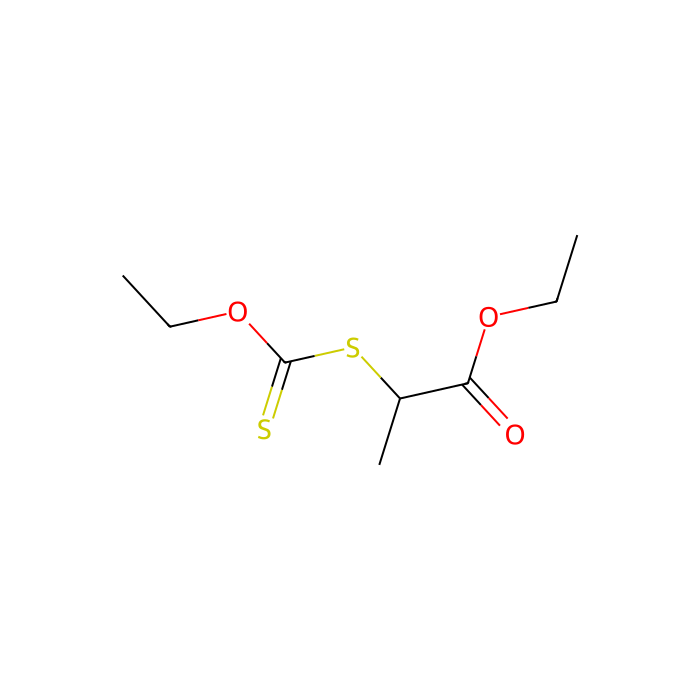
Ethyl 2-[(ethoxycarbonothioyl)thio]propionate is a xanthate (O‑ethyl dithiocarbonate) thioester appended at the α‑position of an ethyl propionate ester. It is widely recognized as a RAFT/MADIX chain transfer agent (CTA) for controlled radical polymerization of less-activated monomers.
Item identifiers (from Product Data)
SKU: E404446
CAS: 73232-07-2
InChIKey: 115785 (as provided)
Structure descriptors (literature/computed; for reference only, not item-specific specs)
Preferred name (IUPAC-style): Ethyl 2-[(ethoxycarbonothioyl)thio]propanoate
Molecular formula: C8H14O3S2 (literature)
Molecular weight: ~222.33 g/mol (literature)
SMILES: CCOC(=O)C(SC(=S)OCC)C (literature)
Structural features (general chemistry description)
Functional groups: one carboxylate ester (ethyl ester), one xanthate thionoester [–SC(=S)OR], and a thioether linkage at the α‑carbon of the propanoate chain.
Skeleton: a propanoate backbone bearing a secondary carbon (stereogenic center possible if non-racemic) substituted with a –S–C(=S)–OEt xanthate; terminal alcohol-derived ethyl on both the carboxylate and xanthate.
2D description in words: CH3–CH(–S–C(=S)–O–CH2–CH3)–C(=O)–O–CH2–CH3.
Note: Structural strings and formula are provided as general literature references; consult the CoA/SDS for definitive identifiers for this specific lot.
Synthetic Utility
Key functional motifs and reactivity (literature):
Thiocarbonylthio (xanthate) moiety [–S–C(=S)–OR]:
Engages in reversible addition–fragmentation equilibria with carbon‑centered radicals—basis of RAFT/MADIX control for LAM polymerizations.
Absorbs in near‑UV; can enable photo‑induced RAFT when paired with suitable light/initiators.
Provides steric/electronic environment tuning the fragmentation rate of the intermediate radical, impacting transfer constant (Ctr).
Named/related transformations (general):
RAFT/MADIX polymerization of vinyl acetate, N‑vinylamides, vinyl ethers.
End‑group manipulations: radical-induced reduction, aminolysis to thiols, or nucleophilic substitution to introduce functionality at polymer ω‑end.
Xanthate transfer chemistry akin to Barton–McCombie style radical reactions (using xanthates as radical precursors), though this specific reagent is optimized as a CTA.
Retrosynthetic value:
The molecule can be conceptually derived from ethyl 2‑mercaptopropionate and ethyl chloroformate/thiocarbonyl reagents (e.g., formation of O‑ethyl xanthate), illustrating accessible modular synthesis (literature).
Target Specificity
Not applicable. This product is a small-molecule reagent (RAFT/MADIX chain transfer agent) and does not possess biological target specificity such as antigen binding or enzyme selectivity intended for bioassays.
We use cookies to ensure the website functions properly and, where permitted, to improve your experience. You can manage your preferences at any time in Settings. Learn more in our Cookie Policy.
Shall we send you a message when we have discounts available?
Remind me later
Thank you! Please check your email inbox to confirm.
Products are supplied to verified businesses, institutions, and qualified professionals for research and development use only. Not for use in humans, animals, diagnosis, or therapy.

 J2226761