This compound belongs to the class of organic compounds known as phenol ethers. These are aromatic compounds containing an ether group substituted with a benzene ring.
External Descriptors
Not available
1. Djoumbou Feunang Y, Eisner R, Knox C, Chepelev L, Hastings J, Owen G, Fahy E, Steinbeck C, Subramanian S, Bolton E, Greiner R, and Wishart DS. ClassyFire: Automated Chemical Classification With A Comprehensive, Computable Taxonomy. Journal of Cheminformatics, 2016, 8:61.
Determine the necessary mass, volume, or concentration for preparing a solution.
Dilution Calculator
Determine the dilution needed to prepare a stock solution.
Reconstitution Calculator
Recensioni
Recensioni dei clienti
Application Protocols
No biological assay protocols (WB, IHC, IF, FC) are applicable to this small-molecule reagent. For synthetic protocols, see Reaction Conditions and Synthetic Utility for general laboratory procedures involving saponification, coupling, benzylic functionalization, and reductions.
Biological Roles
This product is supplied strictly for research use; no biological or clinical roles are claimed for the item.
General context (literature; not specific to this item):
Arylacetate esters can serve as pro-fragments for the corresponding acids in biochemical studies, but hydrolysis rates depend on ester alkyl group, enzyme expression (e.g., esterases), and environment.
The para-ethoxy substituent increases lipophilicity relative to unsubstituted phenylacetates, which can influence membrane partitioning in model systems.
No endogenous biological role is known for Ethyl 4-ethoxyphenylacetate itself; it is best viewed as a synthetic intermediate or probe precursor.
Important: This material is not intended for use in humans or diagnostic procedures.
Buffer Applications
Not typically applicable. Ethyl 4-ethoxyphenylacetate is a hydrophobic organic building block, not a buffering agent. It lacks acid/base pairs with appropriate pKa spacing for aqueous buffering. For relevant guidance, see the Reaction & Applications and Synthetic Utility sections for its use in organic synthesis.
Green Alternatives
This material is a building-block reagent rather than a process solvent, so “green alternatives” relate primarily to synthetic route choices and solvent selection during its use.
Greener solvent choices (when feasible):
Replace chlorinated solvents (DCM, chloroform) with ethyl acetate, 2-MeTHF, CPME, or propylene carbonate while monitoring reaction rates and selectivity.
Employ ethanol or isopropanol for transesterifications or amidations where compatible with catalysts.
Catalysis and conditions:
Favor organocatalytic or enzyme-catalyzed ester transformations (e.g., lipase-mediated transesterification) to reduce energy input and waste.
Use milder oxidants (e.g., Oxone, aqueous H2O2 with phase-transfer) for benzylic oxidations instead of stoichiometric chromium reagents.
Concise comparison (general):
DCM vs EtOAc: EtOAc offers significantly improved environmental profile (biodegradable, lower toxicity) with adequate solvency for many aryl esters, at the cost of slightly higher bp and sometimes lower solubility.
THF vs 2-MeTHF: 2-MeTHF is partially biorenewable and less miscible with water (easier separations); may show different reaction kinetics—pilot trials recommended.
Waste minimization:
Plan telescoped sequences (e.g., saponification → coupling) without isolating intermediates, and apply solvent recycling where possible.
Pharmaceutical Uses
No excipient or pharmacopeial status is specified for this item; it is offered for research use only.
General formulation context (literature; not claims for this product):
Aryl acetate esters are occasionally used as masked acids or fragrance components in non-pharmaceutical products; in drug discovery, such esters can function as pro-moieties in structure–activity studies.
Any use in GMP manufacturing would require qualification to pharmacopeial monographs (if available) or bespoke specifications—none are provided here for this item.
For regulated applications, obtain full CoA, impurity profile, residual solvent data, and confirm compliance with applicable standards.
Appearance: Not specified for this item; refer to CoA/Spec Sheet.
Purity/Grade: Not specified for this item; refer to CoA/Spec Sheet.
Literature/computed properties (general reference for this structure; not lot specifications):
Molecular formula: C12H16O3 (calculated)
Molecular weight: ~208.26 g/mol (calculated)
Phase at RT: typically a liquid for related ethyl arylacetate ethers; verify per CoA
Qualitative solubility: expected to be sparingly soluble in water; miscible with common organic solvents (EtOAc, DCM, toluene, ethanol) owing to aromatic and ester functionality
Polarity/logP: moderate hydrophobicity anticipated from aryl ether and ethyl ester (literature analogs logP ~2–3)
UV characteristics: aromatic chromophore absorbs in near-UV (approx. 200–280 nm, literature for aryl esters); exact cutoff Not specified for this item; refer to CoA/Spec Sheet.
Do not treat these as product specifications. For precise physical constants (bp, mp, density, refractive index), consult the product’s CoA/SDS.
Quality and Grades
Grade/Purity for this specific catalog item: Not specified for this item; refer to CoA/Spec Sheet.
Guidance on interpreting grades (general):
Research grade/technical grade: suitable for synthetic chemistry and library build-outs; may have broader impurity profiles.
Purified/synthetic intermediate grade: intended for route scouting and SAR studies; check residual solvent and assay method (GC/LC).
HPLC/GC grade solvents are not applicable here as this is a building-block reagent; however, low-UV background can matter if used as an internal standard or analytical reference—consult UV absorbance data if relevant.
Stabilizers/inhibitors:
No stabilizer is specified for this item. If inhibitors or antioxidants are critical for your application, request CoA details or a stabilized lot.
Verification:
For exact assay, residual solvents, water content (Karl Fischer), and heavy metal limits: Not specified for this item; refer to CoA/Spec Sheet.
Reaction and Applications
As a para-ethoxy-activated aryl ethyl ester, Ethyl 4-ethoxyphenylacetate is a versatile intermediate in small-molecule synthesis and library generation.
Functional handles:
Benzylic methylene (–CH2–): amenable to halogenation (NBS), oxidation to ketone/acid, or deprotonation/alkylation under strong base (via stabilized benzylic carbanion adjacent to carbonyl).
Ester group (–CO2Et): hydrolysis to the acid; conversion to acid chloride; amidation to give 4-ethoxyphenylacetamides; reduction to alcohols (DIBAL, LiAlH4).
Aryl ring activated by –OEt: facilitates electrophilic aromatic substitution (nitration, sulfonylation, Friedel–Crafts acylation/alkylation, directed to ortho/para positions).
Saponification to 4-ethoxyphenylacetic acid followed by coupling (amide formation via EDC/HATU).
Benzylic bromination (NBS, AIBN, light) to the bromide for SN2 diversification.
Hydrogenolysis-resistant ether; demethylation-like cleavage is difficult—BBr3/AlCl3 at low temperature can cleave aryl–OEt in some cases.
Transesterification to other alkyl esters (acid or base catalysis, e.g., catalytic TsOH in ROH).
Applications:
Building block for fragrance/ester libraries, agrochemical scaffolds, and medicinal chemistry SAR around arylacetate motifs.
Practical tips:
Dry solvents and exclude strong nucleophiles to minimize unintended transesterification.
For benzylic functionalizations, control light/initiator loading to avoid overbromination or ring bromination.
Reaction Conditions
General literature guidance (illustrative; tailor to your system and verify experimentally):
Saponification to 4-ethoxyphenylacetic acid:
Conditions: K2CO3 or NaOH (1–2 equiv) in MeOH/H2O or THF/H2O, 20–50 °C, 1–6 h.
Workup: Acidify to pH ~2 with HCl, extract with EtOAc; typical yields high (70–95%) in literature for analogous aryl ethyl esters.
Amidation from the acid:
Convert acid to acid chloride (SOCl2, catalytic DMF, reflux 1–2 h), then react with amine and base (Et3N) in DCM/THF at 0–25 °C.
Alternatively, EDC/HOBt (or HATU/DIPEA) coupling in DMF/DCM, 0–25 °C, 2–16 h.
Benzylic bromination:
NBS (1.1–1.2 equiv), AIBN (5–10 mol%), CCl4/DCM or greener solvent like EtOAc, hv or 80 °C, 2–6 h; control equivalents to avoid dibromination.
DIBAL-H partial reduction to aldehyde:
DCM or toluene, –78 °C, 1.1–1.5 equiv DIBAL-H, 0.5–2 h; quench with MeOH then Rochelle’s salt; monitor carefully to avoid over-reduction.
Transesterification:
ROH (as solvent), catalytic TsOH or sodium alkoxide, 0.1–0.5 equiv catalyst, 25–80 °C, remove ethanol by azeotropic distillation to drive equilibrium.
Notes:
The aryl ethoxy group is robust; cleavage generally requires strong Lewis acids (e.g., BBr3) at low temperature, which may also affect the ester.
Exclude water for moisture-sensitive steps (acid chloride formation, DIBAL reductions). Employ dry glassware and inert atmosphere as needed.
Safety and Handling
Item-specific hazard information:
Signal word, H-statements, GHS classification, pictograms: Not specified for this item; refer to SDS.
General safety guidance for aryl ethers/ethyl esters (literature-based; consult SDS for authoritative data):
Likely hazards: flammable liquid/combustible vapors are common for organic esters and ethers; may cause skin/eye irritation and respiratory irritation upon exposure.
Peroxide formation: aromatic ethers are less prone than dialkyl ethers but can slowly form peroxides upon prolonged air/UV exposure; periodic testing is prudent for long-stored material.
Incompatibilities: strong oxidizers; strong bases and nucleophiles (saponify/transesterify the ester); strong acids (acid-catalyzed hydrolysis/ether cleavage under forcing conditions).
Recommended PPE: lab coat, safety glasses/goggles, nitrile gloves. Handle in a fume hood to avoid inhalation of vapors.
Spill/first aid (overview):
Skin/eye contact: rinse with water for ≥15 minutes; remove contaminated clothing; seek medical evaluation if irritation persists.
Inhalation: move to fresh air; support respiration as needed.
Ingestion: rinse mouth; do not induce vomiting; seek medical attention.
Fire-fighting: use dry chemical, CO2, or alcohol-resistant foam; cool containers with water spray.
Always defer to the current SDS for definitive hazard classifications, exposure limits, and emergency procedures.
Solvent Selection
This compound is a moderately hydrophobic aryl ether–ester. Solvent choice depends on the transformation:
Polarity/miscibility (general):
Expected to be soluble in medium-polarity organic solvents (EtOAc, THF, MeCN, DCM, chloroform, toluene) and alcohols (MeOH, EtOH); poorly soluble in water.
Typical use scenarios:
Nucleophilic substitutions or ester modifications: THF, MeCN, or alcohols (for transesterification) under catalytic acid/base.
Aromatic electrophilic substitutions on the ring: nonpolar to moderately polar solvents (DCM, DCE, toluene, nitrobenzene) depending on electrophile and temperature.
Benzylic functionalizations (bromination, oxidation): CCl4/DCM/toluene; greener alternatives include EtOAc or Me-THF where feasible.
When to choose alternatives:
For greener workflows, replace chlorinated solvents with EtOAc, Me-THF, CPME, or propylene carbonate when compatible.
Small comparison (general guidance):
DCM vs EtOAc: DCM offers higher solubility for lipophilic substrates and lower bp for easy removal; EtOAc is greener and often sufficient for reactions and workups.
THF vs 2-MeTHF: 2-MeTHF provides similar solvating power with improved safety and biorenewable sourcing; test solubility and rate.
Storage and Reconstitution
Storage (item-specific from Product Data): Store at room temperature. Shipped under normal conditions.
Container: Keep tightly closed under inert headspace if possible to minimize oxidation and moisture ingress.
Stability considerations (general):
Esters can slowly hydrolyze under strong acidic/basic conditions; avoid prolonged exposure to moisture and bases/acids.
Aromatic ethers are generally stable; protect from strong oxidants and UV for long-term storage.
Reconstitution: Not applicable; supplied as a neat reagent. If solidification occurs at low temperature, gently warm to room temperature and homogenize before use.
For exact shelf life, water content limits, and impurity controls: Not specified for this item; refer to CoA/Spec Sheet.
Structure and Identity
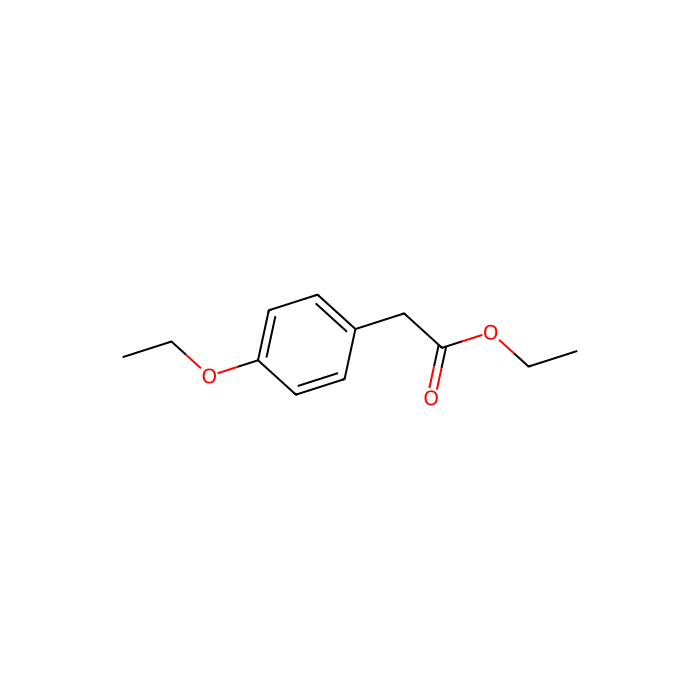
Ethyl 4-ethoxyphenylacetate is an aromatic ether–ester building block featuring a para-ethoxy substituent on a phenyl ring and an ethyl phenylacetate side chain.
Item-specific (from Product Data):
CAS: 40784-88-1
CID: 181675
InChIKey: 194055 (as provided)
Storage: Room temperature; shipped under normal conditions
Research Use: For research use only
Literature/computed identifiers and features (for reference; not item specifications):
Structural description: A benzene ring bearing a para ethoxy substituent and a benzylic –CH2–CO2Et chain. The ring is activated by the ethoxy group (o/p-directing). No stereocenters.
Notes: All computed/literature values are provided for general chemical context and must be verified against the CoA/SDS for this specific lot.
Synthetic Utility
Key reactivity elements make this reagent a useful node in synthesis and library build-outs:
Ester handle:
Hydrolysis (basic or acidic) to 4-ethoxyphenylacetic acid, then activation (SOCl2, Oxalyl chloride) for acylations.
Coupling to amines via carbodiimide reagents (EDC/HOBt, HATU) to access amides; carbamates/ureas via Curtius after conversion to the acid.
Reductions: DIBAL-H to the aldehyde at low temperature (–78 °C); LiAlH4/Red-Al to the benzyl alcohol.
Benzylic site:
Electrophile introduction via NBS/AIBN (light) to benzylic bromide; subsequent SN2 to diversify side chains.
Oxidation to ketone/acid using MnO2 (allylic/benzylic selective), or TEMPO/bleach systems (careful control to avoid ester cleavage).
Aromatic ring (activated by –OEt):
Electrophilic aromatic substitutions (EAS) such as nitration, sulfonation, and Friedel–Crafts acylation/alkylation, with o/p-directing influence.
Cross-coupling requires prefunctionalization (e.g., convert to aryl bromide via directed lithiation/halogenation on suitable precursors rather than direct from this substrate).
Strategic use:
Serves as a para-alkoxy arylacetate scaffold for SAR exploration; the ethyl ester offers balanced stability and ease of conversion to other functionalities.
Target Specificity
Not applicable. This is a small-molecule chemical reagent, not a biological targeting agent. No antigen, epitope, clone, isotype, or species reactivity applies.
Utilizziamo i cookie per garantire il corretto funzionamento del sito web e, ove consentito, per migliorare la tua esperienza. Puoi gestire le tue preferenze in qualsiasi momento nelle Impostazioni. Per saperne di più, consulta la nostra Cookie Policy.
Desidera che le inviamo un messaggio quando avremo sconti disponibili?
Ricordamelo più tardi
Grazie! Controlli la sua casella di posta per confermare.
Products are supplied to verified businesses, institutions, and qualified professionals for research and development use only. Not for use in humans, animals, diagnosis, or therapy.

 L2210384