This compound belongs to the class of organic compounds known as pyridinecarboxylic acids. These are compounds containing a pyridine ring bearing a carboxylic acid group.
External Descriptors
Not available
1. Djoumbou Feunang Y, Eisner R, Knox C, Chepelev L, Hastings J, Owen G, Fahy E, Steinbeck C, Subramanian S, Bolton E, Greiner R, and Wishart DS. ClassyFire: Automated Chemical Classification With A Comprehensive, Computable Taxonomy. Journal of Cheminformatics, 2016, 8:61.
Determine the necessary mass, volume, or concentration for preparing a solution.
Dilution Calculator
Determine the dilution needed to prepare a stock solution.
Reconstitution Calculator
Recensioni
Recensioni dei clienti
Application Protocols
No biological assay protocols are provided for this small-molecule reagent.
Typical chemical application workflows include: hydrolysis to the acid followed by amide coupling; transesterification to alternate esters; or reductions to aldehyde/alcohol, as outlined under Reaction Conditions and Synthetic Utility.
For analytical characterization, common protocols include 1H/13C NMR (CDCl3 or DMSO-d6), LC–MS (ESI+), and HPLC for purity assessment. UV detection at 254 nm is commonly effective for pyridine-containing compounds (general practice).
Item-specific tested applications, recommended dilutions, or controls: Not specified for this item; refer to internal method development and the CoA/Spec Sheet.
Biological Roles
Item-specific biological/biochemical roles: Not specified for this item; refer to primary literature if needed.
General context (literature; not medical/clinical claims):
Ethyl 5-fluoronicotinate is a synthetic small molecule and is not known as a natural metabolite. It serves primarily as a chemical intermediate to access 5-fluoronicotinic acid and its amide/ester derivatives.
The nicotinoyl (pyridine-3-carbonyl) motif is widespread in medicinal chemistry due to its tunable electronics and capacity to engage in hydrogen-bonding as an acceptor via the pyridine nitrogen and carbonyl oxygen. Fluorination at the 5-position modulates electron density and can influence metabolic stability and binding profiles in designed ligands.
After hydrolysis to the corresponding acid, coupling to biomolecule fragments (e.g., amino groups on peptides or linkers) can provide research probes. Such derivatives may be explored for binding studies in enzymology or chemical biology; suitability is entirely context-dependent and must be experimentally verified.
No known endogenous signaling or vitamin-like function is associated with this ethyl ester. Any bioactivity of derivatives arises from the appended pharmacophores rather than inherent biological roles of the parent ester.
Research Use Note: For research use only. Not intended for human or veterinary use.
Buffer Applications
This compound is a neutral organic ester and is not used as a pH buffer component. It lacks the acid/base pair behavior and high aqueous solubility typical of buffering agents.
If aqueous work is required, buffering should be provided by established systems (e.g., phosphate, acetate, HEPES), while the compound itself is introduced via a co-solvent (DMSO, EtOH) at low percentages.
For pH-sensitive transformations involving this ester (e.g., hydrolysis), select appropriate buffer systems external to the substrate; the compound does not function as the buffer.
Item-specific buffer data: Not applicable; not specified for this item.
Green Alternatives
While the substance itself is a target/building block rather than a process solvent, greener choices can be made in operations involving Ethyl 5-fluoronicotinate.
Replace chlorinated solvents (DCM/CHCl3) with EtOAc, Me-THF, dimethyl carbonate, or CPME where feasible.
For amidations, consider acetonitrile or 2-MeTHF instead of DMF/NMP; or run in EtOAc with modern coupling systems when solubility allows.
Transesterification and hydrolysis can often be performed in ethanol or water/ethanol mixtures instead of methanol or dioxane.
Energy and waste considerations:
Use catalytic esterifications/transesterifications (acid catalysts, enzyme catalysis) to reduce stoichiometric wastes.
Explore micellar catalysis (aqueous surfactant media) for couplings post-hydrolysis to the acid—documented to reduce solvent burden in some amide formations.
Comparative snapshot (general):
DCM vs EtOAc: similar polarity window for workups/chromatography; EtOAc is biodegradable and has lower toxicity.
THF vs 2-MeTHF: 2-MeTHF offers better safety (lower peroxide formation tendency than ethers like THF), is bio-based, and often improves phase separations; be mindful of different solvation and boiling point.
Note: Always verify reaction performance when swapping solvents; kinetics and selectivity can shift with solvent polarity and H-bonding properties. Product-specific green metrics are not specified for this item; consult your process development guidelines.
Pharmaceutical Uses
Item-specific pharmacopeial status or excipient roles: Not specified for this item; refer to CoA/Spec Sheet.
General information (manufacturing/formulation context; no therapeutic claims):
Ethyl 5-fluoronicotinate is primarily a synthetic intermediate for discovery and process chemistry rather than a formulated excipient. After conversion to 5-fluoronicotinic acid, standard carboxyl activation and amide coupling routes enable rapid generation of analog series in lead optimization.
In API process development, esters such as this can serve as protected forms of the acid to facilitate crystallization, purification, and controlled deprotection (saponification) upstream of amide formation.
For impurity control, attention should be paid to potential transesterification products, hydrolysis to the acid, and formation of pyridinium salts under acidic conditions. Set specifications for residual solvents, acid/ester content, and related substances as relevant to the stage of manufacture.
If used to prepare salt forms of the derived amides/acids, screening counterions (e.g., HCl, sulfate, maleate for the amine products) may be undertaken post-derivatization; the parent ester itself is typically neutral and not used to form pharmaceutically acceptable salts.
Physical Properties
Item-specific specs: Not specified for this item; refer to CoA/Spec Sheet.
Literature/computed values and qualitative expectations (for reference only; not item specification):
Physical state/appearance (literature): typically a colorless to pale yellow liquid or low-melting solid for comparable nicotinate esters; exact form depends on purity and temperature.
Molecular formula (literature): C8H8FNO2 (ethyl 5-fluoronicotinate)
Molecular weight (literature): ~169.15 g/mol
Polarity/solubility: expected to be sparingly soluble in water; freely soluble in common organic solvents (EtOAc, DCM, THF, MeOH, EtOH, acetonitrile). The basic ring nitrogen can hydrogen bond as an acceptor, increasing solubility in polar aprotic media.
Volatility: as a low-MW aromatic ester, exhibits moderate vapor pressure; handle in a well-ventilated hood.
Refractive index, density, BP/MP, logP, pKa: Not specified for this item; refer to CoA/Spec Sheet. (Typical nicotinate esters display bp in the 200–250 C range and are neutral; pyridine N is weakly basic with conjugate acid pKa ~5.2–5.5, literature.)
Notes on interpretation:
Actual measured values can vary with impurity profile and measurement method. For definitive numbers (e.g., GC assay, water content, UV cutoffs, residual metals), consult the item’s CoA/Spec Sheet.
Quality and Grades
Item-specific grade/purity: Not specified for this item; refer to CoA/Spec Sheet.
Stabilizers/inhibitors: Not specified for this item; refer to CoA/Spec Sheet.
Guidance on interpreting grades for this compound class (general information for professional users):
Research/technical grade is typically suitable for synthetic chemistry, SAR exploration, and library synthesis. Verify GC/HPLC assay, identity (1H/13C NMR, MS), and key impurities if your application is sensitive (e.g., cross-coupling or medicinal chemistry scale-up).
Water and alcohol content matter for moisture- or base-sensitive steps (e.g., DCC/EDC couplings after hydrolysis of the ester). If not specified, determine Karl Fischer water and residual solvent content as needed.
Chromatographic grades (e.g., HPLC grade solvents) are not applicable to the substance itself but to solvents you may use with it. For photochemical or analytical workflows, check UV-Vis background if relevant.
If your downstream step relies on precise acid value or saponification equivalent (for controlled hydrolysis or polymer feedstock uses), obtain or measure acid/base numbers; these are not specified here.
Recommendation: For reproducible medicinal chemistry, request the CoA detailing assay, residual solvents, and any stabilizers, and run orthogonal ID tests (NMR/MS) on receipt.
Reaction and Applications
Manufacturer Applications: Not specified in the Product Data. The following expands on common uses of ethyl 5-fluoronicotinate in synthesis (literature/practice; for research use only):
Scaffold for heteroaryl carboxamide and carboxylate libraries: Hydrolyze to 5-fluoronicotinic acid, then couple to amines (EDC/HATU/HOAt) to access 5-fluoronicotinamides widely used in medicinal chemistry SAR campaigns.
Functional group interconversions of the ester:
Hydrolysis: saponification to the acid (base or acid catalyzed).
Reduction: DIBAL-H to the corresponding 5-fluoronicotinaldehyde (low temperature), or LiAlH4/borane to 5-fluoronicotinyl alcohol (primary alcohol).
Transesterification: exchange ethyl for alternative alkyl/aryl groups under acid or base catalysis.
Ring functionalization strategies:
N-oxidation of the pyridine (to the N-oxide) can activate the ring towards regioselective substitutions, then be reduced back (Boekelheide-type and related tactics).
Direct SNAr at C5–F on a 5-fluoropyridine is generally challenging; however, strongly nucleophilic amines/thiolates under forcing conditions, or metal-mediated catalysis, can effect substitution in certain cases (literature-dependent). Evaluate feasibility via small-scale screens.
Cross-coupling approaches: While aryl C–F activation is difficult, pre-activation (e.g., halogenation or borylation of the ring via directed metalation/N-oxide routes) enables Suzuki–Miyaura, Buchwald–Hartwig, or Negishi couplings to diversify positions 4/5.
Late-stage elaboration: The carboxylate handle allows convergent attachment of linkers, warheads, or solubilizing groups while retaining the 5-fluoropyridyl vector often valued for metabolic stability and electronics.
Reaction Conditions
General literature guidance (illustrative only; not item specification):
Base-catalyzed hydrolysis (saponification):
Conditions: 1–2 M NaOH or KOH in MeOH/H2O or EtOH/H2O (1:1 to 4:1), 25–60 C.
Typical time: 1–6 h depending on concentration and temperature.
Workup: remove alcohol, acidify aqueous phase to pH ~2 with HCl, isolate 5-fluoronicotinic acid.
Acid-catalyzed hydrolysis:
Conditions: aq. HCl (2–6 M) or H2SO4 with dioxane/THF co-solvent, reflux to accelerate.
Reduction to aldehyde (DIBAL-H):
Conditions: 1–1.5 equiv DIBAL-H in toluene or DCM, −78 to −40 C, 0.5–2 h; quench with MeOH then Rochelle’s salt. Monitor to avoid over-reduction.
Reduction to alcohol (LiAlH4 or BH3·THF):
Conditions: 2–3 equiv in dry THF or Et2O, 0–25 C (LAH) or reflux (BH3), 1–4 h. Careful quench protocol required.
Transesterification:
Acidic: catalytic TsOH or H2SO4 (1–5 mol%) in corresponding alcohol, reflux, Dean–Stark if needed.
Basic: sodium alkoxide (0.1–0.3 equiv) in the corresponding alcohol, 25–60 C.
Amide coupling (after hydrolysis to acid):
Reagents: EDC·HCl/HOBt or HATU with DIPEA in DMF, DCM, or MeCN, 0–25 C, 1–12 h.
Ring functionalization enabling strategies:
N-oxide-directed substitutions or lithiation protocols may be employed for diversification of 4/5-positions (consult specific literature for regioselectivity with 5-fluoro substituent).
Note: Optimize equivalents, temperature, and time to substrate scale and purity. Always confirm identity and purity of intermediates (NMR/MS/LC) due to potential for pyridine salt formation under acidic conditions.
Safety and Handling
Regulatory/GHS (item-specific): Not specified for this item; refer to SDS for authoritative classification. Signal word, hazard statements, and pictograms are not provided in the Product Data.
General laboratory safety guidance for heteroaryl esters (literature/practice; not a substitute for SDS):
Likely hazards: Irritant to eyes/skin; harmful if swallowed or inhaled. Aromatic esters and pyridines can cause mucous membrane irritation and have moderate volatility—use in a chemical fume hood.
PPE: lab coat, safety glasses or splash goggles, and appropriate chemically resistant gloves (e.g., nitrile). Avoid skin contact; wash thoroughly after handling.
Handling: Avoid inhalation of vapors and aerosols. Prevent contact with strong bases/acids during storage to minimize hydrolysis. Keep away from strong oxidizers and reducing agents.
Special risks: Esters can slowly hydrolyze in moist air; keep containers tightly sealed. Pyridine derivatives can have strong odors; ensure adequate ventilation.
First aid overview: If on skin—wash with soap and water. Eyes—rinse cautiously with water for several minutes and seek medical attention. Inhalation—move to fresh air; seek medical attention if symptoms persist. Ingestion—rinse mouth; do not induce vomiting; seek medical advice.
Spills/leaks: Contain with inert absorbent (vermiculite, sand), collect for disposal. Avoid discharge to drains.
Fire safety: Combustible. Use CO2, dry chemical, or foam. Thermal decomposition may produce toxic fumes (NOx, HF if fluorinated aromatics decompose).
Solvent Selection
This heteroaryl ethyl ester is a moderately polar, aprotic organic molecule with a basic heteroatom.
Polarity/miscibility (literature expectations):
Miscible with common organic solvents: dichloromethane, chloroform, ethyl acetate, THF, acetonitrile, toluene; good solubility in short-chain alcohols (MeOH, EtOH).
Limited water solubility is expected due to the hydrophobic ring and ethyl ester; pyridine nitrogen does not confer appreciable aqueous solubility at neutral pH, but protonation under acidic conditions can increase aqueous compatibility.
Choosing solvents for typical operations:
Hydrolysis to the acid: MeOH/H2O or EtOH/H2O with NaOH/KOH; for acid-catalyzed routes, aqueous mineral acids in THF or dioxane-water.
Amide couplings (post-hydrolysis): DMF, NMP, DCM, or acetonitrile with EDC/HATU/DIC and base (DIPEA).
Transesterification: MeOH or other alcohols with catalytic acid (H2SO4, TsOH) or base (NaOMe) in the corresponding alcohol solvent.
Comparison and tips:
For chromatography, hexanes/EtOAc or DCM/MeOH systems typically provide good separation range for nicotinate esters.
If odor management is a concern (pyridine derivatives), prefer closed systems and low-odor solvents (Me-THF, CPME) where compatible with the chemistry.
Storage and Reconstitution
Storage conditions (item-specific from Product Data): Room temperature.
Shipping: Shipped under normal conditions.
Appearance: Not specified for this item; refer to CoA/Spec Sheet.
Good practice for this compound class (general guidance):
Store tightly sealed in a dry, well-ventilated area away from strong acids/bases and oxidants. Protect from prolonged exposure to moisture to minimize hydrolysis of the ester.
If long-term storage is anticipated, consider storing under inert gas (argon or nitrogen) and in amber glass to minimize potential light-induced degradation, although pyridine esters are generally light stable.
Reconstitution: Not applicable; supplied neat. If preparing stock solutions, use dry, oxygen-stable solvents (e.g., DMSO, acetonitrile, ethyl acetate). For biological assays, prepare concentrated DMSO stocks and dilute into assay media keeping final DMSO at ≤1–2% v/v (general practice).
Freeze–thaw: Not required for the neat material. For solution stocks, aliquot to avoid repeated freeze–thaw cycles.
Always refer to the product’s CoA/Spec Sheet and SDS for definitive handling, stability, and storage information.
Research Use Note: For research use only.
Structure and Identity
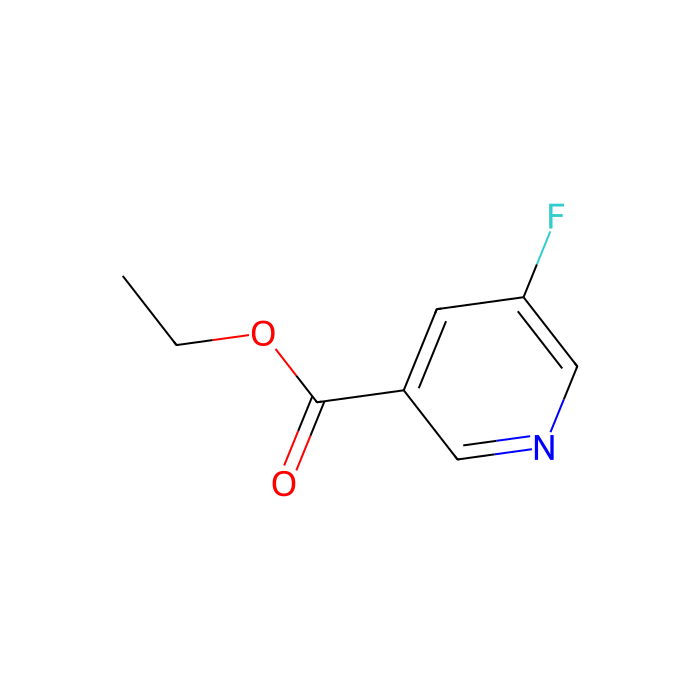
Ethyl 5-fluoronicotinate is an ethyl ester of 5-fluoronicotinic acid, featuring a fluorinated pyridine ring with a 3-carboxylate (nicotinate) functionality.
Item-specific identifiers (from Product Data):
CAS: 22620-29-7
CID: 211184
InChIKey: 97031 (Not a complete InChIKey; Not specified for this item; refer to CoA/Spec Sheet.)
SMILES: Not specified for this item; refer to CoA/Spec Sheet.
Literature identity data (for reference only; not item specification):
Core scaffold: pyridine ring (N in ring at position 1) bearing an ethyl nicotinate group at the 3-position and F substituent at the 5-position (5-fluoro-3-pyridinecarboxylate, ethyl ester).
A six-membered aromatic pyridine ring with the ring nitrogen at position 1; the carboxylate substituent is at position 3 (meta to N), esterified as –CO2CH2CH3; the fluorine atom is at position 5 (para to N). The ethyl ester presents a carbonyl adjacent to the ring and an ethoxy substituent extending from the carbonyl oxygen.
Synthetic Utility
Key functional features and their reactivity (literature; for research use):
Ethyl ester (–CO2Et):
Hydrolysis (acidic or basic) to 5-fluoronicotinic acid.
Reduction: DIBAL-H to aldehyde; LiAlH4 or borane to primary alcohol.
Transesterification: exchange of ethyl group under acid/base catalysis.
Activation: conversion to acid chloride (via SOCl2, oxalyl chloride after hydrolysis) or to active esters (e.g., NHS esters) for amide coupling.
Pyridine ring nitrogen:
Can be oxidized to the N-oxide to direct subsequent substitutions; N-oxide can be reduced back (PCl3, P(OEt)3, Zn/AcOH), enabling regioselective elaboration (e.g., 4/5-positions).
Protonation tunes solubility/reactivity in certain transformations.
Aryl C–F at C5:
Direct SNAr is generally less reactive than chloro/fluoro at activated positions; feasibility depends on nucleophile strength and conditions. Metal-mediated approaches or ring activation (e.g., via N-oxide) may enable substitution.
Retrosynthetic value:
Serves as a convergent handle to append 5-fluoropyridyl fragments to amines/alcohols through the acid after hydrolysis.
Offers orthogonal chemistry: manipulate the ester independently of ring modifications, then reveal the acid late-stage for coupling.
Typical applications:
Construction of heteroaryl amide libraries, linkers, and fragments for SAR.
Synthesis of labeled or tagged derivatives via alcoholysis or amidation for bioconjugation studies (post-hydrolysis/activation).
Target Specificity
Not applicable. This product is a small-molecule building block, not a biological targeting agent or antibody.
No antigen/epitope, clone, isotype, or species reactivity information applies.
Item-specific targeting data: Not specified for this item.
Domande frequenti
How is this product shipped?
This product ships under standard ambient conditions. No temperature-controlled packaging is required.
What is the purity of this product?
This product is supplied at ≥95% purity (chemical assay). Lot-specific values are stated on the Certificate of Analysis.
How should this product be stored?
Store at room temperature.
What are the CAS number, molecular formula and molecular weight?
The CAS Number is 22620-29-7, the molecular formula is C8H8FNO2, and the molecular weight is 169.16 g/mol. InChIKey GAOUAPNRNSFZGW-UHFFFAOYSA-N.
What documentation is provided?
Available product documentation, including Certificates of Analysis (COA), Safety Data Sheets (SDS), and specification sheets, is shown in the product document area. Document availability and access follow the current site policy.
Utilizziamo i cookie per garantire il corretto funzionamento del sito web e, ove consentito, per migliorare la tua esperienza. Puoi gestire le tue preferenze in qualsiasi momento nelle Impostazioni. Per saperne di più, consulta la nostra Cookie Policy.
Desidera che le inviamo un messaggio quando avremo sconti disponibili?
Ricordamelo più tardi
Grazie! Controlli la sua casella di posta per confermare.
Products are supplied to verified businesses, institutions, and qualified professionals for research and development use only. Not for use in humans, animals, diagnosis, or therapy.

 I2208917