This compound belongs to the class of organic compounds known as o-glycosyl compounds. These are glycoside in which a sugar group is bonded through one carbon to another group via a O-glycosidic bond.
External Descriptors
Not available
1. Djoumbou Feunang Y, Eisner R, Knox C, Chepelev L, Hastings J, Owen G, Fahy E, Steinbeck C, Subramanian S, Bolton E, Greiner R, and Wishart DS. ClassyFire: Automated Chemical Classification With A Comprehensive, Computable Taxonomy. Journal of Cheminformatics, 2016, 8:61.
1.Lincai Peng, Chaonan Tao, Hui Yang, Junhua Zhang, Huai Liu. (2022) Mechanistic insights into the effect of the feed concentration on product formation during acid-catalyzed conversion of glucose in ethanol. GREEN CHEMISTRY, 24 (13):(5219-5227). [PMID:][10.1039/D2GC00300G]
2.Xin Yu, Lincai Peng, Jun Dai, Hui Li, Chaonan Tao, Fa Yang, Junhua Zhang. (2021) Ethylene glycol co-solvent enhances alkyl levulinate production from concentrated feeds of sugars in monohydric alcohols. FUEL, [PMID:][10.1016/j.fuel.2021.121471]
3.Huai Liu, Yanping Kong, Weipeng Song, Rui Zhang, Junhua Zhang, Yong Sun, Lincai Peng. (2024) Pretreatment greatly facilitates ethyl levulinate production from catalytic alcoholysis of Napier grass stem. CHEMICAL ENGINEERING JOURNAL, [PMID:][10.1016/j.cej.2024.148559]
Calcolatori di soluzioni
Molarity Calculator
Determine the necessary mass, volume, or concentration for preparing a solution.
Dilution Calculator
Determine the dilution needed to prepare a stock solution.
Reconstitution Calculator
Recensioni
Recensioni dei clienti
Application Protocols
No tested application protocols are provided for this SKU in the Product Data.
General research usage tips (literature/context)
Preparing stock solutions: Dissolve in water or ethanol to desired concentration (e.g., 100–500 mM), filter sterilize if required for biochemical assays.
Enzyme assays: If evaluating hydrolysis by α-glucosidase, select appropriate buffer (e.g., 50 mM sodium acetate, pH 4.5–5.5, or phosphate at neutral pH depending on enzyme source) and include controls with known substrates.
Synthetic operations: For protection reactions, dry the solid and solvents thoroughly; maintain inert atmosphere as per Storage guidance.
For any validated, method-specific protocol, consult the literature pertinent to your assay or synthetic objective and confirm conditions with small-scale trials.
Biological Roles
Literature/general information (not item-specific, no medical claims)
Structural analog: Ethyl α-D-glucopyranoside is a non-reducing glycoside of D-glucose. The anomeric position is blocked as an ethyl acetal, preventing open-chain aldehyde formation.
Enzymology: Serves as a probe compound in studies of α-glucosidase specificity and kinetics; many α-glucosidases hydrolyze α-glycosidic bonds to release glucose and ethanol under appropriate conditions, though rates vary by enzyme source and context.
Transport/metabolism: Unlike free glucose, non-reducing glycosides generally exhibit altered transport and are not directly metabolized via glycolysis unless hydrolyzed by glycosidases.
Interactions: Multiple hydroxyl groups enable extensive hydrogen bonding with proteins and water; often used as a benign osmolyte or stabilizing cosolute in biophysical experiments where a non-reducing sugar derivative is desired.
Note: These roles are general to the chemical class and are provided for research context only. For application-specific performance (e.g., as an enzymatic substrate), validate with relevant controls and reference standards.
Buffer Applications
This compound is not a buffering agent and does not constitute a defined buffer system. It lacks an ionizable group in the physiological pH range and therefore provides no intrinsic pH control.
Practical use (literature/general)
Can be included as a neutral cosolute or osmolyte in buffered solutions to modulate ionic strength or protein stability, recognizing it will not affect pH.
If used in enzyme assays, prepare in an appropriate buffer (e.g., phosphate, acetate, HEPES) selected for the target pH and enzyme requirements.
For buffer recipes and pH control, refer to standard buffering agents; this item functions only as an additive, not as a buffer.
Green Alternatives
Bio-based feedstock (literature/general): Ethyl α-D-glucopyranoside is derived from D-glucose and ethanol—both renewable resources—making it inherently more sustainable than many petrochemical building blocks.
Solvent and process considerations
Aqueous/biobased media (water, ethanol) are typically suitable for dissolution and many protection reactions, reducing reliance on chlorinated solvents.
For acylation/alkylation, alternatives such as 2-MeTHF or Cyrene can sometimes replace DMF/DMSO, though carbohydrate solubility and reactivity must be validated.
Comparison (general)
Versus long-chain alkyl glucosides (green surfactants): Ethyl glucoside is not an effective detergent but offers superior biodegradability and low toxicity profile typical of sugar derivatives.
Versus petrochemical polyols: Similar hydrogen-bonding capacity with better renewability.
Trade-offs
High polarity often necessitates polar aprotic solvents (DMF/DMSO) for certain transformations; greener replacements may affect rates/selectivity.
Water content control is critical; greener solvent swaps should include rigorous drying strategies or water-tolerant catalysts/enzymes.
Conclusion: For many research workflows, pairing this bio-based substrate with aqueous/ethanolic systems or modern green polar aprotics offers a reduced environmental footprint without compromising performance—verify on small scale.
Pharmaceutical Uses
No item-specific pharmacopeial status or excipient grade is provided for this SKU.
Item-specific (Product Data)
Grade/Purity: Not specified for this item; refer to CoA/Spec Sheet.
Literature/general formulation context (no therapeutic claims)
Short-chain alkyl glucosides are hydrophilic, non-reducing carbohydrate derivatives. Ethyl glucoside is markedly more water-soluble and far less surface-active than medium/long-chain alkyl glucosides (e.g., octyl, dodecyl).
Potential research formulation roles include: neutral stabilizer/osmolyte in aqueous systems, cryo/lyoprotectant blends with other polyols, or as a model non-reducing sugar for studying excipient effects.
Regulatory: There is no general monograph known for ethyl glucoside in major pharmacopeias; any use in regulated products would require specification development and qualification.
For GMP or clinical applications, do not use this research-only product; instead, source an appropriate excipient grade with full regulatory documentation.
Physical Properties
Item-specific (Product Data)
Appearance: Not specified for this item; refer to CoA/Spec Sheet.
Literature/Computed (non-spec for this item; provided for general reference to the chemical class)
Phase: Typically a crystalline solid for simple alkyl glucosides with short chains (e.g., methyl/ethyl derivatives).
Solubility: Highly soluble in water and lower alcohols (methanol, ethanol); sparingly soluble in polar aprotic solvents (e.g., acetonitrile, DMF) and essentially insoluble in nonpolar media (hexanes, toluene). Strong hydrogen bonding leads to high aqueous solubility.
LogP: Expected very low/negative (strongly hydrophilic polyol; literature for analogous short-chain alkyl glucosides indicates very low partitioning into octanol).
pKa: Not applicable (neutral polyol; no dissociable acidic/basic centers under physiological pH).
Hygroscopicity: Carbohydrate glycosides may be mildly hygroscopic; store dry to avoid water uptake and caking.
Notes: Do not treat these literature values as specifications. For authoritative physical constants (mp, water content, elemental analysis, UV cutoff, refractive index, etc.), consult the item-specific CoA/Spec Sheet when available.
Quality and Grades
Item-specific (Product Data)
Grade/Purity: Not specified for this item; refer to CoA/Spec Sheet.
Stabilizers/Additives: Not specified for this item; refer to CoA/Spec Sheet.
Guidance for this compound class (literature/general)
Typical quality indicators for glycosides include: assay by qNMR or HPLC (>95–98% for research-grade), water content (Karl Fischer), specific optical rotation (to confirm anomeric configuration), and residual inorganic content (sulfated ash or ICP for trace metals when needed for catalysis).
If designated as “research grade,” expect suitability for general synthetic and biochemical work. “Analytical” or “HPLC” grades may include tighter limits on UV-absorbing impurities and particulates for analytical applications.
Anomeric purity (α vs β) and overall stereochemical integrity are critical for reproducibility in enzymology and carbohydrate chemistry; refer to CoA NMR data to verify.
For exact acceptance criteria (purity threshold, water ppm, metals, optical rotation), consult the item’s CoA/Spec Sheet; values are not specified for this SKU.
Reaction and Applications
Synthetic and analytical uses (literature/general)
Model substrate in carbohydrate chemistry and enzymology to probe α-glucosidase activity or glycosidic stability under acid/base catalysis (verify enzyme specificity before use).
Chiral polyol building block: Multiple hydroxyls enable regioselective protection (e.g., 6-O-silylation/benzylation), oxidation (TEMPO at C6), or acylation to prepare selectively protected intermediates.
Glycosyl acceptor/donor strategies: While an ethyl glycoside is generally glycosidically “locked,” converting it to a leaving group at C1 (e.g., via acetolysis to per-O-acetates followed by generating trichloroacetimidate from the liberated anomeric acetate) allows use as a glycosyl donor. Conversely, the remaining OH groups can serve as acceptors for higher-order oligosaccharide assembly.
Calibration/derivatization: Useful as a defined, non-reducing sugar standard in derivatization-based GC/MS (as alditol acetates) or LC methods.
Practical tips
Drying: For water-sensitive transformations, dry by co-evaporation with toluene/MeOH and store under argon (as specified for this item) to minimize moisture uptake.
Protection patterns: 6-O-TBDPS or 6-O-benzyl protection often achieved selectively due to enhanced primary OH reactivity; 2,3- or 3,4-O-isopropylidene acetal formation typically requires prior oxidation or specific conditions and may be limited with glucosides.
Acid sensitivity: The ethyl glycosidic bond resists mild conditions but undergoes hydrolysis in strong mineral acids or prolonged heating in aqueous acid—use neutral or basic workups where possible.
Reaction Conditions
General guidance for carbohydrate transformations involving ethyl α-D-glucopyranoside (literature/non-specific; optimize per substrate and scale):
Acylation (per-O-acetylation)
Typical: Ac2O (4–6 eq per OH), catalytic DMAP, pyridine or Et3N, 0–25 °C, 1–4 h. Workup by aqueous quench, extract with CH2Cl2/EtOAc. Yields often >80% for peracetates.
Silylation (selective 6-O-TBDPS)
TBDPSCl (1.1–1.5 eq), imidazole in DMF, 0–25 °C, 2–16 h. Enhanced selectivity for primary OH; monitor by TLC/HPLC.
Benzylation
NaH (1.1–2.0 eq per OH) in DMF, BnBr (1.2–2.0 eq), 0 °C to rt, 2–12 h. For milder conditions, use Ag2O/BnBr in toluene or acetone for selective positions.
Formation of glycosyl donors (from protected ethyl glucoside)
Acetolysis (Ac2O/H2SO4 cat., 0–5 °C then rt) to convert the ethyl acetal to anomeric acetate (handle with care; strongly acidic). Subsequent conversion to trichloroacetimidate using CCl3CN/DBU in CH2Cl2 at 0–25 °C.
Oxidation of C6
TEMPO (0.05 eq), NaClO (bleach, pH ~9–10), NaBr co-catalyst, 0–10 °C; quench with Na2S2O3, adjust pH.
Solvents commonly used: DMF, DCM, pyridine, MeCN, and occasionally DMSO. Strictly control water content; use molecular sieves where applicable. These are representative conditions from carbohydrate literature and are not item-specific specifications.
Safety and Handling
Item-specific (Product Data)
GHS classification: Not specified for this item; refer to SDS.
Signal word / H-statements / Pictograms: Not specified for this item; refer to SDS.
Storage: Room temperature, Argon charged. Shipped under normal conditions.
General laboratory safety guidance (literature/good practice; not a substitute for SDS)
Expected hazards: Low acute toxicity for simple carbohydrate glycosides; dust may cause mechanical eye/respiratory irritation. Treat as a combustible organic solid; avoid creating dust clouds.
Incompatibilities: Strong oxidizers (risk of exotherm/combustion), strong mineral acids (acetal hydrolysis to glucose + ethanol), strong bases at elevated temperature (elimination/deglycosylation). Reducing sugars undergo Maillard-type reactions with amines; glycosides are less reactive but acidic hydrolysis can liberate reducing sugar.
PPE: Lab coat, safety glasses, nitrile gloves; dust mask/respirator if handling large quantities of fine powder.
Handling: Use in a dry environment to prevent moisture uptake; close containers promptly. Ground/earth equipment to avoid static when transferring powders.
First aid (overview): Eye/skin contact—rinse with water. Inhalation—move to fresh air. Ingestion—rinse mouth with water. Seek medical attention if symptoms persist.
Always consult the product-specific SDS for definitive hazard, exposure limits, and emergency procedures.
Solvent Selection
Ethyl α-D-glucopyranoside is a highly polar, hydrogen-bond-rich small molecule.
For biochemical assays: Use water or buffered aqueous media. Add small percentages of ethanol or DMSO to assist dissolution if needed, validating assay compatibility.
For protection/glycosylation chemistry: Employ polar aprotic media (DMF, DMSO, MeCN) or mixed solvent systems; control water content tightly.
For chromatography: Carbohydrates elute poorly on normal-phase silica without modifiers. Consider HILIC, aminopropyl columns, or reverse-phase with ion-pairing/derivatization.
Comparison (general)
Versus methyl glucoside: Slightly lower water solubility and higher hydrophobicity; may crystallize more readily.
Versus long-chain alkyl glucosides (e.g., octyl): Far more water-soluble, not surfactant-like; better suited as hydrophilic building block than as detergent.
Select solvents based on the target operation: dissolution for assay (water/alcohols) versus selective protection or coupling (dry polar aprotics).
Container: Store tightly capped in a dry, inert atmosphere container. Argon blanket (as specified) helps minimize moisture uptake and oxidative degradation of sensitive protecting groups in derivatives.
Environment: Keep in a desiccator or dry cabinet to limit hygroscopic caking. Avoid prolonged exposure to ambient humidity.
Light/heat: Protect from excessive heat; ambient laboratory lighting is acceptable.
Reconstitution/dissolution: For aqueous work, add measured water, gently stir at room temperature until fully dissolved. For anhydrous applications, pre-dry the solid (e.g., vacuum over P2O5 or 3 Å sieves) and dissolve in dry polar solvents (MeOH, EtOH, DMF, DMSO) under inert gas.
Freeze–thaw: Not typically necessary for solids. If preparing aqueous stock solutions, aliquot and store refrigerated or frozen as appropriate for your application; avoid repeated freeze–thaw cycles by dispensing single-use portions.
Always refer to the product’s CoA/SDS for any item-specific stability data and compatibility notes.
Structure and Identity
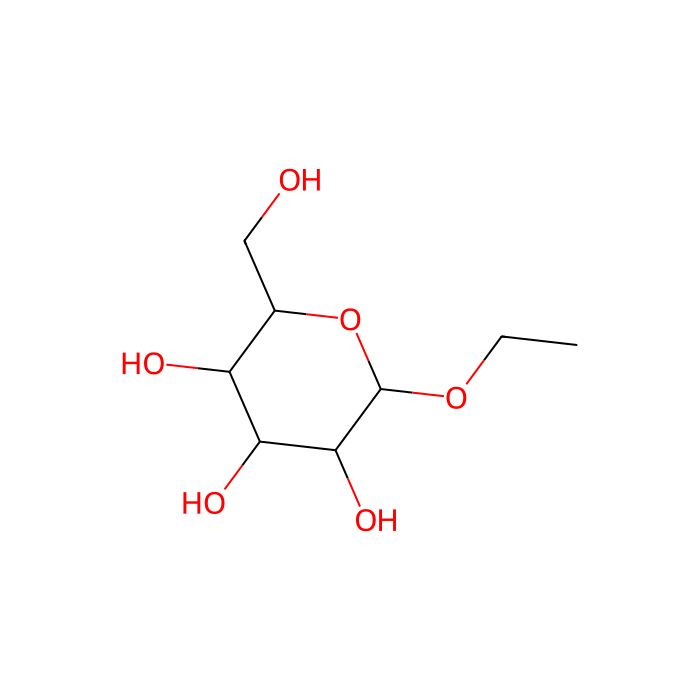
Ethyl α-D-glucopyranoside is a monosaccharide ethyl glycoside derived from D-glucose with an ethoxy substituent at the anomeric (C1) position in the α-configuration.
InChIKey: 411584 (as provided; full InChIKey not specified in Product Data)
SMILES: Not specified for this item; refer to CoA/Spec Sheet.
Molecular formula: Not specified for this item; refer to CoA/Spec Sheet.
Molecular weight: Not specified for this item; refer to CoA/Spec Sheet.
Literature/General structural information
Expected molecular formula (literature): C8H16O6 for ethyl D-glucopyranosides (non-spec for this item)
Typical molecular weight (literature): ~208.21 g/mol (non-spec for this item)
Stereochemistry: α-anomer at C1; remaining centers correspond to D-glucopyranose configuration (multiple defined chiral centers at C2–C5).
Functional groups: Hemiacetal converted to an acetal (glycosidic) linkage at C1; multiple secondary alcohols (C2–C5) and one primary alcohol (C6).
2D description in words (literature): A six-membered pyranose ring (chair form) bearing an anomeric O–CH2CH3 substituent oriented α, with hydroxyl groups at C2, C3, C4 (secondary) and a CH2OH at C5/C6 (primary alcohol), plus ring oxygen between C1 and C5.
Synthetic Utility
Functional handles (literature/general)
Primary alcohol at C6: Selectively reactive for O-alkylation, O-acylation, and silylation (e.g., TBDPS, TBS), enabling orthogonal protection schemes.
Secondary alcohols at C2–C4: Can be differentially protected via steric/electronic control (e.g., 4,6-O-benzylidene acetal in related systems; for glucosides, 4,6-acetalization strategies may be adapted depending on conditions).
Anomeric position: Locked as an ethyl acetal; with appropriate transformations (acetolysis to peracetates, then generating donors such as trichloroacetimidates or halides), the scaffold can be converted into a glycosyl donor.
Transformations
Per-O-acylation (Ac2O/pyridine or DMAP catalysis) to afford fully protected derivatives for downstream glycosylation chemistry.
Selective oxidation of C6 to uronic acid derivatives (e.g., TEMPO/NaClO systems) to access ethyl α-D-glucopyranosiduronic acid analogs.
Installation of permanent protecting groups (benzyl, PMB) for robust assemblies; later global hydrogenolysis or acidolysis to deprotect.
Retrosynthetic value
Serves as a non-reducing, bench-stable surrogate for D-glucose with defined anomeric configuration, simplifying control of downstream glycosylations and minimizing mutarotation concerns.
Target Specificity
Not applicable. This product is a small-molecule carbohydrate, not a biological reagent with target binding (e.g., antibody, enzyme inhibitor designation). No item-specific target or specificity information is provided in the Product Data.
We use cookies to ensure the website functions properly and, where permitted, to improve your experience. You can manage your preferences at any time in Settings. Learn more in our Cookie Policy.
Shall we send you a message when we have discounts available?
Remind me later
Thank you! Please check your email inbox to confirm.
Products are supplied to verified businesses, institutions, and qualified professionals for research and development use only. Not for use in humans, animals, diagnosis, or therapy.

 D2307884