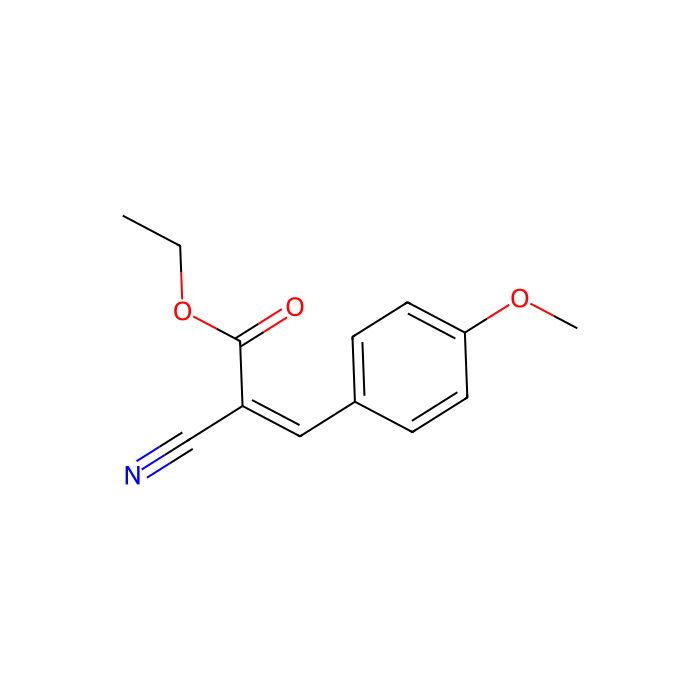
This compound belongs to the class of organic compounds known as cinnamic acid esters. These are compound containing an ester derivative of cinnamic acid.
External Descriptors
Not available
1. Djoumbou Feunang Y, Eisner R, Knox C, Chepelev L, Hastings J, Owen G, Fahy E, Steinbeck C, Subramanian S, Bolton E, Greiner R, and Wishart DS. ClassyFire: Automated Chemical Classification With A Comprehensive, Computable Taxonomy. Journal of Cheminformatics, 2016, 8:61.
Certificati (CoA, COO, BSE/TSE e tabella di analisi)
C of A & Other Certificates(BSE/TSE, COO):
Analytical Chart:
Proprietà chimiche e fisiche
Peso molecolare
231.250 g/mol
XLogP3
2.400
Hydrogen Bond Donor Count
0
Hydrogen Bond Acceptor Count
4
Rotatable Bond Count
5
Exact Mass
231.09 Da
Monoisotopic Mass
231.09 Da
Topological Polar Surface Area
59.300 Ų
Heavy Atom Count
17
Formal Charge
0
Complexity
332.000
Isotope Atom Count
0
Defined Atom Stereocenter Count
0
Undefined Atom Stereocenter Count
0
Defined Bond Stereocenter Count
1
Undefined Bond Stereocenter Count
0
The total count of all stereochemical bonds
1
Covalently-Bonded Unit Count
1
Calcolatori di soluzioni
Molarity Calculator
Determine the necessary mass, volume, or concentration for preparing a solution.
Dilution Calculator
Determine the dilution needed to prepare a stock solution.
Reconstitution Calculator
Recensioni
Recensioni dei clienti
Application Protocols
Not applicable (no vendor-validated protocols provided)
No tested biological assay applications (e.g., WB, IHC, IF, FC) or recommended dilutions are provided for this small-molecule reagent.
General laboratory usage notes (literature/general)
For synthesis, weigh quickly to limit ambient moisture uptake, dissolve in an appropriate dry solvent, and add to the reaction under inert gas if base-sensitive steps are planned.
For analytical studies, prepare stock solutions in HPLC-grade solvents (e.g., MeCN, EtOH) and filter (0.2 μm PTFE) before injection to protect columns/detectors.
For any aqueous assay, prepare concentrated DMSO or MeCN stocks and verify final solubility and absence of precipitation upon dilution into buffer.
Item-specific note
Refer to the CoA/SDS for any handling nuances particular to the lot supplied.
Biological Roles
Item-specific (Product Data)
Biological/biochemical roles: Not specified for this item; for research use only.
Literature/general context
This compound is a synthetic aryl cyanoacrylate and does not have a known native biological role. However, cinnamate motifs broadly are ubiquitous in plant phenylpropanoid metabolism (e.g., p-coumarates, ferulates), and para-methoxy substitution is common among lignin-related structures; these analogies explain the strong UV absorption typical of cinnamate frameworks, which has inspired the use of cinnamate derivatives as UV-absorbing building blocks in materials research.
In chemical biology, activated aryl cyanoacrylates serve as Michael acceptors for selective conjugation to nucleophilic residues (e.g., cysteine) in model peptides and polymers. Any such use should be validated for selectivity and reversibility, recognizing that cyanoacrylates can undergo side polymerization and hydrolysis in aqueous, basic media.
The electron-poor alkene may react with thiols of glutathione or cysteine under physiological-like conditions in vitro; rates depend on pH, buffer composition, and cosolvent. These interactions are of methodological interest, not therapeutic implication.
Caution
Avoid extrapolating any biochemical reactivity to biological efficacy or safety. No pharmacology, ADME, or toxicology data are provided for this item. Always design experiments with appropriate controls and containment.
Buffer Applications
Not typically applicable
ETHYL ALPHA-CYANO-4-METHOXYCINNAMATE is a hydrophobic small-molecule reagent, not a buffering agent. It does not form defined buffer systems over practical pH ranges.
Practical guidance (general)
If used in aqueous assays, prepare concentrated stocks in a water-miscible organic solvent (e.g., DMSO, MeCN, or ethanol) and dilute into the working buffer with vigorous mixing. Keep final co-solvent below assay tolerance (commonly ≤1–2% v/v) and verify solubility/precipitation visually and by UV–Vis or HPLC.
Buffer components with strong nucleophilicity (primary amines, thiols) can react with the Michael acceptor; use inert buffers (e.g., phosphate, HEPES) and minimize free thiol/amine concentrations unless conjugation is intended.
Item-specific note
No buffer recipes or aqueous solubility specifications are provided for this item; consult the CoA and perform small-scale compatibility tests.
Green Alternatives
Context (general)
The substrate itself is a specialized cyanoacrylate; “greenness” considerations most often concern solvent and reagent choices rather than the substrate.
Greener solvent swaps (literature/general)
Replace chlorinated solvents (DCM, CHCl3) with ethyl acetate, 2-MeTHF, or cyclopentyl methyl ether (CPME) when solubility/kinetics permit.
For polar aprotic needs, consider propylene carbonate or dimethyl sulfone in place of DMF/DMSO when feasible; MeCN remains effective but is not especially green.
For hydrogenations, prefer ethanol or isopropanol as solvent and transfer-hydrogenation methods (e.g., HCO2H/Et3N, i-PrOH) to reduce H2 handling.
Catalysis and conditions
Use organocatalysts (secondary amines, NHCs, thioureas) or biobased bases where compatible instead of stoichiometric inorganic bases. Solid-supported catalysts and flow reactors can decrease waste and improve heat/mass transfer.
Micellar catalysis (aqueous surfactant media) may enable certain conjugate additions with dramatically reduced organic solvent use; verify substrate solubility and product isolation strategy.
Comparative snapshot (general)
DCM vs EtOAc: EtOAc offers reduced toxicity and better environmental fate with only modest tradeoffs in solubility; often an easy swap for workups and chromatography.
THF vs 2-MeTHF: 2-MeTHF has lower peroxide tendency, bio-based sourcing, and higher boiling point aiding extractions; minor differences in polarity may slightly affect rates/selectivity.
Item-specific note
No green metrics or solvent restrictions are specified for this item; tailor choices to your process safety and sustainability goals.
Pharmaceutical Uses
Item-specific (Product Data)
Pharmaceutical/excipient status: Not specified for this item; for research use only.
Literature/general context
Cinnamate derivatives are widely studied as UV-absorbing motifs and as intermediates in the synthesis of materials and fine chemicals. The cyanoacrylate function here makes the molecule a strong Michael acceptor, useful for constructing β-functionalized building blocks that may be further elaborated in medicinal chemistry campaigns.
In formulation science, hydrophobic aromatic esters can be explored as model compounds for solubility/permeation studies, crystallization behavior, or as photostable chromophores in polymer matrices. However, no pharmacopeial monograph or excipient role is attributed to this specific compound in the supplied data.
Any use in drug product manufacture would require independent qualification (impurity profiles, residual solvents, elemental impurities, stability indicating methods) and regulatory assessment—none of which are provided here.
Compliance reminder
This product is supplied strictly for research and laboratory use. It is not intended for human or veterinary use, APIs, diagnostics, or as a medical device component without additional qualification.
Physical Properties
Item-specific (Product Data)
Appearance: Not specified for this item; refer to CoA/Spec Sheet.
Molecular weight: Not specified for this item; refer to CoA/Spec Sheet.
Storage: Room temperature (provided)
Literature/general values and qualitative behavior (for reference only; not specifications)
Empirical formula (literature): C13H13NO3 (consistent with an ethyl p-methoxyphenyl cyanoacrylate)
Approximate formula mass (literature): ~231.25 g/mol
Phase/volatility: low-volatility organic compound; expected to be a solid or low-melting solid depending on isomeric purity (literature, qualitative).
Solubility profile: sparingly soluble in water; soluble in common organic solvents such as ethyl acetate, acetone, chloroform, dichloromethane, acetonitrile, THF, and alcohols (literature/general).
UV/Vis: conjugated cinnamate/cyanoacrylate chromophore shows strong π→π* absorption in the near-UV; exact λmax depends on solvent and isomer ratio (literature/general).
Acidity/basicity: neutral compound; the cyanoacrylate methine is deprotonated only under strong basic conditions (e.g., DBU, alkoxides) enabling Michael chemistry (general).
Partitioning: expected moderate hydrophobicity due to aryl/ester; logP in the 2–3 range is typical for para-methoxycinnamate derivatives, but specific value for this item is not established here (literature/general, qualitative).
Important
Numerical specifications (mp, bp, density, refractive index, water/peroxide/metal content) are not specified for this item; refer to CoA/Spec Sheet.
Quality and Grades
Item-specific (Product Data)
Grade/Purity: Not specified for this item; refer to CoA/Spec Sheet.
Stabilizers/Inhibitors: Not specified for this item; refer to CoA/Spec Sheet.
Interpreting grade (general guidance)
Research-grade organics are typically suitable for synthesis, method development, and materials research. If HPLC/UV grade were specified, that would indicate low residual solvent/UV-absorbing impurities tailored to analytical use; in absence of such designation, verify suitability for photophysical or analytical applications via test runs.
For conjugate-addition chemistry, trace base/acid can influence rate and selectivity. If your transformation is base-catalyzed (e.g., DBU-promoted Michael), even ppm-level acidic impurities can matter; conversely, for Lewis-acid catalysis, water and basic residues are deleterious. Review the CoA for assay, residual solvents, and water content.
If an inhibitor/stabilizer is present (common for acrylate-like motifs), it can affect radical or polymerization chemistry. Absence/presence should be verified on the CoA; remove inhibitors by standard procedures (e.g., basic alumina) only if compatible with your reaction.
Recommended QC on receipt (general)
Record NMR (1H/13C) to confirm E/Z ratio of the C=C and check for polymeric/aldehyde impurities.
Inspect by HPLC/UPLC with UV at 254–320 nm to quantify aromatic/conjugated byproducts.
Verify water by Karl Fischer if moisture-sensitive catalysis is planned.
For photochemical work, measure UV–Vis to establish λmax and extinction in your solvent of choice.
Reaction and Applications
General reactivity profile (literature/general)
ETHYL ALPHA-CYANO-4-METHOXYCINNAMATE is a highly activated Michael acceptor due to the geminal −CN and −CO2Et substituents on the alkene. The conjugation with a p-methoxyphenyl ring tunes electrophilicity and UV response.
Representative transformations and uses
Conjugate (Michael) additions of C-, N-, O-, and especially S-nucleophiles to forge β-substituted adducts with high regiocontrol. Bases such as DBU, TBD, K2CO3, or tertiary amines are typical promoters; phase-transfer catalysis can be effective with inorganic bases.
Cycloadditions: functions as a potent dienophile in Diels–Alder reactions with electron-rich dienes; Lewis acids (e.g., AlCl3, Sc(OTf)3) can accelerate reactions and steer endo/exo selectivity.
Multicomponent annulations: participates in Hantzsch dihydropyridine and related heterocycle syntheses as the activated olefin component.
Reduction chemistry: chemoselective hydrogenation of the C=C (Pd/C, H2) affords saturated cyanoesters; selective nitrile reductions (e.g., to imines/amines) are possible with hydride or catalytic hydrogenation under tailored conditions.
Functional handle relay: the β-aryl p-OMe group can be demethylated (e.g., BBr3) to a phenol, enabling further derivatization (etherification/esterification) post-conjugate addition.
Practical tips
Control E/Z: Strong base, prolonged light exposure, or heat can isomerize the C=C; minimize if stereodefined outcomes are required.
Moisture control: While not extremely moisture sensitive, water can attenuate nucleophile strength and quench bases; dry solvents and inert atmosphere improve reproducibility.
Monitoring: Reaction progress is conveniently tracked by TLC/HPLC with UV detection near 254–300 nm.
Item-specific note
No manufacturer application notes are provided; the above represent common literature uses for aryl cyanoacrylates.
Reaction Conditions
Typical conditions (literature/general guidance; not specifications)
Michael additions (thiols, amines, carbon nucleophiles):
Solvent: MeCN, DMF, DMSO, or EtOAc; 0.05–0.2 M.
Base/catalyst: DBU (5–20 mol%), TEA (0.1–1.0 equiv), K2CO3 (1–2 equiv, with PTC), or cinchona-derived organocatalysts for enantioselective variants.
Temperature: 0–25 °C for sensitive nucleophiles; up to 60 °C to drive sluggish additions.
Time: 1–24 h depending on nucleophile and catalyst; monitor by TLC/HPLC (UV 254–300 nm).
Diels–Alder reactions (as dienophile):
Solvent: toluene, DCM, or 2-MeTHF; optional Lewis acid (e.g., Sc(OTf)3, AlCl3, ZnCl2; 5–20 mol%).
Temperature: 25–120 °C (thermal) or 0–25 °C with strong Lewis acid.
Hydrogenation (C=C selective):
Catalyst: Pd/C (5–10 wt% of substrate) in EtOH, EtOAc, or MeOH.
H2 pressure: 1–3 bar typical on small scale.
Temperature: ambient to 40 °C.
Hydrolysis/transesterification of −CO2Et:
Base: K2CO3/MeOH or NaOMe/MeOH (caution: may also trigger conjugate addition/isomerization).
Acidic: HCl/EtOH under reflux; monitor for nitrile stability.
Tips and controls
Dry solvents and exclude strong light for stereochemically sensitive operations.
If unexpected polymerization/gelation occurs, quench base and switch to milder catalysts or lower temperature.
Purify with minimal heat; flash chromatography with EtOAc/hexanes often affords clean separation from polar adducts.
Item-specific note
No tested conditions are provided for this item; optimize on small scale and consult literature for close analogs.
Safety and Handling
Item-specific (Product Data)
GHS classification, signal word, pictograms, and H-statements: Not specified for this item; refer to SDS.
Storage conditions: Room temperature
Shipping: Normal
General safety guidance for α-cyanoacrylate cinnamate esters (literature/general)
Hazards: May cause skin/eye irritation; aromatic acrylates/cyanoacrylates can be sensitizers. Avoid inhalation of dust and contact with skin/eyes. Not expected to release cyanide under ambient conditions; −C≡N is covalently bound.
Reactivity: Activated Michael acceptor; reacts with strong nucleophiles (amines, thiols, alkoxides). Avoid strong bases/acids, strong nucleophiles, and strong oxidizers. Prolonged base exposure may induce polymerization or retro-Knoevenagel processes.
PPE: Use chemical-resistant gloves (e.g., nitrile), lab coat, and splash goggles. Handle in a fume hood to minimize exposure to dust or solvent vapors.
First aid (overview; defer to SDS):
Eyes: Rinse cautiously with water for several minutes; remove contact lenses; seek medical attention if irritation persists.
Skin: Wash with soap and water; remove contaminated clothing.
Inhalation: Move to fresh air; seek medical advice if symptoms occur.
Ingestion: Rinse mouth; do not induce vomiting; seek medical attention.
Fire safety: Treat as combustible organic solid. Use CO2, dry chemical, or foam. Thermal decomposition may produce CO/CO2 and nitrogen-containing irritants.
Handling tips: Keep container tightly closed and dry. Minimize exposure to light/UV if E/Z integrity is important. Use inert atmosphere for moisture/base-sensitive transformations.
Always consult the product-specific SDS for authoritative safety information.
Solvent Selection
Polarity and miscibility (literature/general)
The compound is a neutral, moderately hydrophobic aromatic ester with an activated olefin; it dissolves well in mid-polar organics (EtOAc, acetone, MeCN, DCM, THF) and in aromatic solvents (toluene). Aqueous solubility is low.
For chromatographic purification, ethyl acetate/hexanes or DCM/MeOH gradients are commonly effective; UV-active at 254–320 nm facilitates detection.
Choosing solvents by application
Base-promoted Michael additions: Prefer polar aprotic media (MeCN, DMF, DMSO) to enhance nucleophile reactivity; add co-solvent alcohols only when using alkoxide nucleophiles.
Lewis-acid or organocatalytic reactions: Use toluene, DCM, or EtOAc; screen 2-MeTHF or CPME as greener alternatives to DCM/THF.
Hydrogenation/transfer hydrogenation: Alcohols (EtOH, i-PrOH) or EtOAc under H2/Pd are typical.
Photophysical studies: Anhydrous, peroxide-free solvents recommended to preserve E/Z integrity and avoid radical side reactions.
Quick comparison (general)
DCM: excellent solubility and fast kinetics in many reactions; toxicity and environmental profile are drawbacks.
MeCN: promotes clean conjugate additions; handle with care due to toxicity.
2-MeTHF/CPME: good balance of polarity and safety; water-tolerant, useful in scale-up.
Item-specific limitations
No solvent-related specifications are provided for this item; select based on reaction class and perform small-scale screens when possible.
Storage and Reconstitution
Item-specific (Product Data)
Storage conditions: Room temperature
Shipping: Normal
Practical storage guidance (general)
Keep tightly closed in a dry, well-ventilated place. Store in original amber container or protect from strong light to minimize potential E/Z isomerization or photodegradation of the conjugated system.
If frequent access is expected, consider aliquoting to minimize moisture/air exposure. Purge headspace with inert gas (N2/Ar) for long-term stability of base-sensitive substrates.
Avoid storing near strong bases, acids, and oxidizers. Do not store in the presence of amine vapors or thiols, which can react via Michael addition.
Reconstitution and solution stability (general)
For stock solutions, dissolve in dry, oxygen-free solvents compatible with your application (e.g., MeCN, DMSO, EtOAc, THF, or ethanol). Typical research stocks are 10–100 mM; verify solubility and stability at your chosen concentration.
Store solutions at 2–8 °C in amber vials when possible; bring to room temperature before opening to avoid condensation. Re-verify concentration periodically by UV–Vis or HPLC due to potential slow degradation in basic or wet media.
Notes
No item-specific stability or shelf-life data are provided; refer to the lot-specific CoA/Spec Sheet and SDS for definitive guidance.
Core features: an electron-deficient α,β-unsaturated system bearing two strong −I/−M groups (cyano and ester) conjugated to a para-methoxy-substituted phenyl ring.
Functional groups: aromatic ether (anisole), cyano (−C≡N), conjugated ester (−CO2Et), and an activated olefin (Michael acceptor).
Stereochemistry: the β-aryl cyanoacrylate typically isolates as the E (trans) isomer across the C=C bond under Knoevenagel-type preparation (literature); isomerization is possible under strong base or UV.
2D structure (verbal): a p-methoxyphenyl ring para-substituted with −OCH3 attached at the benzylic position to a C=C unit; the α-carbon of the C=C bears −CN, and the β-carbon is bonded to the aryl ring; the carbonyl carbon of an ethyl ester extends from the α-carbon through a carbonyl and −OCH2CH3 tail.
Notes
The combination of −CN and −CO2Et dramatically activates the double bond toward conjugate addition and cycloaddition while the p-OMe substituent modulates ring electronics and UV absorption (general chemistry).
Synthetic Utility
Reactivity anchors (literature/general)
Dual activation by −CN and −CO2Et makes the C=C a powerful Michael acceptor. The p-OMe aryl group modulates the LUMO and can serve as a future functionalization site (demethylation → phenol). Conjugation facilitates pericyclic and photochemical transformations.
Strategic transformations
β-Functionalization via conjugate addition: generate β-alkyl, β-aryl (via organocuprates), β-amino, or β-thio substituents with high regioselectivity; subsequent manipulations include nitrile reduction (→ amine), ester hydrolysis/alcoholysis, or decyanation to diversify scaffolds.
Annulation chemistry: participation in multicomponent condensations (e.g., Hantzsch dihydropyridine, pyran, pyridine, and chromene formations) where the activated alkene functions as an acceptor fragment.
Selective reductions/oxidations: hydrogenate C=C selectively (Pd/C, H2) preserving −CN/−CO2Et; or reduce −CN (Raney Ni, catalytic hydrogenation, or hydride reagents) to unveil primary amines for downstream coupling.
Cross-coupling on aryl unit after O-demethylation to phenol (BBr3, AlCl3/mercaptan) → convert to triflate/halide and engage in Suzuki/Heck chemistry to access diverse aryl-substituted cyanoesters.
Practical considerations
Control base strength and temperature to avoid polymerization or double addition with particularly “soft” nucleophiles.
E/Z integrity can influence diastereoselectivity in downstream steps; characterize and preserve isomer ratio.
The strong UV chromophore aids in reaction monitoring and purification.
Item-specific note
No additional synthetic specifications are provided for this item; tailor conditions to your transformation and consult primary literature for closely related aryl cyanoacrylates.
Target Specificity
Not applicable
This product is a small-molecule reagent, not a biological targeting agent (e.g., antibody, probe, or inhibitor) with defined target specificity in the supplied data.
No antigen, epitope, clone, isotype, or species reactivity information is provided for this item.
We use cookies to ensure the website functions properly and, where permitted, to improve your experience. You can manage your preferences at any time in Settings. Learn more in our Cookie Policy.
Shall we send you a message when we have discounts available?
Remind me later
Thank you! Please check your email inbox to confirm.
Products are supplied to verified businesses, institutions, and qualified professionals for research and development use only. Not for use in humans, animals, diagnosis, or therapy.