Il negozio non funziona correttamente quando i cookie sono disabilitati.
I JavaScript sembrano essere disabilitati nel tuo browser. Per una migliore esperienza sul nostro sito, assicurati di attivare i javascript nel tuo browser.
· · COA & SDS Disponibile per ogni prodotto · Spedizione lo stesso giorno su articoli in magazzino Cloruro di etile e malonile - ≥97% , CAS No.36239-09-5
Synonyms
EINECS 252-934-5 | BBL100033 | Piridinio, 4-(aminocarbonil)-1-(((6R,7R)-2-carbossi-8-osso-7-(((2R)-2-fenil-2-sulfoacetil)ammino)-5-thia-1-azabiciclo(4. 0)oct-2-en-3-il)metil)-, sale interno, sale di sodio (1:1 | STL511013 | IOTALAMATO MEGLUMINA [ARANCIONE
Storage
Conservare a 2-8°C, con carica di argon
🧪
Why this grade ≥97% for sensitive chromatographic and analytical workflows requiring minimal baseline interference.
🌡
Storage & shipping Conservare a 2-8°C, con carica di argon Ships Ghiaccio umido Check lot-specific COA for exact specifications.
📋
Quality documents SDS, COA, datasheet, and spec sheet available for download. Lot-specific COA accessible via lot number lookup.
📚
Literature proof Cited in 1 peer-reviewed publications across chromatography, organic synthesis, and cross-coupling reactions.
Panoramica L'etil malonil cloruro è un versatile agente acilante per alcoli propargilici, idrazine e ammine.
L'etil malonil cloruro è stato utilizzato per la sintesi di:
. metanofullerodendrimeri cristallini;
. . derivati di 1,2,4-ossadiazoli 3,5-disostituiti, che sono potenziali blocchi di costruzione peptidomimetici;
. . 3-pirrolin-2-oni mediante amidazione con propargilammine e successiva ciclizzazione 5-exo-dig catalizzata da basi
Specifications Sinonimi
EINECS 252-934-5 | BBL100033 | Piridinio, 4-(aminocarbonil)-1-(((6R,7R)-2-carbossi-8-osso-7-(((2R)-2-fenil-2-sulfoacetil)ammino)-5-thia-1-azabiciclo(4. 0)oct-2-en-3-il)metil)-, sale interno, sale di sodio (1:1 | STL511013 | IOTALAMATO MEGLUMINA [ARANCIONE
Condizioni di conservazione di stoccaggio
Conservare a 2-8°C, con carica di argon
Nomi e identificatori Pubchem Sid Url
https://pubchem.ncbi.nlm.nih.gov/substance/508811654
Sorrisi canonici
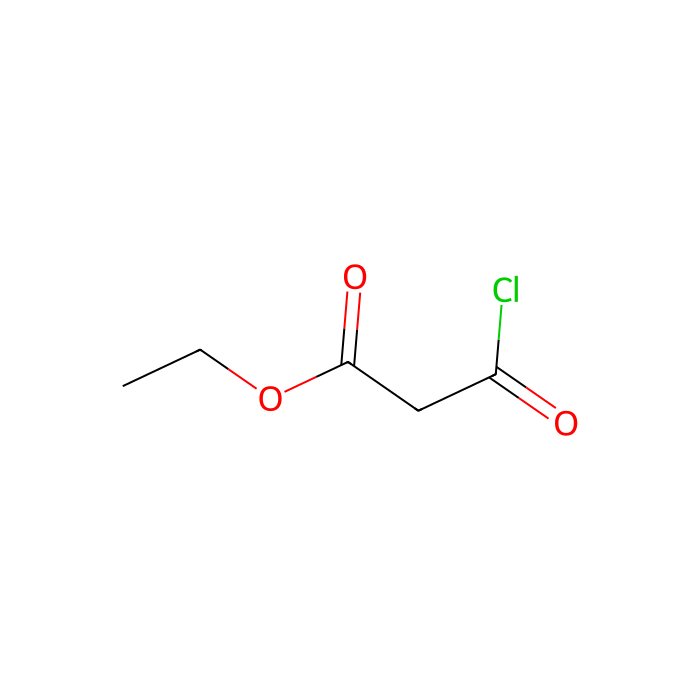
CCOC(=O)CC(=O)Cl
IUPAC Name
ethyl 3-chloro-3-oxopropanoate
InChIKey
KWFADUNOPOSMIJ-UHFFFAOYSA-N
INCHI
1S/C5H7ClO3/c1-2-9-5(8)3-4(6)7/h2-3H2,1H3
Isomeri SMILES
CCOC(=O)CC(=O)Cl
Reaxys-RN_link_address
https://www.reaxys.com/reaxys/secured/hopinto.do?context=S&query=IDE.XRN=636215&ln=
Documentazione 📋 Safety Data Sheet (SDS) Comprehensive hazard, handling, storage, and regulatory compliance document.
Download SDS → ✅ Certificate of Analysis (COA) Lot-specific quality data. Enter your lot number to retrieve the exact COA.
Look up COA → 📊 Datasheet Quick-reference summary of product specifications and applications.
View datasheet → 🔬 Specification Sheet Full quality attributes and acceptance criteria for this grade.
View spec sheet →
Advanced Data Taxonomic Classification Kingdom Organic compounds Superclass Organic oxygen compounds Classe Organooxygen compounds Subclass Carbonyl compounds Intermediate Tree Nodes Not available Direct Parent 1,3-dicarbonyl compounds Alternative Parents Carboxylic acid esters Monocarboxylic acids and derivatives Acyl chlorides Organochlorides Organic oxides Hydrocarbon derivatives Molecular Framework Aliphatic acyclic compounds Substituents 1,3-dicarbonyl compound - Carboxylic acid ester - Monocarboxylic acid or derivatives - Carboxylic acid derivative - Acyl halide - Acyl chloride - Organic oxide - Hydrocarbon derivative - Organochloride - Organohalogen compound - Aliphatic acyclic compound Descrizione This compound belongs to the class of organic compounds known as 1,3-dicarbonyl compounds. These are carbonyl compounds with the generic formula O=C(R)C(H)C(R')=O, where R and R' can be any group. External Descriptors Not available Data sources 1. Djoumbou Feunang Y, Eisner R, Knox C, Chepelev L, Hastings J, Owen G, Fahy E, Steinbeck C, Subramanian S, Bolton E, Greiner R, and Wishart DS. ClassyFire: Automated Chemical Classification With A Comprehensive, Computable Taxonomy. Journal of Cheminformatics, 2016, 8:61.
Struttura 3D Certificati (CoA, COO, BSE/TSE e tabella di analisi) Proprietà chimiche e fisiche Solubilità Miscible with water. Sensibilità Moisture Sensitive Indice di rifrazione 1.429 Punto di infiammabilità (°F) 147.2 °F Punto di infiammabilità (°C) 67°C(152°F) Punto di ebollizione (°C) 83°C/22mm Peso molecolare 150.560 g/mol XLogP3 1.300 Hydrogen Bond Donor Count 0 Hydrogen Bond Acceptor Count 3 Rotatable Bond Count 4 Exact Mass 150.008 Da Monoisotopic Mass 150.008 Da Topological Polar Surface Area 43.400 Ų Heavy Atom Count 9 Formal Charge 0 Complexity 121.000 Isotope Atom Count 0 Defined Atom Stereocenter Count 0 Undefined Atom Stereocenter Count 0 Defined Bond Stereocenter Count 0 Undefined Bond Stereocenter Count 0 The total count of all stereochemical bonds 0 Covalently-Bonded Unit Count 1
Citations of This Product Calcolatori di soluzioni Molarity Calculator Determine the necessary mass, volume, or concentration for preparing a solution.
Dilution Calculator Determine the dilution needed to prepare a stock solution.
Reconstitution Calculator Recensioni
Utilizziamo i cookie per garantire il corretto funzionamento del sito web e, ove consentito, per migliorare la tua esperienza. Puoi gestire le tue preferenze in qualsiasi momento nelle Impostazioni. Per saperne di più, consulta la nostra
Cookie Policy. Impostazioni Accetto tutto Rifiuta
Desidera che le inviamo un messaggio quando avremo sconti disponibili?
Ricordamelo più tardi Permetti
Grazie! Controlli la sua casella di posta per confermare.
Ops! Le notifiche sono disabilitate.
Products are supplied to verified businesses, institutions, and qualified professionals for research and development use only. Not for use in humans, animals, diagnosis, or therapy.
Copyright © 2023–present Aladdin Scientific Corporation. All rights reserved.

 G2610106