This compound belongs to the class of organic compounds known as alpha amino acids and derivatives. These are amino acids in which the amino group is attached to the carbon atom immediately adjacent to the carboxylate group (alpha carbon), or a derivative thereof.
External Descriptors
Not available
1. Djoumbou Feunang Y, Eisner R, Knox C, Chepelev L, Hastings J, Owen G, Fahy E, Steinbeck C, Subramanian S, Bolton E, Greiner R, and Wishart DS. ClassyFire: Automated Chemical Classification With A Comprehensive, Computable Taxonomy. Journal of Cheminformatics, 2016, 8:61.
Determine the necessary mass, volume, or concentration for preparing a solution.
Dilution Calculator
Determine the dilution needed to prepare a stock solution.
Reconstitution Calculator
Recensioni
Recensioni dei clienti
Application Protocols
Not applicable. No antibody/assay application data (WB, IHC, IF, FC, etc.) are associated with this small-molecule reagent. For synthetic uses, see Reaction & Applications, Synthetic Utility, and Reaction Conditions for practical guidance.
Biological Roles
This product is a synthetic organic building block rather than a biomolecule. No intrinsic biological role is established for Ethyl N,N-dimethyloxamate itself.
General context (literature)
Oxamate derivatives appear in chemical biology as probes or as precursors to hydroxamates; however, N,N-dialkyl oxamates are primarily used as synthetic intermediates and not as enzyme substrates or cofactors.
The tertiary amide and ester functionalities render the molecule relatively metabolically stable compared to primary amides/esters, but actual biotransformation depends strongly on context and is not characterized here.
Research-use stance
This product is provided strictly for research and laboratory use. It is not intended for diagnostic, therapeutic, or human/animal consumption applications.
For any biological testing or assay development, characterize purity, residual solvents, and stability in assay media independently; consult the CoA and generate fit-for-purpose stability data.
Buffer Applications
Not typically applicable. Ethyl N,N-dimethyloxamate is a neutral organic building block, not a buffering agent. It does not form defined buffer systems in aqueous media. For practical use in water-rich systems, see Solvent Selection and Safety & Handling for guidance on miscibility and hydrolytic stability.
Green Alternatives
Solvent choices (greener substitutions)
Replace CH2Cl2 with ethyl acetate or 2-MeTHF when solubility/reactivity permit—both have better environmental and safety profiles (literature-based). For organometallic additions, 2-MeTHF often substitutes THF effectively and comes from bio-based sources.
Avoid DMF/DMSO where unnecessary; acetonitrile or EtOAc frequently provide adequate polarity with simpler workups.
Reaction design
Use catalytic, chemoselective reductions (e.g., transfer hydrogenation or catalytic hydrosilanes) instead of stoichiometric metal hydrides when compatible with the substrate.
Favor enzymatic or organocatalytic amidations/transesterifications (lipase-catalyzed methods) for late-stage modification of the ethyl ester, reducing energy input and waste (literature precedent for ester exchange).
Workup/waste minimization
Choose biphasic greener extractions (EtOAc/brine) over halogenated solvents; recover and recycle solvents where possible.
Employ solid-supported reagents (e.g., scavenger resins) to streamline purification and decrease solvent consumption.
Brief comparison (literature; not product specifications)
THF vs 2-MeTHF: similar reactivity with Grignards; 2-MeTHF has higher boiling point and better partitioning for greener processes.
CH2Cl2 vs EtOAc: EtOAc is less toxic, biodegradable, and often suitable for condensations and acyl transfer steps, though cooling capacity and solubility can be inferior to CH2Cl2.
Note: Green substitutions should be validated experimentally for your specific transformation with this substrate.
Pharmaceutical Uses
No excipient or pharmacopeial status is specified for this item. In pharmaceutical research, Ethyl N,N-dimethyloxamate may serve as a synthetic intermediate for SAR exploration of oxamate/amide–ester scaffolds (general literature context). It is not intended for human or veterinary use.
Item-specific status
Grade/compendial designation: Not specified for this item; refer to CoA/Spec Sheet.
Process chemistry considerations (general)
The ethyl ester can be transformed to carboxylic acids, amides, or other esters, enabling route diversification.
The tertiary amide offers stability through many steps, supporting protecting-group-minimal routes; however, strong activating conditions are typically required for amide cleavage.
Control of residual solvents and hydrolysis products (ethanol, oxalic derivatives) is important for downstream GMP development; perform analytical qualification if translating to process scale.
No therapeutic claims are made or implied; this product is for research use only.
Physical Properties
Item-specific specifications (this catalog item)
Appearance: Not specified for this item; refer to CoA/Spec Sheet.
Grade/Purity: Not specified for this item; refer to CoA/Spec Sheet.
Molecular Formula: Not specified for this item; refer to CoA/Spec Sheet.
Molecular Weight: Not specified for this item; refer to CoA/Spec Sheet.
Literature/general values (informational; not product specifications)
Molecular formula (literature): C6H11NO3
Molecular weight (literature): ~145.16 g/mol
Expected physical state: low-melting solid or high-boiling liquid depending on purity; many oxamate esters are low-volatility liquids or waxy solids (literature trend).
Solubility: typically miscible with common organic solvents (EtOAc, CH2Cl2, MeCN, THF) and poorly soluble in water due to tertiary amide and ester functionality (literature expectation).
Volatility: lower than simple ethyl esters owing to the strongly polar amide carbonyl (general observation).
Notes for practitioners
Refractive index, density, mp/bp, UV cutoff, and residual water/peroxide/metal content: Not specified for this item; refer to CoA/Spec Sheet.
If precise physicochemical parameters are critical (e.g., for chromatography or formulation), verify with the batch-specific CoA or measure under your lab conditions.
Quality and Grades
Item-specific grade/purity
Grade/Purity: Not specified for this item; refer to CoA/Spec Sheet.
How to interpret grades (general guidance)
Research, analytical, and HPLC grades differ primarily in impurity profiles and optical/UV background. For carbonyl building blocks like oxamate esters, trace acid/base and residual alcohol can materially affect reactivity (e.g., in nucleophile additions or condensations).
HPLC grade solvents/reagents typically ensure low UV absorbance—relevant if monitoring reactions by UV or performing UV-triggered photochemistry. For building blocks, “high purity” minimizes side reactions (self-condensation, polymerization, or hydrolysis products such as ethanol/oxalic derivatives).
Stabilizers/inhibitors
No stabilizer is listed for this item. If the CoA specifies any stabilizer (e.g., acid scavenger), consider its impact on your reaction and remove if necessary by evaporation or washing (as appropriate for the chemistry).
Verification and documentation
For exact assay, water content, residual solvents, and trace metals, consult the batch-specific CoA. If your application is moisture- or base-sensitive (e.g., selective reductions), Karl Fischer and acid/base titration may be prudent prior to use.
Reaction and Applications
Ethyl N,N-dimethyloxamate is a useful bifunctional electrophile featuring an alpha-keto carbonyl adjacent to a tertiary amide, with an ethyl ester as a latent carboxylate. Representative research uses (literature/general) include:
Nucleophilic additions at the keto carbonyl
Organometallics (RMgX, RLi, R2CuLi, organozinc) add to the more reactive ketone; the adjacent amide moderates reactivity and can influence diastereoselectivity in subsequent steps. Quenching affords tertiary alcohols bearing an amide–ester handle for downstream elaboration.
Selective reductions
NaBH4 or NaBH(OAc)3 can reduce the ketone preferentially in suitable media, leaving the ester intact; DIBAL-H or L-Selectride at low temperature enables chemoselective manipulation (literature guidance). Followed by acyl transfer, lactamization, or intramolecular cyclizations.
Condensations and heterocycle synthesis
The alpha-dicarbonyl character enables formation of imines/oximes/hydrazones at the keto site and can serve as a synthon toward oxazoles, imidazoles, and related heterocycles under dehydrative conditions.
Acyl-transfer chemistry
Under basic or nucleophilic catalysis, the ethyl ester can participate in transesterification or amidation, enabling access to oxamate derivatives (R’O- or R’NH-substituted) for structure–activity studies.
Protecting-group and directing effects
The tertiary amide is robust under many conditions, serving as a directing group for metalation/coordination and surviving many oxidation/reduction protocols.
Practical tips
Exclude moisture for reactions sensitive to hydrolysis/transesterification.
Control temperature carefully for organometallic or hydride additions to maximize chemoselectivity (keto vs ester).
Monitor by TLC/LC–MS; carbonyl bands are diagnostic in IR (~1735–1755 cm−1 ester; ~1640–1680 cm−1 amide, literature).
Reaction Conditions
General literature-style guidance for transforming Ethyl N,N-dimethyloxamate (verify on small scale):
Nucleophilic addition to the keto carbonyl
Reagents: RMgX or RLi (1.1–1.5 equiv); Solvent: THF or 2-MeTHF; Temp: −78 to 0 °C; Time: 0.5–4 h; Quench: saturated NH4Cl; Outcome: tertiary alcohols adjacent to amide/ester. Functional-group tolerance improves with RMgX < RLi in basicity.
Chemoselective reduction
NaBH4 (2–3 equiv) in MeOH/EtOH or MeOH/THF at 0–25 °C reduces the keto preferentially within 1–3 h; monitor for over-reduction under prolonged times. For greater selectivity, use NaBH(OAc)3 in AcOH-containing media.
DIBAL-H (1.2–2.0 equiv) in CH2Cl2 or toluene at −78 to −20 °C can reduce the keto and, at higher equivalents/temperatures, begin to affect the ester; precise conditions depend on substrate substitution.
Condensations/derivatizations
Oxime formation: NH2OH·HCl (1.2–2.0 equiv), pyridine or NaOAc, MeOH/EtOH, 0–25 °C, 1–6 h.
Hydrazone formation: RNHNH2 (1.2–1.5 equiv), EtOH/AcOH catalytic, reflux to drive water removal.
Transesterification: catalytic acid (TsOH) or base (NaOMe/MeONa) in ROH solvent, 25–65 °C; remove ethanol to shift equilibrium.
Workup/purification
Typical extractions with EtOAc/brine; silica gel chromatography with EtOAc/hexanes or DCM/MeOH gradients. Protect from moisture during manipulations to limit hydrolysis.
Note: Conditions are literature-style generalizations for 1,2-dicarbonyl amide–esters; optimize for your specific substrates and scales.
Safety and Handling
Item-specific hazard data
Signal Word: Not specified for this item; refer to SDS.
H-Statements: Not specified for this item; refer to SDS.
GHS Classification/Pictograms: Not specified for this item; refer to SDS.
General handling guidance (literature-based; defer to SDS for authority)
Likely hazards: As an organic amide/ester, may cause skin/eye irritation and respiratory irritation upon exposure to vapors or mists. Avoid inhalation, ingestion, and contact.
Recommended PPE: lab coat, safety glasses or goggles, and appropriate chemical-resistant gloves (e.g., nitrile). Work in a fume hood to minimize vapor/aerosol exposure.
Storage incompatibilities: Keep away from strong acids/bases (risk of hydrolysis), strong oxidizers, and moisture; avoid prolonged exposure to elevated temperatures.
First aid overview: In case of skin/eye contact, rinse with water for at least 15 minutes; remove contaminated clothing. If inhaled, move to fresh air. If ingested or in any exposure incident, seek medical attention and provide the SDS to responders.
Stability considerations
Hydrolysis: Ester functionality is susceptible to base- or acid-catalyzed hydrolysis; the tertiary amide is comparatively resistant.
Reduction/oxidation sensitivity: No intrinsic peroxide-forming tendency (unlike ethers), but follow good practice by storing tightly closed under dry conditions.
Always consult the Aladdin SDS for definitive hazard and response information.
Solvent Selection
This compound is a moderately polar, aprotic 1,2-dicarbonyl (tertiary amide + ester). It dissolves well in many organic media and is poorly soluble in water (literature trend).
Polarity/miscibility profile (literature-based)
Highly compatible: dichloromethane, chloroform, ethyl acetate, acetonitrile, THF, dioxane, acetone, toluene (at ambient to mild warming), alcohols (limited for prolonged storage due to potential transesterification under acid/base catalysis).
Limited/poor: water; very nonpolar alkanes (hexanes) may require co-solvent or warming.
Selection guidance for common operations
Nucleophilic additions to the keto carbonyl: choose polar aprotic solvents (THF, MeTHF, DCM, Et2O) compatible with the nucleophile (Grignard/RLi vs organozinc).
Reductions (NaBH4, DIBAL-H): use alcoholic or protic media with NaBH4 when reducing the ketone selectively; use toluene/CH2Cl2/THF at low temperature for DIBAL-H to manage chemoselectivity.
Condensations with amines (imines/enamines from the keto group): azeotropic water removal (Dean–Stark in toluene) or molecular sieves in CH2Cl2/MeCN can drive equilibria.
Practical comparison (literature perspective)
THF vs 2-MeTHF: similar solvation for organometallics; 2-MeTHF often offers greener metrics and easier phase splits.
CH2Cl2 vs EtOAc: CH2Cl2 provides better solubility and lower reaction temperatures; EtOAc is a greener alternative when feasible.
Storage and Reconstitution
Item-specific storage/shipping
Storage Conditions: Room temperature (per Product Data). Store tightly closed in a dry, well-ventilated place.
Shipped In: Normal (per Product Data).
General handling and stability (literature guidance)
Protect from moisture and prolonged exposure to acids/bases to minimize ester hydrolysis and transesterification.
If long-term storage is anticipated, consider inert atmosphere (argon/nitrogen) and amber glass to limit oxidation/light exposure, although no special light sensitivity is expected.
Reconstitution
This product is supplied neat (no reconstitution required). For solution use, prepare fresh solutions in dry organic solvents (e.g., CH2Cl2, THF, EtOAc, MeCN) immediately prior to use. Avoid aqueous media unless hydrolysis is intended.
Freeze–thaw guidance
Not applicable to neat liquids/solids. If stored as a solution, keep at low temperature (e.g., 2–8 °C) in airtight vials and avoid repeated freeze–thaw cycles; discard solutions that show signs of precipitation, discoloration, or degradation.
Always refer to the batch CoA/SDS for definitive instructions and stability information. Research use only.
Structure and Identity
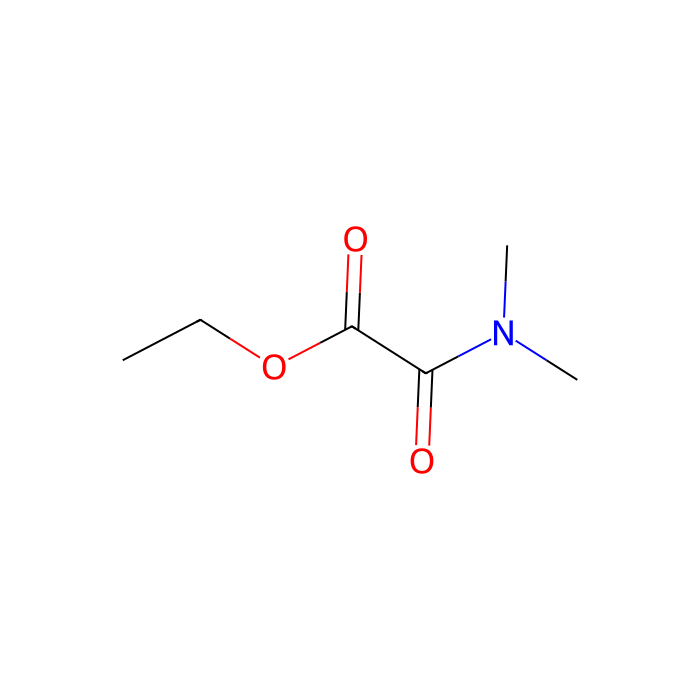
Ethyl N,N-dimethyloxamate is an oxalic acid monoamide–monoester: a tertiary amide linked to an ethyl oxalate ester, forming a 1,2-dicarbonyl (oxamide/oxalate) motif.
Item-specific identifiers (from Product Data)
CAS: 16703-52-9
SKU: E167788
InChIKey: Not specified for this item; refer to CoA/Spec Sheet.
SMILES: Not specified for this item; refer to CoA/Spec Sheet.
Literature/Computed identity (informational; not product specifications)
Preferred/IUPAC-style name (literature): Ethyl N,N-dimethyloxamate; ethyl 2-(dimethylcarbamoyl)-2-oxoacetate
Typical SMILES (literature): CCOC(=O)C(=O)N(C)C
Molecular formula (literature): C6H11NO3
Molecular weight (literature): ~145.16 g/mol
Structural features (general description)
Functional groups: one tertiary amide [–C(=O)–NMe2] and one ethyl ester [–C(=O)–OEt] arranged as adjacent carbonyls (oxamate framework).
Ring systems: none; fully acyclic.
Stereochemistry: none (no stereogenic centers).
2D structure in words: Ethoxycarbonyl carbonyl (ester) directly bonded to a second carbonyl (the amide carbonyl), which is bound to a dimethyl-substituted nitrogen; the two carbonyls are in 1,2-relationship (–CO–CO–).
Synthetic Utility
Key reactivity arises from the juxtaposition of two carbonyls (ester and tertiary amide) with a ketone-like electrophilic center at C2 (the “oxo” carbonyl).
Transformations (literature/general)
Nucleophile additions: RMgX/RLi add to the keto carbonyl to give tertiary alcohols; organozinc and cuprates can offer improved chemoselectivity.
Reductions: NaBH4 reduces the keto group in protic media; DIBAL-H at low temperature modulates selectivity. Subsequent intramolecular acylation can forge heterocycles/lactams.
Condensations: Amines, hydroxylamine, and hydrazines form imines/oximes/hydrazones at the keto site; dehydrative cyclizations can provide oxazoles/imidazoles.
Ester modifications: Transesterification (acid/base catalyzed) or aminolysis to diversify oxamate derivatives; saponification to the acid provides N,N-dimethyloxamic acid analogs.
Cross-coupling adjacency: While the core lacks a halide/boronate, the derived alcohols/oximes can be elaborated to coupling partners.
Retrosynthetic value
Serves as a masked glyoxyl/oxalyl synthon with a robust amide handle, enabling convergent assembly of alpha-oxygenated motifs and beta-amido esters.
Practicalities
Maintain anhydrous conditions to avoid ester hydrolysis during base-catalyzed steps.
The tertiary amide is typically inert to mild bases and nucleophiles, allowing selective manipulation at the keto/ester sites.
IR, 13C NMR, and 2D NMR are especially diagnostic: distinct carbonyl resonances for ester and amide facilitate monitoring (literature guidance).
Target Specificity
Not applicable. This product is a small-molecule chemical reagent and does not have biological target specificity, antigen/epitope information, or clone/isotype attributes. No item-specific target data are provided.
We use cookies to ensure the website functions properly and, where permitted, to improve your experience. You can manage your preferences at any time in Settings. Learn more in our Cookie Policy.
Shall we send you a message when we have discounts available?
Remind me later
Thank you! Please check your email inbox to confirm.
Products are supplied to verified businesses, institutions, and qualified professionals for research and development use only. Not for use in humans, animals, diagnosis, or therapy.

 I2622133