Determine the necessary mass, volume, or concentration for preparing a solution.
| Activity Type | Relation | Activity value | Units | Action Type | Journal | PubMed Id | doi | Assay Aladdin ID |
|---|

Taxonomy Tree
| Kingdom | Organic compounds |
|---|---|
| Superclass | Benzenoids |
| Classe | Phenol ethers |
| Subclass | Not available |
| Intermediate Tree Nodes | Not available |
| Direct Parent | Phenol ethers |
| Alternative Parents | Phenoxy compounds Alkyl aryl ethers Primary alcohols Hydrocarbon derivatives |
| Molecular Framework | Aromatic homomonocyclic compounds |
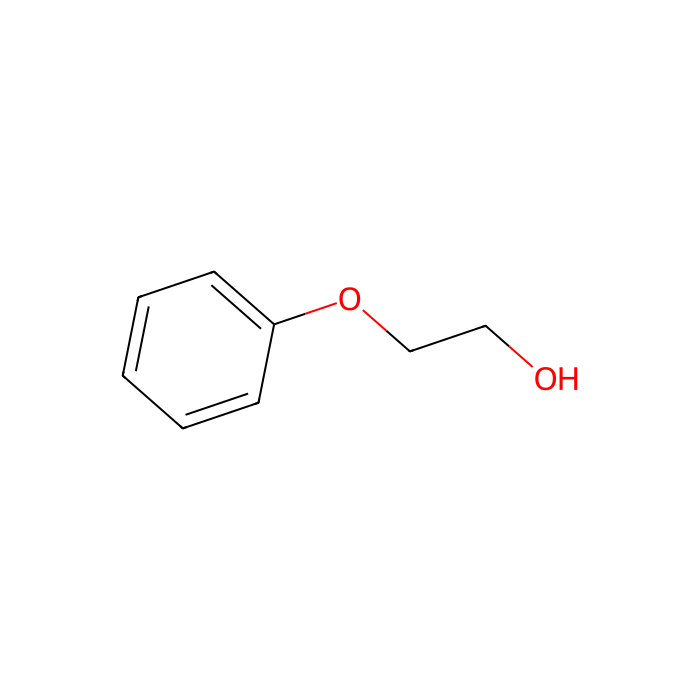
| Substituents | Phenoxy compound - Phenol ether - Alkyl aryl ether - Monocyclic benzene moiety - Ether - Organic oxygen compound - Hydrocarbon derivative - Primary alcohol - Organooxygen compound - Alcohol - Aromatic homomonocyclic compound |
| Descrizione | This compound belongs to the class of organic compounds known as phenol ethers. These are aromatic compounds containing an ether group substituted with a benzene ring. |
| External Descriptors | aromatic ether - primary alcohol - hydroxyether |
| Activity Type | Relation | Activity value | Units | Action Type | Journal | PubMed Id | doi | Assay Aladdin ID |
|---|
| Activity Type | Relation | Activity value | Units | Action Type | Journal | PubMed Id | doi | Assay Aladdin ID |
|---|
| Activity Type | Relation | Activity value | Units | Action Type | Journal | PubMed Id | doi | Assay Aladdin ID |
|---|
| Activity Type | Relation | Activity value | Units | Action Type | Journal | PubMed Id | doi | Assay Aladdin ID |
|---|
| Activity Type | Relation | Activity value | Units | Action Type | Journal | PubMed Id | doi | Assay Aladdin ID |
|---|
| Activity Type | Relation | Activity value | Units | Action Type | Journal | PubMed Id | doi | Assay Aladdin ID |
|---|
| Activity Type | Relation | Activity value | Units | Action Type | Journal | PubMed Id | doi | Assay Aladdin ID |
|---|
| Activity Type | Relation | Activity value | Units | Action Type | Journal | PubMed Id | doi | Assay Aladdin ID |
|---|
| Activity Type | Relation | Activity value | Units | Action Type | Journal | PubMed Id | doi | Assay Aladdin ID |
|---|
| Activity Type | Relation | Activity value | Units | Action Type | Journal | PubMed Id | doi | Assay Aladdin ID |
|---|
| Activity Type | Relation | Activity value | Units | Action Type | Journal | PubMed Id | doi | Assay Aladdin ID |
|---|
Find and download the COA for your product by matching the lot number on the packaging.
| Lot Number | Certificate Type | Data | Oggetto |
|---|---|---|---|
 K2617258 | Certificate of Analysis | Nov 19, 2026 | E109367 |
| K2617256 | Certificate of Analysis | Nov 19, 2026 | E109367 |
| K2617251 | Certificate of Analysis | Nov 19, 2026 | E109367 |
| K2617250 | Certificate of Analysis | Nov 19, 2026 | E109367 |
| B2301214 | Certificate of Analysis | Nov 18, 2026 | E109367 |
| D2624004 | Certificate of Analysis | May 07, 2026 | E109367 |
| A2616201 | Certificate of Analysis | Jan 20, 2026 | E109367 |
| A2616208 | Certificate of Analysis | Jan 20, 2026 | E109367 |
| A2616209 | Certificate of Analysis | Jan 20, 2026 | E109367 |
| A2616200 | Certificate of Analysis | Jan 20, 2026 | E109367 |
| C1816002 | Certificate of Analysis | Oct 14, 2025 | E109367 |
| L2025018 | Certificate of Analysis | Oct 12, 2024 | E109367 |
| G2403489 | Certificate of Analysis | Jul 12, 2024 | E109367 |
| G2504098 | Certificate of Analysis | Jul 05, 2024 | E109367 |
| G2403488 | Certificate of Analysis | Jul 05, 2024 | E109367 |
| G2403487 | Certificate of Analysis | Jul 05, 2024 | E109367 |
| D2523109 | Certificate of Analysis | Apr 29, 2024 | E109367 |
| J2528453 | Certificate of Analysis | Jan 09, 2024 | E109367 |
| J2531135 | Certificate of Analysis | Jan 09, 2024 | E109367 |
| L2326179 | Certificate of Analysis | Jan 09, 2024 | E109367 |
| L2326180 | Certificate of Analysis | Jan 09, 2024 | E109367 |
| L2326181 | Certificate of Analysis | Jan 09, 2024 | E109367 |
| L2326182 | Certificate of Analysis | Jan 09, 2024 | E109367 |
| I2305055 | Certificate of Analysis | Sep 09, 2023 | E109367 |
| E2330129 | Certificate of Analysis | Jun 02, 2023 | E109367 |
| D2301023 | Certificate of Analysis | Dec 28, 2022 | E109367 |
| L2216924 | Certificate of Analysis | Dec 28, 2022 | E109367 |
| B2301576 | Certificate of Analysis | Dec 15, 2021 | E109367 |
| L2108523 | Certificate of Analysis | Dec 15, 2021 | E109367 |
| Solubilità | Slightly soluble in water; Degree of Solubility in water: 27 g/l; Very soluble in Ether,Solution of sodium hydroxide in water,Alcohol |
|---|---|
| Indice di rifrazione | 1.536-1.54 |
| Punto di infiammabilità (°F) | 266 ℉ |
| Punto di infiammabilità (°C) | 130°C |
| Punto di ebollizione (°C) | 237°C |
| Punto di fusione (°C) | 11-13°C |
| Peso molecolare | 138.16 |
| XLogP3 | 1.200 |
| Hydrogen Bond Donor Count | 1 |
| Hydrogen Bond Acceptor Count | 2 |
| Rotatable Bond Count | 3 |
| Exact Mass | 138.068 Da |
| Monoisotopic Mass | 138.068 Da |
| Topological Polar Surface Area | 29.500 Ų |
| Heavy Atom Count | 10 |
| Formal Charge | 0 |
| Complexity | 77.300 |
| Isotope Atom Count | 0 |
| Defined Atom Stereocenter Count | 0 |
| Undefined Atom Stereocenter Count | 0 |
| Defined Bond Stereocenter Count | 0 |
| Undefined Bond Stereocenter Count | 0 |
| The total count of all stereochemical bonds | 0 |
| Covalently-Bonded Unit Count | 1 |
H302:Harmful if swallowed
H316:Causes mild skin irritation
H319:Causes serious eye irritation
P264:Wash hands [and …] thoroughly after handling.
P270:Do not eat, drink or smoke when using this product.
P280:Wear protective gloves/protective clothing/eye protection/face protection.
P330:Rinse mouth.
P305+P351+P338:IF IN EYES: Rinse cautiously with water for several minutes. Remove contact lenses if present and easy to do - continue rinsing.
P501:Dispose of contents/container to an approved waste disposal plant.
P264+P265:Wash hands [and …] thoroughly after handling. Do not touch eyes.
P301+P317:IF SWALLOWED: Get medical help.
P337+P317:If eye irritation persists: Get medical help.