QUALITÀ & PUREZZAMoligand™?Moligand™ — Aladdin's line of ligands and bioactive small molecules. Use for receptor, pathway, and binding studies needing defined small-molecule tools.10 mM in Water
Etoposide phosphate (BMY-40481) is a potent anti-cancer chemotherapy agent and a selective topoisomerase II inhibitor to prevent re-ligation of DNA strands. Etoposide phosphate is the phosphate ester proagent of etoposide and is considered as active equivalent to Etoposide. Etoposide phosphate induces cell cycle arrest, apoptosis , and autophagy .
Specifiche
Specifiche e purezza
Moligand™, 10 mM in Water
Condizioni di conservazione di stoccaggio
Store at -80°C
Spedito in
Dry ice packs + Cold packs
Questo prodotto richiede spedizione a catena fredda. I servizi di terra e altri servizi economici non sono disponibili.
Certificati (CoA, COO, BSE/TSE e tabella di analisi)
C of A & Other Certificates(BSE/TSE, COO):
Analytical Chart:
Calcolatori di soluzioni
Molarity Calculator
Determine the necessary mass, volume, or concentration for preparing a solution.
Dilution Calculator
Determine the dilution needed to prepare a stock solution.
Reconstitution Calculator
Recensioni
Recensioni dei clienti
Application Protocols
Validated, item-specific protocols are not provided. The following are general, literature-informed guidelines for common research uses. Optimize for your system.
Preparation of stock solutions:
Dissolve in sterile water or DMSO to prepare a concentrated stock (e.g., 10–50 mM in DMSO or high mg/mL in water, as solubility permits; determine empirically). Filter sterilize aqueous stocks through 0.22 μm PVDF or PES.
Aliquot and store at −80°C to avoid repeated freeze–thaw cycles.
Biochemical Topo II decatenation assay (outline):
Assemble reactions with kinetoplast DNA substrate, recombinant Topo II, assay buffer (non-phosphate buffer recommended), Mg2+, ATP, and serial dilutions of the compound.
Incubate at 30–37°C for 15–60 min. Quench and analyze by agarose gel electrophoresis to quantify decatenation. Include vehicle and positive controls.
Cell-based mechanism studies (outline):
Dilute DMSO stocks into culture media to desired concentrations, keeping final DMSO ≤0.1–0.5% v/v. Treat appropriate cell models and analyze pathway readouts relevant to DNA topology/repair.
LC–MS reference standard use:
Prepare calibration curves in matched matrices. Monitor both etoposide phosphate and etoposide transitions to assess hydrolysis during sample handling.
Note: For research use only.
Biological Roles
Biochemical function (literature/general):
Etoposide phosphate is a phosphate pro-moiety of etoposide, a well-characterized small molecule that interacts with DNA topoisomerase II. In biochemical systems, etoposide stabilizes the transient topoisomerase II–DNA cleavage complex, interfering with relegation and perturbing DNA topology management.
The phosphate ester increases aqueous solubility and can be hydrolyzed (chemically or enzymatically) to release etoposide, enabling study of conversion kinetics and transport processes.
Research applications:
Model compound for studying enzyme–poison interactions, cleavage complex stabilization, and DNA damage signaling cascades in cells and lysates.
Probe for evaluating efflux/uptake transporters and metabolism impacting phosphate pro-moieties vs aglycones, including phosphatase-mediated dephosphorylation (general/literature).
Mechanistic notes:
Topoisomerase II forms a covalent tyrosyl–DNA intermediate; etoposide binding biases the equilibrium toward the cleaved state. The presence of the phosphate pro-moiety can influence cellular uptake, distribution, and rate of active species formation, factors often examined in comparative studies with etoposide (literature).
Caveat:
Biological effects are system- and concentration-dependent. Include appropriate negative/vehicle controls and, where relevant, compare to the parent compound to deconvolute pro-moiety contributions. No clinical or therapeutic assertions are made.
Buffer Applications
This material is a bioactive small molecule rather than a buffering agent. It does not serve as a pH buffer component in the conventional sense.
Practical guidance (general):
Prepare working solutions in assay-compatible buffers (e.g., HEPES, Tris, or phosphate-buffered saline) chosen for your biological system, not for the compound itself.
Maintain pH ~6–8 to balance stability of the phosphate monoester with biological compatibility. Avoid strong acid/base conditions that can promote phosphate ester hydrolysis.
For enzyme assays sensitive to phosphate (e.g., kinases that use phosphate-binding sites), select non-phosphate buffers (HEPES, MOPS, Tris) to prevent buffer-component interference and to isolate effects of the test compound.
Green Alternatives
This product is a bioactive small molecule, not a process solvent or bulk reagent; “green solvent” substitution frameworks are not directly applicable.
Sustainable handling considerations (general):
Minimize single-use plastics by aliquoting into compatible, reusable cryovials where feasible.
Use aqueous buffers instead of high volumes of organic solvents for preparation and dilution when compatible with your assay, leveraging the compound’s high water solubility (literature, qualitative).
For analytical methods, prefer LC–MS mobile phases with water and low percentages of MeOH over ACN where acceptable for separation, and avoid halogenated solvents.
Consolidate shipping and select ambient-stable assay plates where possible; however, adhere to the specified cold-chain requirements for this product during transit and storage.
Waste and EHS:
Collect unused solutions and rinsates as organic/aqueous hazardous waste according to institutional green chemistry guidelines.
Consider microscale assay formats (384/1536-well) to reduce material usage and solvent consumption.
Pharmaceutical Uses
This product is provided strictly for research use and is not intended for human or veterinary use.
Reference standard: used to develop and qualify analytical methods (HPLC/LC–MS) that differentiate etoposide phosphate from etoposide and track degradation/impurity profiles under stress conditions.
Preformulation research: model for assessing solubility enhancement by phosphate pro-moieties, salt screening, and conversion kinetics to the parent drug under various pH/ionic strength conditions.
Compatibility studies: evaluation of adsorption and stability in different primary containers (borosilicate glass vs cyclic olefin polymers) and in the presence of common excipients in research settings.
Regulatory status: No pharmacopeial or GMP status is implied by this listing. For any regulated work, source an appropriate reference standard and follow applicable compendial requirements.
Note: No therapeutic claims are made. This material is not labeled for clinical or diagnostic applications.
Physical Properties
Appearance: Not specified for this item; refer to CoA/Spec Sheet.
Molecular weight: Not specified for this item; refer to CoA/Spec Sheet.
Molecular formula: Not specified for this item; refer to CoA/Spec Sheet.
Melting point: Not specified for this item; refer to CoA/Spec Sheet.
Boiling point: Not applicable for this nonvolatile, thermally labile organic phosphate (general).
Density: Not specified for this item; refer to CoA/Spec Sheet.
Refractive index: Not applicable to solids; not specified for this item; refer to CoA/Spec Sheet.
Solubility and ionization (literature/general):
Aqueous solubility: substantially higher than etoposide due to the phosphate monoester and possible salt form; readily soluble in water and physiological buffers (literature, qualitative).
Organic solubility: soluble in polar aprotic solvents (e.g., DMSO); limited solubility in nonpolar solvents (literature, qualitative).
pKa values (phosphate monoester, typical): pKa1 ~1–2 and pKa2 ~6–7 for the two acidic protons of a phosphate monoester (literature, approximate). Actual values depend on microenvironment and counterions.
logP/logD: markedly reduced lipophilicity vs etoposide; logD is pH-dependent due to ionization of the phosphate (literature, qualitative).
Stability notes (general/literature):
Aqueous phosphate monoesters can undergo hydrolysis at extreme pH and elevated temperature; avoid prolonged exposure to strong acid/base and heat.
Protect from moisture if provided as a lyophilized solid; minimize freeze–thaw cycles of solutions.
Quality and Grades
Grade: Moligand™ — Aladdin Scientific’s small-molecule/compound library grade designed for screening, profiling, and exploratory research workflows.
What Moligand™ generally implies (general):
Intended for research assays (biochemical, biophysical, or cell-based) where compound identity and baseline purity are important for structure–activity studies.
Typically accompanied by batch-level documentation (e.g., CoA) specifying identity confirmation (NMR/MS/HRMS) and purity by chromatographic methods suitable for library compounds. Exact analytical methods and thresholds can vary between items and lots.
Item-specific specifications:
Purity, residual solvent limits, counter-ion content, water content, and stabilizers: Not specified for this item; refer to CoA/Spec Sheet.
Practical notes for use:
For screening campaigns, verify purity and identity in-house when required by your QA/SOPs, especially for quantitative pharmacology or biophysics.
Be aware of salt form and hydration state; these affect molarity calculations. If the CoA lists a salt (e.g., disodium) or solvate, adjust MW accordingly for dosing solutions.
For analytical comparability across studies, record batch/lot numbers and any reformatting history (lyophilization, desalting, buffer exchange).
Reaction and Applications
This product is primarily used as a research small molecule standard or tool compound rather than as a synthetic reagent.
Research applications (literature/general):
Enzymology of DNA topoisomerase II: employed in biochemical assays (e.g., decatenation, supercoil relaxation, DNA cleavage complex stabilization) to study enzyme mechanism, catalytic cycles, and protein–DNA interactions.
Chemical biology and cell studies: used to perturb pathways associated with DNA topology, replication stress, and checkpoint signaling for mechanistic investigations. The phosphate increases aqueous delivery versus the parent compound.
Analytical reference: serves as a system suitability or reference standard in stability-indicating HPLC/LC–MS methods that distinguish the phosphate pro-moiety from etoposide and degradation products.
Practical assay tips (general):
Prepare a concentrated DMSO or aqueous stock; dilute into assay buffer to minimize cosolvent to ≤1–2% v/v where sensitive enzymes or cells are used.
Control for phosphate/salt effects: include appropriate vehicle controls and ionic strength matching.
Monitor for hydrolysis: etoposide phosphate can hydrolyze to etoposide under certain conditions; consider orthogonal analytics (LC–MS) if stability is a concern over assay timescales.
Note: No clinical/therapeutic claims are made. For research use only.
Reaction Conditions
As a bioactive small molecule standard, etoposide phosphate is not commonly subjected to synthetic transformations in end-user labs. However, for handling and analytical studies, the following general guidance applies (literature/general):
Stock preparation: dissolve in water or DMSO. Aqueous stocks should be adjusted to neutral pH and filtered (0.22 μm) if sterility is required. Minimize exposure to elevated temperature.
Hydrolysis/dephosphorylation studies: phosphate monoesters typically hydrolyze faster under alkaline conditions and at higher temperatures; enzymatic dephosphorylation can be performed with alkaline phosphatase in buffered aqueous media (pH 7.5–9) at ambient to 37°C, monitoring by LC–MS. Reaction times vary from minutes to hours depending on enzyme loading and matrix.
Stability-indicating analytics: perform LC using aqueous buffers (e.g., ammonium formate/acetate) with MeOH or ACN gradients at ambient temperature; monitor both the phosphate form and the aglycone (parent) for mass balance.
No specific catalytic or named-reaction conditions are endorsed for this item. For any chemical modification attempts, develop conditions empirically with small-scale trials and appropriate controls.
Safety and Handling
Hazard information for this specific item (GHS classification, signal word, pictograms, H-statements) is not provided here. Always consult the product SDS for authoritative safety data.
General laboratory safety guidance (for research use only):
PPE: use lab coat, safety glasses, and appropriate chemically resistant gloves. Handle powders/solids in a fume hood to avoid inhalation of dust or aerosols.
Avoid exposure: prevent skin/eye contact and ingestion. Use closed containers and secondary containment for transport within the lab.
Incompatibilities (general): strong acids/bases (risk of phosphate ester hydrolysis), strong oxidizers, and prolonged exposure to elevated temperatures. Avoid metal-catalyzed conditions that could promote degradation.
First aid overview (general):
Skin: wash with soap and water. Remove contaminated clothing.
Eyes: rinse cautiously with water for several minutes; remove contact lenses if present and easy to do; continue rinsing.
Inhalation: move to fresh air; seek medical attention if symptoms persist.
Ingestion: rinse mouth; seek medical attention.
Spill/leak: avoid dust formation; absorb solutions with inert material and dispose per institutional and local regulations.
Waste: dispose as organic hazardous waste; segregate halogenated vs non-halogenated streams per facility policy.
Note: No medical or clinical use. This material is supplied strictly for research and laboratory use.
Solvent Selection
Compound class considerations: etoposide phosphate is a polar, ionizable small molecule (phosphate monoester). Solvent choice is driven by its high polarity and potential salt form.
Aqueous media (literature/general):
Readily soluble in water and common physiological buffers due to the phosphate group and typical counterions. Suitable for biochemical assays and cell-based studies where aqueous delivery is required.
Maintain pH ~6–8 to minimize phosphate ester hydrolysis.
Polar aprotic solvents:
DMSO: excellent for preparing concentrated stocks; miscible with water for subsequent dilution into buffers or media. Common for library storage at low temperatures.
DMF: less frequently used for bioassays; may be considered for analytical sample prep.
Mixed solvents: Water/DMSO or water/acetonitrile blends are often used for LC sample preparation and method development (general/literature).
Comparison with parent compound (literature):
Etoposide base is poorly water-soluble; the phosphate derivative is chosen when high aqueous solubility is required, reducing reliance on cosolvents or surfactants.
Practical guidance:
Filter sterilize aqueous working solutions (0.22 μm) where sterility is required.
Avoid strong acids/bases and prolonged high temperatures in solution. Use freshly prepared working solutions or aliquots stored at low temperature to preserve integrity.
Storage and Reconstitution
Storage conditions (item-specific): Store at −80°C.
Shipping (item-specific): Shipped with dry ice packs + cold packs to maintain cold chain.
General handling recommendations:
Upon receipt, verify container integrity and keep the material at −80°C. If frequent access is anticipated, prepare single-use aliquots to minimize freeze–thaw cycles.
Protect from moisture and light. If supplied as a solid, allow the sealed container to equilibrate to room temperature before opening to reduce condensation.
Reconstitution (general guidance):
Solvents: water or DMSO are typical. Choose based on downstream application. For biological assays, aqueous solutions are preferable; for long-term library storage, DMSO stocks are commonly used.
Procedure: add solvent to achieve the desired concentration, mix gently until fully dissolved. For aqueous solutions, adjust to near-neutral pH if needed and filter sterilize (0.22 μm) for sterile applications.
Storage of solutions: keep aliquots at −80°C. Avoid repeated freeze–thaw; thaw on ice, use promptly, and discard unused portions according to institutional policies.
Specifications such as exact solubility limits, pH stability windows, and solution shelf life are not specified for this item; refer to CoA/Spec Sheet and SDS for authoritative instructions.
Structure and Identity
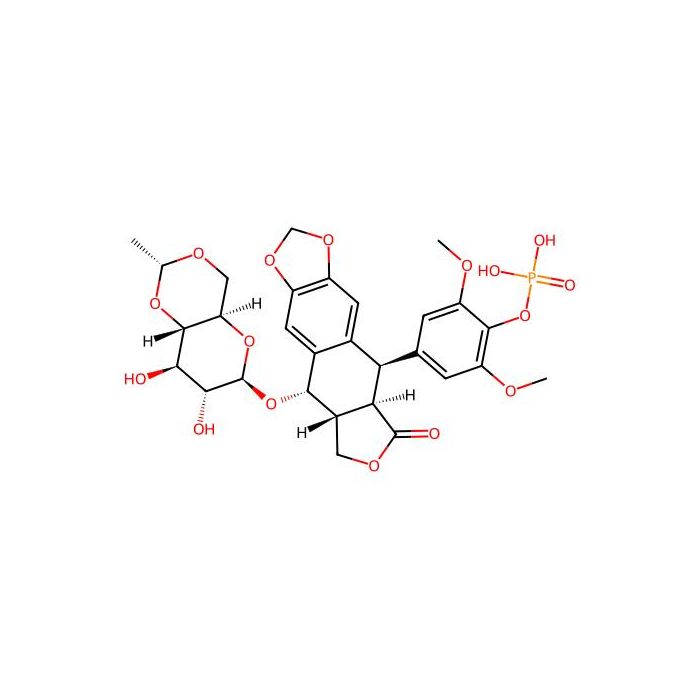
Etoposide phosphate is a phosphorylated derivative of the lignan-based topoisomerase II–targeting small molecule etoposide; the phosphate ester confers markedly increased aqueous solubility relative to the parent compound.
SKU: E1496485
Product name: Etoposide phosphate
CAS: 117091-64-2
PubChem CID: 6918092
Grade: Moligand™ (research compound library)
InChIKey: Not specified for this item; refer to CoA/Spec Sheet.
SMILES: Not specified for this item; refer to CoA/Spec Sheet.
Molecular formula: Not specified for this item; refer to CoA/Spec Sheet.
Molecular weight: Not specified for this item; refer to CoA/Spec Sheet.
Structural features (general/literature):
Core scaffold derived from podophyllotoxin (polycyclic lignan) bearing a glycosidic moiety and multiple phenolic/ether substituents.
Contains a single phosphate monoester substituent on the phenolic hydroxyl (4′-position of the glycoside in the etoposide framework; literature), often handled as an inorganic salt for solubility.
Functional groups: aromatic rings, methoxy ethers, a glycosidic acetal, tertiary alcohol, and a phosphate monoester (acidic, typically dianionic when fully deprotonated or as a disodium salt; literature).
2D description: a multi-ring aglycone attached via a C–O glycosidic linkage to a dioxolane-like sugar; one phenolic oxygen is phosphorylated (P=O with two P–O substituents), and several methoxy groups decorate the aromatic system.
Synthetic Utility
Etoposide phosphate is a complex, functionalized small molecule chiefly used as a bioactive tool/standard rather than as a synthetic building block.
General synthetic considerations (literature):
The phosphate ester illustrates late-stage phosphorylation of phenolic hydroxyls on polyfunctional natural product derivatives. In method-development studies, analogous phosphorylation can be achieved using phosphoryl chlorides, phosphoramidites, or POCl3-mediated strategies with controlled chemoselectivity.
Protecting-group strategy: the etoposide scaffold contains acetal, methoxy, and secondary/tertiary alcohol functionalities; selective phosphorylation requires appropriate protection of competing nucleophiles (general insight).
Analytical utility in synthesis labs:
Useful as a standard to validate the success of phosphorylation steps or to calibrate LC–MS methods that track monoester formation versus diester/pyrophosphate byproducts.
Deprotection/hydrolysis studies: provides a model for phosphate monoester lability under acidic/basic or enzymatic conditions, informing conditions for dephosphorylation.
Limitations:
Due to structural complexity and bioactivity, it is not typically deployed as a reagent or coupling partner in routine organic synthesis. If transformation is attempted, care must be taken to preserve sensitive motifs (glycosidic bond, acetal, and phosphate ester).
Target Specificity
Biological target (literature/general):
Primary target: DNA topoisomerase II (Topo IIα and Topo IIβ isoforms). The parent active species (etoposide) is known to stabilize the Topo II–DNA cleavage complex, perturbing the enzyme’s relegation step.
Selectivity considerations:
Isoform differences: binding and functional effects can vary between Topo IIα and IIβ. Comparative studies often quantify decatenation inhibition or cleavage complex stabilization for each isoform.
Off-targets: at higher concentrations, interactions with other DNA-processing pathways or induction of oxidative stress responses have been reported in various systems (literature, system-dependent). Appropriate counterscreens are recommended.
Assay guidance:
Include etoposide as a comparator to distinguish effects attributable to the phosphate pro-moiety versus the aglycone.
Employ orthogonal readouts (e.g., gel-based decatenation assay, cleavage complex detection, and cell-based DNA damage markers) to confirm target engagement.
Note: This section summarizes target biology for research design. It is not a clinical or diagnostic claim.
Hai bisogno di aiuto per scegliere la qualità?
La nostra guida alla selezione delle qualità copre purezza, stato dello stabilizzatore e idoneità all'applicazione per tutte le varianti del nostro catalogo.
Utilizziamo i cookie per garantire il corretto funzionamento del sito web e, ove consentito, per migliorare la tua esperienza. Puoi gestire le tue preferenze in qualsiasi momento nelle Impostazioni. Per saperne di più, consulta la nostra Cookie Policy.
Desidera che le inviamo un messaggio quando avremo sconti disponibili?
Ricordamelo più tardi
Grazie! Controlli la sua casella di posta per confermare.
Products are supplied to verified businesses, institutions, and qualified professionals for research and development use only. Not for use in humans, animals, diagnosis, or therapy.