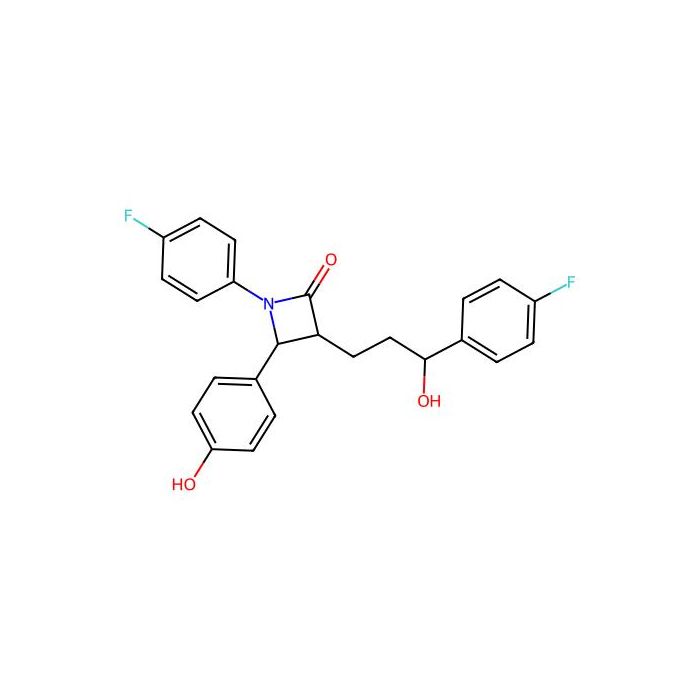
Determine the necessary mass, volume, or concentration for preparing a solution.
Ezetimibe-d4-1 - ≥99% , CAS No.1093659-89-2
Disponibile su ordine
QUALITÀ & PUREZZA ≥99%
Storage
Store at -20°C
Shipped In
Ice chest + Ice pads

Ezetimibe-d 4 -1 is deuterium labeled Ezetimibe. Ezetimibe (SCH 58235) is a potent cholesterol absorption inhibitor. Ezetimibe is a Niemann-Pick C1-like1 (NPC1L1) inhibitor, and is a potent Nrf2 activator.
In Vitro
Stable heavy isotopes of hydrogen, carbon, and other elements have been incorporated into drug molecules, largely as tracers for quantitation during the drug development process. Deuteration has gained attention because of its potential to affect the pharmacokinetic and metabolic profiles of drugs. MCE has not independently confirmed the accuracy of these methods. They are for reference only.
Form:Solid
Taxonomy Tree
| Kingdom | Organic compounds |
|---|---|
| Superclass | Organoheterocyclic compounds |
| Classe | Lactams |
| Subclass | Beta lactams |
| Intermediate Tree Nodes | Not available |
| Direct Parent | Monobactams |
| Alternative Parents | Phenylazetidines Fluorobenzenes 1-hydroxy-2-unsubstituted benzenoids Aryl fluorides Tertiary carboxylic acid amides Secondary alcohols Azacyclic compounds Organonitrogen compounds Organofluorides Organic oxides Hydrocarbon derivatives Carbonyl compounds Aromatic alcohols |
| Molecular Framework | Aromatic heteromonocyclic compounds |
| Substituents | Monobactam - 1-phenylazetidine - 2-phenylazetidine - 1-hydroxy-2-unsubstituted benzenoid - Halobenzene - Fluorobenzene - Phenol - Aryl fluoride - Aryl halide - Monocyclic benzene moiety - Benzenoid - Tertiary carboxylic acid amide - Azetidine - Secondary alcohol - Carboxamide group - Azacycle - Carboxylic acid derivative - Alcohol - Organohalogen compound - Organofluoride - Organonitrogen compound - Organooxygen compound - Aromatic alcohol - Carbonyl group - Hydrocarbon derivative - Organic oxide - Organic oxygen compound - Organic nitrogen compound - Aromatic heteromonocyclic compound |
| Descrizione | This compound belongs to the class of organic compounds known as monobactams. These are compounds comprising beta-lactam ring is alone and not fused to another ring. |
| External Descriptors | Not available |
No vendor‑validated protocols are specified for this SKU. The following is a general LC‑MS/MS workflow for using a d4 internal standard with lipophilic analytes such as ezetimibe (method development guidance only):
Validate all parameters (accuracy, precision, selectivity, carryover, matrix effect, stability) per your lab’s SOPs.
This product is a stable‑isotope–labeled analytical standard and has no intrinsic biological role. The following points describe its function in biochemical/analytical contexts (not therapeutic uses):
Important limitations:
For biological/biochemical workflows, refer to your institutional SOPs for spiking levels, incubation conditions, and bioanalytical validation criteria (accuracy, precision, selectivity, stability, carryover).
This compound is not a buffering agent. However, it is frequently used in LC‑MS/MS assays where mobile phases and sample‑prep buffers impact performance.
Practical notes (analytical context):
What is not applicable:
Always verify that chosen buffers and additives are compatible with your mass spectrometric ionization mode and do not introduce background ions that interfere with the selected MRM transitions.
Because Ezetimibe‑d4‑1 is used chiefly as an LC‑MS internal standard, sustainability considerations focus on solvent selection and sample preparation rather than on replacing the compound itself.
Greener solvent considerations (general guidance):
Small comparison (literature/lab practice):
| Use case | Conventional choice | Greener alternative | Trade‑offs | |---|---|---|---| | LLE of lipophilic analytes | DCM/hexane | EtOAc/hexane or MTBE | May change recovery/selectivity; validate. | LC mobile phase (RP) | ACN/water + 0.1% FA | MeOH/water + 0.1% FA | Viscosity ↑ with MeOH; adjust pressure/temperature. | Protein precipitation | ACN | MeOH | Protein crash less efficient in some matrices; tune ratios.
Operational steps toward greener practice:
All changes should be revalidated to confirm accuracy/precision and analyte recovery.
No therapeutic or clinical claims apply to this research product. In pharmaceutical and QC laboratories, Ezetimibe‑d4‑1 serves roles exclusively as an analytical standard:
Documentation expectations (best practices):
Note: This product is for research and laboratory analysis only. It is not an API, excipient, or clinical diagnostic and is not intended for administration to humans or animals.
Item‑specific numerical specifications are not provided in the product data.
Always consult the CoA/SDS for definitive, lot‑specific physical data.
Context and implications for this product type (stable‑isotope internal standards):
Conclusion: Use the lot‑specific CoA to confirm isotopic enrichment, chemical purity, and impurity profile before method validation.
This material is primarily an analytical standard rather than a synthetic reagent. Typical applications (research/analytical):
Practical tips:
Note: No medical/clinical use—research and analytical use only.
This product is not intended for use in preparative chemical reactions. The most relevant “conditions” pertain to analytical sample preparation and LC‑MS/MS acquisition (general guidance):
All parameters above are general literature/practice guidance and should be optimized for your specific instrumentation and matrix.
General laboratory safety guidance (professional practice; not a substitute for SDS):
Always consult the product SDS for authoritative hazard and response information.
Ezetimibe‑type scaffolds are lipophilic, weakly ionizable solids. For the d4 standard, solvent choice should prioritize solubility, chemical stability, and LC‑MS compatibility.
Quick comparison (general):
Reconstitution/handling (general guidance for stable‑isotope standards):
Disposal: Follow institutional procedures for organic chemical waste. Do not release into drains. Always consult the CoA and SDS for definitive instructions.
Ezetimibe‑d4‑1 is a stable‑isotope–labeled analog of ezetimibe, intended for use as an internal standard and tracer in analytical workflows.
Structural features (general/literature description of the parent molecule and deuteration):
2D structure (verbal depiction, literature/parent): a four‑membered β‑lactam ring bearing a benzylic OH on one side and two para‑substituted phenyl groups, typically one fluorinated, arranged trans about the azetidinone. The d4 version is chemically equivalent but contains four 2H atoms to provide a defined mass shift for MS quantification.
As a deuterium‑labeled analog, Ezetimibe‑d4‑1 is not typically employed as a building block for further synthesis. Its principal utility is as a tracer/internal standard. Nonetheless, the underlying scaffold informs reactivity considerations (general chemical knowledge):
Takeaway: Use this compound primarily as an internal standard; avoid synthetic transformations that could compromise isotopic labeling or generate unlabeled byproducts that confound quantitation.
Not applicable. Ezetimibe‑d4‑1 is a small‑molecule internal standard and does not possess biological target specificity in the sense of antibodies, enzymes, or receptor ligands within this product context. No antigen/epitope, clone, isotype, or species reactivity applies.