QUALITÀ & PUREZZAMoligand™?Moligand™ — Aladdin's line of ligands and bioactive small molecules. Use for receptor, pathway, and binding studies needing defined small-molecule tools.≥97%
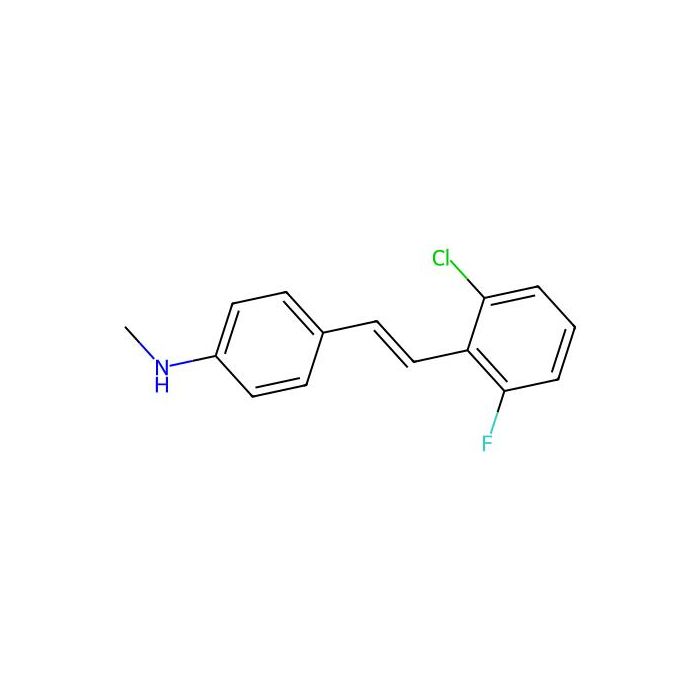
FIDAS-5 is a potent methionine S-adenosyltransferase 2A (MAT2A) inhibitor with an IC50 of 2.1 μM. FIDAS-5 effectively competes against S-adenosylmethionine (SAM) for MAT2A binding. FIDAS-5 has anticancer activities.
Specifiche
Sinonimi
(E)-4-(2-Chloro-6-fluorostyryl)-N-methylaniline
Specifiche e purezza
Moligand™, ≥97%
Condizioni di conservazione di stoccaggio
Store at -20°C
Spedito in
Ice chest + Ice pads
Questo prodotto richiede spedizione a catena fredda. I servizi di terra e altri servizi economici non sono disponibili.
This compound belongs to the class of organic compounds known as stilbenes. These are organic compounds containing a 1,2-diphenylethylene moiety. Stilbenes (C6-C2-C6 ) are derived from the common phenylpropene (C6-C3) skeleton building block. The introduction of one or more hydroxyl groups to a phenyl ring lead to stilbenoids.
External Descriptors
Not available
1. Djoumbou Feunang Y, Eisner R, Knox C, Chepelev L, Hastings J, Owen G, Fahy E, Steinbeck C, Subramanian S, Bolton E, Greiner R, and Wishart DS. ClassyFire: Automated Chemical Classification With A Comprehensive, Computable Taxonomy. Journal of Cheminformatics, 2016, 8:61.
Determine the necessary mass, volume, or concentration for preparing a solution.
Dilution Calculator
Determine the dilution needed to prepare a stock solution.
Reconstitution Calculator
Recensioni
Recensioni dei clienti
Application Protocols
No vendor-validated protocols are provided for FIDAS-5 in the Product Data. The following general procedures apply to small-molecule screening compounds and should be adapted after confirming structure and solubility.
DMSO stock preparation (general)
Weigh required amount quickly at ambient conditions. Add anhydrous DMSO to prepare a 10–50 mM stock. Vortex/sonicate until dissolved. Pass through a 0.22 µm PTFE filter if particulates remain. Aliquot into amber vials or 96-well plates and store at −20 °C.
Assay dosing
Thaw aliquots on ice; avoid multiple freeze–thaw cycles. Dilute into assay buffer to achieve target concentrations with ≤0.5–1% v/v DMSO. Include vehicle controls and, if available, a positive control compound.
Analytical QC before use
Verify concentration by UV–Vis (if chromophore present) or LC–UV/LC–MS against calibration. Check purity by UPLC immediately prior to critical experiments.
Record-keeping
Document lot number, preparation date, solvent, and storage history. Attach chromatograms/spectra to the experiment record.
For specialized applications (e.g., crystallography soaks, chemoproteomics), tailor solvent composition and incubation parameters to the target system’s tolerance.
Biological Roles
Item-specific biological function or target engagement information is not provided for FIDAS-5 in the Product Data. The content below outlines general considerations for small molecules used in research.
Item-specific roles
Target, pathway, and mechanism: Not specified for this item; consult literature by CAS 1391934-98-7 or CID 57521314 and verify against the CoA.
General research context (not item-specific)
Small molecules can modulate enzymatic activity, protein–protein interactions, ion channels, or transcriptional programs. They may serve as tool compounds to interrogate signaling cascades, metabolic pathways, or epigenetic states.
When repurposed or profiled broadly, off-target effects may confound interpretation; orthogonal assays and chemoproteomics can help delineate direct targets.
Best practices
Confirm identity/purity, solubility, and stability under assay conditions. Characterize dose–response, Hill slope, and time-dependence. Include vehicle controls and counter-screens (e.g., redox cycling, assay interference such as PAINS or fluorescence quenching) after reviewing the chemical structure.
Evaluate permeability and binding artifacts (serum protein or plastic adsorption) using appropriate controls.
Data reporting
Document full experimental conditions (vehicle %, incubation time, temperature, protein concentration) to ensure reproducibility. Archive raw spectra/chromatograms supporting identity and stability of the working solutions.
No medical or clinical claims are made; this product is for research use only.
Buffer Applications
This section is typically relevant to buffering agents or salts. FIDAS-5 is a small-molecule screening compound, not a buffer component.
Item-specific buffering data: Not applicable; no pKa or buffer capacity information is provided for this item.
Practical guidance (general)
When dosing into buffered assays, prepare concentrated DMSO stocks and dilute into pre-equilibrated buffers (e.g., HEPES, PBS, Tris) keeping final DMSO ≤0.5–1% v/v.
Monitor for precipitation upon dilution; adjust ionic strength or add minimal co-solvent if needed. Avoid altering buffer composition beyond validated ranges.
For detailed buffer recipes and pH ranges, refer to dedicated buffering reagents rather than this compound.
Green Alternatives
Green chemistry considerations focus on solvent use, packaging, and lifecycle during screening rather than the molecule itself (whose structure is not specified here).
Solvent strategy (general)
Prefer aqueous-compatible assays and minimize DMSO concentration (≤0.5–1% v/v). When organic cosolvents are required, prioritize methanol and ethanol over DMF/NMP when solubility allows.
Implement microvolume dispensing to reduce waste. Use sealed low-dead-volume plates to limit evaporation and VOC emissions.
Comparison of common vehicles (general)
DMSO: High solvency, relatively low volatility; widely accepted in screening. Environmental profile moderate; avoid large-scale disposal without treatment.
MeOH/EtOH: Greener, biodegradable; may be less effective for highly lipophilic compounds.
DMF/NMP: Powerful but of greater regulatory and EHS concern; reserve for challenging solubility cases.
Operational improvements
Consolidate shipments and select cold-chain materials with recyclable components. Thaw only the needed aliquots to reduce spoilage and waste.
Use plate-based, high-throughput analytics to optimize concentration and avoid overformulation.
Data-driven reduction
Pilot solubility screens to identify the lowest effective solvent load for robust assay performance. Adopt design-of-experiments (DoE) to streamline iterations and reduce material consumption.
Note: Specific greener structural analogs cannot be recommended without the disclosed chemotype of FIDAS-5.
Pharmaceutical Uses
No excipient role, pharmacopeial status, or manufacturing application is provided for FIDAS-5. This product is sold strictly for research use only.
Item-specific regulatory status: Not specified for this item; not intended for human or veterinary use.
General context (not item-specific)
Early discovery compounds may be used in preclinical research to elucidate targets and SAR. However, without defined quality attributes, toxicology, and regulatory filings, they are unsuitable for clinical formulation or GMP manufacturing.
If formulating for in vivo research, conduct full characterization (identity, purity, residual solvents, solid-state form) and develop a vehicle compatible with the intended route, following institutional approvals.
Packaging/formulation notes
Provide single-use aliquots from concentrated DMSO stocks to minimize freeze–thaw and adsorption. Employ amber vials if photolability is suspected (not specified here).
No therapeutic claims are made for this product.
Physical Properties
Item-specific physical constants are not disclosed in the Product Data. Use the lot-specific CoA/SDS for definitive values.
Appearance: Not specified for this item; refer to CoA/Spec Sheet.
Molecular weight: Not specified for this item; refer to CoA/Spec Sheet.
Molecular formula: Not specified for this item; refer to CoA/Spec Sheet.
Melting point (literature/computed): Not available; verify experimentally upon receipt if required for QC.
Boiling point (literature): Not applicable if supplied as a non-volatile solid; if liquid, verify via SDS. Not specified for this item.
Density (literature): Not specified for this item; refer to CoA/Spec Sheet.
LogP/logD, pKa (literature/computed): Not specified; retrieve from cheminformatics resources after confirming structure.
Refractive index (if liquid): Not specified.
Solubility guidance (general, not item-specific)
For screening compounds of unknown polarity, begin with DMSO (10–50 mM stock). If insoluble, try DMF or NMP; for basic/acidic scaffolds, consider adding 0.1–1% volatile base (e.g., DIPEA) or acid (e.g., TFA) to assist dissolution for analytical purposes. For aqueous assays, dilute DMSO stocks to ≤0.5–1% v/v final.
Spectroscopic characterization (general)
1H NMR in DMSO-d6 or CDCl3 typically provides adequate assessment of purity and identity. Record UV–Vis spectrum if the compound will be used in photometric assays to select appropriate detection wavelengths.
Note: Treat any non-CoA values as preliminary. Always defer to the SDS and CoA for authoritative specifications.
Quality and Grades
Grade/Purity (item-specific): Moligand™ (as provided). Specific assay purity, residual solvent levels, or metal content are not specified for this item; refer to CoA/Spec Sheet.
About Moligand™ (general explanation)
Moligand denotes a research-grade small-molecule suitable for ligand screening, target discovery, or chemical biology workflows. Such materials are typically provided with structure identity, purity by HPLC/UPLC or NMR, and storage recommendations appropriate for discovery assays. However, acceptance criteria (e.g., HPLC purity threshold, water/peroxide ppm, UV cutoff) are not specified here and must be confirmed on the lot CoA.
What this means for your workflow
The material is intended for research use only and is not for human or veterinary use.
If using for quantitative biology or SAR studies, independently confirm purity and identity (HPLC/UPLC-UV, HRMS, and NMR) and document your in-house acceptance criteria.
If the compound will enter regulated pipelines (GLP/GMP), perform gap assessment against your quality system (traceability, method validation, and impurity profiling).
Stabilizers/inhibitors: Not specified for this item; refer to CoA/Spec Sheet.
Appearance and lot-to-lot acceptance: Not specified for this item; confirm visually upon arrival and review CoA metrics.
For any missing parameter, Aladdin can provide the CoA/SDS on request for your specific lot.
Reaction and Applications
This product is supplied as a Moligand™ screening compound and is not primarily positioned as a synthetic reagent. Therefore, classical reaction applications (as a solvent, catalyst, or building block) are not typically applicable without confirmed structure.
Discovery and screening (general guidance)
Use in biochemical or biophysical assays to explore ligand–target interactions after independently confirming identity and purity.
Common assay modalities include enzyme activity assays, binding displacement (fluorescence polarization, TR-FRET), DSF/thermal shift, and SPR/ITC, contingent on target and solubility.
Analytical considerations
Establish a stability-indicating LC method (e.g., reversed-phase C18, gradient 5–95% MeCN/H2O + 0.1% FA) to monitor integrity in assay buffers and upon freeze–thaw.
If photolabile or oxidatively sensitive motifs are suspected (unknown here), minimize light/air exposure.
If using synthetically (conditional, not item-specific)
Should you intend to derivatize FIDAS-5 for SAR, first retrieve the definitive structure (CAS/CID) and evaluate functional handles (e.g., aryl halides for cross-coupling, amines/acids for amide formation). Apply orthogonal protection and robust purification (prep HPLC) to maintain analytical clarity.
Given the absence of structural data in this listing, prioritize assay design, stock solution validation, and stability studies over speculative reactivity.
Reaction Conditions
Classical synthetic reaction conditions are not applicable without knowledge of FIDAS-5’s functional groups. This section provides general guidance relevant to handling small molecules in analytical and assay contexts.
Analytical method development (general)
Start with reversed-phase UPLC: C18, 1.7–3 µm, 30–50 °C, gradient 5–95% MeCN/H2O with 0.1% formic acid over 5–10 min. Monitor at multiple wavelengths (210–330 nm) and MS (ESI±) if available.
For logP >3 compounds (if applicable), increase organic proportion or add isocratic holds to resolve late-eluters.
Stock and dosing conditions
Prepare 10–50 mM DMSO stocks, filter if needed, store aliquots at −20 °C. Thaw once and keep on ice during assay setup. Aim for final DMSO ≤0.5–1% v/v.
Stability assessments
Conduct bench-top, 4 °C, and 37 °C stability in both DMSO stock and assay buffer over 24–72 h. Track by LC–MS for degradation pathways (hydrolysis, oxidation) after structure is confirmed.
Light/air sensitivity (unknown here)
As a precaution, minimize exposure to light and air for initial tests; consider inert-atmosphere storage if degradants are observed.
For any synthetic transformations or reaction optimization, first obtain and review the definitive molecular structure.
Safety and Handling
Safety information specific to this item is limited in the Product Data; consult the SDS shipped with the product.
GHS classification (item-specific): Not specified for this item; refer to SDS.
Pictograms, Signal word, H-statements: Not specified for this item; refer to SDS.
General hazard expectations for small-molecule screening compounds (not item-specific)
May cause skin/eye irritation; avoid inhalation of dust or aerosols. Handle in a chemical fume hood.
Unknown toxicological profile; minimize exposure and prevent environmental release.
Personal protective equipment (PPE)
Laboratory coat, safety glasses, and appropriate chemically resistant gloves (e.g., nitrile). Use respiratory protection if airborne exposure may occur (consult EHS policy).
Handling practices
Open vials at room temperature to avoid condensation, then promptly reseal and return to cold storage. If hygroscopic or air-sensitive (status not specified), consider handling under dry nitrogen/argon and store with desiccant.
Incompatibilities (general)
Avoid strong oxidizers and strong acids/bases until functional groups are confirmed. Segregate from foodstuffs and incompatible reagents.
First-aid overview (general)
Skin/eye contact: Rinse with water for at least 15 minutes; remove contaminated clothing; seek medical attention if irritation persists.
Inhalation: Move to fresh air; seek medical attention if symptoms occur.
Ingestion: Rinse mouth; seek medical attention.
Always defer to the product SDS and institutional EHS protocols for authoritative safety guidance.
Solvent Selection
Because structure and ionization state are not specified for FIDAS-5, choose solvents using a tiered, empirical approach suited to small-molecule screening compounds.
Primary stock preparation (general best practice)
Start with anhydrous DMSO (10–50 mM). Warm gently (≤40 °C) and vortex/sonicate. Filter through 0.22 µm PTFE if particulates remain.
If insoluble in DMSO, test DMF or NMP. For sensitive assays, verify solvent blank compatibility.
Aqueous assay dilution
Dilute DMSO stocks into assay buffers to ≤0.5–1.0% v/v final DMSO to minimize vehicle effects. Pre-wet plasticware to reduce adsorption for hydrophobic chemotypes.
Solvent polarity considerations (general)
Neutral/nonpolar scaffolds may prefer MeOH/EtOH with a DMSO cosolvent; ionizable bases/acids may dissolve better with 0.1% v/v DIPEA or TFA, respectively, in organic, followed by rapid dilution into buffer.
Solubility verification
Use nephelometry or plate-based UV scans to detect precipitation after dilution. Confirm concentration by UV–Vis or LC–UV/LC–MS against a standard curve if the chromophore is suitable.
Alternative vehicles (when required)
For very lipophilic compounds, consider cyclodextrin complexation or serum-containing media in cell assays, noting potential binding and activity shifts.
Comparison note (general): DMSO offers broad solubilizing power and assay compatibility; DMF/NMP can improve solubility further but may be less cell-compatible. Select based on downstream biology and analytic constraints.
Appearance: Not specified for this item; refer to CoA/Spec Sheet.
Stability notes (general, not item-specific)
Upon receipt, allow the sealed container to reach room temperature before opening to prevent condensation. If the compound is hygroscopic or air-sensitive (not specified), handle under dry nitrogen/argon and re-seal promptly. Store with desiccant and protect from light until properties are confirmed.
Reconstitution guidance (general)
Prepare concentrated stock solutions in anhydrous DMSO (10–50 mM). If necessary, warm gently (≤40 °C) and sonicate to aid dissolution. Filter through a 0.22 µm PTFE membrane if particulates persist.
Aliquot into single-use portions to avoid freeze–thaw cycles. Label with concentration, solvent, lot, and date.
For aqueous use, dilute the DMSO stock into buffer immediately before experiments; aim for ≤0.5–1% v/v final DMSO.
Shelf life and monitoring
Specific shelf life is not specified for this item; refer to CoA/Spec Sheet. Periodically check integrity by HPLC/LC–MS, particularly after 3–6 months of storage or any temperature excursions.
Research Use Only: Not for human or veterinary use.
Structure and Identity
Brief overview: FIDAS-5 is listed in our Moligand small-molecule collection. Item-specific structural identifiers are limited in the provided data; use the CoA/SDS for authoritative identification.
Item-specific identifiers (from Product Data)
SKU: F649416
Product name: FIDAS-5
CAS: 1391934-98-7
PubChem CID: 57521314
InChIKey: 192536 (as provided)
SMILES: Not specified for this item; refer to CoA/Spec Sheet.
Molecular formula: Not specified for this item; refer to CoA/Spec Sheet.
Molecular weight: Not specified for this item; refer to CoA/Spec Sheet.
Structural features (general guidance)
The exact functional groups, ring systems, heteroatoms, and stereochemistry are not provided for this listing. Consult the CoA or an authoritative database entry (cross-check by CAS or CID) to confirm 2D structure, stereocenters, and tautomeric form.
2D structure description (not item-specific)
Without a disclosed SMILES or formula, a textual 2D description cannot be provided. For rigorous work (analytical methods, docking, or synthesis), retrieve the structure file (SDF/MOL) by CAS or CID and confirm with your internal reference. Ensure the protonation state matches your assay pH.
Identity verification (best practices)
Cross-validate by high-resolution MS (accurate mass), 1H/13C NMR (solvent and temperature noted), and, where applicable, HPLC/UPLC retention time against the supplied CoA reference method.
Synthetic Utility
FIDAS-5 is offered as a screening compound, and no structural details are provided in this listing; therefore, specific synthetic transformations or building-block utility cannot be assigned.
Item-specific functional groups/handles: Not specified for this item; refer to CoA/Spec Sheet.
General considerations if derivatization is planned (not item-specific)
After retrieving the verified structure (via CAS/CID), identify potential diversification points (e.g., aryl halides for cross-coupling, amines/acids for amide coupling, heteroatoms for SNAr). Map out protecting-group strategy if multiple nucleophiles/electrophiles are present.
Assess physicochemical properties (cLogP, pKa, TPSA) to guide substituent selection for solubility and permeability improvements in SAR.
Use robust, high-yielding transformations (Suzuki–Miyaura, Buchwald–Hartwig, amide couplings) and rely on prep HPLC for purification when lipophilicity complicates silica chromatography.
Analytical quality control
Implement HRMS and comprehensive NMR (1H, 13C, HSQC/HMBC) for identity; employ HPLC/UPLC purity assays with orthogonal detection (UV and MS) to monitor impurities and isomers.
Without the disclosed chemotype, treat this item as a fixed end-product for screening rather than a general reagent.
Target Specificity
Item-specific target, selectivity profile, and binding constants for FIDAS-5 are not provided in the Product Data.
Target/epitope details: Not specified for this item; consult primary literature or databases by CAS 1391934-98-7 or CID 57521314 and verify alignment with the supplied CoA.
General guidance (not item-specific)
Establish biochemical potency (IC50/Ki) and selectivity across relevant isoforms/panels. Use orthogonal biophysical methods (SPR, ITC, DSF) to confirm direct binding and thermodynamics.
Evaluate off-target liabilities (CYP inhibition, hERG, transporter interactions) early if the compound is intended for advanced research.
Any claims of specificity must be supported by your own data or peer-reviewed literature; none are made here.
Domande frequenti
How should this product be stored?
Store at ?20 °C. Freezer storage is required to maintain the specified shelf life.
What is the purity of this product?
This product is supplied at ≥97% purity (chemical assay). Lot-specific values are stated on the Certificate of Analysis.
What is Moligand??
Moligand? is one of Aladdin Scientific's premium product lines, formulated for high-purity applications across multiple workflows. Compared to standard grades in the same workflow, Moligand? products typically offer tighter specifications, more rigorous QC, and stronger lot-to-lot consistency.
How is this product shipped?
This product ships in an insulated container with ice pads. Unpack on arrival and transfer it to the storage condition stated above.
What are the CAS number, molecular formula and molecular weight?
The CAS Number is 1391934-98-7, the molecular formula is C15H13ClFN, and the molecular weight is 261.72 g/mol. InChIKey KXVXICBOMOGFMH-JXMROGBWSA-N.
What documentation is provided?
Available product documentation, including Certificates of Analysis (COA), Safety Data Sheets (SDS), and specification sheets, is shown in the product document area. Document availability and access follow the current site policy.
Hai bisogno di aiuto per scegliere la qualità?
La nostra guida alla selezione delle qualità copre purezza, stato dello stabilizzatore e idoneità all'applicazione per tutte le varianti del nostro catalogo.
Utilizziamo i cookie per garantire il corretto funzionamento del sito web e, ove consentito, per migliorare la tua esperienza. Puoi gestire le tue preferenze in qualsiasi momento nelle Impostazioni. Per saperne di più, consulta la nostra Cookie Policy.
Desidera che le inviamo un messaggio quando avremo sconti disponibili?
Ricordamelo più tardi
Grazie! Controlli la sua casella di posta per confermare.
Products are supplied to verified businesses, institutions, and qualified professionals for research and development use only. Not for use in humans, animals, diagnosis, or therapy.

 J2610785