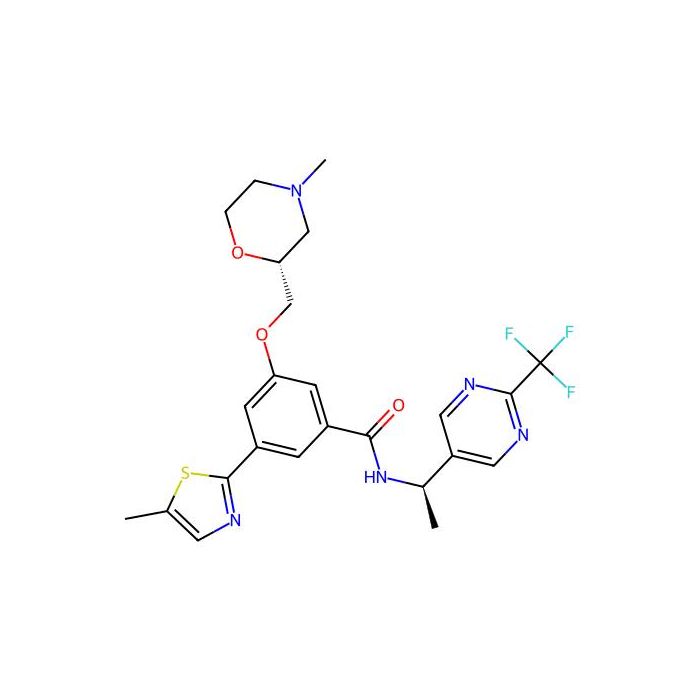
Filapixant is a purinoreceptor antagonist extracted from patent WO2016091776A1, example 348. Filapixant is the active reference substance of Eliapixant
Form:Solid
IC50& Target:purinoreceptor
Specifiche
Specifiche e purezza
≥98%
Meccanismi biochimici e fisiologici
Filapixant is a purinoreceptor antagonist extracted from patent WO2016091776A1, example 348. Filapixant is the active reference substance of Eliapixant.
Condizioni di conservazione di stoccaggio
Store at -20°C
Spedito in
Ice chest + Ice pads
Questo prodotto richiede spedizione a catena fredda. I servizi di terra e altri servizi economici non sono disponibili.
Certificati (CoA, COO, BSE/TSE e tabella di analisi)
C of A & Other Certificates(BSE/TSE, COO):
Analytical Chart:
Proprietà chimiche e fisiche
Solubilità
DMSO : 146.67 mg/mL (281.21 mM; Need ultrasonic)
Calcolatori di soluzioni
Molarity Calculator
Determine the necessary mass, volume, or concentration for preparing a solution.
Dilution Calculator
Determine the dilution needed to prepare a stock solution.
Reconstitution Calculator
Recensioni
Recensioni dei clienti
Application Protocols
No tested application protocols are provided in the Product Data for this item.
General, non-binding guidance for small-molecule tool compound handling (not item-specific; validate in your lab):
Stock preparation: Dissolve in anhydrous DMSO to prepare a 10–50 mM stock. Vortex/sonicate as needed. Filter through 0.22 μm PTFE if particulates persist.
Working solutions: Dilute stocks into assay buffer or media immediately before use. Keep final DMSO ≤0.1–0.5% v/v unless otherwise validated.
Controls: Include vehicle controls and a known P2X3 agonist (e.g., ATP or α,β-meATP) to confirm assay performance. Consider a reference P2X3 antagonist as a comparator if available.
Stability: Limit compound exposure to light/heat; use amber vials and keep on ice during setup. Discard solutions if precipitation or degradation is observed.
For authoritative, item-specific instructions, refer to the lot CoA/Spec Sheet or the SDS.
Biological Roles
Literature context (not item-specific): Filapixant is described as a small-molecule antagonist of the P2X3 receptor, an ATP-gated cation channel within the purinergic P2X family. P2X3 is predominantly expressed in peripheral sensory neurons (e.g., dorsal root and nodose ganglia) and contributes to transduction of noxious and mechanosensory stimuli.
Key biological considerations for research use:
Target/pathway:
P2X3 activation by extracellular ATP leads to Na+/Ca2+ influx and neuronal depolarization. Selective antagonists help delineate ATP’s role in sensory circuits.
Selectivity profiling:
Tool compounds are often benchmarked for selectivity vs. other P2X subtypes (e.g., P2X2/3 heterotrimers). Users should verify reported selectivity and potency values from primary sources and confirm under their assay conditions.
Experimental systems:
Heterologous expression systems (HEK293, CHO) stably expressing human or rodent P2X3.
Native neurons or tissue preparations where endogenous P2X3 is present.
Readouts include patch-clamp current inhibition, calcium imaging, and downstream signaling markers.
Practical tips:
Confirm compound stability in the chosen vehicle/buffer and during the assay timeframe.
Establish concentration–response curves and include a positive control P2X3 agonist (e.g., ATP/α,β-meATP) to verify assay window.
No medical or clinical claims are made. This product is for laboratory research use only.
Buffer Applications
Filapixant is not a buffering agent and does not form a defined buffer system. However, appropriate buffer selection is crucial for bioassays using small-molecule antagonists.
General, assay-oriented guidance (not item-specific):
Common assay buffers: HEPES- or PBS-based extracellular solutions for electrophysiology and calcium imaging, maintaining physiological ionic strength (Na+, K+, Ca2+, Mg2+).
pH: Maintain near-physiological pH (7.2–7.4) for P2X3 assays; avoid high DMSO (>0.5% v/v final) which can affect channel function.
Chelators: Control free Ca2+/Mg2+ where relevant, as divalent cations can modulate P2X receptor activity.
Additives: Include 0.1% BSA to minimize nonspecific binding if adsorption to plastics is observed; confirm that surfactants do not interfere with readouts.
Always validate that the chosen buffer does not alter Filapixant’s apparent potency or receptor function under your conditions.
Green Alternatives
This item is a bioactive small molecule, not a process solvent or commodity reagent. “Green alternatives” are generally discussed for solvents and reaction media rather than for discrete screening compounds.
For users preparing solutions or formulations (general guidance):
Prefer greener, assay-compatible vehicles where possible:
Use aqueous buffers with minimal DMSO when solubility permits.
Consider ethanol/water mixtures over DMF/NMP when compatible with the biology.
Minimize solvent volumes and waste:
Prepare concentrated stock solutions (e.g., in DMSO) and dilute at point-of-use to reduce overall solvent consumption.
Waste handling:
Segregate halogenated from non-halogenated organic waste. Adopt microscale assay formats (96/384-well) to limit solvent use.
These measures improve environmental footprint without altering the identity of the compound itself.
Pharmaceutical Uses
This product is supplied strictly for laboratory research use. No pharmacopeial grade or formulation status is provided in the Product Data, and no therapeutic or clinical claims are made.
Excipient/compendial status: Not specified for this item; refer to CoA/Spec Sheet.
DMSO stock solutions diluted into physiological buffers for in vitro assays.
For exploratory in vivo research, vehicles may include aqueous systems containing co-solvents and surfactants (e.g., 10–20% PEG400, 5–10% ethanol, 10–20% Cremophor EL/Solutol HS 15), with pH adjustment as needed. Confirm stability and tolerability in the intended model.
Stability considerations:
Assess light, temperature, and pH sensitivity before preparing multi-dose formulations. Perform short-term stability indicating assays (e.g., HPLC) on working solutions.
Note: Any use in humans or clinical applications is not supported by this listing. For regulated development, seek GMP-grade material and comprehensive CMC documentation.
Physical Properties
Item-specific physicochemical specifications are not provided in the Product Data for this listing.
Appearance (Product Data): Not specified for this item; refer to CoA/Spec Sheet.
Molecular Weight (Product Data): Not specified for this item; refer to CoA/Spec Sheet.
Molecular Formula (Product Data): Not specified for this item; refer to CoA/Spec Sheet.
General guidance for handling small, drug-like research compounds (literature/typical, not item-specific):
Physical state: Often isolated as a crystalline solid or amorphous powder; confirm by CoA.
Solubility profile: Many heteroatom-rich small molecules are sparingly soluble in water and readily soluble in polar aprotic solvents (DMSO, DMF) and mixed organic systems (MeOH, EtOH, acetonitrile). Determine actual solubility empirically for this lot.
pKa/logP: Ionizable functional groups and lipophilicity govern aqueous solubility and membrane permeability; consult literature or measure to support assay design.
UV-Vis: Drug-like chromophores frequently absorb in the 200–350 nm range; verify for quantitative UV assays.
What to verify prior to use (recommended):
Determine working solubility in your intended vehicle (e.g., DMSO) and any aqueous assay buffer using small-scale titration.
Confirm hygroscopicity and thermal behavior (DSC/TGA) if you plan long-term storage outside −20°C.
For LC/LC–MS method development, obtain retention behavior in your system and confirm purity profile by HPLC/UPLC.
Quality and Grades
The Product Data do not specify a grade or purity for this item.
Grade/Purity (Product Data): Not specified for this item; refer to CoA/Spec Sheet.
Interpreting common research grades (general guidance):
Research grade: Suitable for exploratory in vitro/in vivo research. Purity is typically reported by HPLC/UPLC with area% integration; residual solvents and water may be listed separately. Review the CoA for assay method and thresholds.
Screening/library grade: Intended for HTS or phenotypic screening; often provided with identity by NMR/LC–MS and purity by HPLC. Trace impurities can influence assay readouts; consider secondary purification if needed for mechanistic studies.
What to look for on the CoA/Spec Sheet:
Identity confirmation: 1H NMR, LC–MS (m/z), and possibly HRMS. Match to expected mass for Filapixant.
Purity: HPLC method (column, gradient, detection wavelength) and area% purity; enquire about chiral purity if applicable.
Residuals: Water (KF), residual solvents (GC), and inorganic residues/metals if relevant to your assay.
Solid-state form: Free base vs. salt, solvate/hydrate content, and polymorph—these can impact solubility and bioassay consistency.
If low baseline at UV detection wavelengths is critical (e.g., analytical HPLC), request a chromatogram and details on UV cutoff/response for your detection method.
Reaction and Applications
This product is supplied as a bioactive small-molecule research compound rather than a synthetic reagent. Consequently, it is not typically used as a solvent or stoichiometric building block in general organic synthesis.
Research application context (literature-level background, not item-specific):
Filapixant is reported as a selective antagonist of the P2X3 purinergic receptor, frequently employed as a tool compound to interrogate ATP-gated ion channel signaling in sensory neurons and related physiological pathways.
Typical experimental paradigms include electrophysiology (e.g., whole-cell patch clamp on P2X3-expressing cells), calcium flux assays, and organotypic tissue studies to dissect P2X3-mediated responses.
In chemical biology, it may be used to benchmark structure–activity relationships (SAR) within P2X3 antagonist series or as a comparator in pharmacology panels evaluating selectivity versus other P2X family members.
If you intend to use Filapixant in a chemical transformation (e.g., for derivatization or probe synthesis), first confirm the exact functional group set via CoA or primary literature to ensure compatibility with your planned chemistry.
Reaction Conditions
Not typically applicable. Filapixant is supplied as a finished small-molecule research compound, not a reagent for promoting or mediating chemical reactions.
If you plan chemical biology derivatization (general advice, not item-specific):
Solvents: Anhydrous DMSO, DMF, or acetonitrile are common for coupling/labeling reactions if the functional groups allow. Ensure compatibility with the compound’s stability profile.
Temperatures: Favor ambient to mildly elevated temperatures (20–50°C) to limit degradation; exclude moisture/oxygen when necessary.
Bases/catalysts: Use mild organic bases (e.g., DIPEA) and coupling agents (e.g., HATU/EDC) appropriate to the targeted functional handle.
Workup/purification: Employ preparative HPLC for final purification to maintain high purity for biological testing.
These are general synthetic considerations; confirm the molecule’s functional group set and stability before attempting any modification.
Safety and Handling
Hazard classification data are not provided in the Product Data and may vary by supplier and jurisdiction.
GHS information (Product Data):
Signal Word: Not specified for this item; refer to SDS.
H-Statements: Not specified for this item; refer to SDS.
GHS Classification: Not specified for this item; refer to SDS.
Pictograms: Not specified for this item; refer to SDS.
General laboratory safety guidance for small organic compounds (not item-specific; consult the SDS as authoritative):
PPE: Wear lab coat, safety glasses, and appropriate chemical-resistant gloves. Use in a fume hood to avoid inhalation of dusts or solvent vapors from solutions.
Handling: Avoid generating dust/aerosols. When weighing, use antistatic tools and closed containers. Prepare stock solutions in a fume hood.
Incompatibilities: Strong oxidizers and strong acids/bases may cause decomposition depending on functional groups; segregate accordingly. Avoid prolonged exposure to elevated temperatures, light, or moisture until stability is known.
First aid (overview):
Inhalation: Move to fresh air; seek medical attention if symptoms persist.
Skin/eye contact: Rinse with water for at least 15 minutes; remove contaminated clothing; seek medical attention if irritation persists.
Ingestion: Rinse mouth; do not induce vomiting; seek medical attention.
Spills: Avoid dust. Cover with inert absorbent, collect, and dispose according to institutional and local regulations.
Waste: Dispose as organic laboratory chemical waste per institutional EHS procedures.
Always consult the lot-specific Safety Data Sheet (SDS) before first use.
Solvent Selection
No item-specific solubility data are provided. The following are practical, literature-based guidelines for preparing stock solutions of drug-like small molecules such as Filapixant.
Primary solvent for stocks:
DMSO (anhydrous) is typically the first choice due to broad solubilizing power and compatibility with biological assays at low final percentages (≤0.1–0.5% v/v). Verify Filapixant solubility empirically.
Alternative organic vehicles:
DMF or NMP (for highly lipophilic compounds); ethanol or methanol for screening if assay permits.
PEG400 or propylene glycol can aid in co-solvent systems for in vivo formulation research (non-clinical).
Aqueous systems:
If the compound is weakly basic/acidic, slight pH adjustment (e.g., to pH 2–3 or 8–9) and inclusion of co-solvents (DMSO 5–20% + surfactant such as 0.5–1% Tween 80 or 1–10% Solutol) can enhance apparent solubility. Confirm compound stability across pH.
Miscibility and compatibility:
DMSO is miscible with water and most organic solvents. Minimize freeze–thaw cycles; aliquot stocks.
Practical workflow:
Begin with a 10–50 mM DMSO stock trial; vortex/sonicate gently and visually assess clarity. Filter (0.22 μm PTFE) if needed. Back-calculate final DMSO content in assays to remain within tolerance.
Note: These are general recommendations. For regulated studies or precise dose solutions, determine exact solubility/compatibility for the lot in your intended matrices.
Storage and Reconstitution
Follow the storage conditions provided in the Product Data and adopt best practices for small-molecule stocks.
Storage (Product Data): Store at −20°C.
Shipping (Product Data): Shipped in an ice chest with ice pads.
Appearance (Product Data): Not specified for this item; refer to CoA/Spec Sheet.
Recommended handling (general guidance):
Upon receipt: Allow the sealed container to equilibrate to room temperature before opening to minimize moisture condensation. Reseal promptly after use.
Solid aliquoting: If possible, subdivide into single-use aliquots under dry conditions (desiccator or dry box) to avoid repeated freeze–thaw and moisture uptake.
Reconstitution: Prepare concentrated stock solutions in anhydrous DMSO (e.g., 10–50 mM). Mix gently and verify complete dissolution. Record the exact concentration.
Stock storage: Store DMSO stocks at −20°C or −80°C in tightly sealed, inert vials (amber glass recommended). Protect from light. Avoid repeated freeze–thaw by preparing small aliquots.
Stability: Item-specific stability in solid and solution states is not provided; confirm by analytical check (e.g., HPLC) after defined storage intervals.
Note: For any deviations from these guidelines or for long-term storage planning, consult the lot-specific CoA/Spec Sheet and SDS.
Structure and Identity
Filapixant is a cataloged small-molecule research compound. Detailed structural identifiers are not provided in the Product Data for this specific item.
Item identifiers (Product Data):
SKU: F647152
Product Name: Filapixant
CAS: 1948232-63-0
Category: Small Molecules & Compound Libraries (研究/实验用)
Structure descriptors:
Molecular Formula: Not specified for this item; refer to CoA/Spec Sheet.
Molecular Weight: Not specified for this item; refer to CoA/Spec Sheet.
SMILES: Not specified for this item; refer to CoA/Spec Sheet.
InChIKey: Not specified for this item; refer to CoA/Spec Sheet.
2D structural features (general, literature context): Filapixant is reported in the literature as a drug-like, heteroatom-containing small molecule designed to interact with the P2X3 purinergic receptor binding site. Precise ring systems, stereocenters, and substituent patterns should be confirmed from a primary reference or the CoA/Spec Sheet for this lot.
Notes:
Where exact structural identifiers are critical (e.g., for registration, modeling, or analytical reference), please consult the lot-specific CoA/Spec Sheet or authoritative databases using the provided CAS (1948232-63-0) and CID (121397607).
All identifiers not explicitly listed under Product Data above are literature-level context and should be verified for your use case.
Synthetic Utility
Filapixant is offered as a defined bioactive small molecule and is not typically employed as a synthetic reagent or building block.
Context for chemists (general guidance):
If derivatization or probe development is desired (e.g., biotinylated or photoaffinity analogs), consult primary structural literature to identify modifiable positions that preserve P2X3 affinity and selectivity.
Prior to any functionalization:
Confirm the exact functional groups (e.g., amines, amides, heterocycles) by consulting the CoA and authoritative references.
Evaluate liabilities for common transformations (oxidation, acylation, N-alkylation) and potential for regio-/chemoselectivity issues.
Analytical support:
Use LC–MS and NMR to confirm identity/purity after any modification; consider chiral analyses if stereocenters are present in the scaffold.
For routine organic synthesis tasks, select purpose-built reagents and solvents; Filapixant itself is not recommended as a general synthetic input.
Target Specificity
Not applicable to this product type in the catalog sense. Target specificity data (antigen, epitope, clone, isotype, species reactivity) apply to antibody/biologic reagents and are not provided in the Product Data for this small-molecule listing.
Literature context (for user awareness; not item-specific specifications): Filapixant is reported as a selective antagonist of the P2X3 purinergic receptor and is commonly profiled for selectivity against related P2X subtypes. Users should consult primary publications and generate internal data under their assay conditions.
Domande frequenti
What is the purity of this product?
This product is supplied at ≥98% purity (chemical assay). Lot-specific values are stated on the Certificate of Analysis.
How should this product be stored?
Store at ?20 °C. Freezer storage is required to maintain the specified shelf life.
How is this product shipped?
This product ships in an insulated container with ice pads. Unpack on arrival and transfer it to the storage condition stated above.
What are the CAS number, molecular formula and molecular weight?
The CAS Number is 1948232-63-0, the molecular formula is C24H26F3N5O3S, and the molecular weight is 521.56 g/mol.
What documentation is provided?
Available product documentation, including Certificates of Analysis (COA), Safety Data Sheets (SDS), and specification sheets, is shown in the product document area. Document availability and access follow the current site policy.
Utilizziamo i cookie per garantire il corretto funzionamento del sito web e, ove consentito, per migliorare la tua esperienza. Puoi gestire le tue preferenze in qualsiasi momento nelle Impostazioni. Per saperne di più, consulta la nostra Cookie Policy.
Desidera che le inviamo un messaggio quando avremo sconti disponibili?
Ricordamelo più tardi
Grazie! Controlli la sua casella di posta per confermare.
Products are supplied to verified businesses, institutions, and qualified professionals for research and development use only. Not for use in humans, animals, diagnosis, or therapy.