10mM in DMSO per flussi di lavoro cromatografici e analitici sensibili che richiedono un'interferenza minima della linea di base.
🌡
Stoccaggio e spedizione
Store at -80°C Spedizione Dry ice packs + Cold packs. Consultare il COA specifico del lotto per le specifiche esatte.
📋
Documenti di qualità
SDS, COA, scheda tecnica e scheda delle specifiche disponibili per il download. COA specifico del lotto accessibile tramite ricerca per numero di lotto.
📚
Prova documentale
Citato in 0 pubblicazioni peer-reviewed su cromatografia, sintesi organica e reazioni di accoppiamento incrociato.
Panoramica
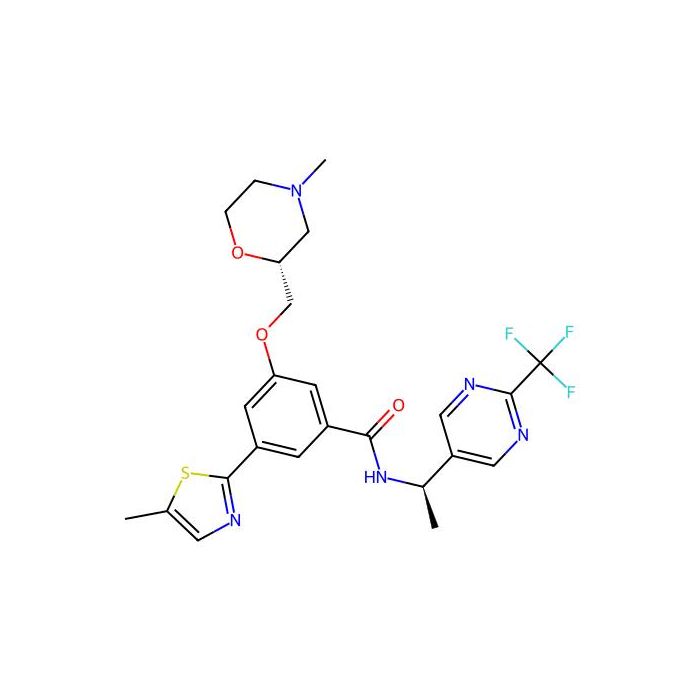
Filapixant is a purinoreceptor antagonist extracted from patent WO2016091776A1, example 348. Filapixant is the active reference substance of Eliapixant
IC50& Target:purinoreceptor
Specifiche
Specifiche e purezza
10mM in DMSO
Meccanismi biochimici e fisiologici
Filapixant is a purinoreceptor antagonist extracted from patent WO2016091776A1, example 348. Filapixant is the active reference substance of Eliapixant.
Condizioni di conservazione di stoccaggio
Store at -80°C
Spedito in
Dry ice packs + Cold packs
Questo prodotto richiede spedizione a catena fredda. I servizi di terra e altri servizi economici non sono disponibili.
Certificati (CoA, COO, BSE/TSE e tabella di analisi)
C of A & Other Certificates(BSE/TSE, COO):
Analytical Chart:
Calcolatori di soluzioni
Molarity Calculator
Determine the necessary mass, volume, or concentration for preparing a solution.
Dilution Calculator
Determine the dilution needed to prepare a stock solution.
Reconstitution Calculator
Recensioni
Recensioni dei clienti
Application Protocols
Tested applications and recommended conditions are not specified for this item. Please refer to your internal SOPs and assay-specific literature.
General guidance (non-item-specific)
For concentration–response assays, prepare serial dilutions in DMSO, then back-dilute into buffer to maintain a constant vehicle percentage across all wells. Include positive control (agonist response) and vehicle control groups.
For electrophysiology, confirm compound access and equilibration times; use perfusion systems to achieve rapid solution exchange and stable baselines. Validate that vehicle alone does not affect holding currents or membrane properties.
For LC–MS quantitation, prepare a calibration curve with at least 6–8 non-zero levels, bracketed QCs, and evaluate carryover and matrix effects.
Biological Roles
Biology-focused information below is literature-based and provided for context; it is not item-specific and is not a clinical claim.
Filapixant is widely reported as a small-molecule antagonist of purinergic P2X3 receptors, ligand-gated ion channels activated by extracellular ATP. P2X3 is predominantly expressed in subsets of sensory neurons, including those of dorsal root and nodose/jugular ganglia.
Antagonism at P2X3 modulates ATP-mediated neuronal excitability. In vitro, functional readouts include inhibition of ATP-evoked currents, calcium influx, or ion flux in recombinant and native systems.
Selectivity considerations typically include profiling across P2X family members (e.g., P2X2/3 heteromers, P2X2, P2X4, P2X7) and non-purinergic targets to exclude off-target actions; exact selectivity data should be drawn from primary literature for the specific batch/reference.
In translational pharmacology, P2X3 signaling has been linked to sensory processing pathways. For research purposes, Filapixant can serve as a tool compound to interrogate ATP–P2X3 axis contributions in neuronal assays and tissue preparations.
Good practice
Confirm receptor expression and assay window with orthogonal methods (qPCR/Western, functional agonist response) before antagonist testing.
Use appropriate vehicles and include vehicle controls; report free fraction and adsorption losses (to plastics/proteins) if these influence potency estimates.
Buffer Applications
This product is a small-molecule research ligand and is not a buffering agent. Therefore, dedicated buffer formulation guidance is not typically applicable.
Practical notes for assay buffers (general)
Choose a physiological buffer (e.g., HEPES, PBS) compatible with your biological system and detection modality. Maintain constant vehicle percentage (e.g., 0.1–1% DMSO) across all wells/conditions.
Include divalent cations as required for P2X receptor function (literature often employs extracellular solutions with NaCl, KCl, CaCl2, MgCl2, HEPES; pH ~7.3–7.4), and adjust ionic strength/osmolality appropriately.
Filter (0.2 µm) and degas buffers for sensitive optical or electrophysiological assays to reduce noise and bubble formation.
Green Alternatives
In the context of dissolving and analyzing a research compound like Filapixant, environmental impact is largely driven by solvent choices and purification workflows. While item-specific solubility is not provided, greener practices can often be adopted without compromising data quality.
Greener choices (general guidance)
Prefer ethanol or isopropanol over methanol where compatible (lower toxicity), recognizing possible differences in solubility and evaporation rates.
In chromatography, favor water–acetonitrile over water–methanol for LC when appropriate (lower toxicity, easier solvent recovery), and use volatile modifiers (formic acid, ammonium formate) judiciously.
For extractions/workups (if applicable), consider ethyl acetate or 2-methyltetrahydrofuran (2-MeTHF) instead of chlorinated solvents; assess partitioning first on a small scale.
Reduce solvent volumes via miniaturized assay formats (384/1536-well), acoustic dispensing of DMSO stocks, and efficient plate sealing to curb evaporation and waste.
Trade-offs
Greener solvents may exhibit reduced solvency for highly lipophilic compounds; limited co-solvent percentages in bioassays can constrain achievable test concentrations.
Alternative eluents can shift retention/selectivity; re-optimize gradients and buffer strength to maintain resolution.
Documentation
Record actual solvent compositions and waste minimization steps in your ELN to facilitate reproducibility and institutional green-chemistry reporting.
Pharmaceutical Uses
For research use only; not for human or veterinary use. No clinical or therapeutic claims are made for this product.
Research and development contexts (general)
Employed as a reference standard or tool compound in drug discovery campaigns targeting purinergic ion channels (e.g., P2X3), supporting SAR benchmarking, assay validation, and hit triage.
Utilized in preformulation-style experiments (solubility screening in pharmaceutically relevant vehicles, pH-solubility profiling, stability studies) to inform discovery-stage developability assessments.
Suitable as a calibration/analyte standard in bioanalytical method development (LC–MS/MS) to quantify exposure in in vitro systems (microsomes/hepatocytes) or for in vivo method readiness studies in animal models, where permitted by institutional approvals.
Can support permeability and protein-binding measurements to contextualize pharmacological readouts in terms of unbound concentrations.
Documentation and compliance
Maintain traceable records for reference standards (lot numbers, purity, storage history). Validate analytical methods (selectivity, linearity, accuracy, precision, stability) per internal SOPs when using the compound as a quantitative control.
Physical Properties
Item-specific physico-chemical specifications are not provided in the current data set.
Appearance: Not specified for this item; refer to CoA/Spec Sheet.
Melting point (MP): Not specified for this item; refer to CoA/Spec Sheet.
Boiling point (BP): Not applicable/rarely reported for complex drug-like solids; Not specified for this item.
Density: Not specified for this item; refer to CoA/Spec Sheet.
Solubility: Not specified for this item; refer to CoA/Spec Sheet.
logP/logD, pKa, refractive index: Not specified for this item; refer to CoA/Spec Sheet.
General laboratory guidance (literature/good practice – not item-specific)
Drug-like small molecules are commonly handled as solids and reconstituted in anhydrous DMSO to create concentrated stocks (e.g., 10–50 mM), then diluted into aqueous buffers or media with co-solvents (≤1% DMSO final, where compatible).
If solubility is uncertain, perform a small-scale solubility screen (DMSO, DMF, ethanol, acetonitrile; and buffered aqueous with co-solvent) before committing to large preparations.
For analytical characterization, LC–MS grade solvents and 0.2 µm filtration typically improve chromatographic performance and spectral quality.
Hygroscopicity and polymorphism can influence handling and apparent melting behavior; confirm with thermogravimetric analysis (TGA/DSC) if critical to your workflow.
Quality and Grades
Grade/Purity: Not specified for this item; refer to CoA/Spec Sheet.
This product is sold for research use only; not for human or veterinary use.
Interpretation and best practices (general guidance)
For small-molecule reference ligands, typical documentation includes HPLC/UPLC purity, identity confirmation by HRMS and NMR, and residual solvent analysis. Review the CoA for acceptance criteria and analytical methods employed.
If low UV background or chromatographic compatibility is critical (e.g., LC–MS quantitation, bioanalytical calibration curves), confirm that impurity and counterion profiles are suitable for your application.
Stabilizers/salts: If present, they will be listed on the CoA/label. Stabilizers can influence mass assays and UV spectra; correct for them in quantitative work.
Lot-to-lot comparability: Archive an in-house reference chromatogram and MS spectrum for each lot. For biological assays, establish an internal control curve with the received lot to confirm potency alignment before broad deployment.
Reaction and Applications
As supplied, Filapixant is a finished small-molecule research ligand rather than a synthetic reagent. Consequently, its primary applications are in analytical and biological assay contexts rather than as a stoichiometric reactant.
Research and screening uses (general/literature-informed)
Reference/benchmark ligand in purinergic receptor pharmacology panels (e.g., P2X receptor subtypes). Employ in concentration–response experiments to validate assay performance (Z′, dynamic range, EC/IC benchmarks) and to rank-order test compounds.
Electrophysiology (patch clamp, TEVC) and ion flux/Calcium imaging assays to quantify antagonist activity and kinetic parameters (on/off rates) using ATP or selective agonists as stimuli.
Radioligand displacement or SPR/BLI binding studies to characterize binding affinity and competitiveness when an appropriate tracer or immobilization strategy is available.
ADME profiling: Use as a control article in microsomal stability, plasma protein binding, permeability (PAMPA/Caco-2), and solubility assays for comparative assessment.
Practical tips
Prepare accurately quantified DMSO stocks (gravimetric or volumetric), record lot-specific potency references, and minimize freeze–thaw.
Verify absence of aggregation or fluorescence interference if using optical readouts (e.g., include detergent controls, dynamic light scattering checks as needed).
For cross-lab comparability, standardize solvent composition and incubation times, and report free (unbound) concentrations when possible.
Reaction Conditions
This product is not intended as a general synthetic reagent; therefore, conventional reaction condition guidance (temperature, catalysts, equivalents) is not applicable.
Assay and handling conditions (general best practices)
Stock solutions: Prepare in anhydrous DMSO under inert atmosphere if stability is a concern. Typical discovery stocks are 10–50 mM; filter through 0.2 µm PTFE if particulate is present.
Working solutions: Dilute into assay buffer to achieve the desired final concentration while keeping DMSO at a constant, low percentage (commonly 0.1–1%). Verify absence of precipitation or adsorption to plastics (use low-bind labware when needed).
Stability checks: Assess bench-top, refrigerated, and frozen stability by LC–MS at relevant time points. Include freeze–thaw cycling studies if aliquoting is not feasible.
Electrophysiology-compatible conditions: Use well-defined external/internal solutions; control temperature (typically 20–25 °C) and minimize solvent content to avoid altering seal quality or baseline currents.
Yield/kinetics
For biological antagonism assays, report concentration–response parameters (IC50, Hill slope) and, where feasible, kinetic metrics (kon/koff). These are assay- and system-dependent and should be established empirically for your setup.
Safety and Handling
Safety data specific to this item are not provided in the listing. Always consult the shipped Safety Data Sheet (SDS) for authoritative information.
GHS Classification: Not specified for this item; refer to SDS.
Signal word / H-statements / P-statements / Pictograms: Not specified for this item; refer to SDS.
General laboratory precautions (good practice – not item-specific)
Handle in a fume hood, avoiding inhalation of dust or aerosols. Use appropriate PPE: lab coat, safety glasses, and suitable chemically resistant gloves (e.g., nitrile). Wash thoroughly after handling.
Avoid skin contact, especially when using DMSO or DMF as they can enhance dermal absorption of solutes.
Prevent cross-contamination: dedicate tools (weigh boats, spatulas) to this compound; close containers promptly to minimize moisture uptake and degradation.
Incompatibilities: Avoid strong oxidizers and strong acids/bases unless compatibility is known. Do not heat or mill the solid unless stability has been established.
First aid (overview; defer to SDS): If inhaled—fresh air and seek medical advice. Skin/eye contact—rinse with water for at least 15 minutes and remove contaminated clothing; seek medical attention if irritation persists. If swallowed—rinse mouth; do not induce vomiting; obtain medical attention.
Waste: Collect in organic hazardous waste according to institutional and local regulations.
Transport/receipt: Product is shipped on dry ice + cold packs; inspect upon arrival and transfer to the specified storage temperature without delay.
Solvent Selection
Item-specific solubility data are not provided. The following guidance reflects common practice for drug-like small molecules and should be verified experimentally for Filapixant.
Primary stock solvent: Anhydrous DMSO is typically preferred due to broad solvating power and assay compatibility at low final percentages (≤0.1–1%).
Co-solvents for aqueous dosing: Ethanol, methanol, acetonitrile, or PEG400 (alone or in combination with DMSO) can aid dissolution prior to dilution into buffers or culture media. Add compound to solvent first, then titrate buffer with vortexing/sonication.
Miscibility and dilution: Avoid precipitation by maintaining the co-solvent fraction above the compound’s kinetic solubility threshold during serial dilutions; prepare intermediate dilutions if needed.
Chromatography: For LC–MS analysis, water–acetonitrile (0.1% formic acid or ammonium formate, as appropriate) is a robust starting point. For preparative work, screen MeOH/ACN gradients and, if necessary, add modifiers to suppress secondary interactions.
Solid-state concerns: If the compound exhibits slow dissolution, employ brief sonication and gentle warming (≤37 °C). Do not heat aggressively unless thermal stability has been demonstrated.
Comparison notes (general)
DMSO vs DMF: DMSO is less volatile and more biocompatible at low percentages; DMF offers similar solvency but is less favored in bioassays. Ethanol/ACN are useful for rapid drying and LC compatibility but have narrower solvency windows.
Storage and Reconstitution
Storage Conditions (item-specific): Store at −80 °C.
Shipped In (item-specific): Dry ice packs + Cold packs.
Reconstitution and handling (general best practices; verify experimentally for your use case)
Allow vials to equilibrate to room temperature in a desiccated environment before opening to minimize condensation.
Prepare concentrated stocks in anhydrous DMSO (e.g., 10–50 mM) unless your validated protocol specifies another solvent. Vortex and, if necessary, sonicate briefly to aid dissolution.
Aliquot stocks into single-use vials or plate wells to avoid repeated freeze–thaw cycles. Flush headspace with inert gas if oxidative sensitivity is suspected.
Store DMSO stocks at ≤ −20 °C (short term) or ≤ −80 °C (long term) in tightly sealed, chemically compatible containers. Protect from light if the scaffold is chromophoric.
For aqueous working solutions, prepare fresh on the day of use. If stability must be extended, confirm by LC–MS and avoid microbial contamination (sterile filtration, aseptic technique as applicable).
Record lot number, preparation dates, and storage history in your ELN to support data traceability.
Specifications
Appearance, purity, water/peroxide/metal limits, UV cutoff: Not specified for this item; refer to CoA/Spec Sheet.
Structure and Identity
Overview: Filapixant (SKU F654889) is a research-only small molecule in our small-molecule/compound library category.
Product Name: Filapixant
CAS: 1948232-63-0
PubChem CID: 121397607
InChIKey: Not specified for this item; refer to CoA/Spec Sheet.
SMILES: Not specified for this item; refer to CoA/Spec Sheet.
Molecular Formula: Not specified for this item; refer to CoA/Spec Sheet.
Molecular Weight: Not specified for this item; refer to CoA/Spec Sheet.
Structural description
Item-specific structural identifiers (2D structure, functional group breakdown, ring systems, stereochemistry) are not provided in the current product data.
Literature note: Filapixant is reported as a small-molecule antagonist of purinergic P2X3 receptors; detailed structural features should be confirmed from primary literature or the CoA prior to structural or computational workflows.
Identity confirmation recommendations
Verify identity using orthogonal methods suitable for small molecules (e.g., HRMS, 1H/13C NMR, HPLC/UPLC purity profile, and, where applicable, LC–MS fragmentation pattern) against an authenticated reference.
If performing quantitative pharmacology assays, establish a reference spectrum/chromatogram for this lot to support longitudinal comparability across studies.
Synthetic Utility
Filapixant is supplied as a finished research compound and is not typically used as a synthetic building block. Accordingly, classical reagent-style synthetic utility (e.g., nucleophilic/electrophilic transformations) is not applicable without prior functionalization.
Potential roles in synthesis workflows (general)
Analytical standard: Serve as an external or internal standard to validate reaction monitoring methods (LC–MS/UPLC) when developing synthetic routes to related chemotypes.
Impurity/degradant studies: Forced-degradation or stress-testing (acid/base, oxidative, thermal, photolytic) can elucidate intrinsic liabilities of the scaffold, guiding design of more stable analogs in a medicinal chemistry program.
Derivatization for probes: If the scaffold contains handles amenable to modification (literature-dependent), it may be derivatized to generate photoaffinity or fluorescent probes for target engagement studies; such work requires dedicated synthetic planning based on the known structure.
Caveat
Because item-specific structural features are not provided here, any synthetic manipulation must first be guided by verified structural data from the CoA or peer-reviewed sources to avoid misassignment or loss of activity.
Target Specificity
Item-specific target binding/selectivity data: Not specified for this item; refer to CoA/Spec Sheet and primary literature.
Literature context (for orientation only)
Filapixant has been described as a selective antagonist of P2X3 receptors. Programs often examine activity on P2X3 homomers and P2X2/3 heteromers, and assess selectivity over other P2X subtypes and unrelated ion channels/GPCRs.
Recommendation
Confirm target engagement and selectivity in your own system using orthogonal assays (functional electrophysiology or calcium flux; binding where available). Document assay conditions (agonist concentration, extracellular ions, temperature) due to their impact on apparent potency.
Domande frequenti
How should this product be stored?
Store at ?80 °C. Ultra-low temperature storage is required to maintain the specified shelf life.
How is this product shipped?
This product ships frozen with dry ice and cold packs. Unpack on arrival and transfer it to the storage condition stated above; handle dry ice with insulated gloves in a ventilated area.
What are the CAS number, molecular formula and molecular weight?
The CAS Number is 1948232-63-0, the molecular formula is C24H26F3N5O3S, and the molecular weight is 521.56 g/mol.
What documentation is provided?
Available product documentation, including Certificates of Analysis (COA), Safety Data Sheets (SDS), and specification sheets, is shown in the product document area. Document availability and access follow the current site policy.
Utilizziamo i cookie per garantire il corretto funzionamento del sito web e, ove consentito, per migliorare la tua esperienza. Puoi gestire le tue preferenze in qualsiasi momento nelle Impostazioni. Per saperne di più, consulta la nostra Cookie Policy.
Desidera che le inviamo un messaggio quando avremo sconti disponibili?
Ricordamelo più tardi
Grazie! Controlli la sua casella di posta per confermare.
Products are supplied to verified businesses, institutions, and qualified professionals for research and development use only. Not for use in humans, animals, diagnosis, or therapy.