Filipin complex is a potent polyene macrolide antifungal antibiotic . Filipin complex inserts into membranes and sequester cholesterol into complexes and inhibits PRRSV entry. Filipin complex compriss 70% filipin III and 5% other filipin homologues
In Vitro
Filipin complex (2 μg/ml; 1+48 h) inhibits PRRSV entry with respiratory syndrome virus (PRRSV) genome copies in infected cells reduced by 61% in MARC-145 cells. MCE has not independently confirmed the accuracy of these methods. They are for reference only.
IC50& Target:Macrolide
Specifiche
Specifiche e purezza
10mM in DMSO
Meccanismi biochimici e fisiologici
Filipin complex is a potent polyene macrolide antifungal antibiotic . Filipin complex inserts into membranes and sequester cholesterol into complexes and inhibits PRRSV entry. The Filipin complex consists of 70% filipin III and 5% of other filipin homolog
Condizioni di conservazione di stoccaggio
Protected from light,Store at -80°C
Spedito in
Dry ice packs + Cold packs
Questo prodotto richiede spedizione a catena fredda. I servizi di terra e altri servizi economici non sono disponibili.
Determine the necessary mass, volume, or concentration for preparing a solution.
Dilution Calculator
Determine the dilution needed to prepare a stock solution.
Reconstitution Calculator
Recensioni
Recensioni dei clienti
Application Protocols
No tested applications or vendor-validated protocols are provided in the product data for this entry. Only information from the listing may be reported here.
Recommended dilutions, positive controls, assay formats: Not specified for this item; refer to CoA/Spec Sheet.
General literature guidance (for user method development; not item-specific):
Fixed-cell staining: Fix/permeabilize (often with cold methanol), quickly rinse, incubate with freshly prepared filipin working solution protected from light, wash, and image promptly using UV excitation and appropriate emission filters.
Controls: include cholesterol-depleted controls (e.g., methyl‑β‑cyclodextrin treatment) and enriched controls to benchmark dynamic range.
Imaging: minimize exposure, use low-intensity illumination, and consider antifade conditions compatible with filipin.
These suggestions are for research method development only and are not validated for this specific lot/item.
Biological Roles
Biochemical interaction profile (literature):
Sterol binding: Filipin complex noncovalently associates with 3β‑hydroxysterols (notably cholesterol) in biological membranes. Binding perturbs local membrane order and yields characteristic fluorescence, enabling visualization of sterol-rich domains.
Membrane effects: At higher local concentrations, filipin can disrupt membrane integrity by forming aggregates/pores with sterol components, a property shared with polyene macrolides.
Cellular pathways monitored with filipin staining: cholesterol uptake, endocytic trafficking to late endosomes/lysosomes, esterification to cholesteryl esters (via ACAT), and efflux pathways (ABCA1/ABCG1). These are research uses to infer changes in free cholesterol pools.
Model systems: Frequently applied in giant unilamellar vesicles (GUVs), supported lipid bilayers (SLBs), and proteoliposomes to map sterol-dependent phase behavior.
Important caveats:
Filipin reports primarily on unesterified (free) cholesterol accessible in membranes; it does not directly quantify esterified cholesterol reserves.
Fixation and permeabilization strongly affect staining patterns; methanol fixation is often preferred to preserve filipin–cholesterol complexes, while strong detergents can redistribute sterols.
Signal is sensitive to illumination history and oxygen; limit light exposure and use anti-fade conditions consistent with your imaging platform.
No medical/clinical claims are made. Use is limited to laboratory research applications.
Buffer Applications
This product is not a buffering reagent and does not constitute a buffer system. Consequently, there are no canonical pH ranges or buffer recipes associated with filipin complex.
Practical notes (literature) for use in aqueous media:
Working solutions are typically prepared by diluting a DMSO or alcohol stock into PBS or similar physiological buffers immediately prior to staining.
Inclusion of serum proteins or albumin may aid dispersion; avoid harsh detergents that can extract or redistribute membrane sterols.
Item-specific buffer composition guidance: Not specified for this item; refer to CoA/Spec Sheet and application notes if provided.
Green Alternatives
Given that filipin complex is a specialized sterol-binding probe rather than a bulk solvent or common reagent, classical “green chemistry” substitution frameworks are less directly applicable. Nevertheless, laboratories can reduce environmental impact while maintaining data quality.
Considerations and alternatives (literature/best practice):
Solvent minimization: Use DMSO stocks at higher concentration (within solubility/stability limits) to reduce volumes of organic solvents, then dilute into aqueous buffers immediately before use.
Alcohol choice: If methanol is used for fixation/permeabilization, evaluate ethanol as a potentially less toxic alternative when compatible with your staining outcomes.
Alternative probes: Depending on the experiment, fluorescent cholesterol analogs (e.g., BODIPY‑cholesterol) or intrinsically fluorescent sterol-binding peptides/proteins may offer improved photostability, enabling lower probe loadings and less chemical waste. Trade‑off: these analogs can perturb sterol trafficking and may not faithfully report native cholesterol localization.
Light management: Employ low-intensity illumination and optimized optics to reduce photobleaching and repeated staining cycles, lowering reagent consumption.
Trade-offs summary:
Filipin: label‑free recognition of native 3β‑OH sterols; bright but photolabile; requires organic solvent stocks.
Cholesterol analogs: potentially greener through reduced use/longer-lasting signal; may alter biology; require validation.
Item-specific environmental/safety certifications: Not specified for this item; refer to CoA/Spec Sheet and SDS.
Pharmaceutical Uses
No pharmacopeial/excipient status or formulation role is provided for this catalog item.
Context (general, literature):
Filipin complex is a research-grade polyene macrolide mixture primarily used as a biochemical probe for laboratory studies of sterols. It is not supplied as an active pharmaceutical ingredient or excipient in this context.
In pharmaceutical research, filipin staining is sometimes used as an analytical tool to assess intracellular free cholesterol distribution in cell-based assays or to characterize sterol content in lipid-based delivery systems (research use only).
Regulatory status and compendial specifications for this specific item: Not specified for this item; refer to CoA/Spec Sheet. No clinical or therapeutic claims are made.
Physical Properties
Item-specific physicochemical specifications were not provided for this catalog entry; consult the CoA/Spec Sheet for lot-resolved details.
General/literature characteristics for filipin complex (mixture):
Appearance: typically a yellow to orange, light-sensitive amorphous solid (literature).
Solubility: sparingly soluble in water; soluble in polar aprotic/organic solvents such as DMSO, DMF, methanol, and ethanol; forms working solutions upon dilution into aqueous buffers containing proteins or serum (literature). Avoid non-sterol-complexing detergents that can alter binding.
Melting behavior: decomposes upon heating; no sharp melting point expected for the mixture (literature).
UV/Vis and fluorescence (in sterol-bound state, literature typical): strong absorption in the near‑UV with excitation commonly used around 340–360 nm and emission observed ~480–500 nm. Exact maxima vary with environment and congener distribution.
Partitioning: amphipathic macrolide with high affinity for lipid phases; effectively partitions into cholesterol-rich membranes (literature).
Do not treat the above as product specifications. For quantitative values such as purity, water/peroxide/metal content, UV cutoff, density, refractive index, logP, or pKa: Not specified for this item; refer to CoA/Spec Sheet.
Quality and Grades
Grade/Purity: Not specified for this item; refer to CoA/Spec Sheet.
Context for this product type:
Filipin “complex” denotes a natural-product mixture (commonly Filipin I–IV). Batch-to-batch congener ratios can affect spectral properties, sterol-binding efficiency, and background fluorescence. Professional practice is to consult the lot-specific CoA for UV/Vis profile, HPLC trace, and any stated purity/identity criteria.
Research grade typically indicates suitability for laboratory use with common analytical acceptance tests (identity by UV/Vis/LC, residual solvents, loss on drying). It is not intended for clinical/diagnostic use.
Stabilizers: None are typically added to filipin complex so that binding/fluorescence are not perturbed; consequently, strict protection from light and moisture is important (literature). For this item, presence/absence of stabilizers: Not specified for this item; refer to CoA/Spec Sheet.
Acceptance testing suggestions (user-side QC): verify excitation/emission in your imaging setup, run a known cholesterol-positive control sample (e.g., fixed cells treated with exogenous cholesterol) and a methyl‑β‑cyclodextrin–depleted negative control to benchmark lot performance.
Documentation:
For exact assay suitability (e.g., HPLC grade for analytical use vs microscopy grade), and any impurity limits, defer to the lot-specific CoA/Spec Sheet.
Reaction and Applications
Primary laboratory applications (literature):
Fluorescent sterol probe: Filipin binds 3β‑hydroxysterols (e.g., cholesterol) in membranes, yielding characteristic blue fluorescence (excitation ~340–360 nm; emission ~480–500 nm). Widely used to visualize cholesterol distribution in fixed cells, tissue sections, and model membranes.
Cholesterol homeostasis assays: Semi-quantitative imaging of intracellular free cholesterol in endo‑lysosomal storage models; monitoring depletion/enrichment after cyclodextrin, statin, or oxysterol treatments (research use only).
Membrane biophysics: Reporter for liquid-ordered vs disordered phases, sterol-dependent domain formation in GUVs/SLBs.
Analytical support: Qualitative check for sterol content in liposome preparations or detergent-resistant membrane fractions by microscopy/plate-based fluorescence.
Practical tips (literature):
Work quickly and protect from light to minimize photobleaching/phototoxicity.
Prepare fresh working solutions immediately before use; avoid repeated freeze–thaw of concentrated stocks by aliquoting.
For cell/tissue imaging, include appropriate controls: cholesterol depletion with methyl‑β‑cyclodextrin (negative) and exogenous cholesterol loading (positive).
Methanol fixation often preserves filipin-cholesterol complexes; avoid strong non-ionic detergents during staining to reduce redistribution of sterols.
Concentration windows are assay-dependent; titrate to minimize background while preserving signal.
Note: Filipin complex is not typically employed as a reagent in synthetic organic transformations; its utility is predominantly as a biochemical probe.
Reaction Conditions
This product is not generally used as a reagent in chemical reactions; therefore, there are no standard synthetic “reaction conditions” to report.
Experimental handling conditions for analytical use (literature, for context):
Stock solutions: prepare in DMSO, methanol, or ethanol under low light; filter (PTFE, low-binding) if particulate is present. Typical laboratory concentrations range from low µM to tens of µM in final staining mixtures, adjusted empirically.
Temperature: room temperature incubations are common for staining fixed specimens; minimize exposure time and light to reduce photobleaching.
Atmosphere: ambient is acceptable, but exclusion of oxygen/light during stock preparation and storage improves stability.
Compatibility: avoid strong oxidants, strong acids/bases, and sterol-extracting detergents during staining workflows.
Any item-specific parameters (e.g., guaranteed stability in a given solvent, concentration limits): Not specified for this item; refer to CoA/Spec Sheet.
Safety and Handling
Hazard information specific to this item (GHS classification, signal word, H/P statements, pictograms) is not provided here. Always consult the product SDS for authoritative safety data.
Signal Word: Not specified for this item; refer to SDS.
H‑Statements / GHS Classification / Pictograms: Not specified for this item; refer to SDS.
General safety considerations (literature/practice):
Polyene macrolides can cause irritation to skin, eyes, and respiratory tract. Avoid inhalation of dust/aerosols and contact with skin/eyes. Use in a chemical fume hood.
Light sensitivity: protect all solids/solutions from light to prevent photodegradation and loss of fluorescence.
PPE: lab coat, nitrile gloves (change regularly), and splash-resistant eye protection. When weighing dry powder, consider a particulate mask or work in a balance enclosure.
Incompatibilities: strong oxidizers, strong acids/bases may degrade the polyene; peroxides/ozone and UV exposure accelerate decomposition.
First aid (overview; defer to SDS): rinse eyes/skin with water for ≥15 min upon contact; move to fresh air if inhaled; seek medical attention if symptoms persist. If ingested, rinse mouth and seek medical advice.
Waste: collect solutions/solids as organic hazardous waste. Avoid drain disposal due to potential aquatic toxicity. Photodegraded waste should be handled as chemical waste.
Storage hazards mitigation: maintain low temperature as specified and exclude light/oxygen; use amber vials and inert gas headspace when feasible.
Solvent Selection
Filipin complex is an amphipathic, light-sensitive macrolide mixture used primarily as a cholesterol probe. Solvent choice critically impacts stability and sterol-binding behavior.
General/literature guidance:
Stock preparation: DMSO is commonly preferred for concentrated stocks (e.g., 1–10 mg/mL) due to high solvating power and compatibility with aqueous dilution. Methanol and ethanol are also used; methanol is common in fixed-cell protocols.
Aqueous buffers: Following dilution, phosphate-buffered saline (PBS) is typical. Inclusion of serum albumin or minimal amounts of non-ionic components can help maintain dispersion. Avoid sterol-extracting detergents (e.g., high concentrations of Triton X‑100, saponin) during staining as they perturb membrane cholesterol.
Polarity class: polar aprotic (DMSO/DMF) or polar protic (MeOH/EtOH) for stock; ultimately applied in aqueous media.
Dielectric/Protic effects: Alcohols can slightly quench or shift filipin fluorescence; DMSO tends to preserve the spectral profile prior to aqueous dilution (literature).
Permeabilization: Methanol fixation/permeabilization is commonly paired with filipin staining; harsh detergents can artifactually redistribute cholesterol.
Quick comparison (literature):
DMSO: best solubility, minimal immediate photobleaching; miscible with buffer upon dilution.
Methanol: convenient for fixed-cell workflows; can alter membrane order at high content.
Ethanol: acceptable alternative; slightly lower solubility than MeOH.
Item-specific solvent specifications (water content, UV cutoff, stabilizers): Not specified for this item; refer to CoA/Spec Sheet.
Open vials only under low light. If moisture control is needed, equilibrate in a desiccator before opening.
Prepare concentrated stocks in dry, oxygen-poor DMSO or alcohol, using amber vials. Typical working stock concentrations are in the 1–10 mg/mL range depending on application; verify solubility and performance in your system.
Aliquot immediately after initial dissolution to minimize freeze–thaw cycles; store aliquots at −80 °C protected from light. Avoid frost-free freezers that cycle warm air.
For working solutions, dilute into buffer immediately before use. Discard any solution that shows precipitate, discoloration, or loss of signal.
Stability: Filipin is photosensitive and prone to oxidation; minimize exposure to light and air. Track preparation and expiry dates in your lab records.
Always prioritize the lot-specific CoA and SDS for authoritative instructions on storage, stability, and handling.
Structure and Identity
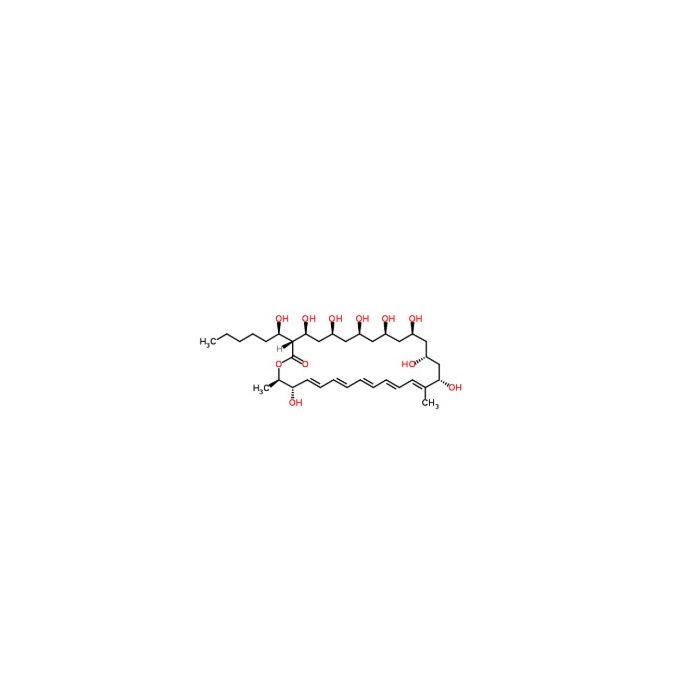
Filipin complex is a mixture of closely related polyene macrolides (classically Filipin I–IV) produced by Streptomyces species. It is supplied as a research reagent for sterol binding/visualization.
CAS: 11078-21-0 (filipin complex, mixture)
PubChem CID: 6433194 (mixture entry)
InChIKey: Not specified for this item; refer to CoA/Spec Sheet. (Note: single identifiers are generally not assigned for mixtures.)
SMILES: Not specified for this item; refer to CoA/Spec Sheet. (Mixture does not have a single SMILES.)
Molecular Formula: Not specified for this item; refer to CoA/Spec Sheet. (Individual congeners differ.)
Molecular Weight: Not specified for this item; refer to CoA/Spec Sheet. (Congener MWs differ.)
Structural features (general, literature):
Polyene macrolide scaffold: a large macrocyclic lactone ring bearing a conjugated pentaene chromophore (responsible for strong absorbance/fluorescence).
Multiple secondary/tertiary alcohols; a single carboxylate as part of the lactone; no nitrogen atoms.
Sterol-binding pharmacophore: hydrogen bonding via the 3β‑hydroxyl of sterols and hydrophobic insertion of the polyene into membranes (literature).
2D description (general, literature):
A ~28–38‑member macrocycle containing an internal ester (lactone), decorated by a linear array of alternating C=C bonds (pentaene) on one arc and polyol substituents on the opposite arc. Subtle differences in oxidation state/side chains distinguish Filipin I–IV.
Synthetic Utility
Filipin complex is not typically employed as a reagent or building block in synthetic organic chemistry. Its primary value is as a sterol-binding fluorescent probe.
For researchers in chemical biology/bioconjugation (general, literature):
The macrolide contains multiple secondary alcohols and a conjugated polyene, but derivatization is rarely pursued in routine labs due to sensitivity (light/oxygen), mixture heterogeneity, and risk of perturbing sterol binding and fluorescence.
Where chemical modification is contemplated (e.g., affinity tags), rigorous validation of sterol-binding and spectral properties is essential, and semisynthetic strategies often target minor, less critical hydroxyls—these are specialized undertakings beyond routine synthesis.
Retrosynthetic value: limited; the complex macrocyclic and polyene framework presents significant synthetic challenges and is not a common substrate for standard named reactions in preparative chemistry.
Bottom line: treat filipin complex as an analytical/biochemical probe rather than a synthetic intermediate. For chemical synthesis needs, consider alternative simpler polyenes or macrolides with defined single-entity structures.
Target Specificity
Target specificity details are not provided in the product data for this catalog entry. Only information present in the product listing may be reported here.
Antigen/ligand, epitope, species reactivity, clone/isotype (if applicable): Not specified for this item; refer to CoA/Spec Sheet or SDS.
Note: Although filipin complex is widely used in research as a sterol-binding probe, no target claims are made for this specific product beyond what appears in the catalog data.
Domande frequenti
How should this product be stored?
Store at ?80 °C, protected from light. The material is light-sensitive — keep it in its original opaque or amber container.
How is this product shipped?
This product ships frozen with dry ice and cold packs. Unpack on arrival and transfer it to the storage condition stated above; handle dry ice with insulated gloves in a ventilated area.
What are the CAS number, molecular formula and molecular weight?
The CAS Number is 11078-21-0, the molecular formula is C35H58O11 (for Filipin III), and the molecular weight is 654.80 g/mol.
What documentation is provided?
Available product documentation, including Certificates of Analysis (COA), Safety Data Sheets (SDS), and specification sheets, is shown in the product document area. Document availability and access follow the current site policy.
Utilizziamo i cookie per garantire il corretto funzionamento del sito web e, ove consentito, per migliorare la tua esperienza. Puoi gestire le tue preferenze in qualsiasi momento nelle Impostazioni. Per saperne di più, consulta la nostra Cookie Policy.
Desidera che le inviamo un messaggio quando avremo sconti disponibili?
Ricordamelo più tardi
Grazie! Controlli la sua casella di posta per confermare.
Products are supplied to verified businesses, institutions, and qualified professionals for research and development use only. Not for use in humans, animals, diagnosis, or therapy.

 D2608275