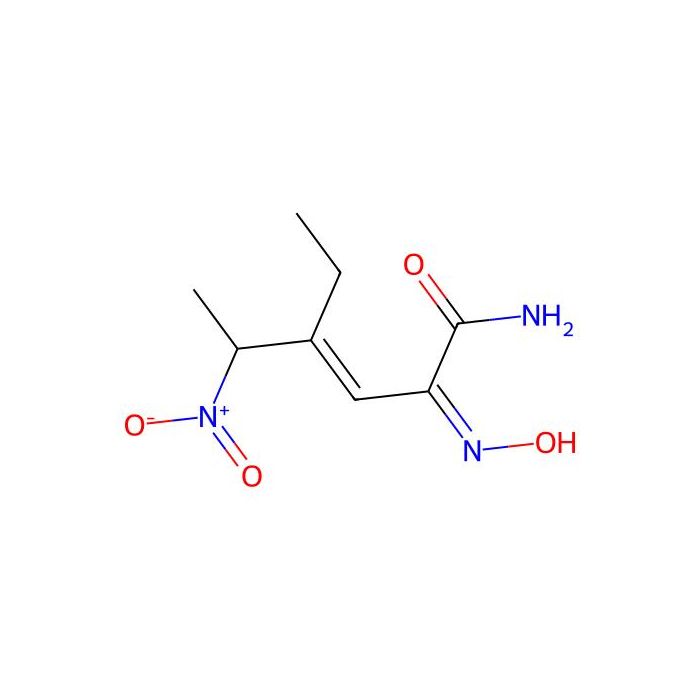
This compound belongs to the class of organic compounds known as ketoximes. These are organic compounds with the general formula RC(R')=NOH (R,R' = organyl).
External Descriptors
Not available
1. Djoumbou Feunang Y, Eisner R, Knox C, Chepelev L, Hastings J, Owen G, Fahy E, Steinbeck C, Subramanian S, Bolton E, Greiner R, and Wishart DS. ClassyFire: Automated Chemical Classification With A Comprehensive, Computable Taxonomy. Journal of Cheminformatics, 2016, 8:61.
P264:Wash hands [and …] thoroughly after handling.
P270:Do not eat, drink or smoke when using this product.
P321:Specific treatment (see ... on this label).
P330:Rinse mouth.
P405:Store locked up.
P501:Dispose of contents/container to an approved waste disposal plant.
P301+P316:IF SWALLOWED: Get emergency medical help immediately.
Calcolatori di soluzioni
Molarity Calculator
Determine the necessary mass, volume, or concentration for preparing a solution.
Dilution Calculator
Determine the dilution needed to prepare a stock solution.
Reconstitution Calculator
Recensioni
Recensioni dei clienti
Application Protocols
Manufacturer-tested application protocols are not provided for this item.
Given the variability in solubility and NO-release kinetics across donor classes, end users should develop and validate protocols under their exact assay conditions. General starting points (for method development only):
Stock preparation: Dissolve in an appropriate solvent (often DMSO or buffer) to a convenient concentration; filter sterilize only if verified not to induce decomposition.
Working solutions: Prepare fresh immediately before use; minimize headspace and protect from light.
Controls: Include vehicle-only and, if possible, a second NO donor with distinct kinetics to confirm NO-dependent effects.
Important: These are general considerations for NO donors. No item-specific, validated protocol is claimed here. Consult the SDS for safe handling and your internal SOPs for assay development.
Biological Roles
Scope: Biological context for nitric oxide (NO) donors in research; no medical or clinical claims.
Mechanistic role: NO is a gaseous signaling molecule influencing soluble guanylate cyclase (sGC) to elevate cGMP, modulating smooth muscle tone, neurotransmission, and platelet function in experimental systems. Donors like FK 409 are used to exogenously supply NO.
Redox chemistry: NO can react with O2•− to form peroxynitrite (ONOO−), leading to protein tyrosine nitration and oxidative/nitrosative stress—important in mechanistic toxicology studies.
Post-translational modifications: NO and derived species support S-nitrosation and metal nitrosylation; donors enable controlled induction for proteomics workflows assessing cysteine SNO sites.
Kinetics considerations: Biological outcomes depend on NO release rate, total NO dose (area under the curve), oxygen tension, and presence of metal chelators; ensure experimental design reflects the desired NO flux.
Assay integration: NO donors serve as positive controls or calibration standards in colorimetric (Griess), fluorescent (DAF-FM/DAF-2), EPR, and chemiluminescent NO detection methods under well-defined conditions.
Notes specific to this item:
FK 409 is widely cited as a spontaneous NO-releasing probe in the literature; however, exact kinetics, solubility, and byproduct profiles should be confirmed from primary sources and the product CoA to ensure relevance to your model system.
Buffer Applications
This product is not a buffering agent and is not used to maintain pH. Accordingly, there are no buffer system recipes associated specifically with FK 409.
Practical notes for use in buffered systems (general guidance for NO donors):
Prepare fresh working solutions in the assay buffer at the target pH and temperature to achieve the desired NO release kinetics.
Common laboratory buffers (e.g., PBS, HEPES) can be used if the compound is compatible; avoid amine-rich buffers when they may react with donor functional groups (verify empirically for FK 409).
Control variables: pH, ionic strength, dissolved oxygen, and trace metal content (consider metal chelators like EDTA when appropriate) can influence NO lifetime and downstream chemistry.
Green Alternatives
Context: Solvent and reagent selection can impact environmental footprint. For NO donors, the core choice is often between different donor chemotypes and the solvents used to deliver them.
Considerations (general, literature-based):
Solvent selection: Prefer water or aqueous buffers when solubility and stability permit; otherwise use greener organics (ethanol) rather than higher-toxicity solvents (e.g., acetonitrile, DMF) when compatible.
Alternative NO donors: Depending on required kinetics, some donors (e.g., PROLI/DEA NONOates) are water-soluble and may reduce reliance on organic co-solvents, improving EHS profiles. Tradeoff: much shorter half-lives at physiological pH versus some nonoate-independent donors.
Illustrative comparison (general):
Water-soluble donors (NONOates): Pros—aqueous handling, predictable pH/temperature-dependent half-lives; Cons—very fast release, CO2 evolution, pH shifts.
FK 409 (literature-reported spontaneous donor): Pros—convenient NO generation without added triggers; Cons—verify solubility and manage release rate under your exact conditions.
Green lab tips:
Prepare minimal volumes of concentrated stock; use amber glassware; avoid repeated freeze–thaw to reduce waste.
Implement microscale assays and validated NO quantification to avoid overuse.
Pharmaceutical Uses
No pharmacopeial grade or excipient designation is provided for this listing, and the product is labeled For research use only.
Research/manufacturing context (non-clinical):
May be employed as a reference or system-suitability standard in analytical methods that quantify NO or its stable metabolites (nitrite/nitrate) during preclinical studies.
Can serve as a process control reagent in method development to validate NO-detection workflows (e.g., calibration of Griess or chemiluminescent analyzers) in a non-GLP setting.
Compliance and quality:
For any regulated or GLP/GMP use, obtain a qualified grade and documentation package (full CoA, stability data, impurity profile). This product, as listed, does not specify such qualifications.
No claims are made regarding suitability for human or veterinary use; not for diagnostic, therapeutic, or clinical applications.
Physical Properties
Only item-specific values from the Product Data or clearly cited literature should be used for quantitative parameters. For this listing, the following are available/not available:
Appearance: Not specified for this item; refer to CoA/Spec Sheet.
Melting point (literature): Not specified here.
Boiling point (literature): Not applicable (decomposes) for many NO donors; FK 409-specific value not provided here.
Density (literature): Not specified here.
Solubility: Not specified for this item; refer to CoA/Spec Sheet. Many NO donors are soluble in polar organic solvents (e.g., DMSO) and sometimes in aqueous buffers; confirm experimentally.
logP/logD (literature/computed): Not specified here.
pKa (literature): Not specified here.
Refractive index (literature): Not applicable (solid) for many NO donors; FK 409-specific value not provided here.
Practical guidance (general for NO donors; verify for FK 409):
Prepare small test dissolutions (e.g., 1–5 mg in 0.5–1 mL) in candidate vehicles (anhydrous DMSO, ethanol, or buffer) to confirm solubility and stability before scaling.
Many NO donors can be sensitive to moisture, heat, and light; handle under ambient lab light with protection from prolonged exposure and avoid elevated temperatures.
Always rely on the batch CoA/SDS for authoritative physicochemical data before quantitative or regulated work.
Quality and Grades
Grade/Purity: Not specified for this item; refer to CoA/Spec Sheet. The CoA will list assay method (e.g., HPLC), purity percentage, and known impurities where applicable.
Guidance on interpreting grades (general):
Research grade: Suitable for most discovery and exploratory studies; impurity profiles are documented on the CoA but not controlled to pharmacopeial standards.
HPLC grade/assay: Indicates high chemical purity determined by chromatographic assay; does not imply low-UV background unless specifically stated for solvents.
Bioactive small-molecule grade: May include additional tests (identity by NMR/MS, water content, residual solvents) when specified.
Stabilizers/inhibitors:
Not specified for this item; refer to CoA/Spec Sheet. Many NO donors are supplied neat without stabilizers; if a stabilizer or salt form is present, this will be noted on the CoA and can impact solubility and release kinetics.
Recommendations:
Review batch-specific CoA prior to quantitative biological assays.
For reproducible NO flux, consider lot qualification by your in-house assay (e.g., Griess or chemiluminescence) since NO-release kinetics can be sensitive to microimpurities and storage history.
If LC-MS quantitation is planned, request or check for residual solvent and counter-ion information on the CoA.
Reaction and Applications
This product is primarily used as a bioactive probe (nitric oxide donor) rather than as a conventional synthetic reagent. There are no manufacturer-specified chemical reaction applications in the Product Data.
General research applications (literature context for NO donors like FK 409):
Chemical biology: Controlled generation of NO in biochemical assays to study NO-mediated signaling, S-nitrosation, and cGMP pathway activation.
Physiology/pharmacology research: Modulation of NO levels in cell culture or isolated tissue preparations to probe downstream responses (e.g., soluble guanylate cyclase activation). No clinical/therapeutic claims.
Method development: Positive control for NO-detection assays (e.g., Griess, DAF-FM, EPR spin trapping) after appropriate calibration.
Practical notes:
Prepare solutions fresh; NO donors can decompose over time depending on pH and temperature.
Validate NO release under your exact assay conditions; ionic strength, trace metals, and buffer composition can affect kinetics.
For comparative studies, include an inert structural analog or vehicle control to deconvolute NO-dependent from off-target effects.
If your intended use is synthetic (e.g., nitrosation studies), consult primary literature for FK 409’s compatibility; this item is not typically highlighted as a building-block reagent.
Reaction Conditions
No manufacturer-specified reaction conditions are provided for this item, and FK 409 is not typically sold as a synthetic reagent.
General operational conditions for NO donor studies (literature context; not product-specific specifications):
Solvents: Aqueous buffers and/or DMSO cosolvent are commonly used depending on solubility; prepare stocks immediately prior to experiments.
Temperature: Many NO release rates increase with temperature; perform at intended assay temperature (e.g., 22–37°C) and avoid unnecessary heating.
pH: Release kinetics are pH-dependent for many donors; maintain tight pH control (±0.1) with validated buffers.
Time: Determine time courses empirically via NO/nitrite readouts; half-lives can range from seconds to hours across donor classes—confirm FK 409 behavior under your conditions.
Analytical controls:
Include vehicle controls and, when possible, an orthogonal NO donor to confirm NO-specific effects.
Use light protection if the donor is photosensitive; employ amber vials and reduced ambient light exposure during preparation.
Because quantitative parameters for FK 409 are not specified in this listing, consult primary literature and your in-house validation data for exact conditions.
Safety and Handling
Safety classifications provided for this item are limited; defer to the product SDS for authoritative guidance.
Item-specific hazard data:
Signal word: Not specified for this item; refer to SDS.
H-statements: Not specified for this item; refer to SDS.
GHS classification: Not specified for this item; refer to SDS.
Pictograms: Not specified for this item; refer to SDS.
General precautions for NO-donor small molecules (literature-based, not product-specific):
Likely to release nitric oxide under physiological or basic conditions; avoid unnecessary heating and strong acids/bases unless intended, as these may accelerate decomposition and gas evolution.
Avoid inhalation, ingestion, and skin/eye contact. Use appropriate PPE: lab coat, nitrile gloves, safety glasses or goggles, and work in a fume hood.
Prevent exposure to strong oxidizers/reducers and transition metal salts unless part of the experimental design; these can alter decomposition pathways.
Protect from prolonged light exposure; many NO donors are light-sensitive to some degree.
First-aid overview (consult SDS):
Inhalation: Move to fresh air; seek medical attention if symptoms develop.
Skin/eye contact: Rinse with water for at least 15 minutes; remove contaminated clothing; get medical advice as needed.
Ingestion: Rinse mouth; do not induce vomiting; seek medical attention.
Waste: Collect solutions/solids as organic hazardous waste. Neutralize/react only within approved protocols in a hood.
Solvent Selection
Item-specific solubility data are not provided for this listing; verify empirically with your material and batch.
General guidance for small-molecule NO donors (literature context):
Primary screening vehicles: anhydrous DMSO (typical for stock solutions), ethanol, or aqueous buffers (e.g., PBS) if water solubility permits. Start with 10–50 mg/mL trials in DMSO before moving to aqueous vehicles.
Aqueous use: Many NO donors can be prepared as fresh aqueous stocks immediately before use to control release kinetics; pH can strongly influence decomposition. Work at the target experimental pH and temperature.
Co-solvent strategies: If aqueous solubility is limited, prepare a concentrated DMSO stock (e.g., 10–100 mM) and dilute into buffer keeping final DMSO ≤0.1–0.5% v/v for cell assays.
Comparison to alternatives (general):
Fast NO donors (e.g., diazeniumdiolates) vs. slower sustained donors (e.g., SNAP derivatives): choose based on desired NO flux and half-life. FK 409 is described in literature as a spontaneous NO releaser; confirm exact kinetics from primary sources.
Operational tips:
Filter sterilize only if validated not to induce decomposition (use low-protein-binding 0.2 µm filters, minimal residence time).
Minimize headspace and exposure to air/light during solution prep; use amber vials and prepare fresh working solutions.
Storage and Reconstitution
Item-specific conditions:
Storage temperature: Store at -20°C (as provided in Product Data).
Shipping: Shipped in ice chest with ice pads (cold chain maintained).
General handling and stability guidance for NO donors (apply to FK 409 unless contradicted by CoA/SDS):
Protect from light and moisture. Keep container tightly closed under inert headspace where feasible.
Upon first opening, equilibrate to room temperature in a desiccated environment before breaking the seal to minimize condensation.
Aliquoting: Prepare single-use aliquots to avoid repeated freeze–thaw cycles that can accelerate degradation.
Reconstitution (verify solubility for FK 409 empirically):
Common vehicles: anhydrous DMSO for concentrated stocks; aqueous buffer for immediate-use working solutions. Start with 10–50 mM in DMSO and adjust based on solubility and assay needs.
Preparation tips: Use amber vials; minimize preparation time; avoid elevated temperatures; mix gently to limit air exposure. If filtration is necessary, use low-binding 0.2 µm filters and validate no loss/decomposition.
In-use stability:
Prepare fresh working solutions for each experiment; many NO donors show time- and pH-dependent decomposition.
Document storage history for each lot and consult the CoA for any available stability data.
Research use note: For research use only.
Structure and Identity
Brief overview: FK 409 is a small-molecule nitric oxide (NO) donor commonly used as a chemical biology tool compound. Item-specific identifiers are provided below; structural details not present in the Product Data should be verified on the CoA/Spec Sheet or primary literature.
SKU: F1307795
Product Name: FK 409
CAS: 138472-01-2
PubChem CID: 6437875 (identifier provided; verify structure on PubChem if needed)
InChIKey: 232285 (as provided; format appears truncated—consult CoA or databases for the full key)
SMILES: Not specified for this item; refer to CoA/Spec Sheet.
Molecular formula: Not specified for this item; refer to CoA/Spec Sheet.
Molecular weight: Not specified for this item; refer to CoA/Spec Sheet.
Structural features (general, literature context for NO donors):
FK 409 is reported in the literature as a spontaneous NO-releasing small molecule; detailed functional group annotation (e.g., nitrosated or N-nitrosamine-like motif) should be confirmed from a trusted database or the CoA.
2D structure description: Not specified for this item; refer to CoA/Spec Sheet or authoritative databases.
Notes:
When precise stereochemistry, tautomers, or salt form are required, consult the batch-specific documentation (CoA) to avoid ambiguity in quantitative work.
Synthetic Utility
FK 409 is primarily a bioactive nitric oxide donor rather than a general synthetic intermediate.
General commentary (applicability limits):
Functional group reactivity: NO donors release NO under defined conditions; they are typically not leveraged as electrophiles/nucleophiles for bond construction. Attempted use in nitrosation chemistry should be validated with primary references for FK 409 specifically.
Retrosynthetic value: Limited; the molecule is generally employed as a tool compound rather than a building block for further synthesis.
If synthetic manipulation is intended:
Assess compatibility of the donor motif with planned reagents and conditions; many NO donors are sensitive to strong acids/bases, high temperature, and certain metals.
Monitor for decomposition via LC-MS or NMR to ensure that the parent compound remains intact through workup and purification.
Conclusion: Treat FK 409 as a functional probe in chemical biology rather than as a synthetic reagent unless a literature precedent specifically supports the desired transformation.
Target Specificity
This product is a small-molecule nitric oxide donor and not an antibody, enzyme, or nucleic acid tool with defined biological target-binding specificity in the immunoassay sense.
No antigen/epitope, clone, isotype, or species reactivity information applies.
Functional specificity (general): acts as a donor of NO, which activates soluble guanylate cyclase and engages redox/nitrosative chemistry broadly rather than binding a single target.
Item-specific target data: Not specified for this item; refer to CoA/Spec Sheet and primary literature for mechanistic details relevant to your assay.
Domande frequenti
How should this product be stored?
Store at ?20 °C. Freezer storage is required to maintain the specified shelf life.
How is this product shipped?
This product ships in an insulated container with ice pads. Unpack on arrival and transfer it to the storage condition stated above.
What are the CAS number, molecular formula and molecular weight?
The CAS Number is 138472-01-2, the molecular formula is C8H13N3O4, and the molecular weight is 215.21 g/mol. InChIKey MZAGXDHQGXUDDX-AGLLBGTNSA-N.
What documentation is provided?
Available product documentation, including Certificates of Analysis (COA), Safety Data Sheets (SDS), and specification sheets, is shown in the product document area. Document availability and access follow the current site policy.
Utilizziamo i cookie per garantire il corretto funzionamento del sito web e, ove consentito, per migliorare la tua esperienza. Puoi gestire le tue preferenze in qualsiasi momento nelle Impostazioni. Per saperne di più, consulta la nostra Cookie Policy.
Desidera che le inviamo un messaggio quando avremo sconti disponibili?
Ricordamelo più tardi
Grazie! Controlli la sua casella di posta per confermare.
Products are supplied to verified businesses, institutions, and qualified professionals for research and development use only. Not for use in humans, animals, diagnosis, or therapy.