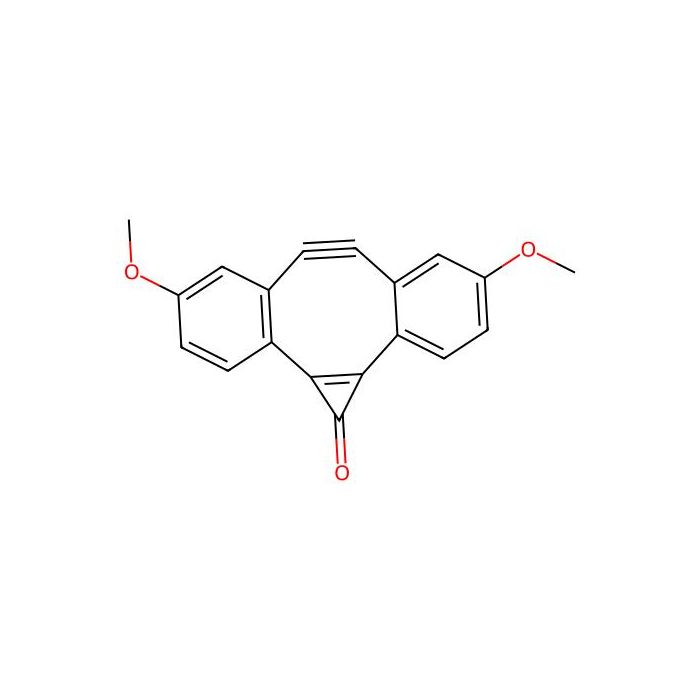
Fl-DIBO (fluorogenic dibenzocyclooctyne) is a selective and high sensitivity fluorescent probe to azide compounds. Fl-DIBO can react rapidly with azide compounds to form new highly fluorescent products with a maximum emission wavelength of 469 nm and excitation wavelength of 363 nm. Fl-DIBO can be used to label diazo-tagged proteins without detectable background signal interference.
In Vitro
Guidelines (Following is our recommended protocol. This protocol only provides a guideline, and should be modified according to your specific needs). Labeling diazo-labeled proteins : 1. Resuspend the protein with 1×PBS (pH 7.4) and incubate with NHS-activated ester (25 mM in DMSO) overnight at room temperature. 2. Labeled proteins are co-incubated with Fl-DIBO (25-500 μM) at 37 °C for 18 h. 3. Protein SDS-PAGE gel analysis and in-gel fluorescence imaging analysis with λ ex =365 nm, λ em =480 nm. MCE has not independently confirmed the accuracy of these methods. They are for reference only.
Form:Solid
Specifiche
Specifiche e purezza
≥99%
Meccanismi biochimici e fisiologici
Fl-DIBO (fluorogenic dibenzocyclooctyne) is a selective and high sensitivity fluorescent probe to azide compounds. Fl-DIBO can react rapidly with azide compounds to form new highly fluorescent products with a maximum emission wavelength of 469 nm and exci
Condizioni di conservazione di stoccaggio
Protected from light,Store at -80°C
Spedito in
Dry ice packs + Cold packs
Questo prodotto richiede spedizione a catena fredda. I servizi di terra e altri servizi economici non sono disponibili.
Purezza
≥99%
Nomi e identificatori
SMILES
O=C1C2=C1C3=CC=C(OC)C=C3C#CC4=C2C=CC(OC)=C4
Peso molecolare
288.30
Dati avanzati
Certificati (CoA, COO, BSE/TSE e tabella di analisi)
C of A & Other Certificates(BSE/TSE, COO):
Analytical Chart:
Calcolatori di soluzioni
Molarity Calculator
Determine the necessary mass, volume, or concentration for preparing a solution.
Dilution Calculator
Determine the dilution needed to prepare a stock solution.
Reconstitution Calculator
Recensioni
Recensioni dei clienti
Application Protocols
General protocols below are literature-based best practices for fluorescein–DIBO SPAAC and are not item-specific. Optimize for your system.
A. Labeling purified azide-containing proteins/peptides
Prepare a 10 mM stock of Fl-DIBO in anhydrous DMSO (amber vial).
Buffer: 50 mM HEPES, 150 mM NaCl, pH 7.4 (no sodium azide). Optional: 0.5 mg/mL BSA.
Incubate 30–90 min at RT (or 37 °C if stable), protected from light.
Quench/remove excess: Desalt via spin column or size-exclusion; alternatively, capture on affinity resin and wash thoroughly.
Analyze: UV–Vis at 280/495 nm, in-gel fluorescence, LC–MS.
B. Live-cell surface labeling of metabolically azide-labeled cells
Wash cells into serum-free, phenol-red–free medium buffered with 25 mM HEPES, pH 7.4.
Add Fl-DIBO to 5–20 μM (≤0.5% DMSO). Incubate 15–30 min at 37 °C, protected from light.
Wash 3–5× with warm buffer/medium; return to complete medium for imaging.
Image using FITC/GFP filter sets (Ex ~488 nm/Em ~520 nm). Include unlabeled and no-azide controls.
C. Small-molecule/materials coupling
Dissolve azide substrate and Fl-DIBO (1–3 equiv) in dry DMSO or MeCN at 1–10 mM.
Stir at RT–40 °C for 1–6 h.
Monitor by LC–MS; purify by RP-HPLC; collect fractions by 495 nm absorbance.
Notes
Always protect from light. Validate cell viability after labeling, and titrate dye to minimize background.
Biological Roles
Scope: Fl-DIBO is a synthetic bioorthogonal labeling reagent and has no endogenous biological role. The following discusses its function in biochemical workflows (literature/general) and not therapeutic effects.
Bioorthogonal function
Reactivity: The DIBO moiety performs SPAAC with azides introduced metabolically (e.g., azido-sugars in glycans), genetically/enzymatically (azido amino acids), or chemically (azide-modified ligands/biomolecules).
Labeling outcome: Formation of a stable triazole linkage appends a fluorescein reporter to the azide-bearing target, enabling visualization and quantitation.
Biochemical considerations
Cellular compatibility: Copper-free chemistry avoids Cu(I)-induced oxidative stress, allowing labeling in live cells and on the cell surface with minimal perturbation (subject to concentration and exposure time).
Environmental sensitivity of signal: Fluorescein fluorescence depends on pH and microenvironment; signal is enhanced in neutral/basic pH and may be quenched in acidic organelles.
Non-specific interactions: Hydrophobic domains (from DIBO and linkers) can drive membrane association or protein binding; blocking agents (BSA, casein) and proper washing help reduce background.
Use cases
Glycobiology: Visualization of metabolically labeled cell-surface glycoconjugates bearing azido-sialic acids or azido-mannosamine derivatives.
Proteomics/chemical biology: Readout for azide-installed probes that capture enzyme activities or binding events.
Materials/bioconjugation: Fluorescent tagging of azide-functionalized polymers, nanoparticles, and hydrogels for tracking and imaging.
Note: Any biological application should be optimized empirically for the specific system. For research use only.
Buffer Applications
Applicability: As a labeling reagent, Fl-DIBO is used in buffers rather than serving as a buffer component. The following provides practical buffer guidance for SPAAC labeling with fluorescein–DIBO (literature/general).
Recommended buffers and conditions
Base buffers: PBS (1×), HEPES (25–50 mM), or TBS, pH 7.0–8.5.
Additives: 0.5–1 mg/mL BSA (for protein work) to minimize nonspecific adsorption; 0.01% Tween-20 to aid solubility if needed.
Co-solvent: 0.5–2% DMSO to deliver reagent from concentrated stocks.
Strictly avoid: Sodium azide (0.02–0.1% commonly found in buffer preservatives) — it will consume the DIBO alkyne and block labeling.
Typical recipes (examples; adjust to system)
Protein labeling: 50 mM HEPES, 150 mM NaCl, pH 7.4; 0.5 mg/mL BSA optional; 1% DMSO max.
Cell-surface labeling: Serum-free, phenol-red–free medium buffered with 25 mM HEPES, pH 7.4; keep DMSO ≤0.5%.
pH and fluorescence
Fluorescein intensity increases above pH ~6.5; for readouts, measure at pH 7–8.5 when possible to maximize signal.
Quenching/removal of excess probe
After reaction, wash with several buffer exchanges; for protein samples, use desalting spin columns (e.g., 7–10 kDa cutoff) equilibrated with target buffer.
Note: Optimize ionic strength and additives to maintain biomolecule stability while ensuring adequate solubility and minimal background.
Green Alternatives
Context: The “green” profile of bioorthogonal click labeling depends on solvent choice, atom economy, and hazard profile of the cycloaddition partner. SPAAC (as used by Fl-DIBO) already eliminates copper catalysts found in CuAAC, reducing metal waste and cytotoxic residues.
Greener considerations (literature/general)
Solvent systems: Favor aqueous buffers with minimal DMSO (≤1–5%) instead of purely organic media. Work at ambient temperature to reduce energy use.
Alternative strained alkynes:
BCN (bicyclo[6.1.0]non-4-yne) derivatives: often less hydrophobic and sometimes synthesized via shorter routes; rate constants comparable to DBCO but generally below BARAC; potential lower bioaccumulation.
DBCO-PEG/sulfo-DBCO dyes: improved water solubility can reduce organic co-solvent needs.
Tetrazines (iEDDA) as an orthogonal platform: extremely fast with TCO but requires different partners; may allow lower reagent loadings.
Balanced comparison (literature; qualitative)
DIBO vs DBCO: DBCO often exhibits equal or higher SPAAC rates and broader commercial availability; DIBO can be more hydrophobic, potentially increasing nonspecific binding but sometimes improving membrane labeling.
DIBO vs BCN: BCN may offer better balance between reactivity and stability with lower hydrophobicity, but may require longer reaction times.
Mini comparison table (general)
DIBO (this class): Cu-free SPAAC; moderate–fast; may need DMSO co-solvent.
DBCO (alt.): Cu-free SPAAC; moderate–fast to fast; broader aqueous compatibility with PEG/sulfo variants.
BCN (alt.): Cu-free SPAAC; moderate; often better solubility; slower than DBCO in many cases.
Note: Selection should consider target, matrix, and purification constraints alongside environmental impact.
Pharmaceutical Uses
This product is supplied strictly for research use only. No medical, diagnostic, or therapeutic use is intended or implied.
Relevant roles in pharmaceutical R&D workflows (general/literature)
Conjugation process development: Fluorescein–DIBO probes enable rapid screening of azide-functionalization levels on peptides, proteins, and polymers via SPAAC without copper, informing downstream ADC or imaging conjugate design.
Assay development: Serves as a fluorescent readout for azido-tagged ligands or fragments in target engagement assays, enabling plate-based or gel-based detection.
Surface analytics: Rapid fluorescent derivatization of azide-bearing surfaces (e.g., microarrays, biosensor chips) to validate functional group density and coupling efficiency.
In-process control: Quick checks of azide incorporation by reacting small aliquots with Fl-DIBO and measuring fluorescence, supporting batch-to-batch consistency.
Formulation/excipient perspective
While not an excipient, the dye’s photophysical properties provide a convenient surrogate for optimization of purification and analytical methods (HPLC gradients, desalting conditions) prior to scaling with non-fluorescent SPAAC partners.
Regulatory note
Any translation of bioorthogonal chemistry to clinical manufacturing requires separate, GMP-grade materials and full validation. This research reagent is not suitable for human or veterinary use.
Physical Properties
Item-specific (from Product Data)
Appearance: Not specified for this item; refer to CoA/Spec Sheet.
Molecular weight: Not specified for this item; refer to CoA/Spec Sheet.
Other specs (mp, bp, density, water/peroxide/metal content, UV cutoff): Not specified for this item; refer to CoA/Spec Sheet.
General/literature physical and spectroscopic characteristics for fluorescein–DIBO conjugates (non-item-specific)
Molar extinction coefficient: ~70,000–90,000 M⁻¹·cm⁻¹ (dye-dependent; conjugation and isomer ratio can shift values).
Quantum yield: typically high (∼0.8 in basic aqueous media), reduced in acidic media or in hydrophobic environments.
pH sensitivity (fluorescein, literature): strong pH dependence; fluorescence increases above pH ~6.5 as phenolic groups deprotonate (pKa values near 6.4 and 4.4 for fluorescein phenols; exact values depend on substitution).
Solubility tendencies (literature): readily soluble in anhydrous DMSO/DMF; aqueous solubility improves with base (phenolate formation) or with added co-solvent/surfactant; overall solubility influenced by linker/PEG content.
LogP/logD (literature expectation): amphiphilic; DIBO increases hydrophobicity relative to fluorescein alone; effective partitioning can depend strongly on pH (ionization of fluorescein).
Note: The above values are typical literature properties of fluorescein-based DIBO probes and should not be interpreted as specifications for this SKU. Consult the item’s CoA/Spec Sheet for exact data.
Quality and Grades
Item-specific
Grade/Purity: Not specified for this item; refer to CoA/Spec Sheet.
How quality is typically defined for fluorescein–DIBO reagents (general/literature)
Purity assessment: Commonly by analytical HPLC with UV/fluorescence detection; identity by HRMS and/or NMR. For fluorescein conjugates, an isomer ratio (5- vs 6-substitution) may be reported; some products are sold as mixed isomers unless stated otherwise.
Dye content: Some suppliers report dye content or extinction coefficient to support molar quantitation. Batch-specific ε values may vary with microenvironment and isomer ratio.
Residual solvents and salts: Assessed by GC/HPLC and Karl Fischer (water). These are item-specific and should be taken from the CoA only.
Stabilizers: Fluorescein conjugates are typically shipped without stabilizers; if any stabilizer or counterion is used (e.g., acetate, trifluoroacetate), it should be disclosed on the CoA.
What the stated storage implies
Stringent storage (−80 °C, light protection) is consistent with high-value dye–click reagents that can slowly degrade via hydrolysis, oxidation, or photolysis. Maintain dry conditions and minimize thaw cycles to preserve purity.
Recommendations for incoming QC (user practice)
Verify identity by LC–MS.
Check purity by analytical RP-HPLC with dual detection (495 nm and 214/254 nm).
If exact concentration matters, determine stock concentration via absorbance at λmax using a batch-specific ε from the CoA or by gravimetry.
Mechanism: The strained internal alkyne of DIBO undergoes a [3+2] cycloaddition with organic azides to form a stable 1,2,3-triazole without need for Cu(I) catalysis.
Kinetics: Second-order rate constants typically in the 10⁻²–10⁰ M⁻¹·s⁻¹ range for DIBO with aryl/alkyl azides in aqueous media; rate increases with hydrophobic preorganization and in water-rich environments.
Representative applications (literature)
Biomolecule labeling: Rapid tagging of azide-labeled proteins, glycans (metabolic labeling with azido-sugars), nucleic acids, and lipids under mild conditions compatible with live or fixed cells.
Imaging and tracking: Fluorescein provides green-channel fluorescence (Ex ~495/Em ~520 nm), enabling microscopy, flow cytometry, and in-gel fluorescence.
Surface/particle modification: SPAAC to azide-bearing polymers, nanoparticles, hydrogels, or microarrays for constructing fluorescent materials and sensors.
Practical considerations
Avoid sodium azide in buffers; it competes quantitatively.
Typical working concentrations: 1–50 μM for live-cell labeling; 10–200 μM for purified biomolecules, with 2–20 molar equivalents relative to azide handles.
Reaction conditions: pH 7.0–8.5; RT to 37 °C; 15–120 min. Gentle mixing improves homogeneity.
Purification: Desalting spin columns (for proteins), dialysis, or RP-HPLC for small molecules/peptides. Monitor by absorbance at ~495 nm and/or fluorescence.
Advantages vs CuAAC
No copper catalyst required (reduced cytotoxicity and sample handling burden), single-step operation, compatible with delicate biomolecules and live-cell conditions.
Reaction Conditions
General SPAAC conditions for DIBO–azide coupling (literature; optimize per system)
Solvent: Aqueous buffers (PBS, HEPES, pH 7.0–8.5) with 0–5% DMSO. For non-biological substrates, dry DMSO/DMF or MeCN is acceptable.
Temperature: 20–37 °C for biomolecules; up to 50 °C for small molecules/materials if stability permits.
Concentrations: 1–50 μM dye for cell work; 10–200 μM dye for purified biomolecules; 0.1–10 mM for small-molecule synthesis.
Stoichiometry: 1.2–5.0 equiv (small molecules); 2–20 equiv vs azide (proteins/polymers) to drive completion.
Time: 15–120 min typical for biomolecules; 1–12 h for sterically hindered substrates.
Light: Protect from light throughout to preserve fluorescein integrity.
Kinetics (literature values; order-of-magnitude)
Second-order rate constants k2 for DIBO + simple alkyl azides in water/MeOH: ~0.02–0.5 M⁻¹·s⁻¹ (faster with aryl azides or preorganization; slower in purely organic media). DBCO analogs can be comparable or faster; BARAC faster still.
Controls and analytics
Include no-azide control to assess nonspecific binding/adsorption.
Track reaction by HPLC at ~495 nm and by MS for mass confirmation.
For proteins, SDS-PAGE with in-gel fluorescence provides a rapid qualitative check.
Troubleshooting
Low conversion: Increase equivalents, extend time, raise temperature moderately, or increase aqueous content to accelerate SPAAC.
Solubility issues: Add 0.01% nonionic detergent or raise DMSO to ≤5% if biologically acceptable.
High background: Reduce dye concentration, shorten incubation, and enhance washing or use scavenger resins.
Safety and Handling
Item-specific safety information
GHS classification: Not specified for this item; refer to SDS.
Pictograms: Not specified for this item; refer to SDS.
Signal word / H-statements: Not specified for this item; refer to SDS.
Research use: For research use only (non-clinical, non-diagnostic).
Storage (from Product Data): Store at −80 °C, protected from light.
General safety considerations (literature/good laboratory practice)
Photosensitivity: Fluorescein dyes are light sensitive; handle under low light/amber conditions to minimize photobleaching and photo-degradation.
Chemical reactivity: DIBO is a strained alkyne that undergoes SPAAC with azides; avoid unintended contact with azide-containing preservatives (e.g., sodium azide) in buffers before intended labeling. Minimize exposure to strong nucleophiles and high thiol concentrations to reduce side reactions.
Handling/PPE: Wear lab coat, safety glasses, and appropriate chemical-resistant gloves. Work in a clean, dry environment; for powder/film, avoid aerosol generation. For solutions, cap tightly to limit moisture/oxygen ingress and evaporation.
Incompatibilities (general): Strong oxidizers/reductants, strong bases/acids may degrade dye/linker; azide-containing buffers will consume the click handle; avoid copper catalysts (not required for SPAAC) that may quench fluorescence or promote degradation.
First-aid overview: In case of contact, rinse thoroughly with water. If inhaled, move to fresh air. If ingested, rinse mouth and seek medical attention. Always consult the SDS for authoritative guidance.
Waste: Collect dye-containing organic/aqueous waste separately according to institutional and local regulations.
Solvent Selection
Applicability: Fl-DIBO functions as a bioorthogonal labeling reagent rather than a bulk solvent. This section focuses on dissolving and using the reagent in compatible media (general/literature guidance).
Recommended solvents (general)
Primary: anhydrous DMSO (high solubility, inert to SPAAC), DMF as an alternative.
Co-solvent use: Prepare a concentrated DMSO stock (e.g., 5–10 mM) and dilute into aqueous buffer (PBS, HEPES) to final DMSO ≤1–5% v/v for biological applications.
Aqueous buffers: Use neutral to slightly basic buffers (pH 7.0–8.5). Avoid buffers containing sodium azide, which will consume the DIBO alkyne.
Amphiphilic character: fluorescein contributes ionic/polar behavior (especially at pH >6), while DIBO is hydrophobic; co-solvent strategies improve homogeneity.
Surfactants/proteins: Low levels of nonionic detergents (e.g., 0.01% Tween-20) or serum proteins can assist solubilization in biological media.
When to choose related alternatives
If greater aqueous solubility is required, consider PEG-extended or sulfonated DBCO/BCN dyes (literature) while maintaining SPAAC compatibility.
For strictly organic-phase reactions, dry DMF, DMSO, or MeCN are suitable; methanol/ethanol may be used at low fractions if the conjugate is sufficiently soluble.
Practical tips
Filter stock solutions (PTFE, 0.2 μm) if particulates are observed.
Equilibrate solutions to room temperature before opening to reduce moisture condensation.
Work under low light to protect the fluorescein chromophore.
Storage and Reconstitution
Item-specific instructions (from Product Data)
Storage conditions: Store at −80 °C, protected from light.
Shipping: Shipped on dry ice packs + cold packs.
General handling and reconstitution (literature/good practice)
Upon receipt: Allow container to equilibrate to room temperature in a desiccator before opening to avoid condensation.
Reconstitution: Prepare concentrated stocks (e.g., 5–10 mM) in anhydrous DMSO in amber vials/tubes. Mix gently to fully dissolve.
Aliquoting: Divide into single-use aliquots (e.g., 10–50 μL) to avoid repeated freeze–thaw cycles.
Short-term storage of solutions: At −20 to −80 °C, protected from light; minimize headspace to reduce moisture/oxygen ingress. For working solutions in buffer, use immediately; stability is typically hours at 0–4 °C in the dark.
Freeze–thaw: Avoid; if unavoidable, limit to a single thaw. Discard aliquots showing precipitation, significant color change, or loss of fluorescence.
Light protection: Use amber vials or wrap with foil; minimize exposure during weighing and pipetting.
Record-keeping: Note preparation date, solvent, concentration, and batch/lot for traceability.
Compatibility cautions
Do not store or use in buffers containing sodium azide.
Maintain neutral to slightly basic pH during use to preserve fluorescein brightness and linker stability.
For definitive stability/shelf-life claims, consult the item’s CoA/Spec Sheet and SDS.
Structure and Identity
Overview: Fl-DIBO is commonly understood in the literature to denote a fluorescein–DIBO (dibenzocyclooctyne) conjugate designed for copper-free click chemistry (SPAAC) labeling. Item-specific identifiers below reflect only what is provided for this SKU; all other structural notes are general/literature context.
Item-specific (from Product Data)
SKU: F648521
Product name: Fl-DIBO
CAS: 1407523-31-2
Molecular formula: Not specified for this item; refer to CoA/Spec Sheet.
Molecular weight: Not specified for this item; refer to CoA/Spec Sheet.
SMILES: Not specified for this item; refer to CoA/Spec Sheet.
InChIKey: Not specified for this item; refer to CoA/Spec Sheet.
General structural features (literature, typical for “Fl-DIBO” reagents)
Fluorophore: fluorescein/xanthene dye core (planar tricyclic xanthene fused to a benzene ring), often 5-/6-carboxamide linked.
Click handle: a dibenzocyclooctyne (DIBO) moiety — a bicyclic aryl-fused cyclooctyne bearing a strained internal alkyne for SPAAC with organic azides.
Linker: frequently an amide- or carbamate-based spacer (sometimes PEGylated) joining fluorescein to DIBO to balance hydrophobicity and reactivity.
Functional groups present: phenolic/phenolate sites on fluorescein (pH-dependent), amide/carbonyl linkages, and a strained C≡C within the 8-membered DIBO ring.
2D description in words (literature)
A xanthene dye scaffold bearing a pendant amide linker terminates in a dibenzocyclooctyne ring system containing a highly strained alkyne; overall, the molecule is amphiphilic with a delocalized chromophore (fluorescein) and a hydrophobic strained alkyne domain (DIBO).
Synthetic Utility
Role in synthesis (literature/general)
As an electrophile/handle: The strained alkyne of DIBO is a reactive synthon for SPAAC with azides, efficiently installing a fluorescein tag onto azide-functionalized substrates (small molecules, peptides, polymers, surfaces) to yield a stable 1,2,3-triazole linkage.
Orthogonality: SPAAC proceeds in the presence of many functional groups (alcohols, amines, amides, thiols, halides) under mild, aqueous conditions without metal catalysts, preserving sensitive motifs.
Retrosynthetic value
Enables late-stage diversification: Introduce azide during synthesis (e.g., via nucleophilic substitution or Staudinger–azide formation) and append fluorescein at the final step, minimizing chromatographic burden during scaffold assembly.
Convergent assembly: Separate synthesis of azide-bearing and dye-bearing fragments allows streamlined coupling in the final step.
Complementary reactions
Sequential clicks: Combine SPAAC with SuFEx, thiol–ene, or oxime ligations for modular, multifunctional constructs.
Post-labeling transformations: The resulting triazole is robust to hydrogenation, many oxidants, and moderate bases/acids; downstream purification typically by RP-HPLC.
Practical guidance
Reagent equivalents: 1.2–5.0 equiv for small molecules; 2–20 equiv for biopolymers/proteins depending on azide density and sterics.
Monitoring: LC–MS (mass shift of +dye), HPLC at 495 nm, or gel-shift/fluorescence assays for biomolecules.
Minimizing background: Include scavengers or sacrificial azide resins post-reaction if necessary to remove residual DIBO dyes prior to biological testing.
Target Specificity
Not applicable. This product is a small-molecule bioorthogonal labeling reagent and is not an antibody, enzyme, or affinity ligand with intrinsic biological target specificity. Its “specificity” arises from the chemoselective SPAAC reaction between the DIBO alkyne and organic azides introduced into the intended target. No clone/epitope/species data are applicable.
Domande frequenti
What is the purity of this product?
This product is supplied at ≥99% purity (chemical assay). Lot-specific values are stated on the Certificate of Analysis.
How should this product be stored?
Store at ?80 °C, protected from light. The material is light-sensitive — keep it in its original opaque or amber container.
How is this product shipped?
This product ships frozen with dry ice and cold packs. Unpack on arrival and transfer it to the storage condition stated above; handle dry ice with insulated gloves in a ventilated area.
What are the CAS number, molecular formula and molecular weight?
The CAS Number is 1407523-31-2, the molecular formula is C19H12O3, and the molecular weight is 288.30 g/mol.
What documentation is provided?
Available product documentation, including Certificates of Analysis (COA), Safety Data Sheets (SDS), and specification sheets, is shown in the product document area. Document availability and access follow the current site policy.
Utilizziamo i cookie per garantire il corretto funzionamento del sito web e, ove consentito, per migliorare la tua esperienza. Puoi gestire le tue preferenze in qualsiasi momento nelle Impostazioni. Per saperne di più, consulta la nostra Cookie Policy.
Desidera che le inviamo un messaggio quando avremo sconti disponibili?
Ricordamelo più tardi
Grazie! Controlli la sua casella di posta per confermare.
Products are supplied to verified businesses, institutions, and qualified professionals for research and development use only. Not for use in humans, animals, diagnosis, or therapy.