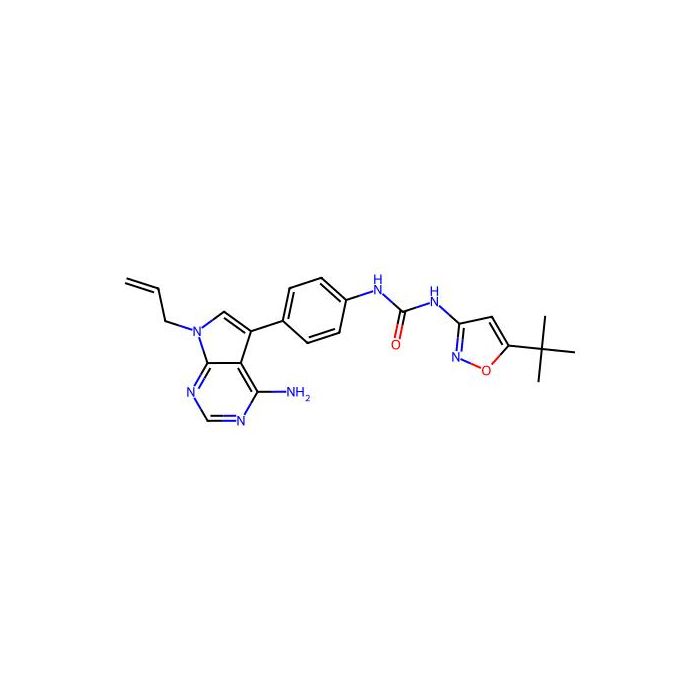
FLT3-IN-4 is a potent and orally effective Fms-like tyrosine receptor kinase 3 ( FLT3 ; IC 50 =7 nM) inhibitor for treating acute myelogenous leukemia.
In Vitro
FLT3-IN-4 (Compound 9u) shows potent inhibitory activities against MV4-11 and Molm-13 cells with IC 50 values are 0.089±0.001 nM and 0.022±0.003 nM, respectively. MCE has not independently confirmed the accuracy of these methods. They are for reference only.
Form:Solid
Specifiche
Specifiche e purezza
≥98%
Meccanismi biochimici e fisiologici
FLT3-IN-4 is a potent and orally effective Fms-like tyrosine receptor kinase 3 ( FLT3 ; IC 50 =7 nM) inhibitor for treating acute myelogenous leukemia.
Condizioni di conservazione di stoccaggio
Store at -20°C
Spedito in
Ice chest + Ice pads
Questo prodotto richiede spedizione a catena fredda. I servizi di terra e altri servizi economici non sono disponibili.
Tipo di azione
INHIBITOR
Purezza
≥98%
Nomi e identificatori
Peso molecolare
431.49
Dati avanzati
Certificati (CoA, COO, BSE/TSE e tabella di analisi)
C of A & Other Certificates(BSE/TSE, COO):
Analytical Chart:
Proprietà chimiche e fisiche
Solubilità
DMSO : 25 mg/mL (57.94 mM; Need ultrasonic)
Calcolatori di soluzioni
Molarity Calculator
Determine the necessary mass, volume, or concentration for preparing a solution.
Dilution Calculator
Determine the dilution needed to prepare a stock solution.
Reconstitution Calculator
Recensioni
Recensioni dei clienti
Application Protocols
No tested application protocols, recommended dilutions, or validated assay formats are provided in the Product Data for this item.
Per non-negotiable rules, application specifics must come from product data. For guidance, refer to:
The product’s SDS and CoA/Spec Sheet for any handling or preparation notes.
Peer-reviewed literature and internal SOPs for FLT3 kinase assays or cell-based signaling studies if you intend to employ this compound as a tool molecule.
If you require a starting point, Aladdin Scientific technical support can provide references to general kinase assay workflows and good practices (control selection, plate setup, vehicle control usage), but no item-specific protocol is claimed here.
Biological Roles
Item-specific biological data (potency, selectivity, cellular activity) are not provided. The following context concerns the FLT3 pathway and the general role of small-molecule inhibitors as research tools (literature, general):
FLT3 (Fms-like tyrosine kinase 3): A class III receptor tyrosine kinase expressed predominantly in hematopoietic progenitors. Activation by FLT3 ligand (FL) drives signaling through PI3K/AKT, RAS/MAPK, and JAK/STAT pathways to regulate proliferation, differentiation, and survival of hematopoietic cells.
Inhibitor role: ATP-competitive small molecules targeting FLT3 serve as chemical probes to dissect receptor autophosphorylation, downstream effector modulation (e.g., STAT5 phosphorylation), and feedback regulation.
Selectivity considerations: Kinase inhibitors often display activity across a subset of kinases with related ATP-binding site features. Profiling against kinome panels helps define on-/off-target interactions and informs phenotypic outcomes.
Assay systems: Common biological evaluations include recombinant kinase assays, cellular phospho-protein ELISA/western blotting, and reporter assays in engineered cell lines expressing FLT3.
ADME/stability (general): Drug-like heteroaromatics may exhibit variable microsomal stability, plasma protein binding, and permeability; these parameters shape observed cellular potency and should be empirically determined when relevant to the study design.
Note: All usage is restricted to laboratory research. No clinical, diagnostic, or therapeutic claims are made or implied for this product.
Buffer Applications
This item is not a buffering reagent. However, when using small-molecule kinase inhibitors in biochemical assays, buffer composition can critically influence apparent potency and specificity. No item-specific buffer requirements are provided.
General guidance for kinase assay buffers (literature/practice):
Composition: 20–50 mM HEPES or Tris (pH 7.3–7.6), 0.1–0.5 mM EDTA (as needed), 5–10 mM MgCl2 or MnCl2 (cofactor for phosphorylation), 0.01–0.05% Tween-20 to mitigate aggregation/adsorption, 0.1 mg/mL BSA to reduce nonspecific binding.
ATP concentration: Adjust near the enzyme’s Km(ATP) to properly evaluate ATP-competitive inhibition; too high ATP can mask inhibitor potency.
Reducing agents: 0.5–2 mM DTT or TCEP may be included to maintain enzyme stability; verify compound stability toward reductants.
DMSO tolerance: Validate enzyme activity across 0–1% v/v DMSO to set acceptable solvent limits for your assay.
Filtration/clarification: Centrifuge or filter test solutions to remove particulates that can confound readouts.
For cell-based assays, use serum conditions and media compatible with the cell model, and maintain constant vehicle concentration across treatments. Refer to assay-specific SOPs and literature for FLT3 assay conditions.
Green Alternatives
As a research tool compound, environmental impact is primarily influenced by the choice of solvents and scale of use rather than the compound itself. While item-specific synthesis and solvent data are not provided, the following general green-chemistry considerations can reduce footprint:
Prefer aqueous systems: Where feasible, maximize aqueous buffer content and minimize organic co-solvent (e.g., keep DMSO ≤0.1–0.2% v/v in assays) to reduce VOCs.
Greener stock solvents: If solubility permits, consider ethanol (preferably bio-derived) instead of aprotic dipolar solvents; validate biological compatibility first.
Microscale operations: Conduct screening and profiling at the lowest practical scale to reduce chemical consumption and waste.
Benign surfactants: Use low-toxicity, biodegradable surfactants (e.g., polysorbates) for solubilization where appropriate.
Waste segregation: Segregate aqueous vs. organic waste; avoid halogenated solvents in any ancillary purification steps when alternatives (e.g., ethyl acetate, 2-MeTHF) suffice.
Illustrative comparison (general; not item-specific):
2-MeTHF (for synthetic workup/purification if applicable): Bio-based, lower peroxide risk than THF; immiscible with water; not typically used in bioassays but valuable in upstream synthesis.
Adopt institution-specific green lab guidelines (e.g., solvent selection guides) to further optimize environmental performance.
Pharmaceutical Uses
No pharmacopeial status, excipient role, or clinical applicability is provided for this item. It is supplied strictly for research use.
Typical roles of such compounds in pharmaceutical R&D (general, not item-specific):
Reference/benchmark compound: Used as a positive control or comparator in FLT3-targeted screening cascades and mechanistic studies.
Analytical standard: Supports development/qualification of bioanalytical LC–MS/MS methods (e.g., establishing retention times, MRM transitions) for related chemical matter.
Tool for SAR and target validation: Helps define structure–activity relationships, guide medicinal chemistry design, and validate FLT3 as a tractable target in preclinical research models.
Stability studies: Employed in forced-degradation and stability-indicating method development to understand liability motifs (oxidation, hydrolysis, photolysis) of analogous series (general practice).
Compliance note:
Not intended for use in humans or animals, not for diagnostic procedures, and not manufactured under GMP unless explicitly stated on accompanying documentation. For any regulated application, obtain and review the CoA/SDS and align with institutional QA requirements.
Physical Properties
Item-specific physicochemical specifications are not provided in the Product Data.
Molecular weight: Not specified for this item; refer to CoA/Spec Sheet.
Molecular formula: Not specified for this item; refer to CoA/Spec Sheet.
Melting point (MP): Not specified for this item; refer to CoA/Spec Sheet.
Boiling point (BP): Not applicable/unknown for a non-volatile solid; item-specific value not specified.
Density: Not specified for this item; refer to CoA/Spec Sheet.
Refractive index: Not applicable for solids; item-specific value not specified.
Solubility: Not specified for this item; refer to CoA/Spec Sheet.
General/literature guidance for kinase tool compounds (not specific to this item):
Many kinase inhibitors are sparingly soluble in water but dissolve in polar aprotic solvents such as DMSO and DMF; aqueous working solutions are typically prepared by diluting DMSO stocks into assay buffers containing carrier protein or surfactant to mitigate precipitation.
Typical screening stocks are prepared at 10–50 mM in anhydrous DMSO and aliquoted to avoid freeze–thaw cycles (literature, general practice).
DMSO properties (literature): dielectric constant ~47, miscible with water; keep final DMSO in bioassays ≤0.1–0.5% v/v to minimize solvent effects.
If concrete physical data are required for method development or safety assessment, please consult the CoA/Spec Sheet and the SDS for this specific lot.
Quality and Grades
Item-specific grade, purity, and stabilizers are not provided in the Product Data.
Grade/Purity: Not specified for this item; refer to CoA/Spec Sheet.
Stabilizers/antioxidants: Not specified for this item; refer to CoA/Spec Sheet.
Guidance on interpreting typical documentation (general, not item-specific):
Research-use small molecules are commonly released with HPLC purity and LC–MS/HRMS identity data. Some catalogs also include 1H/13C NMR confirmation and water/residual solvent content.
For screening and assay use, higher HPLC purity (e.g., ≥95% area) is often preferred to minimize off-target background; however, the fit-for-purpose threshold depends on the application (biochemistry vs. cell-based).
If UV transparency is relevant (e.g., for HPLC detection), refer to the UV spectrum on the CoA to ensure minimal interference at your detection wavelength.
If the compound is supplied as a free base vs. salt, verify stoichiometry on the CoA to calculate accurate molar stock concentrations.
Lot-specific documents:
For exact specifications (purity method, chromatographic conditions, counterion content, residual solvents, water content), please consult the CoA/Spec Sheet that accompanies your lot or request it from Aladdin Scientific support.
Regulatory note:
Provided strictly for research use only; not tested for clinical, diagnostic, or food/cosmetic applications.
Reaction and Applications
This product is supplied as a bioactive small molecule for research, not as a general-purpose synthetic reagent. No item-specific synthetic application notes are provided.
Research applications (general, not item-specific):
Enzymology: Use as a test article in in vitro kinase assays to probe FLT3 catalytic activity, ATP-competitive inhibition, and enzyme kinetics (e.g., IC50/Ki determination). Optimize ATP concentration near the Km of the kinase to assess competitive behavior.
Cell biology: Evaluate pathway engagement using cellular readouts such as phospho-FLT3 levels or downstream signaling markers (e.g., STAT5 phosphorylation) under serum-controlled conditions.
Chemical biology: Employ as a tool compound in target-validation studies, chemoproteomics, or structure–activity relationship (SAR) benchmarking against analogs.
Analytical: Serve as a reference material for LC–MS method development (retention behavior, mass transitions) and stability-indicating assays.
Practical tips (general):
Prepare fresh DMSO stock solutions and aliquot to avoid repeated freeze–thaw cycles. Assess precipitation upon dilution; if observed, reduce concentration or adjust co-solvent/surfactant.
Control solvent carryover and plate effects in HTS/biochemical assays by using matched vehicle controls and edge-well management.
Confirm chemical identity and purity by orthogonal methods (LC–MS, HPLC, NMR) if your application is highly sensitive to impurities.
Note: No reaction chemistry or named-reaction utility is claimed for this item in the provided Product Data.
Reaction Conditions
No item-specific reaction conditions are provided because this product is intended as a bioactive small-molecule tool rather than a synthetic reagent. For users performing biochemical evaluations, the following general conditions (literature/practice) are commonly applied to kinase inhibitors and can be adapted to FLT3 systems:
Stock preparation: 10–50 mM in anhydrous DMSO; store aliquots at −20 °C; thaw immediately before use.
Enzyme assays:
Buffer: 20–50 mM HEPES (pH ~7.5), 5–10 mM MgCl2, 0.01–0.05% Tween-20, ±0.1 mg/mL BSA.
ATP: Titrate around Km(ATP) to assess competitive inhibition; typical screening at 10–100 µM ATP depending on kinase preparation (general).
Temperature/time: 25–30 °C for 15–60 min; ensure initial-rate conditions.
Detection: ADP-coupled assays, radiometric incorporation, or phospho-specific antibody readouts.
Cellular assays:
Vehicle: Maintain constant DMSO (≤0.1–0.5% v/v).
Incubation: 0.5–4 h pre-treatment before stimulation/readout is common; optimize per cell line and endpoint.
Stability checks: Assess compound integrity in assay buffer over the experimental time frame by LC–MS to rule out degradation/adsorption.
These are illustrative, literature-based practices and are not specifications for this item. Always validate conditions empirically for your biological system.
Safety and Handling
GHS and hazard classifications are not provided in the Product Data for this item. Always consult the product-specific SDS before use.
Item-specific hazard fields:
Signal word: Not specified for this item; refer to SDS.
H-statements: Not specified for this item; refer to SDS.
GHS classification: Not specified for this item; refer to SDS.
Pictograms: Not specified for this item; refer to SDS.
General laboratory precautions for small-molecule research compounds:
PPE: Lab coat, safety glasses, and appropriate chemically resistant gloves (e.g., nitrile). Handle powders in a fume hood to avoid inhalation and dust exposure.
Avoid exposure: Prevent contact with skin, eyes, and clothing. Avoid generating aerosols or dust. Wash thoroughly after handling.
Incompatibilities: Avoid strong oxidizers and strong acids/bases unless compatibility is verified (general chemical hygiene). Use dry, oxygen-free conditions if handling in anhydrous solvents.
First aid (overview; defer to SDS): If inhaled, move to fresh air; if on skin, wash with soap and water; if in eyes, rinse cautiously with water for several minutes; if ingested, rinse mouth and seek medical attention. Provide the SDS to healthcare personnel.
Spill response: Avoid dust formation; collect using disposable wipes/HEPA-filtered vacuum; place waste in a sealed container for disposal per institutional and regulatory requirements.
DMSO handling note (if used for stocks): DMSO can enhance dermal absorption of solutes; avoid skin contact when handling solutions.
Waste disposal:
Dispose of according to local regulations for organic laboratory chemicals; segregate halogenated vs non-halogenated solvent waste as applicable.
Solvent Selection
This product is a small-molecule inhibitor intended primarily for biochemical/cellular assays rather than as a bulk solvent. Solubility parameters for this specific item are not provided; consult the CoA/Spec Sheet. The following guidance reflects common practice for kinase tool compounds (general, not item-specific):
Primary stock solvent: Anhydrous DMSO is widely used due to its strong solvating power for aromatic/heteroaromatic drug-like molecules and full miscibility with water.
Alternative stock solvents:DMF, NMP, or ethanol can be considered if DMSO is unsuitable, ensuring compatibility with the biological system.
Working solution preparation: Dilute the organic stock into buffered aqueous media (e.g., HEPES, Tris, or PBS-based assay buffers) with gentle mixing to minimize local supersaturation.
Co-solubilization strategies: Include small amounts of non-ionic surfactants (e.g., 0.01–0.05% Tween-20 or Pluronic F-68) or carrier protein (e.g., 0.1% BSA) to reduce aggregation/adsorption (general practice).
Final organic content: Keep final DMSO ≤0.1–0.5% v/v in enzyme and cell assays to limit solvent effects (optimize per system).
Filtration: For light particulates, pass working solutions through a 0.22–0.45 µm low-protein-binding filter.
Comparison (literature, general):
DMSO (ε ~47, high solvency; can alter cell membranes at >0.5–1%).
DMF/NMP (ε ~38/32; strong solvency but generally avoided in live-cell contexts due to cytotoxicity). Select based on assay needs.
Storage and Reconstitution
Item-specific storage from Product Data:
Storage Conditions: Store at −20 °C.
Shipped In: Ice chest + Ice pads.
Additional best practices (general; not item-specific specifications):
Protection: Store in a tightly closed container, protected from light and moisture. If supplied as a solid, allow the container to equilibrate to room temperature in a desiccator before opening to prevent moisture condensation.
Reconstitution: If preparing stock solutions (e.g., in anhydrous DMSO), use dry, oxygen-free solvent when possible. Record exact mass and final volume to ensure accurate molarity. Vortex and, if needed, sonicate briefly to aid dissolution.
Aliquoting: Divide stock into single-use aliquots (e.g., 10–50 µL) to avoid repeated freeze–thaw. Store aliquots at −20 °C or lower in amber vials or low-bind tubes.
Freeze–thaw: Avoid multiple cycles; inspect for precipitation or discoloration before use.
Working solutions: Prepare fresh on the day of experiment. For aqueous dilutions, add organic stock slowly with mixing to minimize local supersaturation. If precipitation occurs, reduce concentration or adjust co-solvent/surfactant as permitted by the assay.
Stability: No item-specific stability data are provided; verify solution stability by LC–MS/HPLC over intended use times.
For exact reconstitution solvent, concentration limits, and stability for your lot, consult the CoA/Spec Sheet.
Structure and Identity
FLT3-IN-4 is supplied as a small-molecule research tool categorized under small molecules and compound libraries.
Molecular formula: Not specified for this item; refer to CoA/Spec Sheet.
Molecular weight: Not specified for this item; refer to CoA/Spec Sheet.
SMILES: Not specified for this item; refer to CoA/Spec Sheet.
InChIKey: Not specified for this item; refer to CoA/Spec Sheet.
Appearance: Not specified for this item; refer to CoA/Spec Sheet.
Structural features (general context):
No structure is provided in the item data. Many FLT3-targeted inhibitors are aromatic/heteroaromatic kinase-directed scaffolds designed to engage the ATP-binding site through hydrogen-bond acceptors/donors and hydrophobic motifs (literature, general). This description is not specific to this item.
2D structural description (item-specific):
Not specified for this item; refer to CoA/Spec Sheet.
Research use note:
For research use only. Not for diagnostic or therapeutic use.
Synthetic Utility
This product is not presented as a synthetic building block in the Product Data, and no functional-group specifications are provided.
Context (general):
Many kinase inhibitors contain heteroaromatic cores, amide/urea linkages, or anilide motifs; while such scaffolds can, in principle, be elaborated, commercial tool compounds are typically used as final molecules rather than intermediates.
If derivatization is of interest (e.g., for probe development, biotinylation, or photoaffinity labels), first confirm the presence and accessibility of a modifiable handle via the structural data in the CoA/Spec Sheet. Any modification may materially alter target engagement.
Recommendation:
Use this product primarily as a reference/tool compound. For synthetic exploration or conjugation chemistry, request detailed structural information and consider sourcing building-block analogs explicitly designed for SAR or linker attachment.
Target Specificity
Item-specific target panel data, potency values, or selectivity profiles are not provided in the Product Data for FLT3-IN-4.
Primary intended target (name inference from product name): FLT3 (Fms-like tyrosine kinase 3), a receptor tyrosine kinase. However, no potency/selectivity data are supplied for this specific item.
No antigen/epitope/clone/isotype information applies (this is not an antibody product).
Please consult the CoA/Spec Sheet or contact Aladdin Scientific for any available biochemical profiling data (e.g., IC50, KD, kinome scan results) associated with your lot.
Domande frequenti
How is this product shipped?
This product ships in an insulated container with ice pads. Unpack on arrival and transfer it to the storage condition stated above.
What are the CAS number, molecular formula and molecular weight?
The CAS Number is 2304799-09-3, the molecular formula is C23H25N7O2, and the molecular weight is 431.49 g/mol.
What is the purity of this product?
This product is supplied at ≥98% purity (chemical assay). Lot-specific values are stated on the Certificate of Analysis.
How should this product be stored?
Store at ?20 °C. Freezer storage is required to maintain the specified shelf life.
What documentation is provided?
Available product documentation, including Certificates of Analysis (COA), Safety Data Sheets (SDS), and specification sheets, is shown in the product document area. Document availability and access follow the current site policy.
Utilizziamo i cookie per garantire il corretto funzionamento del sito web e, ove consentito, per migliorare la tua esperienza. Puoi gestire le tue preferenze in qualsiasi momento nelle Impostazioni. Per saperne di più, consulta la nostra Cookie Policy.
Desidera che le inviamo un messaggio quando avremo sconti disponibili?
Ricordamelo più tardi
Grazie! Controlli la sua casella di posta per confermare.
Products are supplied to verified businesses, institutions, and qualified professionals for research and development use only. Not for use in humans, animals, diagnosis, or therapy.