QUALITÀ & PUREZZAMoligand™?Moligand™ — Aladdin's line of ligands and bioactive small molecules. Use for receptor, pathway, and binding studies needing defined small-molecule tools.10mM in DMSO
Moligand™, 10mM in DMSO Moligand™ per flussi di lavoro cromatografici e analitici sensibili che richiedono un'interferenza minima della linea di base.
🌡
Stoccaggio e spedizione
Store at -80°C Spedizione Dry ice packs + Cold packs. Consultare il COA specifico del lotto per le specifiche esatte.
📋
Documenti di qualità
SDS, COA, scheda tecnica e scheda delle specifiche disponibili per il download. COA specifico del lotto accessibile tramite ricerca per numero di lotto.
📚
Prova documentale
Citato in 2 pubblicazioni peer-reviewed su cromatografia, sintesi organica e reazioni di accoppiamento incrociato.
Panoramica
Information
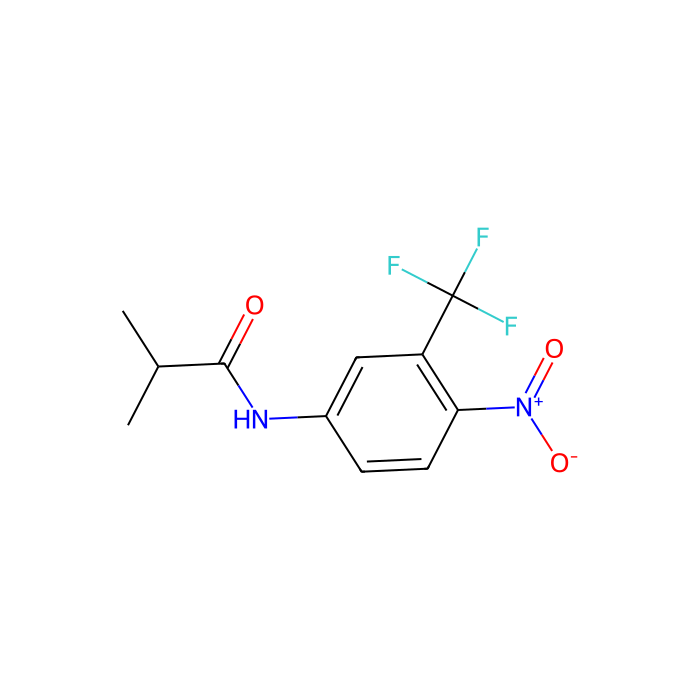
Flutamide Flutamide (SCH-13521) is an antiandrogen drug, with its active metablolite binding at androgen receptor with K i values of 55 nM, and primarily used to treat prostate cancer. In vitro
Flutamide (Eulexin) is an antiandrogen drug. Flutamide-OH, the active metabolite of flutamide, directly binds at rat anterior pituitary androgen receptor with Ki values of 55 nM. Flutamide does not affect the proliferation of an androgen-sensitive clone of the mouse mammary carcinoma Shionogi SC-l 15 cells in culture, shows only antiandrogenic effect, but not androgenic effect. Flutamide provides treatment for prostate cancer when used along with leuprolide.
In vivo
Flutamide causes a markedly reduction in rat ventral prostate weight from 319 mg to 245 mg. A combination of flutamide and LHRH agonist induces an additive effect with a decrease in prostate weight to 101 mg, and an marked drop in prostatic ODC activity. Cell Data
Flutamide (SCH-13521) is an antiandrogen drug, with its active metablolite binding at androgen receptor with Ki values of 55 nM, and primarily used to treat prostate cancer.
Condizioni di conservazione di stoccaggio
Store at -80°C
Spedito in
Dry ice packs + Cold packs
Questo prodotto richiede spedizione a catena fredda. I servizi di terra e altri servizi economici non sono disponibili.
Determine the necessary mass, volume, or concentration for preparing a solution.
Dilution Calculator
Determine the dilution needed to prepare a stock solution.
Reconstitution Calculator
Recensioni
Recensioni dei clienti
Application Protocols
No vendor-validated bioassay protocols are provided for this small-molecule item. Typical user workflows include:
Preparation of DMSO master stocks (10–100 mM), serial dilution, and dosing into biochemical or biophysical assays with appropriate vehicle controls.
LC–MS/MS calibration curve preparation (e.g., 0.5–1000 ng/mL) in relevant matrices for bioanalytical method development.
Any application-specific parameters (WB, IHC, IF, FC) are not applicable to this compound. For detailed methods, consult peer‑reviewed literature and validate locally.
Biological Roles
The following describes general, literature-based biochemical context and is not a medical or therapeutic claim.
Xenobiotic fate (literature)
Flutamide is a lipophilic anilide that undergoes hepatic oxidative metabolism. The primary oxidative metabolite reported is 2‑hydroxyflutamide (phase I), with further conjugation (phase II) via glucuronidation.
Cytochrome P450 enzymes (notably CYP1A2 and others, literature) catalyze aromatic hydroxylation and N‑dealkylation pathways typical for anilides and nitroaromatics.
Molecular recognition features
The amide NH and carbonyl provide H‑bonding capacity; the nitro and CF3 groups tune electronics and lipophilicity, affecting binding to hydrophobic protein cavities.
The CF3 substituent is metabolically robust and often increases residence time by enhancing hydrophobic contacts.
Physicochemical drivers of ADME (qualitative, literature)
Moderate lipophilicity (logP ~2–2.5) and neutrality favor passive membrane permeability; low aqueous solubility can limit free concentrations in aqueous media.
Nitroaromatic functionality may be bioreductively sensitive under certain cellular conditions but is generally stable in aerobic aqueous buffers for short-term assays.
Laboratory implications
For target engagement studies, verify equilibrium is achieved in the presence of binding proteins/serum; protein binding may sequester the compound.
Track parent vs metabolite content in microsome/S9 incubations by LC–MS/MS, as hydroxyflutamide formation is a common readout in metabolic stability assays.
Buffer Applications
This compound is not a buffering agent and does not form defined buffer systems. It is typically introduced into existing buffers as a solute from an organic stock solution (e.g., DMSO).
Practical notes
Maintain low final organic content (≤0.5–1% v/v DMSO) to preserve buffer properties and biological assay integrity.
If precipitation occurs upon dilution, increase the percentage of compatible cosolvent (ethanol or acetonitrile), add solubilizers (e.g., HP‑β‑cyclodextrin), or warm briefly and sonicate.
Filter through 0.2 μm membranes (PTFE or PVDF) if particulates are observed; avoid cellulose esters with high DMSO content.
Green Alternatives
Because flutamide is a solid, “green” considerations primarily concern solvent choices for dissolution, processing, and analytical workflows rather than replacing the active substance.
Replace DMF/NMP with DMSO when feasible (lower toxicity profile, good solvating power).
Consider ethanol or isopropanol in place of acetonitrile for preparative tasks if solubility permits; confirm no impact on assay or crystallization outcomes.
For extractions, prefer ethyl acetate or MTBE over dichloromethane/chloroform where partitioning allows.
Aqueous enabling strategies
Use cyclodextrins (e.g., 10–20% HP‑β‑CD) or mild surfactants to increase apparent solubility, enabling lower organic content in assays.
Apply microscale dosing (acoustic or pin‑tool) from concentrated DMSO master plates to minimize solvent volumes and waste.
Comparative snapshot (literature/general)
DMSO: high solvency, low volatility, acceptable EHS profile; widely compatible with biochemical assays up to 0.5–1%.
Ethanol: renewable feedstock, readily biodegradable; may impose assay constraints at >1–2% v/v and can reduce solubility relative to DMSO.
Acetonitrile: excellent chromatography solvent but higher environmental burden; optimize gradients to minimize usage.
Process and waste minimization
Scale experiments to analytical/microscale when establishing conditions; employ LC–MS microflows; segregate halogenated waste from CF3‑containing synthesis streams.
Tradeoffs
Greener solvents may reduce solubility; verify concentration targets and precipitation risk in your system prior to committing to a switch.
Pharmaceutical Uses
No clinical or therapeutic claims are made for this product; it is supplied strictly for research use.
Reference standard for analytical method development (HPLC/UPLC–MS) in quality control labs and bioanalytical studies.
System suitability/retention marker in reversed‑phase chromatography due to its robust UV chromophore and moderate hydrophobicity.
Internal/working standard for dissolution, stability, and extractables/leachables impact assessments, where appropriate.
Compendial status
Potential compendial monographs may exist in major pharmacopeias for flutamide as a drug substance; verification is user’s responsibility. Specific pharmacopeial specifications for this item are Not specified for this item; refer to CoA/Spec Sheet.
Formulation relevance (research context)
Low aqueous solubility necessitates cosolvent systems or solid dispersion approaches in preformulation studies.
Stability screening across pH 2–9 (buffered) and under light/oxidative stress is recommended to define handling limits for analytical reference use.
Physical Properties
Note: Values below are literature/computational references for flutamide, provided for planning purposes only. They are not item-specific specifications for SKU F408131.
Appearance: Not specified for this item; refer to CoA/Spec Sheet.
Phase at RT: crystalline solid (literature)
Melting point: ~110–114 °C (literature)
Boiling point: Not applicable (decomposes before boiling at ambient pressure) (literature)
Molecular weight: ~276.21 g/mol (literature)
Density: Not specified for this item; refer to CoA/Spec Sheet.
pKa: no strongly ionizable groups in the physiological range; amide N is nonbasic; very weak acidity of amide N (literature, qualitative)
logP (XlogP3-AA): ~2.2–2.5 (literature)
Aqueous solubility: low; practically insoluble in water (literature). Typical practice is dissolution in DMSO or DMF, then dilution with aqueous buffer to low final % organic.
Solubility in organics (qualitative, literature):
DMSO, DMF, NMP: high
Ethanol, methanol, acetonitrile: moderate
Ethyl acetate, dichloromethane: moderate to low (method-dependent)
Hexanes: poor
UV–vis: aromatic nitroanilides exhibit strong absorption in the UV; exact ε/λmax not specified here (literature trend).
Vapor pressure: negligible at ambient (nonvolatile solid) (literature expectation).
Quality and Grades
Supplied grade (item-specific): Moligand™. This designation indicates the compound is part of a curated small‑molecule/ligand collection intended for screening, chemical biology, and reference workflows.
What Moligand™ typically implies (general guidance; consult CoA for this lot):
Identity confirmation by orthogonal methods (commonly 1H NMR/LC–MS/HRMS). Specific methods and acceptance criteria are batch-dependent.
Purity suitable for screening and reference use; exact purity percentage, residual solvents, and related impurities are Not specified for this item; refer to CoA/Spec Sheet.
Format may be neat solid, plated film, or pre-dissolved DMSO stock depending on order configuration; see label/pack slip for exact form.
UV/background considerations: For analytical assays (HPLC/UPLC–UV), nitroaromatic chromophores give strong UV absorbance; choose mobile‑phase wavelengths accordingly.
Stabilizers/inhibitors: None indicated. If any stabilizer is present, it will be listed on the CoA/specification.
Trace limits (water, peroxides, metals, UV cutoff): Not specified for this item; refer to CoA/Spec Sheet.
Practical note for screening campaigns: Verify concentration by quantitative NMR or UV with extinction coefficient calibration when preparing master plates; confirm solubility in your assay buffer at the intended DMSO percentage to avoid precipitation artifacts.
Reaction and Applications
This compound is supplied primarily as a small‑molecule ligand/reference for discovery and analytical use rather than as a general-purpose reagent. Nonetheless, its functional groups enable several useful laboratory applications.
Screening and chemical biology (typical use for Moligand™ items)
Positive control or comparator in target engagement assays (e.g., ligand competition, thermal shift, SPR, DSF) where applicable to your target class.
Benchmark for bioanalytical methods (LC–MS/MS) development and validation, including recovery, matrix effects, and stability studies.
Crystallography: potential co‑crystallization/soaking ligand for structural studies of binding proteins; ensure high-purity DMSO stocks and gradual soaking to avoid precipitation.
Reactivity/derivatization (general chemistry)
Nitro group: reducible (e.g., catalytic hydrogenation, Fe/NH4Cl, SnCl2) to give the corresponding aniline, opening access to diazotization, azo coupling, or further acylation/urea formation.
Amide bond: relatively robust; can be hydrolyzed under strong acidic/basic conditions; transamidation under activating conditions (e.g., Vilsmeier, CDI routes) if derivatization is desired.
CF3 substituent: strongly deactivating; resists many electrophilic aromatic substitutions; directs metalation to positions activated by amide/nitro if harsh conditions are used.
Analytical characterization tips
Strong UV chromophore from nitroaromatic ring facilitates HPLC–UV at 254–280 nm.
In LC–MS, observe [M+H]+ at m/z ~277 (literature) with characteristic Cl-free isotope pattern; CF3 often fragments to give neutral HF loss signatures depending on ion source conditions.
Practical handling
Avoid prolonged light/heat during long assays; verify stability in the chosen buffer and vehicle by short-term LC re-checks.
Reaction Conditions
General literature guidance for transformations relevant to flutamide’s functional groups (not production instructions for this item):
Nitro reduction to aniline
Catalytic hydrogenation: H2 (1–3 bar), Pd/C (5–10 wt%), MeOH/EtOH or EtOAc, 20–40 °C, 1–6 h. Monitor to avoid over‑reduction of other moieties. Isolated yields commonly 70–95% (substrate-dependent; literature).
Chemoselective transfer hydrogenation: Fe/NH4Cl or Zn/NH4Cl in EtOH/H2O at 25–60 °C can give high conversions with minimal dehalogenation (literature).
Basic: NaOH or KOH (1–5 M) in EtOH/H2O, 70–100 °C, 4–24 h; yields of aniline and carboxylate typically high but substrate resistant due to deactivation.
Acidic: HCl (6 M) or H2SO4 (conc.) under reflux; longer times required owing to aromatic amide stability.
Chemical surrogates (e.g., Fremy’s salt, CAN, or directed lithiation followed by quench) can provide hydroxy analogs, but regioselectivity is challenging; enzymatic/microsomal systems are commonly used in practice.
Stock solution preparation for assays
Dissolve to 10–100 mM in anhydrous DMSO; sonicate/warm gently (≤40 °C) if needed. Confirm by LC–MS or qNMR. Store aliquots at −80 °C to minimize freeze–thaw.
All conditions above are literature-style guidance and must be optimized and validated for your specific substrate, scale, and EHS constraints.
Safety and Handling
Authoritative safety information resides in the product’s SDS. Because item-specific hazard data were not provided, treat flutamide as a potentially hazardous research chemical and follow conservative lab practices.
GHS classification, signal word, hazard statements, pictograms: Not specified for this item; refer to SDS.
General hazards (literature-informed): aromatic nitroanilides may present toxicity on ingestion/inhalation and may cause skin/eye irritation. Avoid dust generation and aerosolization.
Engineering controls: handle in a fume hood with appropriate local exhaust; implement dust control for powders.
PPE: lab coat, safety glasses or splash goggles, and suitable gloves (e.g., nitrile). For weighing/milling, consider a particulate respirator in accordance with institutional policy.
Incompatibilities: strong oxidizers and strong reducing agents (nitro group is redox‑active); strong bases and strong acids can catalyze amide hydrolysis under forcing conditions; avoid reactive acylating agents.
Thermal stability: degrades on strong heating; avoid temperatures near decomposition.
First aid (summary; see SDS for details):
Inhalation: move to fresh air; seek medical attention if symptoms persist.
Skin: wash with soap and water; remove contaminated clothing.
Eyes: rinse cautiously with water for several minutes; remove contact lenses if present and easy; continue rinsing.
Ingestion: rinse mouth; obtain medical attention.
Spill response: avoid raising dust; collect with inert absorbent; dispose per local regulations.
Waste: treat as hazardous organic waste; segregate halogenated solvent residues if used during cleanup.
Solvent Selection
Flutamide is a neutral, moderately lipophilic aromatic amide with low water solubility. Solvent choice should balance solubilization, assay compatibility, and safety.
Partitioning: logP ~2.2–2.5 (literature) indicates preference for organic phases.
Recommended stock solutions
Prepare concentrated stocks (e.g., 10–100 mM) in dry DMSO. Filter through 0.2 μm PTFE if particulates persist.
For aqueous assays, dilute DMSO stocks into buffer to ≤0.5–1.0% v/v DMSO final to limit vehicle effects; include vehicle controls.
Co-solvent and formulation tactics
For higher aqueous loadings: cosolvent blends (e.g., 10–20% acetonitrile or ethanol) or use of solubilizers (HP‑β‑cyclodextrin, small amounts of nonionic surfactant) can help; confirm no assay interference.
For synthetic manipulation: ethyl acetate or dichloromethane for extractions; methanol/ethanol for recrystallization trials (literature practices).
Comparison notes
DMSO vs DMF: DMSO is generally preferred for bioassays (lower volatility, better biocompatibility), whereas DMF can offer similar solubility but is more problematic toxicologically.
Acetonitrile vs ethanol: ACN offers lower viscosity and strong elution strength for LC methods; ethanol is a greener option but may give lower solubility.
Drying/compatibility
Hygroscopicity is low; however, water in solvents can impact assay solubility limits. Use anhydrous solvents for precise dosing and crystallography.
Storage and Reconstitution
Item-specific storage and shipping (from Product Data)
Storage: Store at −80 °C.
Shipped: On dry ice packs + cold packs.
General handling guidance for small‑molecule library solids/stocks
Upon receipt, allow the sealed container to equilibrate to room temperature before opening to minimize moisture condensation.
If supplied as a DMSO solution/film, centrifuge plates/tubes briefly before opening to collect contents.
Reconstitution (literature/best practice)
Dissolve in anhydrous DMSO to prepare a 10–100 mM stock. Gentle warming (≤40 °C) and brief sonication can assist dissolution. If needed, add a small co‑solvent fraction (EtOH or ACN) and then back‑dilute with DMSO.
Filter through a 0.2 μm PTFE syringe filter if particulates persist.
For aqueous assays, dilute into buffer slowly with mixing to a final DMSO content ≤0.5–1% v/v to avoid precipitation; prepare fresh working solutions.
Aliquoting and stability
Aliquot stocks into low‑bind tubes to single‑use volumes (e.g., 10–50 μL) to avoid repeated freeze–thaw.
Store aliquots at −80 °C protected from light and moisture. Working stability in DMSO at room temperature is experiment‑dependent; item-specific stability data are Not specified for this item; refer to CoA/Spec Sheet.
Shelf life
No explicit shelf-life is provided for this item. Verify integrity periodically by HPLC/LC–MS and compare to initial reference data.
Structure and Identity
Brief overview: Flutamide is a trifluoromethylated nitroanilide (aromatic amide) commonly used as a small‑molecule ligand/standard in discovery screening and bioanalytical workflows.
Item-specific identifiers from Product Data
SKU: F408131
CAS: 13311-84-7
Category: Small molecules and compound libraries (Moligand™ collection)
Research use: For research use only
Literature structural data (for reference; not item-specific specifications)
While flutamide is primarily handled as a finished small molecule, its functional motifs allow transformations valuable for analog generation, labeling, or mechanistic studies.
Transformable handles (literature/general)
Nitro group: reduction to aniline enables further diversification (diazotization/azo coupling, urea/carbamate formation, amide re‑acylation). Selective partial reductions (e.g., to hydroxylamine) can probe SAR.
Amide: hydrolysis to the corresponding aniline and isobutyric acid under forcing acidic/basic conditions; activation (e.g., via CDI or Vilsmeier reagents) can enable transamidation.
Aromatic core: CF3 strongly deactivates electrophilic substitution; metalation-directed cross‑couplings are challenging but possible after aniline formation/derivatization.
Retrosynthetic perspective (general)
Common routes assemble the anilide by acylation of a substituted aniline with isobutyryl chloride/anhydride, with nitro and CF3 installed by electrophilic nitration and/or trifluoromethylation on a suitable precursor or by starting from commercially available 3‑CF3‑4‑nitroaniline.
Labeling/derivatization
Isotopic labeling (2H/13C/15N) in the amide or ring positions can furnish internal standards for LC–MS/MS quantitation.
Affinity probes: conversion of the anilide to a linker‑bearing urea/carbamate after nitro reduction enables attachment of reporter tags, maintaining the CF3/nitro electronic motif influence.
Purification/analytics
Nitroanilides typically crystallize well; recrystallization from ethanol or EtOAc/hexanes is common (optimize empirically).
Monitor by HPLC–UV at 254–280 nm; LC–MS [M+H]+ ~277 (literature) provides orthogonal confirmation.
Target Specificity
Not applicable to this product type. Flutamide (SKU F408131) is a small‑molecule chemical, not an antibody or biological with defined antigen/epitope parameters. No clone/isotype/species reactivity info applies.
Domande frequenti
What is Moligand??
Moligand? is one of Aladdin Scientific's premium product lines, formulated for high-purity applications across multiple workflows. Compared to standard grades in the same workflow, Moligand? products typically offer tighter specifications, more rigorous QC, and stronger lot-to-lot consistency.
How should this product be stored?
Store at ?80 °C. Ultra-low temperature storage is required to maintain the specified shelf life.
How is this product shipped?
This product ships frozen with dry ice and cold packs. Unpack on arrival and transfer it to the storage condition stated above; handle dry ice with insulated gloves in a ventilated area.
What are the CAS number, molecular formula and molecular weight?
The CAS Number is 13311-84-7, the molecular formula is C11H11F3N2O3, and the molecular weight is 276.22 g/mol.
What documentation is provided?
Available product documentation, including Certificates of Analysis (COA), Safety Data Sheets (SDS), and specification sheets, is shown in the product document area. Document availability and access follow the current site policy.
La nostra guida alla selezione delle qualità copre purezza, stato dello stabilizzatore e idoneità all'applicazione per tutte le varianti del nostro catalogo.
Utilizziamo i cookie per garantire il corretto funzionamento del sito web e, ove consentito, per migliorare la tua esperienza. Puoi gestire le tue preferenze in qualsiasi momento nelle Impostazioni. Per saperne di più, consulta la nostra Cookie Policy.
Desidera che le inviamo un messaggio quando avremo sconti disponibili?
Ricordamelo più tardi
Grazie! Controlli la sua casella di posta per confermare.
Products are supplied to verified businesses, institutions, and qualified professionals for research and development use only. Not for use in humans, animals, diagnosis, or therapy.