≥98% per flussi di lavoro cromatografici e analitici sensibili che richiedono un'interferenza minima della linea di base.
🌡
Stoccaggio e spedizione
Store at 2-8°C Spedizione Wet ice. Consultare il COA specifico del lotto per le specifiche esatte.
📋
Documenti di qualità
SDS, COA, scheda tecnica e scheda delle specifiche disponibili per il download. COA specifico del lotto accessibile tramite ricerca per numero di lotto.
📚
Prova documentale
Citato in 0 pubblicazioni peer-reviewed su cromatografia, sintesi organica e reazioni di accoppiamento incrociato.
This compound belongs to the class of organic compounds known as glutamic acid and derivatives. These are compounds containing glutamic acid or a derivative thereof resulting from reaction of glutamic acid at the amino group or the carboxy group, or from the replacement of any hydrogen of glycine by a heteroatom.
External Descriptors
Not available
1. Djoumbou Feunang Y, Eisner R, Knox C, Chepelev L, Hastings J, Owen G, Fahy E, Steinbeck C, Subramanian S, Bolton E, Greiner R, and Wishart DS. ClassyFire: Automated Chemical Classification With A Comprehensive, Computable Taxonomy. Journal of Cheminformatics, 2016, 8:61.
Determine the necessary mass, volume, or concentration for preparing a solution.
Dilution Calculator
Determine the dilution needed to prepare a stock solution.
Reconstitution Calculator
Recensioni
Recensioni dei clienti
Application Protocols
No test methods such as WB, IHC, IF, or FC apply to this small-molecule reagent. For practical use, see Reaction Conditions for representative SPPS protocols (Fmoc deprotection, coupling, OAll deprotection) and adapt to your peptide sequence and resin system.
Biological Roles
This product is a protected amino acid building block intended for chemical synthesis. It is not a biologically active free amino acid in its protected form.
Context (biochemistry, general):
Glutamate (the deprotected L-glutamic acid) is a proteinogenic amino acid with a negatively charged side chain at physiological pH and plays central roles in protein structure, enzymatic catalysis, and metabolism (e.g., transamination, urea cycle intermediacy).
In peptides, γ-carboxyl functionality enables formation of salt bridges and metal coordination sites; selective side-chain derivatization can modulate binding and stability.
Relevance of the protected form:
Fmoc and OAll protections are synthetic handles; they suppress biological activity and membrane transport and are designed to survive common SPPS steps until selective deprotection.
After peptide assembly and global deprotection, the resulting glutamate residues in the final peptide can contribute to charge, solubility, and conformation.
Note: For research use only. Not intended for use in diagnostics, therapeutic applications, or any form of in vivo administration.
Buffer Applications
Not typically applicable. Fmoc-Glu-OAll is a protected amino acid building block and is not used as a buffer component. For peptide synthesis workflows, focus on the Solvent Selection, Reaction & Applications, and Reaction Conditions sections for practical guidance.
Green Alternatives
While DMF/DCM remain common in SPPS, greener solvent systems and strategies can reduce EHS impact without sacrificing performance with Fmoc-Glu-OAll.
Solvent substitutions (literature/generic):
Replace DMF with NBP (N-butylpyrrolidone) or GBL (γ-butyrolactone), often paired with EtOAc or CPME to tune viscosity and resin swelling.
Minimize DCM by using greener chlorinated-free swelling cosolvents (e.g., 2-MeTHF, anisole) where resin compatibility allows.
Protecting-group strategy trade-offs:
OAll is orthogonal and enables Pd(0) deprotection; if avoiding Pd, consider Glu(OtBu) with acid-labile side-chain protection at the expense of orthogonality and on-resin selectivity.
Comparative view (general):
| Aspect | Conventional | Greener alternative | Trade-offs |
|---|---|---|---|
| Coupling solvent | DMF | NBP or GBL/PC blends | Viscosity, pumpability, sometimes slower kinetics |
| Swelling | DCM for PS resins | EtOAc, CPME, 2-MeTHF | Swelling efficiency varies by resin |
| OAll deprotection | Pd(PPh3)4 in DCM/DMF + PhSiH3 | Lower Pd loading, solid-supported Pd, or Pd-free workflows (not orthogonal) | Catalyst cost, metal residues |
Practical tips:
Validate resin swelling and coupling rates when transitioning to NBP/GBL.
Implement robust Pd scavenging and waste capture to reduce environmental Pd release.
Consider solvent recovery/recycling, especially for high-volume DMF replacements.
Pharmaceutical Uses
This product serves as a synthetic intermediate/building block in the preparation of peptide drug candidates and other research compounds. No pharmacopeial monograph or excipient designation is specified for this item.
Item-specific regulatory status: Not specified for this item; refer to CoA/Spec Sheet.
Typical roles in development (general):
Enables on-resin side-chain manipulations (e.g., lactam cyclizations, conjugations) that can improve peptide properties such as stability, binding orientation, or linker installation.
Orthogonal protection simplifies route design, reducing protecting-group interferences during multi-step solid-phase or convergent solution-phase syntheses.
Process considerations:
Residual palladium control may be required if Pd-mediated OAll deprotection is used; plan for scavenging and analytical release limits compatible with your quality system.
Selection of coupling reagents and solvents should consider potential genotoxic impurities and established purge factors.
Documentation:
For GMP or IND-enabling work, request detailed specifications, impurity profiles, and elemental analysis limits; establish incoming QC aligned with your process validation.
Research use only. Not for human or veterinary use.
Physical Properties
Item-specific physico-chemical specifications have not been provided and should be confirmed on the Certificate of Analysis (CoA) or Specification Sheet.
Appearance: Not specified for this item; refer to CoA/Spec Sheet.
Molecular weight: Not specified for this item; refer to CoA/Spec Sheet.
Molecular formula: Not specified for this item; refer to CoA/Spec Sheet.
Melting point: Not specified for this item; refer to CoA/Spec Sheet.
Solubility (practical, literature guidance):
Readily soluble in polar aprotic solvents commonly used in SPPS such as DMF and NMP (literature/generic for Fmoc-amino acid derivatives).
Limited solubility in hydrocarbons; variably soluble in DCM/CH2Cl2 depending on temperature and concentration (literature/generic).
LogP, pKa, refractive index: Not typically reported for protected amino acid solids; Not specified for this item; refer to CoA/Spec Sheet.
Hygroscopicity: Many Fmoc-amino acids show low-to-moderate moisture uptake. Store tightly closed under dry conditions (general handling guidance).
Note: When exact physical constants (mp, water content, residual solvents) are critical for your process control, consult the batch CoA. Do not treat literature values as specifications.
Quality and Grades
Grade/Purity: Not specified for this item; refer to CoA/Spec Sheet.
Context and expectations for peptide-building-block quality (general guidance):
Peptide synthesis grade materials typically emphasize:
High chemical purity with tightly controlled levels of related amino acid derivatives (e.g., racemization byproducts, over-acylated species).
Low residual solvents and controlled moisture content to ensure accurate stoichiometry in coupling reactions.
Trace metal control is important when the product is used in Pd-mediated on-resin manipulations to minimize background metal contamination.
Stabilizers: Not typically required for Fmoc-Glu(OAll); any stabilizers or anti-caking agents would be declared on the specification—Not specified for this item; refer to CoA/Spec Sheet.
What to check on receipt (best practice):
Verify optical purity (ee or [α]D) if provided, to ensure L-configuration integrity.
Confirm assay/purity, identity (IR/NMR/HRMS), and water content (Karl Fischer) on the batch CoA where available.
Review residual solvent and palladium content limits if relevant to your process or regulatory setting.
For regulated manufacturing or analytical qualification, request the full specification and CoA to define acceptance criteria aligned with your SOPs.
Reaction and Applications
Primary application: orthogonally protected glutamate building block for SPPS enabling selective, on-resin unmasking of the γ-carboxyl for side-chain functionalization while maintaining the Fmoc/tBu protection regime.
Key use cases (literature/general for Fmoc-Glu(OAll)):
On-resin allyl deprotection with Pd(0) to reveal the side-chain carboxyl, enabling chemoselective acylation, lactam formation (i→i+4 side-chain-to-backbone cyclizations), or installation of linkers/labels.
Assembly of polyglutamyl motifs and branched peptides via side-chain carboxyl activation while the main chain remains protected.
Orthogonality to Fmoc: Palladium-mediated O-allyl cleavage does not remove Fmoc under optimized conditions, allowing iterative manipulations.
Common workflows:
Linear SPPS with standard Fmoc cycles; at the desired step, deprotect OAll (Pd(0) + scavenger), couple a second amino acid or acid chloride to the liberated γ-COOH, then continue chain elongation.
Macrocyclization strategies forming lactams on resin to constrain peptide conformation or improve stability.
Practical notes:
Rigorous exclusion of air/moisture and use of fresh Pd(PPh3)4 increases deallylation rates and minimizes over-reduction or side reactions.
Incorporate Pd scavengers post-deprotection (e.g., diethyldithiocarbamate, sodium diethyldithiocarbamate, or N-acetylcysteine) to reduce residual Pd before proceeding.
Monitor deprotection and subsequent couplings by Kaiser or chloranil tests and confirm with test cleavages/LC-MS when critical.
Beyond SPPS: Solution-phase couplings can exploit the OAll group’s stability to bases and most acids, enabling multi-step sequences with late-stage selective deprotection.
Reaction Conditions
General, literature-based conditions for common operations with Fmoc-Glu-OAll (verify and optimize for your system):
Fmoc deprotection (standard SPPS):
20% piperidine in DMF, 2 × 5–10 min at rt; alternatives include 10% piperazine in NMP/EtOH mixtures to reduce base strength. Monitor by Kaiser test.
Catalyst: Pd(PPh3)4 (0.05–0.2 equiv vs. allyl); Scavenger: 5–20 equiv phenylsilane, morpholine, or dimedone.
Solvent: DCM or DMF; rt under N2/Ar, typically 10–45 min; repeat once if necessary.
Post-treatment: Wash with chelating/scavenging solutions (e.g., 0.5% sodium diethyldithiocarbamate in DMF or DCM) to remove residual Pd.
Side-chain acylation/cyclization:
After deallylation, activate the γ-COOH with HATU/COMU (2–3 equiv) and couple to on-resin amines for lactam formation; bases like DIPEA (2–4 equiv); rt to 50°C, 30–120 min.
Global cleavage/deprotection (if tBu-based side-chain protections elsewhere):
TFA cocktails (e.g., 95% TFA with scavengers) at rt for 0.5–3 h depending on sequence (general SPPS guidance).
All parameters above are literature/general guidance and should be optimized per resin, sequence, and equipment.
Safety and Handling
Use standard precautions for handling protected amino acid derivatives and palladium-compatible side-chain protecting groups.
GHS/SDS information (item-specific):
Signal word: Not specified for this item; refer to SDS.
Hazard statements: Not specified for this item; refer to SDS.
GHS classification and pictograms: Not specified for this item; refer to SDS.
General hazards (literature/generic for Fmoc-amino acids):
May cause irritation to eyes, skin, and respiratory tract as an organic solid/powder. Avoid dust formation and inhalation.
Combustible dust hazard if dispersed in air; handle away from ignition sources.
PPE and engineering controls:
Wear safety glasses, lab coat, and appropriate chemically resistant gloves (nitrile). Use local exhaust/hood during weighing and solution preparation.
Avoid prolonged skin contact; wash thoroughly after handling.
Incompatibilities and special considerations:
Avoid strong acids/bases that could remove protecting groups or hydrolyze the allyl ester or Fmoc carbamate.
For on-resin allyl deprotection, Pd(0) catalysts and hydride scavengers (e.g., phenylsilane) are commonly used—implement proper Pd handling and waste segregation.
Prevent moisture ingress; store under dry conditions to minimize hydrolysis.
First-aid (summary; defer to SDS):
Eye/skin contact: Rinse with water for several minutes; remove contaminated clothing; seek medical advice if irritation persists.
Inhalation: Move to fresh air; seek medical attention if symptoms occur.
Ingestion: Rinse mouth; do not induce vomiting; seek medical advice.
Always consult the official SDS for authoritative hazard, toxicological, and disposal guidance.
Solvent Selection
This orthogonally protected amino acid is typically handled in SPPS or solution-phase peptide coupling media.
Polarity and miscibility (general behavior):
Favored solvents: DMF, NMP, and DCM/CH2Cl2 (for swelling of polystyrene resins); solubility is generally high in DMF/NMP.
Compatible alternatives: DMAc, N-butylpyrrolidone (NBP), or green polar aprotics such as GBL/PC blends for DMF minimization (literature/generic).
Poor solvents: Aliphatic hydrocarbons and water.
Use-case guidance:
Fmoc deprotection: Piperidine or piperazine in DMF/NMP; DMF-free workflows may use NBP/EtOAc.
Coupling: Perform in DMF, NMP, or DMAc with standard reagents (e.g., HATU/HBTU/COMU/DIC+Oxyma). DCM co-solvent can help wetting of resins.
Allyl deprotection: Often in DCM or DMF using Pd(PPh3)4 and a soft nucleophile/hydride scavenger (e.g., PhSiH3, morpholine); strictly anoxic and dry conditions improve efficiency.
Practical tips:
Warm gently (25–35°C) or add small amounts of DCM to aid dissolution if needed; avoid strong bases in solution that could cause premature deprotection.
Filter solutions before loading into automated synthesizers to prevent particulates from clogging lines.
When choosing between DMF and greener options (NBP/PC, GBL), consider resin compatibility, coupling kinetics, and downstream EHS constraints.
Storage and Reconstitution
Storage conditions (item-specific): Store at 2–8°C. Shipped on wet ice.
General handling:
Keep container tightly closed in a dry, inert atmosphere. Use desiccant and protect from prolonged light exposure.
Allow to equilibrate to room temperature in a sealed container before opening to minimize moisture condensation.
Stability considerations:
Avoid strong acids/bases outside intended SPPS steps to prevent premature loss of OAll or Fmoc groups.
Prolonged exposure to moisture can lead to hydrolysis of the allyl ester; prepare solutions immediately before use.
Reconstitution/solution preparation:
Dissolve in dry DMF, NMP, or compatible solvent immediately prior to coupling. Typical stock concentrations: 0.1–0.5 M (literature/generic for SPPS convenience); filter if needed.
For Pd-mediated steps, degas solvents and use inert atmosphere to protect catalyst activity.
Freeze–thaw: Not generally applicable to solids. If preparing concentrated solutions for short-term storage, keep at 2–8°C under inert gas and use within 24–48 h; discard if precipitation or discoloration occurs.
Research use only: For laboratory research. Not for drug, diagnostic, or household use.
Structure and Identity
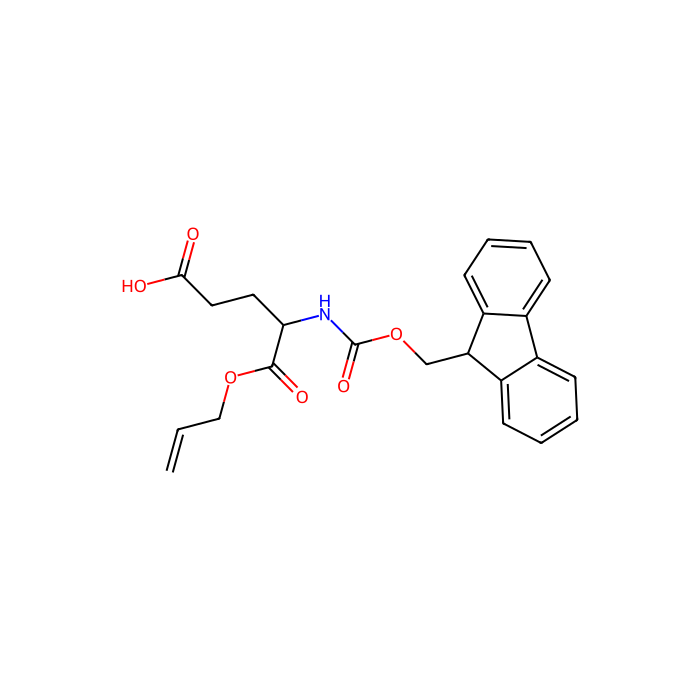
Fmoc-Glu-OAll is an Fmoc-protected L-glutamic acid derivative in which the side-chain γ-carboxyl is protected as an allyl ester, while the α-amino is protected as an Fmoc carbamate and the α-carboxyl remains as a free acid. This orthogonally protected amino acid is designed for solid-phase peptide synthesis (SPPS) strategies requiring on-resin, Pd(0)-mediated selective deprotection of the glutamate side chain.
Item-specific identifiers (from Product Data):
CAS: 144120-54-7
CID: 7020606
InChIKey: 265415 (as provided)
SMILES: Not specified for this item; refer to CoA/Spec Sheet.
Molecular details:
Molecular formula: Not specified for this item; refer to CoA/Spec Sheet.
Molecular weight: Not specified for this item; refer to CoA/Spec Sheet.
Stereochemistry: L-configuration at the α-carbon (literature, typical for SPPS building blocks of this name).
Structural features (general chemistry description):
Protecting groups: Fmoc on the α-amino (fluorenylmethoxycarbonyl carbamate); O-allyl ester on the γ-carboxyl side chain.
Functional groups: Aromatic polycyclic fluorene (Fmoc), carbamate, carboxylic acid (α-COOH), allyl ester (–O–CH2–CH=CH2), and a secondary amide after coupling.
2D description in words: A central α-amino acid backbone bearing an Fmoc-carbamate on nitrogen, a free α-carboxyl at the C-terminus, and a three-carbon side chain terminating in a carboxyl masked as an allyl ester; the Fmoc is a fused bicyclic aromatic system attached via an oxycarbonyl linker.
Synthetic Utility
Fmoc-Glu-OAll provides dual orthogonality—base-labile Fmoc on the α-amino and Pd(0)-labile O-allyl on the γ-carboxyl—making it highly versatile in peptide and peptidomimetic synthesis.
Functional group reactivity:
α-Carboxyl (free acid): Activates with carbodiimides (DIC/EDC) plus additives (Oxyma/HOBt), uronium (HBTU/HATU), or phosphonium reagents (PyBOP) for amide bond formation.
γ-Carboxyl (OAll): Inert to bases/acids typically used in Fmoc/tBu SPPS; selectively cleaved by Pd(0) under mild, neutral conditions to unmask a carboxyl for side-chain acylations or cyclizations.
Named/standard transformations (literature):
Pd-catalyzed deallylation (Tsuji–Trost type) with soft nucleophiles/hydrides (e.g., PhSiH3, morpholine, dimedone) as allyl acceptors.
On-resin macrolactamization and side-chain-to-backbone cyclizations.
Retrosynthetic value:
Facilitates branched or multi-acid architectures by temporally separating α- and γ-carboxyl reactivity.
Supports chemoselective installation of labels (biotin, dyes), spacers (PEGylated acids), or side-chain capping to tune peptide properties.
Practical synthesis guidance:
Minimize racemization during α-carboxyl activation by using Oxyma/HOAt surrogates, lower temperatures, and short activation times.
After Pd-mediated OAll removal, immediately proceed to couple the liberated γ-COOH to reduce re-allylation or side reactions; include Pd scavenging steps before resuming Fmoc cycles.
Target Specificity
Not applicable. This product is a small-molecule amino acid building block and does not possess antibody/biological target specificity. No antigen, clone, isotype, or species reactivity information applies.
Domande frequenti
What is the purity of this product?
This product is supplied at ≥98% purity (chemical assay). Lot-specific values are stated on the Certificate of Analysis.
How should this product be stored?
Store at 2–8 °C. Refrigerated storage is required to maintain the specified shelf life.
How is this product shipped?
This product ships chilled on wet ice. Unpack on arrival and transfer it to the storage condition stated above.
What are the CAS number, molecular formula and molecular weight?
The CAS Number is 144120-54-7, the molecular formula is C23H23NO6, and the molecular weight is 409.43 g/mol. InChIKey ORKKMGRINLTBPC-FQEVSTJZSA-N.
What documentation is provided?
Available product documentation, including Certificates of Analysis (COA), Safety Data Sheets (SDS), and specification sheets, is shown in the product document area. Document availability and access follow the current site policy.
Utilizziamo i cookie per garantire il corretto funzionamento del sito web e, ove consentito, per migliorare la tua esperienza. Puoi gestire le tue preferenze in qualsiasi momento nelle Impostazioni. Per saperne di più, consulta la nostra Cookie Policy.
Desidera che le inviamo un messaggio quando avremo sconti disponibili?
Ricordamelo più tardi
Grazie! Controlli la sua casella di posta per confermare.
Products are supplied to verified businesses, institutions, and qualified professionals for research and development use only. Not for use in humans, animals, diagnosis, or therapy.

 I2601110