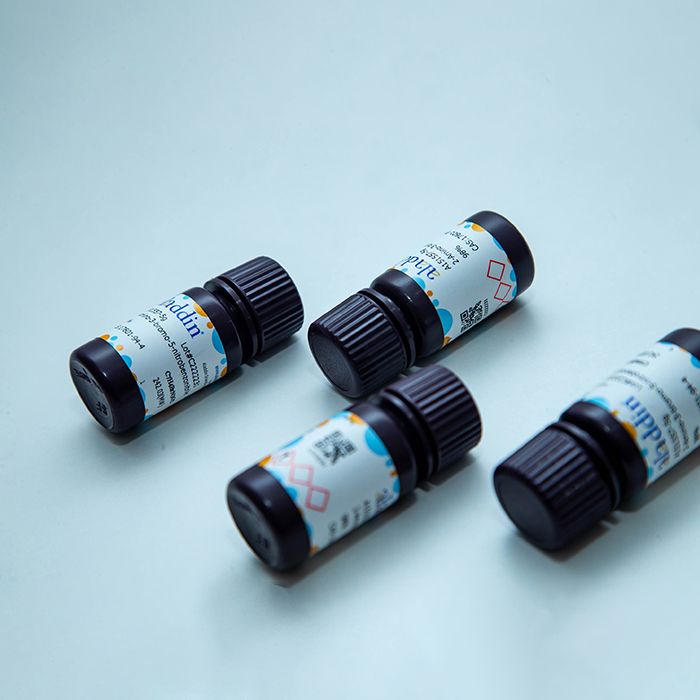
≥99% for sensitive chromatographic and analytical workflows requiring minimal baseline interference.
🌡
Storage & shipping
Protected from light,Store at -20°C,Desiccated Ships Ice chest + Ice pads Check lot-specific COA for exact specifications.
📋
Quality documents
SDS, COA, datasheet, and spec sheet available for download. Lot-specific COA accessible via lot number lookup.
📚
Literature proof
Cited in 0 peer-reviewed publications across chromatography, organic synthesis, and cross-coupling reactions.
Panoramica
Frakefamide TFA is a potent analgesic that acts as a peripheral active μ-selective receptor agonist. Frakefamide is unable to penetrate the blood-brain-barrier and enter the central nervous system.
Appearance:Solid
In Vivo:Frakefamide (LEF576) yields a dose dependent increase in morphine appropriate responding to 50% at the highest dose tested (10 μmol/kg) after infusion durations of 2 min, whereas after 15 min infusions a maximum of 25% morphine appropriate responding was
Biological Activity:Frakefamide TFA is a potent analgesic that acts as a peripheral active μ-selective receptor agonist. Frakefamide is unable to penetrate the blood-brain-barrier and enter the central nervous system .
Specifications
Specifiche e purezza
≥99%
Condizioni di conservazione di stoccaggio
Protected from light,Store at -20°C,Desiccated
Spedito in
Ice chest + Ice pads
Questo prodotto richiede spedizione a catena fredda. I servizi di terra e altri servizi economici non sono disponibili.
Certificati (CoA, COO, BSE/TSE e tabella di analisi)
C of A & Other Certificates(BSE/TSE, COO):
Analytical Chart:
Proprietà chimiche e fisiche
Solubilità
DMSO : 250 mg/mL (368.93 mM; Need ultrasonic)
Calcolatori di soluzioni
Molarity Calculator
Determine the necessary mass, volume, or concentration for preparing a solution.
Dilution Calculator
Determine the dilution needed to prepare a stock solution.
Reconstitution Calculator
Recensioni
Recensioni dei clienti
Application Protocols
No tested or validated application protocols are provided for this item in the catalog entry.
Tested applications (WB, IHC, IF, FC, in vitro/in vivo): Not specified for this item.
Recommended working concentrations/dilutions: Not specified for this item.
Users should develop application-specific protocols based on their assay systems and consult the primary literature for guidance on peptide handling in analogous experiments. See Storage & Reconstitution for general solution preparation practices.
Biological Roles
Item-specific biological targets or mechanisms are not provided in this listing.
General context for peptide-based research compounds (literature, non-clinical):
Peptides serve as ligands, inhibitors, or substrates in diverse biochemical pathways, enabling interrogation of protein–protein interactions, receptor pharmacology, and enzyme specificity in vitro.
As TFA salts, peptides are typically protonated at basic sites, which can influence cellular uptake (often reduced), receptor binding (depending on pH and ionic strength), and chromatographic/analytical behavior.
Biostability considerations: Proteolytic susceptibility varies with sequence and modifications (e.g., D-amino acids, N-methylation, cyclization). Without a disclosed sequence for Frakefamide, stability must be determined empirically for the supplied lot.
Adsorptive losses: Cationic or hydrophobic peptides can adsorb to glass and plastics; recovery studies are recommended when working at low concentrations.
Use limitations:
For research use only. No medical, diagnostic, or clinical claims are made for this product.
For project planning, define:
Assay pH/ionic strength to balance solubility with biological relevance.
Protease inhibitors or serum-free conditions if degradation is a concern.
Analytical methods (LC–MS/MS) for quantification and metabolism studies.
Buffer Applications
This compound is not a classical buffering agent. However, proper buffer selection is crucial for preparing reliable peptide stock and working solutions.
General guidance for peptide TFA salts (literature/practice):
Stock preparation: Dissolve initially in water, dilute acids (e.g., 0.1% formic acid), or a small volume of DMSO followed by buffer. Aim for pH 3–7 to minimize base-catalyzed degradation during stock preparation.
Working buffers: PBS (pH 7.2–7.4) or HEPES (pH 7.2–7.6) are commonly used for cell-free and cell-based assays, provided the peptide remains soluble and stable. Filter sterilize if sterility is required.
LC–MS compatibility: Prefer formic acid (0.05–0.1%) or ammonium formate/acetate (2–20 mM) over TFA to reduce ion suppression. If TFA is needed for chromatographic performance, use post-column infusion or low-concentration TFA strategies.
Adsorption mitigation: Include inert carrier proteins (e.g., 0.1% BSA) or non-ionic surfactants at low levels (e.g., 0.01% Tween 20) when compatible with assays to reduce losses on plastics; verify assay tolerance first.
Not applicable: This product is not intended to set or maintain a specific pH range as a dedicated buffer component. Refer to Storage & Reconstitution for handling details.
Green Alternatives
While the compound identity and counterion (TFA) are fixed for this item, greener choices can be implemented in handling, dissolution, and analysis.
Opportunities (general):
Counterion exchange: If compatible with your research, exchanging TFA for acetate or chloride may reduce fluorinated waste and improve biocompatibility. This is optional and sequence-dependent (not item-specific guidance).
Solvent selection: Favor water and aqueous buffers as primary media. When organic co-solvents are required, prefer ethanol or isopropanol over acetonitrile where feasible; for high solubility stocks, DMSO remains common but minimize final assay %.
Chromatography: Use buffered aqueous mobile phases with low percentages of organic modifiers; replace TFA as an LC modifier with formic acid for LC–MS to reduce ion suppression and improve ESI sensitivity.
Comparison snapshot (general; pros/cons):
TFA vs acetate counterion:
TFA: Often improves HPLC peak shape in UV methods; can suppress MS signals and introduces fluorinated waste.
Acetate: More MS-friendly and greener; may alter retention/peak shape and slightly reduce salt stability in some cases.
Acetonitrile vs ethanol (as co-solvent):
MeCN: Excellent peptide wetting and LC performance; higher environmental impact.
EtOH: Greener, but may be less effective for some hydrophobic sequences.
Implement routine green practices: right-size reaction/assay volumes, reduce repeat freeze–thaw via aliquoting, and use energy-efficient cold storage management.
Pharmaceutical Uses
No pharmacopeial monograph or excipient role is provided for this item. The product is supplied strictly for research use only.
Context (general, non-clinical):
Peptide TFA salts are frequently used during discovery and pre-formulation research to evaluate solubility, stability, and assay compatibility in vitro. TFA salts may later be converted to alternative counterions during development to meet formulation and regulatory needs.
Typical formulation research activities (laboratory scale): assessing compatibility with diluents, evaluating lyophilization cycles, and screening excipients for solubility or stability enhancement. These steps are investigational and sequence-dependent.
Important limitations:
Not for human or veterinary use, not for diagnostic procedures, and not intended for therapeutic applications.
No medical claims are made for Frakefamide TFA in this catalog entry.
If formulation-style studies are intended in research settings, consult the CoA/SDS for batch-specific data (purity, residual solvents, counterion content) and perform necessary compatibility/stability assessments under your laboratory’s quality procedures.
Physical Properties
Item-specific physicochemical specifications are not disclosed for this product.
Appearance: Not specified for this item; refer to CoA/Spec Sheet.
Molecular weight: Not specified for this item; refer to CoA/Spec Sheet.
Molecular formula: Not specified for this item; refer to CoA/Spec Sheet.
Melting point: Not specified for this item; refer to CoA/Spec Sheet.
Solubility: Not specified for this item; refer to CoA/Spec Sheet.
LogP, pKa, refractive index, density: Not specified for this item; refer to CoA/Spec Sheet.
General guidance for peptide TFA salts (literature/experience; not product specifications):
Solubility profile (typical): Many peptide TFA salts dissolve readily in polar solvents such as water, aqueous buffers (pH 2–7), DMSO, and DMF; initial wetting with a small volume of DMSO or acetonitrile followed by aqueous buffer can improve dissolution.
Hygroscopicity: Peptide TFA salts can be mildly hygroscopic; handle quickly in low humidity to maintain mass accuracy.
Counterion content: The presence of TFA counterions may influence pH on dissolution (slight acidity) and LC–MS ionization behavior.
Note: For experimental planning, determine exact solubility and concentration by gravimetry and, where needed, verify by UV/Vis or amino acid analysis. Always defer to the item’s CoA for binding specifications (water content, counterion %, purity, and residual solvents), which are not provided in this entry.
Quality and Grades
Grade/Purity: Not specified for this item; refer to CoA/Spec Sheet.
What the listing implies:
The product is offered for research use and as part of a small-molecule/compound library category. In this context, key quality attributes typically documented on the CoA include identity confirmation (e.g., HRMS, LC–MS, or HPLC-UV), purity by HPLC, and counterion/volatile content. These specifics are not provided in this entry and should be verified on the current CoA.
Notes on TFA salt form (general implications):
TFA counterion: Trifluoroacetate is commonly used to afford a stable, readily soluble salt of basic peptides. It can influence chromatographic behavior and bioassay conditions due to ion pairing and mild acidity.
Counterion exchange (if required): Researchers sometimes convert TFA salts to alternative counterions (e.g., acetate, HCl) to reduce TFA background in bioassays or improve lyophilization outcomes. This is typically performed via ion-exchange resin or repeated dissolution/lyophilization from volatile acid solutions (literature practice).
Documentation to consult:
CoA/Spec Sheet: For batch-specific purity, residual solvent, water content (Karl Fischer), counterion %, and analytical methods.
SDS: For hazard classification, handling, and transport information.
If low-UV absorbance or LC-MS cleanliness is critical, request available analytical chromatograms for the supplied lot.
Reaction and Applications
As supplied, Frakefamide TFA is positioned for research use (screening/reference studies) rather than as a general synthetic reagent.
Applications (general, non–item-specific):
Reference standard and tool compound work: Peptide TFA salts are commonly used to probe receptor–ligand interactions, enzyme susceptibility, stability in plasma or microsomes, and transporter interactions in in vitro systems. Specific targets for Frakefamide are not specified in this listing.
Analytical development: Method development for LC–MS/MS quantification (MRM setup, ion transitions optimization) and stability-indicating HPLC assays under ICH conditions (pH, light, heat) can be conducted with peptide salts.
Formulation feasibility (research scale): Evaluation of solubility enhancers (cyclodextrins, co-solvents), adsorption mitigation to lab plastics, and pH-dependent stability.
Not typical synthetic applications:
The compound is not presented as a building block for cross-coupling, organometallic reactions, or classical small-molecule transformations. If derivatization is intended (e.g., labeling), use chemoselective bioconjugation strategies compatible with peptide functionality and confirm functional handles exist in the specific sequence (not provided here).
Practical tips:
Prepare fresh working solutions when possible; assess adsorption losses by recovery checks.
For bioanalytical assays, consider counterion effects; residual TFA can suppress ESI signals at high levels—optimize mobile phase and sample cleanup accordingly.
Reaction Conditions
There are no reaction conditions specific to this catalog item because it is supplied as a research-standard peptide salt rather than a reagent for chemical transformations.
General laboratory handling conditions (for solution preparation and analysis; literature/practice):
Dissolution: Start with water, dilute acid (0.1% formic acid), or a small volume of DMSO, then adjust with buffer to desired pH (3–7) and ionic strength. Gentle warming (≤30 °C) and brief sonication can aid dissolution; avoid prolonged heating.
Stability checks: Assess stability at planned assay temperature (e.g., 4–37 °C) over relevant timeframes by LC–MS/HPLC. Include controls for light exposure given the storage instruction to protect from light.
LC method development: Reverse-phase HPLC with C18 stationary phases is typical. Mobile phases: water/MeCN with 0.05–0.1% formic acid for MS; limit TFA to ≤0.02% if MS detection is needed to reduce ion suppression (literature guidance).
Adsorption control: Use low-bind labware for low-concentration work; pre-rinse vials with dilute solution to condition surfaces.
Expected yields/times do not apply here, as no synthetic transformations are recommended for this product in routine use. Always validate any new handling or analytical method with small test quantities first.
Safety and Handling
Hazard classification for this specific item is not provided. Always consult the product’s SDS for authoritative information.
GHS/CLP: Not specified for this item; refer to SDS.
Signal word / H-statements / pictograms: Not specified for this item; refer to SDS.
General laboratory precautions for peptide TFA salts (good practice):
PPE: Wear lab coat, safety glasses, and suitable gloves (e.g., nitrile). Avoid inhalation of dusts and contact with skin/eyes.
Handling: Open vials in a dry environment; peptides can be moisture-sensitive. Allow the sealed vial to equilibrate to room temperature before opening to minimize condensation.
Incompatibilities: Strong oxidizers and strong bases can degrade peptide materials; avoid prolonged exposure to high pH (>9) unless required briefly for specific experiments. Avoid reactive anhydrides/acid chlorides unless derivatization is intended.
TFA considerations: Although the material is the TFA salt (not neat TFA), solutions may be mildly acidic. Avoid contact with carbon steel and reactive metals; use glass or compatible plastics.
First aid (overview; consult SDS): If inhaled, move to fresh air. On skin/eye contact, rinse with water for several minutes. If ingested or upon persistent irritation, seek medical attention.
Waste: Dispose of peptide-containing solutions and solids as organic laboratory waste per institutional and local regulations.
Research use only: Not for human or veterinary use.
Solvent Selection
This product is a peptide TFA salt; solvent choice should prioritize complete dissolution while preserving integrity.
General solvent guidance (literature/practice; not specifications):
Primary solvents: Water, aqueous buffers (pH 2–7), DMSO, and DMF typically provide good solubility for peptide TFA salts.
Co-solvent strategy: Pre-wet with a small volume of DMSO or acetonitrile, then dilute with water or buffer to target concentration to mitigate aggregation.
Buffer considerations: Use volatile acids (0.05–0.1% formic acid) for LC–MS compatibility; for bioassays, choose physiological buffers (e.g., PBS or HEPES) and avoid high ionic strength if aggregation is observed.
Avoid: Strongly basic media (>pH 9) for prolonged periods due to potential peptide backbone or side-chain degradation (e.g., deamidation, racemization). Minimize exposure to strong oxidants.
Polarity and miscibility (general):
Peptide salts are polar/ionic; they are miscible with water upon adequate dissolution. DMSO is fully miscible with water for stock solutions and stepwise dilution.
Comparison (general):
Water vs DMSO: Water is preferred for immediate use in aqueous assays; DMSO enables high-concentration stocks (e.g., 10–50 mM typical for small peptides) with subsequent dilution—validate assay DMSO tolerance.
Acetonitrile (MeCN): Useful as a co-solvent for LC and to disrupt secondary structure during dissolution, then dilute into aqueous media.
Storage and Reconstitution
Storage conditions (item-specific, from Product Data):
Store at −20 °C.
Desiccated (keep dry).
Protect from light.
Shipped with ice chest + ice pads.
Research use only.
General reconstitution guidance for peptide TFA salts (literature/practice; not product specifications):
Equilibration: Allow the sealed vial to warm to room temperature before opening to avoid condensation.
Solvent choice: Begin with water or a small volume of DMSO. For challenging dissolution, pre-wet with DMSO or acetonitrile, then add water or buffer (pH 3–7). Gentle vortexing and brief sonication can assist. Avoid high pH and prolonged heating.
Concentration: Prepare a concentrated stock (e.g., 1–10 mM in water or DMSO, as solubility allows), then aliquot.
Aliquoting: Divide into single-use aliquots to minimize freeze–thaw cycles. Use low-bind tubes to reduce adsorption losses.
Storage of solutions: Store aqueous solutions at 2–8 °C for short term (hours to a few days) and at −20 °C for longer periods; include appropriate antimicrobial agents only if compatible with intended use. For DMSO stocks, store at −20 °C and protect from light and moisture.
Thawing: Thaw on ice or at room temperature; mix gently to ensure homogeneity. Discard solutions showing precipitation, discoloration, or unexpected HPLC/LC–MS profiles.
Always confirm lot-specific details (purity, counterion %, water content) on the CoA before critical experiments.
Structure and Identity
Frakefamide TFA is supplied as the trifluoroacetate (TFA) salt of the peptide-based research compound “Frakefamide.” This entry does not include a disclosed structure.
CAS: F659434 (catalog placeholder; not a registry number)
Molecular formula: Not specified for this item; refer to CoA/Spec Sheet.
Molecular weight: Not specified for this item; refer to CoA/Spec Sheet.
SMILES: Not specified for this item; refer to CoA/Spec Sheet.
InChIKey: Not specified for this item; refer to CoA/Spec Sheet.
Structural features (general, literature context for peptide TFA salts):
Peptide amide backbone comprising multiple amide (–CONH–) linkages (literature, general for peptide analogs).
TFA salt indicates protonation of one or more basic sites (e.g., N-terminus or side-chain amines) balanced by trifluoroacetate counterions (general information).
Stereochemistry: Peptide-based compounds typically contain defined L/D chiral centers at alpha-carbons of amino acid residues; the specific pattern for Frakefamide is not provided here.
2D structural description (general):
Linear or cyclic sequence of amide-bonded residues with potential side-chain functionality; exact sequence, protecting groups, and terminal modifications for Frakefamide are not specified in this listing.
Synthetic Utility
This product is offered as a finished research compound rather than a synthetic intermediate. Accordingly, its primary value is as a reference/tool material.
Potential laboratory manipulations (general, conditional on actual functional groups; item-specific handles are not disclosed):
Counterion exchange: Convert TFA to alternative counterions (e.g., acetate, chloride) via ion-exchange resins or repeated dissolution/lyophilization to alter solubility or analytical behavior.
Conjugation/derivatization: If the peptide contains accessible functional groups (e.g., free N-terminus, cysteine thiol, carboxylate), standard bioconjugation chemistries (NHS ester acylation, maleimide–thiol coupling, EDC/NHS coupling) may be applicable. Presence of such groups for Frakefamide is not confirmed in this listing.
Isotope or tag introduction: For bioanalytical studies, isotopic labeling or reporter tag attachment may be considered on an analog, rather than modifying the supplied material, to preserve reference integrity.
Not typical:
Use in classical small-molecule synthetic reactions (e.g., cross-coupling, organometallic insertions) is uncommon for peptide salts due to functional group complexity and sensitivity.
Recommendation: If derivatization is planned, obtain structural details and protect labile motifs accordingly; validate product identity and purity post-modification by LC–MS and HPLC.
Target Specificity
Target/epitope/biomolecule specificity: Not specified for this item; refer to literature and the product’s CoA if available.
Species/receptor selectivity, binding constants, or functional profiles: Not specified for this item.
Note: This catalog entry does not include validated target information, assay readouts, or selectivity data. Users should consult independent peer-reviewed sources for Frakefamide if target-specific research is planned and verify that the supplied material matches the reported structure and salt form.
We use cookies to ensure the website functions properly and, where permitted, to improve your experience. You can manage your preferences at any time in Settings. Learn more in our Cookie Policy.
Shall we send you a message when we have discounts available?
Remind me later
Thank you! Please check your email inbox to confirm.
Products are supplied to verified businesses, institutions, and qualified professionals for research and development use only. Not for use in humans, animals, diagnosis, or therapy.